Historians worthy of their craft must portray the past and present honestly, as accurately as possible, and ideally be unbiased. They should verify the truth of each subject to eliminate inaccuracies and establish the correct facts, or, at worst, as close to them as possible if no further research material is available. Unfortunately, this is not always the case, as there can be too many inconsistencies in the references they use.

Ken Wright explains.
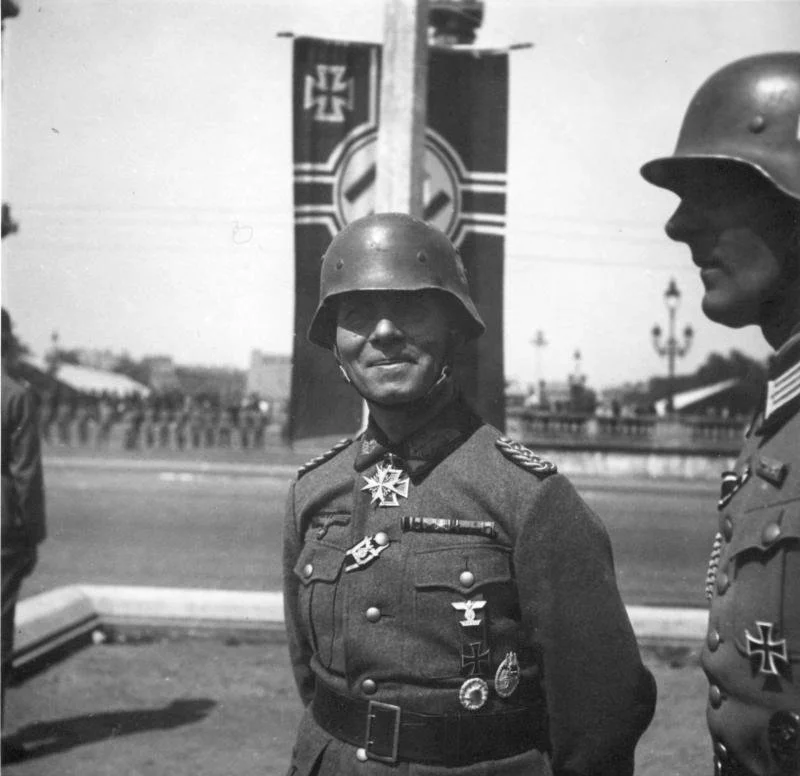
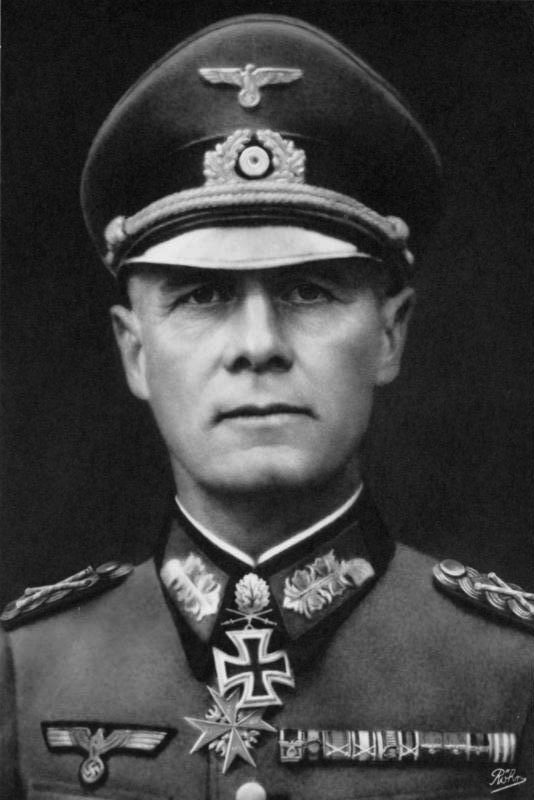
Field Marshall Rommel in Paris in 1940. Source: Bundesarchiv, Bild 146-1970-076-43 / CC-BY-SA 3.0, German Federal Archives, available here.

When attempting to write his history of the Roman people in the late first century BC, the Roman historian Livy [59bc-AD17] found it difficult to determine which (if any) accounts could be trusted. He concluded that none were reliable. In his research, he was troubled by how families had created traditions of heroic deeds and high office held by their ancestors—an early form of today's ‘fake news’.

Over the centuries, nothing has changed.

In the acknowledgment chapter of his excellent book ‘Last Battle’ Decapo Press, 2013, author and historian Stephen Harding wrote, ‘Writing history is always challenging and in that the passage of time often obscures certain events, versus revealing them. Eyewitnesses pass away, memories fade, and records, if they were kept at all, are destroyed as being no longer relevant or disappear into bureaucratic oblivion. That being said, the historian must diligently search out whatever documents remain. Like a detective evaluates evidence through knowledge of the subject and the application of both logic and common sense, the historian assesses the available information and then weaves all the various strands into an account that is accurate and as complete as possible.’ 

Readers interested in history should be aware that books, documentaries, magazines, and official records can, and quite often do, contain flaws. The who, what, when, and how are the main offenders, making it difficult for the reader to understand what the valid and proper account of an event or events is.

Using an extract from a distinguished American Research Professor at UCLA, Lynn Hunt's excellent book ‘History, Why it Matters’ discusses a universal problem facing historians. ‘Despite its occasional reliance on scientific techniques, history is not a science. It is a literary art that uses scientific techniques where relevant, but whose fundamental aim is to tell a true story. The truthful part rests on documentation, and in this regard, the historian is like a detective, lawyer, or investigative journalist sifting through information, analysing and comparing sources, written or not, using every possible forensic procedure to get at the truth, that is, the facts of the case. The story part requires something else: a literary reconstruction that relies on a series of interpretations. The interpretations make the facts relevant. The world is filled with mountains of historical facts, but we only care about a tiny number of them at any given moment. We care about those facts that enable us to tell the story we want to tell. Telling the story draws our attention to the facts but also frequently stirs up disputes. Historians can tell very different stories about the same event by emphasising different facts. This cacophony casts doubt on the truth of any one interpretation. If there is so much disagreement about interpretations, how can history make any claim on the truth about the past? Is it just your story vs. mine?’


EVENT ONE

Here, two military historical events are used as examples of the inconsistencies found in books, documentaries, magazines, and official records, which can often contain flaws. Errors in dates, locations, and who did what are the main issues, making it difficult for readers to determine the true and accurate account of events. These are just a few of the many historical incidents that show the challenges faced by historians and writers when working with material that might be incorrect but is still presented as fact.


Version One. July 17, 1944.

In this account, one author places Field Marshal Rommel in the area around Caen, France, visiting the 227th and 276th Infantry Divisions, the II SS Panzer Corps, and the I SS Panzer Corps headquarters to confer with various commanders, including SS-Oberst-Gruppenführer Sepp Dietrich and SS-Oberführer Kurt [Panzer] Meyer.

After the meeting, Rommel left Dietrich’s HQ in his staff car at 4:00 pm. Sergeant Daniel, the driver, took back roads until Livarot, about twenty-five miles from Caen. Rommel’s car then turned onto a paved road that joined the main highway a couple of miles outside Vimoutiers. At that point, Rommel and Daniel decided to attempt a quick dash on the highway.

Allied air supremacy had made any movement along the Falaise–Caen road extremely risky, if not impossible. When Rommel’s vehicle entered the main highway on routine patrol, a South African pilot with the Royal Air Force, Squadron Leader J.J. le Roux, and his wingman spotted an enemy vehicle and quickly attacked.

The official German report records what happened. ‘Suddenly, the air observer, Obergefreiter [Lance-Corporal] Holke, reported two aircraft closing in right above the road. Sgt Daniel drove at top speed, trying to reach a track and take cover there. Just as he reached it, the enemy aircraft, going flat out, opened fire. Field Marshal Rommel at that moment glanced backwards’ 2.  

Hit in the left shoulder and arm, Daniel lost control of the vehicle, which ricocheted off a tree stump and ended up embedded against the embankment on the far side of the road. Shrapnel hit Rommel in the temple and cheekbone as he sat in the jump seat on the side away from the cannon fire and was thrown twenty yards from the car, suffering a triple fracture to the skull. 3. ‘A second aircraft flew back over the crash site, firing at the wounded where they lay.’ 4. Only two of the four men emerged unscathed. Field Marshal Rommel was taken to a Luftwaffe hospital near Paris and eventually returned home to recuperate.

Observations

The author only mentions Rommel and Daniel leaving Dietrich’s HQ. However, the official German account reports an air observer [Holke] observing two aircraft approaching. Only Rommel was taken to the hospital, so what happened to his driver? Who was the other person with the air observer, and where did both of them originate? The author and many other sources have credited Squadron Leader Johannes Jacobus le Roux, RAF 602 Squadron, with the attack on Rommel’s staff car. There are, however, other contenders for this event, as will be discussed further.


Version Two

Another author wrote that in a large open Horch, Rommel’s car, his party departed Dietrich’s HQ. Rommel sat in the front as was his habit. At the wheel was his regular driver, Daniel. In the back were staff members Captain Lang, Major Neuhaus, and Holke, who was there specifically as an aircraft lookout. On N179, just outside Livarot, the lookout shouted an alarm. Two Canadian Spitfires from 412 Squadron came diving down in a curving attack from behind and to the left. At about three hundred yards, Charlie Fox, in the lead aircraft, squeezed off a brief burst from his 20mm cannon.

Daniel was seriously wounded, losing control of the speeding car. It hurtled on for several hundred yards before crashing into the ditch. Captain Lang escaped unhurt, Major Neuhaus received minor injuries, and Daniel died of his injuries shortly afterwards—no mention of  Holke. Field Marshal Rommel was thrown against the windshield post, sustaining serious head injuries. 5.

Observations

In this account, five people are in the staff car, and Charlie Fox, a Canadian pilot, was credited with the attack. A ditch suddenly appears, and Rommel is alleged to have sustained a serious head injury from contact with the windshield post [pillar], compared with the injuries described in version one. And what is, or where is, N179? One could assume it was the major road or highway that Rommel’s car had just entered.


Version Three

From the German perspective, Second Lieutenant Heins was in a Panzer Grenadier Unit of the 21st Panzer Division, travelling in a German Kubelwagon [German version of the Willys Jeep] from Livarot to St. Pierre-sur-Dille. Two Mercedes cars overtook him, and he noticed that a General was sitting in the first one. He followed at about 550 yards distance. Their average speed was about 80-100 kilometres per hour. The General, he found out later, was Field Marshal Rommel, and he was sitting to the right of the driver. Another two high-ranking officers were sitting in the back [of the first car] whilst Rommel’s adjutants were following in the second car.

About a mile outside Livarot, they came to a bend in the road, an open target for any prowling enemy aircraft. Heins, in the Kubelwagon, noticed six [Typhoons] were in the air. Heins saw one of the Typhoons diving onto the road from the right. He took evasive action and managed to get onto a sidetrack whilst the other two cars continued on their way. The first car was machine-gunned, but no rockets were fired. Rommel’s driver was hit and lost control of the car, which was swaying from one side of the road to the other. At this juncture, Rommel jumped out of the car, which was still travelling at high speed, fell on his face, and slid about ten yards along the road. His driver, who was severely wounded, managed to stop the car about 200 yards further on.

When Rommel’s Adjutants and Heins arrived on the scene, they found Rommel had bad injuries to the right side of his face and a possible skull fracture. Rommel was taken straight back to Livaro, staying one day, then was transferred to the Luftwaffe hospital at Bernay. Rommel was sent home after three weeks to recuperate. 6.

Observations

Heins noted Rommel’s two cars as Mercedes. The previous author stated they were Horch. Heins describes seeing six Typhoons, but both earlier authors suggest only two Spitfires were involved. Heins mentioned no rockets being fired. Since Typhoons carried rockets, this might mean the attacking aircraft had expended all their rockets, or perhaps they weren’t Typhoons at all. Another possibility is that he saw Typhoons earlier and assumed they were the same aircraft attacking later. Even Rommel eventually said they were Spitfires. All three accounts give very different versions of Sergeant Daniel’s fate and whether he lost control of his car. Did it crash, or didn’t it?

There is no consistency among these three versions regarding how Rommel sustained his injuries, and Heins noted that Rommel’s two cars were Mercedes. The previous author stated they were Horch. Heins describes seeing six Typhoons, but both earlier authors suggest only two Spitfires were involved. Heins mentioned no rockets being fired. Since Typhoons carried rockets, this might mean the attacking aircraft had used all their rockets, or perhaps they weren’t Typhoons at all. Another possibility is that he saw Typhoons earlier and assumed they were the same aircraft attacking later. Even Rommel eventually said they were Spitfires. All three accounts give very different versions of Sergeant Daniel’s fate and whether he lost control of his car. Did it crash, or didn’t it? What exactly they were. The first author wrote that Rommel was taken to the Luftwaffe hospital near Paris, but Heins placed the hospital at Bernay, which is nowhere near Paris. The shortest distance in modern times is eighty-one miles [130 km]. The air observer, Holke, is not mentioned. Was he killed, wounded, or having a quiet cigarette? If he was injured, did he go to the hospital with Rommel.?

The final question is who should get the credit for taking the famed Desert Fox out of action. The debate still rages today. Not to be left out, of course, the Americans claimed that it was one of their fighters, a P-47 Thunderbolt, that deserved the credit. Since both Le Roux and Fox were flying Spitfires, and as Rommel himself stated, it was a Spitfire, Typhoons and the American P-47 are dismissed.

17 July 1944. Field Marshal Erwin Rommel was always a risk-taker. His bold manoeuvres, ferocity in attack, and tenacity in pursuit were the qualities that earned him the nickname 'Desert Fox’ during his battles against the Allied forces in the Western Desert. He was both feared and respected as a highly professional soldier — polite, decent, and untainted by the crimes of the Nazi regime. Although he was not a member of the Nazi Party, he was nevertheless devoted to Hitler, who had shown him respect and affection. As the tide of war turned against Germany and its Axis allies, Rommel, by 1944 or even earlier, had realised — as many others in the German armed forces also did — that Germany’s only hope of survival lay in making peace or facing destruction. Rommel’s views on the future of the war damaged his once-excellent relationship with Hitler, and he was branded a defeatist and consequently ignored.

While Rommel was recovering from his wounds at the Luftwaffe hospital, ‘Operation Valkyrie’, an assassination attempt on Hitler, was carried out by Colonel Count Claus von Stauffenberg on 20 July 1944 at ‘Wolfsschanze’ [Wolf’s Lair] in East Prussia. A bomb was detonated inside the building where Hitler was holding a meeting. Hitler survived, and his vengeance was severe. Those who were implicated or even suspected of being involved were rounded up and executed. Rommel had become involved in the plot but had only taken a passive stance, prepared to assume whatever role the new government might ask of him rather than actively attempting to kill Hitler.

Rommel had been transferred to his home in Herrlingen, which is midway between Munich and Stuttgart, to convalesce when on 14 October around midday, Generals Burgdoff and Maisel arrived. Their driver remained outside in the car while the two visitors spent the next forty-five minutes in private conversation with Rommel.

Rommel was informed he faced two options due to his involvement in the plot to remove Hitler: a poison that acted in three seconds, a state funeral with no repercussions for his family, or going on trial for high treason. This would have been a sham trial, and the verdict a foregone conclusion.

For the sake of his family, Rommel chose the first option and, leaving his home and family for the last time, went with the two Generals some distance away from the house in their car. The news spread all over Germany. Rommel had died of a heart attack and was given a state funeral as befitting one of Germany’s most popular military leaders and folk heroes.

Of the two pilots believed to have attacked Rommel’s car on that significant day, 17 July 1944, Sqn Leader le Roux died in an aircraft crash on 19 September 1944, and Charlie Fox died in a car accident on 18 October 2008.


EVENT TWO

The second example of historical inconsistencies begins in early August 1944. Allied intelligence reported that the German army threatened to break through the Allied lines near the small French village of Mortain, using four or five Panzer units. The German code for this operation was Unternehmen [Operation] Lüttich. Opposing them were only two United States divisions. At a high-level Allied conference, it was decided that rocket-firing Typhoon squadrons would be deployed to help counter the German attack.


7 August

Around midday, once a heavy mist had lifted, the RAF Typhoons attacked and inflicted significant damage on the German forces. Three pilots were lost, all from the 245 Squadron. One aircraft crash-landed in what was then a ‘no man’s land’ between the opposing forces.

Lieutenant Belton Cooper served in the United States Army’s 3rd Armoured Division Maintenance Battalion, which played a role in the battle described in his excellent book ‘Death Traps’ about American Sherman tanks struggling against the superior firepower and heavy armour of German tanks. As tank casualties increased, an air strike was called for. The American Ninth Air Force was already stretched thin, so the Royal Air Force was brought in to help.

Lt Cooper describes a group of low-flying RAF Hawker Typhoons coming in at low altitude, firing rockets at German armour and infantry on the hilltop. This, combined with heavy artillery, infantry, and tank fire, eventually brought the German counterattack to a slow, grinding halt.

As soon as it was safe to do so, Lt Cooper’s Maintenance Battalion started moving their recovery vehicles into the area for the maintenance crews to salvage and repair whatever tanks they could. It was during this operation that a crashed wreck of a British Typhoon shot down by German ground fire was found upside down, with the tail section embedded in the ground.

Lt Cooper; ‘One of the maintenance mechanics notified a sergeant that there was a body inside the aircraft upside down and still secured by his seatbelt. There was a strong odour of gasoline leaking from the plane's fuel tanks as the graves registration people removed the young British Flight Lieutenant’s body and placed it on a stretcher. But suddenly, they realised that the Flight Lieutenant was still alive. He had been hanging upside down for several hours; it was a miracle that he had survived. A fuel line in the engine department had broken, and fuel was leaking inside the cockpit and running down his seat, down his back, into his hair and onto the ground. He was soaked from head to foot and was beginning to develop red burn marks on his neck and hands from the high-octane fuel. Medics brought blankets, rolled him on his stomach, and stripped off his gasoline-soaked clothing.’

‘His entire back, buttocks, and the back of his legs were burned red raw from the gasoline. As he slowly regained consciousness, he was obviously in severe pain. As soon as the medics had moved him a safe distance from the plane, he asked for a cigarette. 7.

Observations

Lt Cooper fails to mention the date when his recovery crew started their battlefield clearance, nor does he specify who the pilot was or what events led to the pilot's predicament. Usually, this is a simple account of a battlefield event. The more curious reader might want to know that the pilot was Flight Lieutenant Robert [Bob] Gordon Fallas Lee of the Royal Air Force Volunteer Reserve, from Selbourne, Orchard Road, Shalford, Surrey, England. His aircraft, MN459/M-R, belonged to 245 Squadron, part of the 2nd Tactical Air Force, and he had been flying in combat for two years.

It is here that six writers offer conflicting accounts that challenge Lt Cooper’s version. They are as follows:


Version One

Wounded by flak, Flight Lieutenant Lee lost consciousness and control of his Typhoon while attempting a forced landing. The aircraft crashed inverted into the ground, trapping him inside the cockpit. The wreck lay in ‘no man’s land', and as Lee drifted in and out of consciousness, the Germans used the aircraft for target practice. He was struck in the hand and leg by rifle bullets. At one stage, a fire broke out, but fortunately, it was quickly extinguished. After five days, a US Army battlefield clearance team discovered the wreck and rescued an emaciated Lee from the wreckage cockpit.


Version Two

 Flight Lieutenant Bob Lee of 245 Sqn was hit by flak and lost consciousness. When he regained awareness, he found his Typhoon had crashed into the ground upside down in ‘no-man's land.' Lee managed to release his harness but was trapped inside his aircraft, where he would spend the next few days. During that time, the Germans used the wreck for target practice, hitting him in the hand and leg; on one occasion, they started a fire that fortunately went out. A US unit clearing the battlefield rescued him.


Version Three

Bob Lee was shot down and performed a wheels-up landing in enemy territory. The aircraft slid along the ground and rolled onto its back, trapping him inside as he hung from his straps. He managed to turn upright but couldn’t escape because the sides of the fuselage had dug into the earth. Besides a broken leg from the crash, he was wounded twice more when the Germans fired shots into the plane. He survived for six days on his emergency rations. When the Germans left, a salvage unit from the army's recovery section checked the aircraft and heard some sounds and knocks on the fuselage. They lifted him out and found him in a serious condition. He was hospitalised and awarded a Distinguished Flying Cross [DFC] 9.  


Version Four

An extract from the fourth supplement to ‘The London Gazette’, dated 27 October 1944, lists the awards approved by the King. It states in part, ‘Flight Lieutenant Lee [124172] was, during a sortie near Falaise in August 1944, forced to attempt a landing on rough ground after being hit in the hand and having his aircraft disabled by anti-aircraft fire. As he touched down, the aircraft overturned close to the enemy lines. Flight Lieutenant Lee was trapped in the cockpit. As he tried to free himself, the enemy directed machine gun fire at him. From then on, he was repeatedly shot at, and on one occasion, he was hit in the leg, which was shattered. Flight Lieutenant Lee was found alive by our [British or US] advancing troops. For five days, he lay trapped, badly wounded, and harassed by enemy machine gun fire.


Version Five

An unknown reporter wrote that while lying in a hospital with a broken leg, a Typhoon pilot shared an amazing story.

‘I got my kite down on the ground all right, but it hit a bump and turned over, leaving me trapped in the cockpit. The petrol tanks were nearly full, and I expected to be roasted any minute as many bullets and shells flew around. There is not a lot of room in the cockpit of a Typhoon, and there I was upside down. I had to risk ripping my parachute off. It might have opened and filled the cockpit anyway. But I succeeded and was able to lever myself into a hunched-up position with my feet resting on the instrument panel.’

‘For four days, the battle raged around me, with the Germans periodically firing a few shells and bullets at my machine. But the armoured plating saved me. On the sixth day, I heard planes above me and switched on my wing lights, trying to attract their attention, but all I got were some bullets from the Germans. Finally, on the eighth day, some American ambulance men came along, and they got the surprise of their lives when they found me.

[The reporter wrote that Flt Lt Lee had lived on malted milk tablets] 10.

Observations

The only consistent facts so far that can be positively established from the previous five versions are that he was shot down, trapped in his aircraft cockpit with a damaged leg, and with an injured hand. He was rescued and later awarded the DFC.

The following has not been positively established.

How was his plane shot down? Was it caused by flak or ground fire? Was he trapped upside down, or did he manage to right himself? Did his hand get wounded in flight or on the ground? Was his leg broken during the crash landing or by German ground fire while he was already on the ground? Was it actually broken? How close was he to enemy lines, and were they firing machine guns or rifles at the wreck? Why would they use the wreck as target practice in the first place? If they did, how was he not killed? It would have been easy for the Germans to walk to the wreckage and check if the pilot was there. Was he covered in aviation fuel, as Lt Cooper wrote, and did any fires start and then stop? Did he land the plane, or, as one report suggests, did he pass out only to find the aircraft had seemingly landed itself and then turned upside down? Were the wheels up or down? How long had he been trapped—eight days, six days, five days, or just a few hours? Did he have emergency rations and eat them? Was the wreck near a knocked-out American tank? Why would he turn on his wing lights, assuming it was nighttime and they were working, when he knew the Germans were nearby? That would’ve been a completely irrational move. How did he handle the blood loss from his wounds, and how did he deal with the call of nature, especially if he was actually upside down? The latter, while not historically crucial, still raises an interesting question.

How does the historian sort out all these mixed and inconsistent reports to form a true picture? What is the reader to believe? In this particular case, America’s most popular Pulitzer-Prize-winning journalist of the time, Ernest Taylor ‘Ernie’ Pyle, might provide some of the answers. But even here, one has to be cautious of journalistic licence and, in modern terms, his use of ‘feel good’ reporting. Pyle was well known for his columns in the American Scripps-Howard newspapers while working as a roving war correspondent from 1935 to 1945.

Pyle was inspecting the battlefield after the Battle of Mortain when he and an unknown officer [not Lt Cooper] noticed a man trapped in an aircraft wreck. His account is entirely different from Lt Cooper’s, yet both were at the scene.


Version Six

Pyle later wrote, ‘We ran to a British plane lying upside down and got down on our hands and knees to peek through the tiny hole in the side. A man lay on his back in the small space of the cockpit. His feet disappeared somewhere in the jumble of dials and pedals above him. His shirt was open, and his chest was bare to the waist. The pilot turned his eyes towards me when I peered in and said, ‘Oh, hello’ in a typical British manner of off-handed friendliness. Stupidly, I asked, ‘Are you all right?’ He answered, ‘Yes, quite. Now that your chaps are here.’ I asked him how long he had been trapped in the wrecked plane. He said he didn’t know for sure, as he got mixed up about the passage of time, but he did know the date of the month he was shot down. When he told me I cried out loud; ‘Good God!’ He had been lying there trapped for eight days.’11.

‘His left leg was broken and punctured by an ack-ack burst. His back was burned by raw gasoline that had spilled. The foot of his injured leg was pinned rigidly under the rudder bar. The space was so small he couldn’t squirm around to relieve his weight from his painful back. He couldn’t straighten out his legs, which were bent above him. He had not a bite to eat or a drop of water for eight days, and yet when we found him, his physical condition was good, and his mind was calm and rational. He was in agony, yet in his Oxford accent, he even apologised for taking up our time to get him out. The American soldiers of our rescue party cussed as they worked, and cussed with open admiration for this British flier’s greatness of heart, which kept him alive and sane through his lonely and gradually hope-diminishing ordeal. One of them said, ‘God, but these Limeys have got guts!’

‘It took us almost an hour to get him out. While we worked, he talked to us. Under the circumstances, we didn’t push him on details, but in a nutshell, he established that he was an RAF Flight Lieutenant piloting a night fighter. Over a certain area, the Germans had let him have it from the ground with machine gun fire. The first hit knocked out his motor. He was too low to jump so foolishly, he said, he turned on his landing lights to try a crash landing. The second hit got him in the leg, and a third bullet cut across his right-hand fingers, clipping everyone to the bone. He left his wheels up, and the plane's belly hit the ground going uphill, leaving a groove it had dug for about fifty yards. Then the plane flopped, tail over the nose, onto its back. He said that was all he remembered for a while. When he came to, they were shelling all around him. For eight days, he was in no man’s land, which passed back and forth between American and German forces.’

‘Lee was taken to a clearing station of the American 30th Division. His back responded very well to treatment. The gangrene [caused by aviation fuel?] was cut away, and when it was seen he would pull through; he was transferred to another field hospital and then three days later was evacuated by air to England.’ 12.   

In early October 1944, Ernie Pyle interrupted his trip back from America to visit the hospital where Flt Lt Lee was recovering. He then penned an article for the Mt. Adams Sun dated 13 October 1944, describing his visit. ‘During that time, I clarified some details I would like to have pursued during the time of Lee’s rescue but did not due to the situation and the pain he was obviously in.’

‘I thought and wrote he was wounded while he was still in the air. But he told me it didn’t happen until about three hours after the crash, when shelling and shooting surrounded him. He said that whatever kind of shell it was, it made a terrific racket when it came through the plane and struck him. The wound was caused by a 20-millimetre shell that had exploded in his leg. It had destroyed about an inch of both bones in the leg, and he has had to date three operations with more to come. It would be about a year before he would have recovered enough to go home.

He said the worst thing in those eight days was the thirst. For days, he visualised creeks full of water, and all the pubs where he had left a little beer in the bottom of the glasses.’ 13. Pyle’s account, whilst detailed, does provide some of the answers, but not all and writing that a 20-millimetre shell had exploded in Lee’s leg could be viewed as a piece of journalistic licence. If this did happen, there is every chance the pilot would have had his leg shattered and died from blood loss or trauma. Considering all his wounds, would it be logical to assume the pilot would have bled to death, especially given the supposed severity of the leg wound.

At this point, the reader has read enough and may wonder if it all matters now. Yes, it does! For the historian whose central ethical responsibility is to record for posterity the truth, the whole truth and nothing but the truth, and for the reader who relies on the historian to inform and shape his or her perception of history, past and present. Moreover, if incorrect facts are not corrected over time, they will only get worse. How can mankind move forward if all its past isn't accurate? Inconsistencies aren't confined to just one branch of history. They are evident throughout it. Perhaps it will always be this way.

It should be pointed out that there is no intention to deride or cast any dispersions on any of the authors of the quoted articles or their historical presentations. They can write about their research and present a valid account. Their accounts were simply used to make chosen comparisons to point out the problems that make writing history so damn frustrating for both the writer and the reader.


What do you think about history writing? Let us know below.

Did you enjoy the piece? Join us on X here to receive regular updates: @HistoryIsNowMag


Footnotes

1- Prados. John.  Normandy Crucible. New American Library, 2012. Pages 104-105.

2- Pimlott. John. [Ed] Rommel In His Own Words. Greenhill Books, London. 1994 Page   183.

3- Prados. Pages 104-105.

4- Pimlott. Page 183.

5- Russworm. Lance. 2003. Spitfire Emporium. www.spitcrazy.com/charleys account.htm

6- Darling Tim. www.amnesta.net/other/rommel.html [with kind permission]

7-Pages 72-73 ‘Death Traps’ Belton. Y. Cooper. Ballantine Books-New York. 2003. Recommended reading.

8- Typhoon Wings of 2nd TAF, 1942-45. Chris Thomas, Osprey Combat Aircraft No 86. UK.

9- Typhoon Warfare. Tom Hall. Self-published book. Australia, 2000.

10- Launceston Examiner [Launceston, Tasmania] Tuesday 22 August 1944, Page 1.

11-. Source-Wikipedia.

12- Extract from Ernest Pyle’s book ‘Brave Men’, University of Nebraska Press. 2001. Pages 311-312.

13- Extract from Mt. Adams Sun. Bingen, Washington. 13 October 1944. Page 2. 

Posted
AuthorHistory Is Now Magazine

Thousands of political science books and magazines discuss the idea of ​​democratic transformation. For example: how can a country once under authoritarian rule, transform from that to individual and democratic rule? And what do we truly know about dictatorships? Can a democratic country transform into a dictatorial country, despite the pre-existence of a constitution and elections?

Probably the most well-known example of this is Germany: which had a parliament; a multi-party system; laws protecting elections; and laws protecting individual freedoms. At the time, the illiteracy rate was almost zero percent,yet it transformed from a democracy into an expansionist dictatorship in 1933, after Hitler's rise to power.

Here, Nora Manseur and Kaye Porter explain how Adolf Hitler took power. Read part 1 on Hitler’s early years here.

Reich Chancellor Adolf Hitler and Reich President Paul V. Hindenburg in March 1933. Source: Bundesarchiv, Bild 183-S38324 / CC-BY-SA 3.0, available here.

Taking advantage of Germany’s financial and social instability, Hitler’s party became the largest in the Reichstag in 1932. Later then President of Germany, Paul Von Hindenburg, appointed Hitler Chancellor. Meanwhile, Hitler also hadarmed paramilitary troops known as “Storm Troops” or more commonly known as Brownshirts, because of their brown uniforms. The Storm Troops were under Hitler's command, and the number of soldiers reached in the region of some 400,000 in 1932. The goal of these forces was to control the streets, because; Hitler saw that controlling the streets was the key to controlling the state. Despite his growing military force and political power, Hitler did not yet have theabsolute power, which would enable him to achieve his expansionist dreams. In order to achieve full power, he would need a majority in parliament; the support of the German people; and the support of the German army. Seeing the growing militia power on the streets, however, the military had begun to fear the influence of the Brownshirts.


Taking power

Hitler systematically and strategically overcame these obstacles. The German parliament contained left-wing parties who strongly opposed to the Nazi Party. On February 27, 1933, the opposition became violent when  Dutch communist Marinus van der Lubbe set fire to the German parliament in protest against the spread of Nazism. Hitlerrecognized this as an opportunity in his interest, as this was an opportunity to get rid of his opponents in parliament.Combined with his growing power on the streets, this was a brutal stab against democracy. The next day, Hitler issued a decision to suspend civil and political freedoms under the guise of bringing safety and order to the chaos.The result was a successful declaration of emergency law.

On March 5, 1933, the government organized new elections, in which Hitler won 44%, 17 million votes. Because Hitler still did not have a majority,  he proposed and persuaded parliament to vote legislation called The Enabling Act. This legislation allowed Hitler to issue laws without the approval of  parliament. With this power, any known communists in parliament were arrested, beaten and prevented from entering parliament. With legislative and executive power in hand, Hitler issued a decision to dissolve all parties and unions except the Nazi Party. With control over the leadership an electoral body, Hitler's target now became the German army.


1934

In 1934, Hitler’s paramilitary Storm Troops numbered roughly 2 million soldiers, many times more the number of soldiers in the German army. Ernst Röhm, who had socialist political beliefs, was also the commander of the Storm Troops. He demanded that Hitler carry out their original plans to lead a revolution and implement socialism. The original party values had been to support the German workers, and in fact they had been known as the National Socialist German Workers' Party. Hitler’s goals had changed however, and he knew that in order to achieve control, he would need the support of businessmen. When Ernst Röhm asked Hitler to join the German army with his Storm Troops under his command as one entity, Hitler had a decision to make. He knew that this combined army would carry out the promised Socialist revolution. The army leaders, however, opposed this therefore Hitler had two options: either  take control of the army leaders who might betray him, or give the power of the military to his friend Ernst Röhm. He chose the army over his friend.

Heinrich Himmler, the leader of the Nazi SS, an elite Nazi security force separate from the Storm Troops, informed Hitler that Ernst Röhm was planning a coup against him. In response Hitler ordered the killing of Ernst Röhm and other Storm Troops Leaders without trial. On June 27, in what became known as the Night of the Long Knives, more than 800 people were liquidated in cold blood. This once again showed Hitler to be a bloody and violent ruler. The German president thanked him and told him that he had saved the German nation.

Hitler knew that a massacre of German citizens could have dangerous repercussions. In order to get control of the media and message, he ordered Joseph Goebbels, the Reich Minister of Propaganda, to spread the word that there was a plot to overthrow him by Ernst Röhm. If he could justify in the minds of the people that what happened was simply law and order, and for their safety, then fewer people would question his actions. In addition, he bribed terrified wives and children of those who were killed that night to keep silent about anything that might harm his image.


Greater power

Shortly after the Night of Long Knives, German President Paul von Hindenburg died, and the position of presidentmerges with that of Chancellor. A referendum was held in August 1934, where the German people voted for Hitler to be the Supreme Leader or "Führer." Then, as the Reich Minister of Propaganda, Joseph Goebbels already controlled all film production companies, and newspapers, helping to consolidate power. Another factor for Hitler’s success was the Autobahn - work began in 17 cities at the same time, and would ultimately be a giant highway network linking German cities together. This project was so important to Hitler, that he himself opened the excavation works in his first year in power. This project aimed to eliminate unemployment, giving jobs to at least 600,000 Germans, Promises of employment and spending on a huge project, combined with the propaganda, inevitably increased  his popularity and he won easily.


Scapegoat

The economic improvement did not last long. The Autobahn only employed approximately 125,000 people and old problems such as unemployment and inflation reappeared. Clutching at power, Hitler used a people he considered to be an enemy, a scapegoat on which to hang all the problems.

The Jews, whom Hitler blamed for everything, from economic difficulties to the decision to surrender in the war, were influenced by Hitler's anti-Jewish ideology since he was in Austria, and also the communists who were carrying out strikes that were one of the reasons for the surrender in 1918, most of whom Hitler said were Jews.

In 1935, in a celebration at the Berlin Opera House, Hitler issued a set of laws called the Nuremberg Laws, which divided the German people into: Germans and Jews. They would mean that Jews were stripped of their German citizenship, were forbidden to marry non-Jewish Germans, were barred from entering universities and schools, and were required to wear visible badges that would identify them on the street.

These laws established the legal persecution of Jews before they were systematically exterminated.

This continued until November 1938, when a German Jew living in France, Herschel Grynszpan, shot a German diplomat in France, Ernst Vom Rath, and a major campaign of incitement against the Jews began. On November 9, 1938, this resulted in  the Jews being subjected to a wave of severe violence in which about 100 Jews died, and the synagogue, homes, and shops of Jews were destroyed. This night is known as the Night of Broken Glass, and a collective fine was also imposed on the Jews, and about 30,000 Jews were arrested.


Find that piece of interest? If so, join us for free by clicking here.

Posted
AuthorHistory Is Now Magazine

‘The Man in the High Castle’ was an American television series created for a “parallel universe” where Nazi Germany, and the Empire of Japan, respectively, would rule the world after winning World War II. The series was nominated for over two dozen awards, winning three of them. The author of this piece, Ken Buller, has just finished watching the entire series. I guess it’s always better to be late, then to never have watched it. 

Vyacheslav Molotov (left) and Joachim von Ribbentrop (right) at the signing of the 1939 Molotov–Ribbentrop Pact.

As I was binge watching the series, I couldn’t help but pull out every history book, paper, and lesson I had gone through in school to really dive into what were some of the fatal mistakes that the Axis (particularly Nazi Germany) had made to make it a fictional series, and thankfully, not a reality. The list could probably go on forever, but here’s a list of four of the most important reasons for what I think cost the Nazis and Japanese their empires. 


Strategic Blunders

  1. The brain drain. With Hitler’s twisted and demonic ideology, he either drove away or killed millions of high IQ, highly skilled entrepreneurs, manufacturers, scientists, engineers, physicians, financers, etc. I think the quote “Our Germans were better than their Germans,” from the film ‘The Right Stuff’ sums up the incalculable waste of talent he could’ve used. 

  2. Declaring War on The United States of America. On December 11, 1941, Nazi Germany declared war on the United States due to Japan’s attack on Pearl Harbor four days earlier. However, according to the terms of their agreements, Germany was obliged to come to the aid of Japan if a third country attacked Japan, but not if Japan attacked a third country. I think if Germany declared war on America, they had a great opportunity through the Kreigsmarine’s U-boat fleet to knock all of his enemies in Europe out, but particularly Great Britain.

  3. The Invasion of the Soviet Union. Well, if any of you know about Napoleon, enough said, but that won’t fly with my Editor. Through the Ribbentrop-Molotov Pact, the Nazis had such an advantage that only a maniac could, and eventually, would ruin it. With their allies in the Balkans, Caucasus, and parts of Eastern Europe, they could have acquired the natural resources and material wealth that they desperately needed in order to maintain their dominance for years to come.

  4. Failure to Work with Japan. It seems that throughout the war, Germany and Japan didn’t really work at all and they were more “frenemies” than actual allies. Throughout the war they had some joint operations, but I think they failed to operate on a grand scale. In my previous point, the German forces that were ultimately used on the Eastern Front, could have been used in North Africa, and the Middle East, who could eventually link up with Japanese Forces in India or Central Asia that were pushing in from China and Burma.

In conclusion, I think Adolf Hitler was obviously an evil monster, and because of his horrible ideology, it got in the way of making the right strategic moves at all the right times. I think even if he didn't commit half of the mistakes listed, the war would've gone on for years, and parts of "The Man in The High Castle" we could be living out right now.


Find that piece of interest? If so, join us for free by clicking here.

The German Nazi Party is responsible for some of the greatest atrocities in all history, notably the Holocaust in which around 6 million Jews were killed. But in Nazi Germany what happened to mixed race, or ‘Mischlinge’ people - that is people who were partly Jewish and partly not Jewish by descent? Seth Eislund explores this question by looking at the work of three historians.

Erhard Milch, who was in charge of Nazi Germany’s aircraft production in World War II. His father was Jewish and his mother was not Jewish.

Erhard Milch, who was in charge of Nazi Germany’s aircraft production in World War II. His father was Jewish and his mother was not Jewish.

From its inception in 1920, the German Nazi Party saw the Jews as an “anti-race” that threatened to destroy the purity of German blood. Following Adolf Hitler’s assumption of power in 1933, the Nazi government legalized its racist anti-Semitism with the 1935 Nuremberg Laws. In addition to discriminating against Jews, these laws created a racial category called “Mischling,”[1] or “mixed-race,” for Germans of partial Jewish descent. There were different classifications of Mischling depending on how much “Jewish blood” a person possessed. A “full Jew” had three or more Jewish grandparents, a “Mischling First Degree” (a “half-Jew”) had two Jewish grandparents, and a “Mischling Second Degree” (a “quarter-Jew”) had one Jewish grandparent.[2] While Nazi legislation defined who a Mischling was, what was the regime’s policy towards Mischlinge, and how was this policy enforced? Historians Peter Monteath, Bryan Mark Rigg, and Thomas Pegelow provide compelling answers to this question. While the three scholars use different methodologies to examine Nazi policy towards Mischlinge, they agree that such policy was inconsistent and vacillated between persecution, semi-toleration, and racial reclassification.


Monteath’s Approach: A Social Analysis

Drawing on extensive oral history research, Peter Monteath argues that Nazi legislation towards Mischlinge displayed a clear disconnect between ideology and practice, and that Mischlinge consequently lived anxious and tumultuous lives. Monteath observes that there were two main schools of thought regarding Nazi Mischling policy. The first school tended towards a pragmatic integration of Mischlinge into German society. This form of thinking led to the opening of the draft to Mischlinge in 1935, and the declaration of “mixed marriages” as privileged and protected against anti-Semitic persecution in 1938.[3] The second school of thought, however, was more radical. Its adherents saw Mischlinge as equivalent to Jews, and therefore they needed to be removed from Germany. These party radicals pushed for violent measures against Jews, such as pogroms like Kristallnacht.[4] These integrationist and radical schools of thought manifested themselves in local Nazi policy. For instance, certain German cities, like Dortmund and Hamburg, gave illegitimate half-Jewish children a “German upbringing,” while Königsberg saw such children as thoroughly “semitised” in blood and mentality.[5] Furthermore, at the infamous Wannsee Conference of 1942, its attendees agreed on conflicting resolutions to “the Mischling Question.” It was agreed that half-Jews should be treated as “full Jews,” while Mischlinge married to Germans with Aryan blood should be exempted from being treated as Jews.[6] Similar to the Nazi government’s inconsistent policy towards them, Mischlinge lived uncertain and anxious lives. They existed in a grey area between the racial categories of “Jewish” and “Aryan,” and faced persecution ranging from daily slights to the deportation and mass murder of relatives and friends.[7] Thus, Monteath convincingly argues that Nazi Mischling policy and the lives of Mischlinge were incoherent and chaotic.


Rigg’s Approach: Mischlinge in the Military

While Monteath does an excellent job of describing the specificities and constant uncertainty of Mischling life and policy in Nazi Germany, his analysis overlooks a key aspect of the Nazi regime: the military. However, Bryan Mark Rigg provides a thorough examination of Nazi policy towards Mischling soldiers in the Third Reich, which he calls “a maze of confusion and contradictions.”[8] According to Rigg, the Nazis either persecuted or tolerated Mischling soldiers based on their perceived loyalty and importance to the regime, which varied widely on an individual basis. Rigg states that despite their Jewish ancestry, half-Jews and quarter-Jews were legally allowed to serve in the German military until 1940.[9] However, they were forbidden from becoming non-commissioned officers or officers without the personal approval of Adolf Hitler. Hence, due to their Jewish blood, Mischling soldiers were not allowed to advance in rank. Their Aryan commanders, who were their superiors in rank and blood, were destined to command them. Thus, the Nazis saw Mischlinge as useful to their military goals but refused to treat them as equal to Aryan soldiers due to their Jewish ancestry. However, Mischling soldiers were treated far better than their Jewish parents, who lost their jobs and civil liberties due to Nazi legislation.[10] This demonstrates a disconnect between the Nazi treatment of “full Jews” and Mischlinge. While a “full Jew’s” blood was completely tainted, a Mischling possessed some Aryan blood and could therefore serve the Third Reich. While Hitler eventually decided to expel all half-Jews from the German military in 1940, he made several exceptions. Hitler personally signed thousands of special permission forms that “allowed [half-Jews] who had proven themselves in battle…  to [remain] with their units.”[11] This demonstrates that Hitler approved of veteran half-Jewish soldiers more than he did ordinary half-Jewish soldiers, as their extensive service demonstrated their loyalty and utility to the regime. Thus, Rigg makes the potent observation that, in military terms, Nazi policy towards Mischlinge was influenced by an individual soldier’s perceived devotion and significance to the regime based on their decoration and experience in combat.


Pegelow’s Approach: The Language of Nazi Racial Categories


Although he reaches similar conclusions to Monteath and Rigg, Thomas Pegelow’s analysis differs from theirs. Instead of examining the social or military aspects of Nazi policy towards Mischlinge, he examines the language behind Nazi racial categories, arguing that “Racial discourses were not static, but were constantly remade.”[12] Pegelow focuses on the Reich Kinship Office (RSA), which was created in 1933 with the mission of “determining people’s ‘racial descent’ in cases of doubt.”[13] The RSA’s decisions about a person’s racial descent had severe consequences: being designated as “Aryan” resulted in one’s safety while being designated as “Jewish” resulted in one’s death in a concentration camp. Mischlinge knew this, and many tried to avoid persecution by publicly disputing their Jewish ancestry with the RSA.[14] Pegelow’s portrayal of Mischlinge corroborates Monteath’s argument that Mischlinge lived frantic lives due to their ambiguous status in Nazi policy. Consequently, Pegelow argues that the RSA committed “linguistic violence” against Mischlinge. This was because the RSA constructed racial categories through language, such as the German Volk and the Jewish race, and it used language to determine who was a member of each group.[15] The RSA excluded some Mischlinge from the Volk, thereby condemning them to persecution and death. However, they also declared 4,100 Mischlinge, or 7.9% of all Mischlinge who petitioned for racial evaluations, to be legally Aryan.[16] Thus, the RSA’s classification of over 4,000 Mischlinge as Aryan demonstrates that Nazi policy towards Mischlinge was inconsistent. The category of “Mischling” was fluid and ambiguous, and it’s meaning changed depending on the individual Nazi official who interpreted it. Some Nazis associated Mischlinge with the Aryan side of the racial spectrum, while others saw Mischlinge and Jews as identical.


Conclusion

Peter Monteath, Bryan Mark Rigg, and Thomas Pegelow’s research demonstrates that Nazi policy was inconsistent towards Mischlinge, as it shifted between persecution, quasi-toleration, and conflicting racial definitions. According to Monteath, Nazi officials contested the status of Mischlinge: some party members advocated for the integration of Mischlinge into German life, while others saw them as “full Jews” and pushed for their removal from Germany. Mischlinge lived similarly incongruous and anxious lives: they suffered varying degrees of persecution and constantly worried that they would face imprisonment and death. Similarly, Rigg observes that even Hitler’s policy towards Mischlinge serving in the German military was contradictory. While Hitler discriminated against Mischling soldiers by preventing them from serving as NCOs or officers, he signed thousands of forms that allowed battle-hardened Mischlinge to continue fighting during the Second World War. Lastly, Pegelow argues that Nazi racial categories, such as “German” and “Jewish,” were linguistically constructed and therefore subject to constant change. Nazi functionaries defined Mischlinge, who occupied an uncertain place within the Nazi racial hierarchy, as either Aryan or Jewish based solely on their individual assumptions. Thus, the inconsistency of Nazi policy towards Mischlinge reflected the latter’s ambiguous status in the Third Reich. For the Nazis, Mischlinge were members of a contradictory and perplexing racial category, a bizarre mix of the most superior race and the most inferior race, and Nazi policy towards them was equally paradoxical.


What do you think about the article? Let us know below.


[1] In German, “Mischling” is singular and “Mischlinge” is plural.

[2] Peter Monteath, “The ‘Mischling’ Experience in Oral History,” The Oral History Review 35, no. 2 (2008): 142, www.jstor.org/stable/20628029.

[3] Monteath, 142-143.

[4] Monteath, 143.

[5] Monteath, 144.

[6] Monteath, 144-145.

[7] Monteath, 154.

[8] Bryan Mark Rigg, “Hitler’s Jewish Soldiers,” in Gray Zones: Ambiguity and Compromise in the Holocaust and Its Aftermath, ed. Jonathan Petropoulos and John K. Roth (New York: Berghahn Books, 2012), 123.

[9] Rigg, 119-121.

[10] Rigg, 119-120.

[11] Rigg, 121.

[12] Thomas Pegelow, “Determining ‘People of German Blood’, ‘Jews’ and ‘Mischlinge’: The Reich Kinship Office and the Competing Discourses and Powers of Nazism, 1941-1943,” Contemporary European History 15, no. 1 (2006): 43, www.jstor.org/stable/20081294.

[13] Pegelow, 44.

[14] Pegelow, 45.

[15] Pegelow, 46.

[16] Pegelow, 64.

Bibliography

Monteath, Peter. “The ‘Mischling’ Experience in Oral History.” The Oral History Review 35, no. 2 (2008): 139-58. Accessed April 23, 2020. www.jstor.org/stable/20628029.

Pegelow, Thomas. “Determining ‘People of German Blood’, ‘Jews’ and ‘Mischlinge’: The Reich 

Kinship Office and the Competing Discourses and Powers of Nazism, 1941-1943.” Contemporary European History 15, no. 1 (2006): 43-65. Accessed April 23, 2020. www.jstor.org/stable/20081294.

Rigg, Bryan Mark. “Hitler’s Jewish Soldiers.” In Gray Zones: Ambiguity and Compromise in the Holocaust and Its Aftermath, edited by Jonathan Petropoulos and John K. Roth, 118-126. New York: Berghahn Books, 2012.

Erwin Rommel had been a military man for decades by the time that World War II broke out. Having fought in World War I for Germany, he was a key general for Nazi Germany by the time of World War II. During the war, Rommel was to play a major role in North Africa, and even tried to remove Hitler from power. Samuel Mitcham Jr., the author of a new book on Rommel (Amazon USAmazon UK), explains.

Erwin Rommel in 1942. Source: Bundesarchiv, Bild 146-1985-013-07 / CC-BY-SA 3.0, available here.

Erwin Rommel in 1942. Source: Bundesarchiv, Bild 146-1985-013-07 / CC-BY-SA 3.0, available here.

The Desert Fox. The words conjure up an image of a dust-covered, sunburned military genius, making quick and incredibly brilliant decisions against overwhelming forces. He is seen as a Godlike and almost infallible figure, winning victory after astonishing victory over his numerically superior but less astute opponents, yet fighting a war without hate and even with a degree of chivalry. This myth is not entirely accurate, of course, but there is a great deal of truth in it.


EARLY LIFE

Erwin Rommel was born in Heidenheim, Wuerttemberg, in the southwestern region of Imperial Germany known as Swabia, on November 15, 1891. His father, Erwin Rommel, Sr., was the headmaster of a secondary school, and young Rommel grew up in a stable, comfortable middle-class German environment. In many ways, he was a typical Swabian: self-reliant, pragmatic, thrifty, with a strong work ethic and a streak of stubbornness. He was a simple, practical young man and would remain so until the day he died.

Despite the lack of military background in his family, he decided to become a soldier. With his father’s help, he gained an appointment as a Fahnenjunker(officer-cadet) in an infantry regiment in the isolated garrison town of Weingarten. Here, lonely and away from home for the first time, he had an affair with a woman who was a fruit seller. He was shocked when she turned up pregnant. In the class-conscious world of the Second Reich, however, she was not considered officer wife material. He decided to marry her anyway; then his father pointed out that he would have to resign his commission if he did so. It was 1913, and many could see what was to become World War I on the horizon. If he left the army now, Professor Rommel pointed out, everyone would think he was a coward. That settled the issue for Lieutenant Rommel. He broke up with his girlfriend, although he provided financial support for his daughter for the rest of his life.

Erwin Rommel learned his lesson. He married Lucie Mollin, the daughter of a West Prussian landowner, and they remained happily married the rest of his life. He apparently didn’t even think about being unfaithful.


1STLEUTENANT ROMMEL TO CAPTAIN ROMMEL

Rommel joined the army in 1910 and was commissioned in January 1912. His career was not out of the ordinary until World War I broke out. The battlefield changed him from an ordinary, if overly serious second lieutenant into a first-class warrior. As Desmond Young, who fought in the Indian Army against Rommel in Africa and went on to write the bestselling Rommel: The Desert Fox (Amazon USAmazon UK), would explain, “From the moment that he first came under fire he stood out as the perfect fighting animal: cold, cunning, ruthless, untiring, quick of decision, incredibly brave.” He fought on the Western Front until the fall of 1915, when he was transferred to an elite battalion of mountain shock troops. He served with them in France, Romania, and Italy. In October 1917, during the Battle of Mount Matajur, Rommel (now a 1stlieutenant) took charge of four companies in addition to his own and captured two Italian brigades and several smaller units, totaling 9,000 men and 81 guns. His total strength never exceeded 800 men. A couple of days later, he captured the entire Italian 1stInfantry Division at Longarone: 10,000 men, 18 guns and 200 machine guns. For this feat, he was awarded the Pour le Merite, which was the equivalent of the Congressional Medal of Honor when granted to someone so young. He was promoted to captain shortly after that.

After the Armistice ended World War I in late 1918, Rommel was selected for the Reichsheer, as the peacetime army was called. Here, he was a content family man. He took to marriage enthusiastically. At home, he was good-tempered and an excellent fix-it man. His only flaw was attempting to play the violin—apparently without a great deal of success.

Adolf Hitler came to power in 1933. Rommel’s political convictions and his ambivalent relationship with the Nazis have been the subject of controversy in recent years. Like many Germans, he supported Hitler at first—at least to a degree. He was pleased with Hitler’s successful economic efforts to end the Depression in Germany, as well as his public works programs (including the building of the autobahnen), his renunciation of the odorous Treaty of Versailles, his rebuilding of the military, and his reoccupation of former German areas taken from the Reich after World War I. Only gradually did this change. Sacred vows were broken, and outlandish statements which Rommel and most Germans dismissed as wild rhetoric turned out to be uttered in deadly seriousness. But all that was in the future.


MILITARY CAREER TAKES OFF

Rommel was a lieutenant colonel in 1935, teaching at the War School in Dresden, when he wrote a book based on his lectures and World War I experiences. It became a best seller and Adolf Hitler read it. He determined to meet the author and had Rommel attached to his escort for the Nuremberg Party Rally of 1936. The Fuehrer liked the Swabian and named him commander of the Fuehrer Bodyguard Battalion during the occupations of Czechoslovakia and Memel, and during the invasion of Poland in 1939. He promoted Rommel to major general on August 23, 1939.

In Poland, Rommel saw the blitzkrieg at first hand. Although he had no armored experience, he saw the future lay in the armored branch. After the fall of Warsaw, he asked Hitler for the command of a panzer division, and the dictator gave it to him.

Erwin Rommel had a natural grasp for mobile warfare. As commander of the 7thPanzer Division during the French campaign (1940), he captured 97,468 men and captured or destroyed 458 tanks and armored cars, 277 guns, 64 anti-tank guns, 4,000 to 5,000 trucks, tons of supplies, five French admirals, and about 20 Allied generals. He had approximately 10,000 men and 218 tanks, mostly inferior Czech T-38s.

Rommel was on occupation duty in southwestern France in early 1941 when the Italian 10thArmy in Libya collapsed under British attack. Hitler ordered Rommel to North Africa as commander of the Afrika Korps (15thand 21stPanzer Divisions) to restore the situation. Here he won victory after victory and made himself a renowned military general. In his First Cyrenaican Campaign (1941), Rommel pushed on to the Egyptian frontier and overran all of Libya except Tobruk, smashing the British XIII Corps (the former Western Desert Force) in the process. With less than one full panzer division, he destroyed the British 2ndArmoured Division. Only four of its tanks escaped.


RESILIENT AND RESOURCEFUL AGAINST GREAT ODDS

Rommel was forced to lay siege to Tobruk. It lasted 242 days. The British made three attempts to liberate Tobruk: Operations Brevity, Battleaxe and Crusader. Rommel was severely handicapped, because the British sank 85% of its supplies, and he had only 15% of his needed petroleum and ammunition. Fighting an entire British army with only two divisions, Rommel destroyed 814 British tanks and armored cars, while losing only 167 himself. He had only about 80 tanks left when he was forced to retreat in December 1941.

“If Rommel had an outstanding quality, it was resilience,” British Brigadier Desmond Young wrote later. “He was like one of those weighted toy figures, no sooner was he knocked down than he was on his feet again.” In January 1942, when he received a shipment of 50 new panzers, he assumed the offensive again. This was the Second Cyrenaican Campaign. In five days, he destroyed or captured 299 tanks and armored cars, 147 guns, and 935 prisoners. He lost three tanks and 14 men. 

The British dug into the Gazala Line, which they enhanced with a million mines. Rommel outflanked it on May 26 and started a battle that lasted until June 21. He had 333 panzers and 228 mostly useless Italian tanks against 900 British tanks. The British 8thArmy had fewer than 100 “runners” when it retreated into Egypt. Rommel overran Tobruk and took 19,000 prisoners. Hitler was so pleased that he promoted the Desert Fox to field marshal.

After the fall of Tobruk, Rommel invaded Egypt, even though he had only about 55 runners. A heavily reinforced 8thArmy checked him at El Alamein, just 60 miles from the Nile. The British then launched a series of counterattacks against Panzer Army Afrika, aimed primarily at Rommel’s Italian units. Rommel checked them all.

The Desert Fox launched a last-chance offensive at Alam Halfa Ridge on August 30. He had 259 panzers. Montgomery had 713 tanks and absolute command of the air. Rommel lost almost 3,000 men and 49 tanks. Monty lost 1,750 men and 67 tanks. It was the turning point of the Desert War.

The decisive battle in North Africa began on October 23, 1942. When it started, Panzer Army Afrika had 104,000 men (half of them German) against Montgomery’s 195,000. The Germans were outnumbered 4 to 1 in men, 5 to 1 in tanks (excluding Italian tanks), 3 to 1 in anti-tank guns, and 3.6 to 1 in aircraft. Rommel’s forces were dangerously low on fuel, making a battle of maneuver impossible. Rommel had 293 tanks when the battle began. Only a dozen of them survived the battle. The British lost about 500 tanks.

In December 1943, Rommel’s Army Group B assumed command of the 7thArmy, 15thArmy, and Armed Forces Netherlands. They were part of Rundstedt’s OB West (Oberbefehlshaber West), the German Supreme Command in the West. OB West had 58 divisions. Hitler had 151 divisions fighting on the Eastern Front.


DEFEAT, CONSPIRACY, AND SUICIDE

Rommel significantly thickened the defenses of Fortress Europe. When the Allies landed in Normandy in June 1944, Rommel was able to check but not repulse the Great Invasion. Meanwhile, Rommel learned that Hitler and his cronies were committing mass murders in the East. He turned against the Nazis and joined the conspiracy to overthrow Hitler and his regime. 

Field Marshal Rommel was seriously wounded by an Allied fighter-bomber on July 17. Three days later, the conspirators detonated a bomb under Hitler’s table, severely injuring him. After the coup attempt failed, the Gestapo launched a full-scale investigation. They discovered Rommel’s part in the plot. On October 14, 1944, a pair of Nazi generals offered Rommel a choice: stand trial in front of the People’s Court or commit suicide. Under the doctrine of Sippenhaft—collective family responsibility—the Nazis would then arrest his family, and they would end up in a concentration camp, if they were lucky. However, if the field marshal committed suicide, they said, his family would be spared, and would even be allowed to draw his pension. Rommel declared that he would be dead in 15 minutes. He took a cyanide pill provided by the Nazis and was dead within half an hour. Thus ended the life of the military general.

On this occasion, the Nazis actually kept their word. They did not harm Rommel’s family. Lucie Mollin Rommel died of natural causes in 1971. Their only child, Manfred, died in 2013. Gertrude, Rommel’s illegitimate daughter, passed away in 2000.

Let us know what you think about the article below. 


Dr. Samuel W. Mitcham Jr. is the author of newly-released Desert Fox: The Storied Military Career of Erwin Rommel (Regnery History; March 12, 2019 - Amazon USAmazon UK), and more than forty other history books. He has appeared on the History Channel and the BBC, been a visiting professor at West Point, and served as an Army helicopter pilot during the Vietnam War.

The Wall Street Journal praised his previous title, Vicksburg: The Bloody Siege that Turned the Tide of the Civil War (Regnery History; June 4, 2018 – Amazon USAmazon UK), as a work that “thoroughly recounts the series of battles leading to the gates of Vicksburg and illuminates some underappreciated aspects of the war.”

He lives with his family in Monroe, Louisiana, where he is now devoted to writing military history books.

Adolf’s Hitler’s Nazis are one of the most terrible movements in history - but to what extent did they achieve what they wanted in their homeland? Here, Seth Eislund follows up from his first article for the site here, and considers whether the Nazis achieved what they wanted politically, economically, and socially within Germany itself.

Adolf Hitler addressing the German Parliament in May 1941. Source: Bundesarchiv, Bild 101I-808-1238-05 / CC-BY-SA 3.0. Available here

Adolf Hitler addressing the German Parliament in May 1941. Source: Bundesarchiv, Bild 101I-808-1238-05 / CC-BY-SA 3.0. Available here

From his election as chancellor on January 30, 1933, until his suicide on April 30, 1945, Adolf Hitler ruled over Germany and transformed the country into a fascist, authoritarian state. Hitler’s Nazi Party imposed its nationalistic, militaristic, racist, and anti-Semitic ideology on all levels of German society, with the hope of establishing the Aryan race as master of the world. More specifically, the Nazi government imposed its views and policies on the political, economic, and social spheres of Germany, vying to establish complete control over the lives of the German people. While the Nazi regime succeeded in eliminating political opposition and quelled political dissent, it was only partially successful economically and socially. The Nazi government's economic program, the Four-Year Plan, failed to achieve its long-term goals. Furthermore, Hitler failed to obtain complete social dominance over his citizens because he couldn't fully control their religious beliefs.


The Nazi Party's Political Ascendancy

The Nazi Party succeeded in achieving total political control over Germany, as it established itself as the only legal political party in the country and ruthlessly eliminated its opponents. On July 14, 1933, the Nazis passed the Law against the Founding of New Parties, which declared the Nazi Party to be the only valid political party in Germany.[i]All other political parties were banned. As a result, this law effectively established Germany as an authoritarian single-party state, nullifying any form of political opposition. A year later, the Nazis continued their political domination of Germany by carrying out the Night of the Long Knives, which purged the Sturmabteilung (also known as the SA), the Nazi Party’s former paramilitary organization. SA leader Ernst Röhm and approximately 85 members were assassinated because the Nazis feared that the SA was a threat to the army and the state, according to historian Richard J. Evans.[ii]With his opposition in and outside of the Party eliminated, Hitler could rule Germany unopposed. Thus, the Nazis were successful in cementing complete political control over Germany, using both legal and extrajudicial methods to achieve their aims.


The Nazi Regime and Economic Success

While the Nazi regime established total political control over Germany, it was only moderately successful in achieving its economic goals. On October 18, 1936, Hermann Göring, one of the highest-ranking members of the Nazi Party, initiated the Four-Year Plan in order to reform Germany’s industrial and military production.[iii]The Nazis aimed to make Germany a self-sufficient nation, capable of producing the materials necessary for later wars and expansion. While Nazi Germany did see a rise in economic activity, employment, and the creation of munitions and explosives, the Four-Year Plan caused the production of consumer goods to suffer. With a greater focus on military production, resources were directed away from consumer goods, and Germany’s economy became weakened in the long-term.[iv]Additionally, historian Richard Overy claims that Nazi Germany was unable to establish a strong war economy, which ultimately led to its defeat in 1945.[v]Furthermore, historians Jeremy Noakes and Geoffrey Pridham state that Germany was still reliant on the resources of other countries for the production of its raw materials by 1939.[vi]Therefore, while Germany was partially successful in stimulating industrial and military production, its failure to permanently establish a robust, self-sufficient economy in the military and civilian sectors ultimately led to the Nazi regime’s downfall.


The Nazi Regime and Social Control

In addition to its mixed economic success, the Nazi regime’s social goal of replacing religious devotion with devotion to Nazism was only partially realized. According to historian Richard Weikart, Adolf Hitler believed that religion had no role to play in German political and ideological life and instead wanted all Germans to believe in the Nazi Party’s ideology.[vii]The Nazi regime was successful in turning the attitudes of children in the Hitler Youth and the League of German Maidens against Catholicism and Protestantism. Historian Richard Bonney states that children in these programs broke up church youth groups and spied on Bible studies classes.[viii]While the Nazis succeeded in influencing anti-religious sentiment among children, they knew that purging religion completely from German society would be unwise. Weikart posits that while Hitler despised Christianity and organized religion in private, he dared not eliminate Catholicism and Protestantism in Germany, as doing so would turn the majority of the German people, who were Christian, against him.[ix]Thus, the Nazis were only moderately successful in achieving social control over the German people, as they required the support of religious Germans to stay in power.


Conclusion

Throughout its 12-year reign, the Nazi authoritarian regime attempted to achieve total control over the political, economic, and social aspects of German society with varying success. The Nazi Party was very successful in obtaining complete political control over Germany, as it legally declared itself to be the only legitimate party in the country and murdered those who opposed it. However, the Nazis only saw moderate success in controlling the economic and social spheres of Germany. While Hermann Göring’s Four-Year Plan did augment Germany’s production of industrial and military-related materials, it ultimately weakened the German economy and left the nation vulnerable to defeat in World War II. Additionally, the Nazis found some success in wielding social control over the German people by instilling anti-religious sentiment in German youth., but they didn’t eradicate religion in Germany because doing so would have resulted in a massive loss of popular support. Regardless of its economic and social shortcomings, though, the Nazi regime still held enough control over German society to incite the world’s deadliest conflict, commit a genocide that killed 11 million people, and change the course of history. Only through studying regimes such as Nazi Germany can one realize the dangers of authoritarianism, and how such systems cause horrific destruction and despair.


What do you think of the article? Let us know below.

You can read Seth’s previous article for the site, on Ancient Greek philosopher Epicurus, here.


[i]United States Holocaust Memorial Museum, "Law against the Founding of New Parties," United States Holocaust Memorial Museum, accessed  August 29, 2018, https://encyclopedia.ushmm.org/content/en/article/law-against-the-founding-of-new-parties.

[ii]Richard J. Evans, The Third Reich in Power(New York: Penguin Press, 2010), 39-40.

[iii]Adam Tooze and Jamie Martin, The Cambridge History of the Second World War, ed. Michael Geyer, vol. 3 (Cambridge: Cambridge University Press, 2015), 35.

[iv]"Nazi Economic, Social and Racial Policy," BBC News, November 13, 2017, accessed August 29, 2018, https://www.bbc.com/bitesize/guides/zw6s7p3/revision/1.

[v]Brian Gray et al., Oxford IB Diploma Programme: Authoritarian States Course Companion (Oxford: Oxford University Press, 2015), 210-228.

[vi]Ibid.

[vii]Richard Weikart, Hitler's Religion: The Twisted Beliefs that Drove the Third Reich (Washington, D.C.: Regnery History, 2016), 89-95.

[viii]Richard Bonney, Confronting the Nazi War on Christianity: The Kulturkampf Newsletters, 1936-1939, 139.

[ix]Weikart, Hitler's Religion, 89.

Posted
AuthorHistory Is Now Magazine

The Holocaust has left its mark as one of the darkest moments in history. However, even during the darkest of times, there was still love. Here, we tell you about a love story between a Nazi concentration camp prisoner and an SS Guard at Auschwitz.

Helena Citronova (left) and Franz Wunsch (right) fell in love at Auschwitz.

Helena Citronova (left) and Franz Wunsch (right) fell in love at Auschwitz.

In September 1935, the Reichstag (the parliament during the Third Reich) voted unanimously to for the passing of the Law for the Protection of German Blood and German Honor, otherwise known as the Nuremberg Laws that not only excluded German Jews from Reich citizenship but from marrying or having sexual relations with people of “German or related blood.”

Persons accused of having sexual relations with non-Aryans faced public humiliation and those convicted were “typically sentenced to prison terms, and (subsequent to 8 March 1938) upon completing their sentences were re-arrested by the Gestapo and sent to Nazi concentration camps.”

Even with the punishments for forbidden affection severe, especially for Nazi soldiers, that was not enough to stop Auschwitz SS officer Franz Wunsch from falling in love with a Jewish Slovakian prisoner named Helena Citronova. Across the world, Auschwitz concentration camp has become a symbol of genocide, terror, war, and the Holocaust.

However, after 70 years, PBS in America as well as an Israeli television brought to life the forbidden romance story between an SS guard and a Jewish prisoner at Auschwitz that highlighted the complexity of human relationships in the most horrifying of world events.

In 1942, Franz Wunsch was serving as a 20-year old SS guard in charge of the gas chambers of Auschwitz. On his birthday, March 21, his Nazi comrades brought in a Jewish girl, Helena Citronova, to sing him birthday songs. Helena was imprisoned at Auschwitz from Slovakia and was forced to sort all of the incoming prisoners’ belongings before they were shipped to Berlin to fuel the Nazi war efforts.

Helena and her sister Rozinka had both been sentenced to die in the gas chambers earlier that very day so Helena attempted to sing the very best she could, melting the heart of the SS guard. When Wunsch realized she wouldn’t be alive the next day, he hurried and managed to postpone the execution of both sisters.

Helena would say years later in Israel, “When he came into the barracks where I was working, he threw me that note. I destroyed it right there and then, but I did see the word "love" — "I fell in love with you". I thought I'd rather be dead than be involved with an SS man. For a long time afterwards there was just hatred. I couldn't even look at him.”

Over time, though unclear of exactly when, Helena succumbed to her feelings for Franz, especially after her SS devotee rushed to prevent her sister and her sister’s children from being sent to the gas chambers.

“'So he said to me, "Tell me quickly what your sister's name is before I'm too late." So I said, "You won't be able to. She came with two little children." Helena later recalled.

'He replied, "Children, that's different. Children can't live here." So he ran to the crematorium and found my sister.'

Helena admitted she had slept with her rescuer and at times had even forgotten who he was and came to terms with the romance. Wunsch would provide Helena with food, clothing, and protection. Though their relationship would not develop any further, Helena would repay him years later for risking his life to protect a Jewish prisoner on the pain of death.

When the war ended, the SS guards fled the Allied advance, even destroying parts of the concentration camps to cover their war crimes. Helena and her sister Rozinka attempted to return home with other displaced people through an Eastern Europe that contained violent and raping Soviet soldiers. Both sisters avoided being raped when Rozinka claimed to be Helena’s mother and defended her. Following the founding of Israel in 1948, Helena moved there while Franz returned to Austria.

Thirty years following Nazi Germany’s defeat and the end of World War II, in 1972, Wunsch was put on trial in Vienna, accused of being cruel towards prisoners by beating men and women alike and operated at the gas chambers to insert the lethal gas. Testimonies include camp survivors describing Wunsch as a “natural Jew hater” and sometimes participated in the selection of inmates all over occupied Europe to live or die. With more than enough evidence for the guilty verdict, life imprisonment and death most likely would have awaited him.

In a twist of events, Helena and her sister defended Wunsch at his trial. Even with ‘an overwhelming evidence of guilt’ as the judge commented in Wunsch’s participation in the Nazi’s largest concentration camp’s mass murder, Wunsch was acquitted of all charges due to the statute of limitations over war crimes in Austria.

“Desire changed my brutal behavior,” Wunsch said. “I fell in love with Helena Citronova and that changed me. I changed into another person because of her influence.”


Citronova died in 2005. Wunsch died in 2009.


Share your thoughts on this article below…

Posted
AuthorHistory Is Now Magazine
20 CommentsPost a comment

Switzerland had a curious position during World War Two. It was officially a neutral country, but that neutrality was not always strictly maintained. Here, Laura Kerr considers how neutral Switzerland really was and how helpful it may have been to Nazi Germany.

Fascist leaders Benito Mussolini and Adolf Hitler together in Munich in 1940. The pair discussed an invasion of Switzerland during World War Two.

Fascist leaders Benito Mussolini and Adolf Hitler together in Munich in 1940. The pair discussed an invasion of Switzerland during World War Two.

Switzerland. Three things come to mind: watches, chocolate and neutrality. And for good reason. Firstly, Switzerland is home to both Rolex and Omega which can boast the titles of ‘first watch on the moon’, ‘James Bond’s official watch since 1995’, and the watch of choice for both the American and British armies during World War One. However despite its truly fascinating watch history, that is not the aspect of Switzerland that I am focusing on today.

Switzerland is the longest standing neutral nation in the world and has not taken part in a war since 1505. Its official stance of non-involvement had been decided during the Congress of Vienna in 1815, in which major European leaders met to discuss the nature of Europe after the defeat of Napoleon.

Up until World War Two, Switzerland upheld her stance of neutrality rather admirably. But despite not engaging in combat during the war, Switzerland’s so called ‘neutrality’ has been heavily scrutinized in recent years, with particular emphasis on border controls, banking and trade with Nazi Germany.


Hitler’s decision not to invade

The first question that needs to be answered to fully understand Switzerland’s position during WWII, is why Hitler did not invade the country while trying to establish the Third Reich. Hitler described Switzerland as a “pimple on the face of Europe” and both its geographical location and culture would seem like a clear target for the Nazis.

A good way to summaries Hitler’s reasoning not to invade Switzerland is simply ‘risk versus reward’. At the prospect of a German invasion, the Swiss improved and invested heavily in their ‘National Redoubt’ (The Swiss National Defense Plan). Along with the tough terrain and modern machinery, this didn’t make the Swiss a particularly easy target.  Not only was the risk high, the reward wasn’t tremendously great for Hitler either. Switzerland and Germany already had a beneficial trading partnership which helped Germany’s war effort. Additionally, the neutral but infamous Swiss banks made Switzerland useful to the Nazis.

There’s little doubt that once the Allies had been defeated, Hitler would have mobilized an attack on Switzerland (a planned invasion was named known Operation Tannenbaum). But as it was, his attention and resources were preoccupied on bigger enemies so any attacks on Switzerland had to wait.

Nevertheless, by 1940 Switzerland was completely surrounded by Axis powers and the Nazis occupied France, making it increasingly difficult to stay clear of the Second World War. It is the ways in which Switzerland allowed and in some ways, assisted, Nazi Germany which makes her “neutrality” so questionable.


Border control

After the Nazis gained power in Germany, many racial minorities attempted to flee to avoid persecution. Switzerland, a neighboring but impartial nation seemed a clear destination choice. As well as an agreement of neutrality, Switzerland had also pledged to be an asylum for any discriminated groups in Europe. They had taken in Huguenots that had fled from France in the 16th century and was an asylum for many liberals, socialists and anarchists from all over Europe in the 19th century. However, this wasn’t exactly upheld during WWII.

In fear of angering Hitler and prompting an invasion, Swiss border regulations were tightened. They did establish internment camps which housed 200,000 refugees, of which 20,000 were Jewish. Importantly though, the Swiss government taxed the Swiss Jewish community for any Jewish refugees they allowed to enter the country.

In 1942 alone, over 30,000 Jews were denied entrance into Switzerland, leaving them under the control of the Nazis. In an infamous speech, a Swiss government official stated “our little life boat is full.” Although the prospect of leaving Jewish civilians to certain death under the Nazis is unthinkable, there are arguments in Switzerland’s defense. Switzerland was a small country (with a population of roughly 4 million) which was completely surrounded by Nazi troops and nations under Hitler’s control. In comparison, the USA (arguably the safest nation for fleeing Jews) repeatedly rejected Jewish refugees and only accommodated approximately 250,000 people between the years from 1939 to 1945; tiny compared to its size. Historians today estimate that the USA could have easily accommodated over 6 million refugees.

But that is not the only controversy when it comes to Swiss border control. It was the Chief of the Swiss Federal Police, Dr Heinrich Rothmund, who proposed the idea of marking Jewish passports with a red ‘J’, and which became an important method of discrimination adopted by the Nazis. The Swiss government wanted to know and control the amount of Jews entering Switzerland but it led to a measure that made fleeing from the Nazis even harder for Jews.

Interestingly, on March 8, 1995, the Swiss government made an official apology for their involvement with the Nazi Party, in particular their role in developing the ‘J’ stamp.


Banking

To this day, Swiss banks are known for their secretive but successful policies that created one of the strongest economies in the world. They were massively important during WWII, especially to high-ranking Nazis, and became another way in which Swiss neutrality was questioned.

But why were they so important?

Until 1936, the Swiss Franc was the only remaining freely convertible currency in the world. Therefore both the Allies and Axis Powers sold large amounts of gold to the Swiss National Bank and relied heavily on its economic stability. The German national currency was no longer a means of payment in international markets which meant the Nazis relied on Swiss banks in order to buy war machinery and commodities from other countries.

But if the banks accepted gold from both sides, then surely they are still technically neutral? Although that may be the case, it is the type of gold and the secretive way in which it was handled which has caused massive controversy in recent years. For over 581,000 Francs worth of ‘melmer’ gold taken from Holocaust victims was sold and kept by Swiss banks. Following the defeat of the Nazis, Swiss banks struggled with what to do with the gold, whose rightful owners had been killed in the awful genocide.


Trade

Prior to WWII, Switzerland had relied heavily on trade with Germany to build a strong and economically powerful nation. It was an industrialized country with virtually no raw materials, experiencing the same economic depression that was felt throughout both Europe and America. When World War Two commenced, Switzerland worried that any non-cooperation would lead to a cease in vital trade and even more significantly, an invasion. As it was completely surrounded by Nazi controlled countries, the Swiss had two choices: cooperate with Nazi trade policies or fight against them.

Between the years of 1939 and 1945, roughly 10,276,000 tons of coal was transported from Germany to Switzerland and provided 41% of Switzerland’s energy requirement. This demonstrates how the Swiss were keen to stay on good terms with Germany to continue their vital trade.

One thing Switzerland provided to the Nazis in return for important materials was access to the railway that ran through Switzerland and connected Italy and Germany. In the event of an invasion, the Swiss army planned to destroy vital tunnels and bridges, immobilizing the railway for years and making transportation between Italy and Germany nearly impossible. To uphold their neutral stand, Switzerland’s governments laid down restrictions on what could be transported over their railway. The Swiss would only allow sealed boxes to pass through without checking their contents, in exchange for raw materials and trade. Officially, the Swiss banned any transportation of people (troops) or war goods over their railway, but the extent to which this was upheld is very questionable.  


Conclusion

So, despite its attempts, Switzerland struggled to remain truly neutral during the Second World War. In fairness, World War Two was a ‘Total War’ which made it hard to remain impartial for almost every nation. It is the type of involvement, however, that is interesting and less well known to people studying history.

The extent to which a country remains neutral during times of armed conflict goes beyond their lack of involvement in armed combat. A country can only be considered neutral if they demonstrate no bias in business, social and economic activity.

Was Switzerland neutral? Arguably not.

But the extent to which they ‘helped’ the Nazis is a much more complex matter.


Now read about whether Sweden was really neutral in World War Two here.

We thought that this review should be about something really special, and then somebody suggested this amazing film.

Alice Herz-Somme is the oldest Holocaust survivor and an amazing pianist. The film, The Lady in Number 6, tells her story. But here, we’ll briefly explain her life.

Having been born in Prague in the Austro-Hungarian Empire in 1903, Alice went on to live an inspiring life – but not before her troubles. In the years before World War II, she gained a reputation as being a world-class pianist, and played with the Czech Philharmonic Orchestra. And that helped to save her and her son when they were sent to the Theresienstadt Concentration Camp by the Nazis. Alice’s husband and mother were killed in Auschwitz; however, Alice’s music allowed her to play in concerts in the Concentration Camp.

After the war, Anna went back to a changed Prague. The Nazis had moved other people into her apartment and so she decided to move to the new country of Israel. She continued to play the piano, while her son became a cellist.

Later in life, at nearly 100, Alice moved to London in order to be close to her son. Alas tragedy struck again, but Alice has an incredible spirit. This film tells the story of her views on life, a woman that has suffered hardships that most of us can’t possibly imagine, but still has a very positive outlook. Here is an extended clip:

You can find out more about the film by clicking here.


And there is another of our reviews available here.  It's on Germany, Poland and the USSR.

Posted
AuthorHistory Is Now Magazine