In the long and often turbulent history of the Medal of Honor, one name stands entirely alone: Mary Edwards Walker. She remains the only woman ever to have received the United States' highest military decoration, and her life was as unconventional as the distinction itself. A surgeon, reformer, prisoner of war, and tireless advocate for women's rights, Walker's story is inseparable from the upheaval of the American Civil War, a conflict that reshaped the nation and, in her case, opened a narrow but historic path into military service.
Terry Bailey explains.
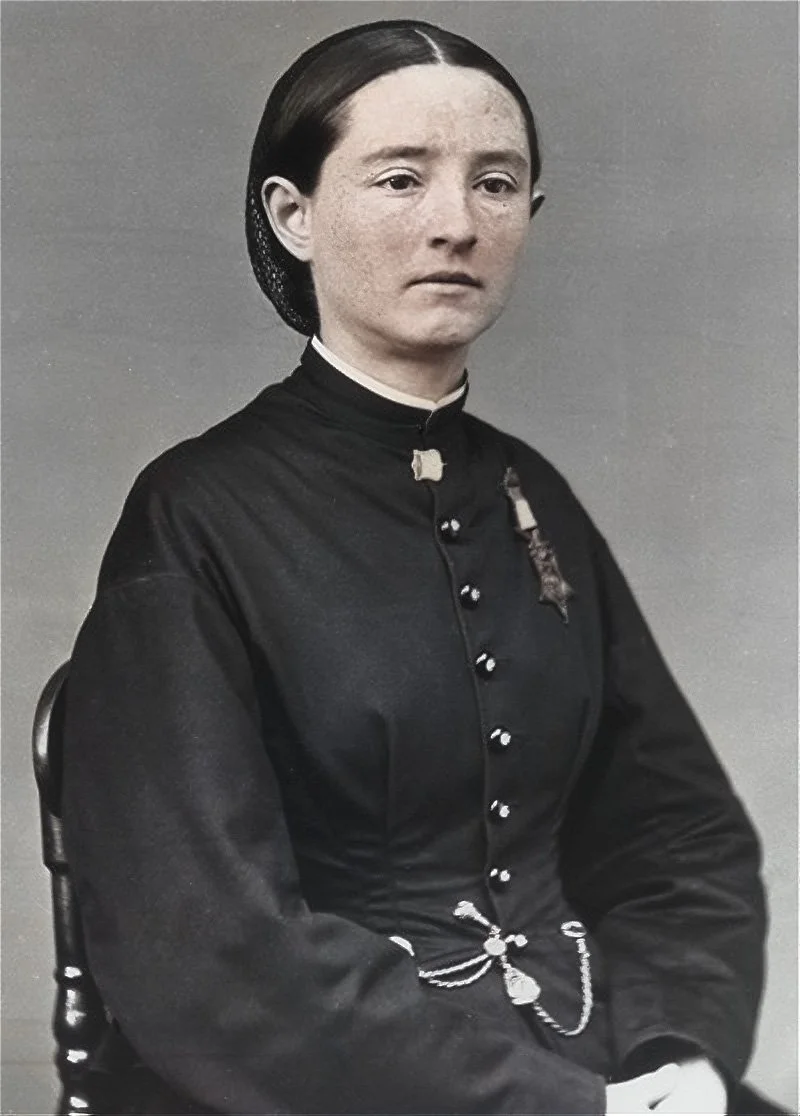
Mary Edwards Walker.
Mary Edwards Walker was born in 1832 in Oswego County, New York, into a household that quietly defied many of the era's expectations. Her parents were progressive thinkers who believed firmly in education, self-reliance, and physical health. Her father, a farmer with reformist views, insisted that his daughters receive the same rigorous schooling as his sons—an unusual stance in mid-nineteenth-century America. From an early age, Mary absorbed the idea that intellectual capacity was not determined by gender. She also rejected restrictive clothing, later arguing that heavy skirts and corsets were both unhealthy and symbolic of women's social confinement.
Her determination led her to pursue a medical career at a time when female physicians were rare and frequently dismissed. She enrolled at Syracuse Medical College, one of the few institutions willing to admit women, and graduated in 1855 with a Doctor of Medicine degree. Even with credentials in hand, she struggled to establish a practice. Patients were hesitant to trust a woman doctor, and professional networks largely excluded her. Yet she persevered, convinced that her skills would eventually find their proper arena.
That arena emerged with the outbreak of civil war in 1861. As the Union and Confederate states mobilized for what would become a four-year struggle of unprecedented scale, medical services were rapidly overwhelmed. Disease—typhoid, dysentery, pneumonia—claimed more lives than bullets, and battlefield surgery was often conducted in makeshift tents or barns with limited anesthesia and rudimentary sterilization. Determined to serve, Walker travelled to Washington, D.C., and petitioned the War Department for a commission as an army surgeon. She was refused solely because she was a woman.
Undeterred, she offered her services as a volunteer and began working in Union hospitals. Over time, her persistence and demonstrated competence earned her a contract appointment as an acting assistant surgeon with the Army of the Cumberland. This placed her in the Western Theatre of the war, where campaigns through Tennessee and Georgia were marked by relentless maneuvering and ferocious engagements. The struggle for control of strategic rail hubs such as Chattanooga and the drive toward Atlanta produced waves of wounded soldiers, and medical personnel worked under constant strain.
Walker frequently placed herself near the front lines, tending not only to Union troops but, when possible, to civilians caught in the crossfire. Her medical practice was guided by both professional duty and humanitarian conviction. In April 1864, during operations connected to the Atlanta Campaign, she crossed into territory controlled by Confederate forces to treat wounded men and suffering civilians. It was a bold and dangerous act. Confederate soldiers arrested her, suspecting that a woman in modified military attire moving between lines must be a spy. She was transported to Richmond, Virginia, and held as a prisoner of war. Confinement was harsh, food scarce, and uncertainty constant. Yet Walker endured several months of captivity before being exchanged in August 1864 as part of a formal prisoner swap. Her experience gave her a rare distinction: she was one of the few women formally held as a prisoner of war during the conflict.
In 1865, after the war had drawn to a close, President Andrew Johnson signed the order awarding Mary Edwards Walker the Medal of Honor. The citation recognized her meritorious service, devotion to the wounded, and steadfastness during captivity. Although the criteria for the award were broader in the nineteenth century than they would later become, her work near the front lines and her imprisonment under enemy authority were extraordinary by any standard.
Decades later, in 1917, a review board reassessed earlier awards and rescinded hundreds of Medals of Honor deemed inconsistent with newly tightened combat requirements. Walker's medal was among those revoked. She refused to surrender it, asserting that her service had been honorable and that no bureaucratic revision could erase lived reality. She continued to wear the medal daily, a small but potent act of defiance. In 1977, long after her death, the U.S. government restored her award, reaffirming her singular place in American military history.
Walker's postwar years were as combative in their own way as her time in uniform. She became a prominent advocate for women's suffrage, lecturing across the country and arguing that the Constitution already guaranteed women the right to vote. Her reformist zeal extended to dress reform; she adopted tailored jackets and trousers, insisting that practicality and health should outweigh social convention. For this she was ridiculed and occasionally arrested for "impersonating a man," yet she remained resolute. While she sometimes clashed with more cautious leaders within the suffrage movement, her independence and courage commanded respect.
Mary Edwards Walker died in 1919, just one year before the ratification of the Nineteenth Amendment secured women's suffrage nationwide. She did not live to cast a ballot in a federal election, but her life had already redefined the boundaries of possibility. In war, she proved that medical skill and personal bravery transcended gender. In peace, she continued to challenge the assumptions that had once barred her from a commission. Her Medal of Honor—awarded, revoked, and restored—serves as more than a military decoration. It stands as a testament to endurance in the face of prejudice, to professional commitment under fire, and to a lifetime spent pressing against the limits imposed by society. In Mary Edwards Walker's story, the upheaval of civil war intersected with the broader struggle for equality, and from that intersection emerged a legacy unlike any other in American history.
The site has been offering a wide variety of high-quality, free history content since 2012. If you’d like to say ‘thank you’ and help us with site running costs, please consider donating here.