The year is 1909. A 75-year-old King Leopold appears calm despite the dreary circumstances and his physical distress. He peacefully welcomed his untimely end. In his final moments he was surrounded by his loyal staff and several members of his family, except his two daughters Princess Louise and Stephanie. After his passing on December 17, 1909 his funeral followed in quick concession, though he wished for it to be a private affair this was ignored and the state provided a formal public display for their dead King. His funeral was met with a public outcry of boos and jeers. This begs the question: who was King Leopold, and how did his actions impact both his private and public life?
Sophie Riley explains.
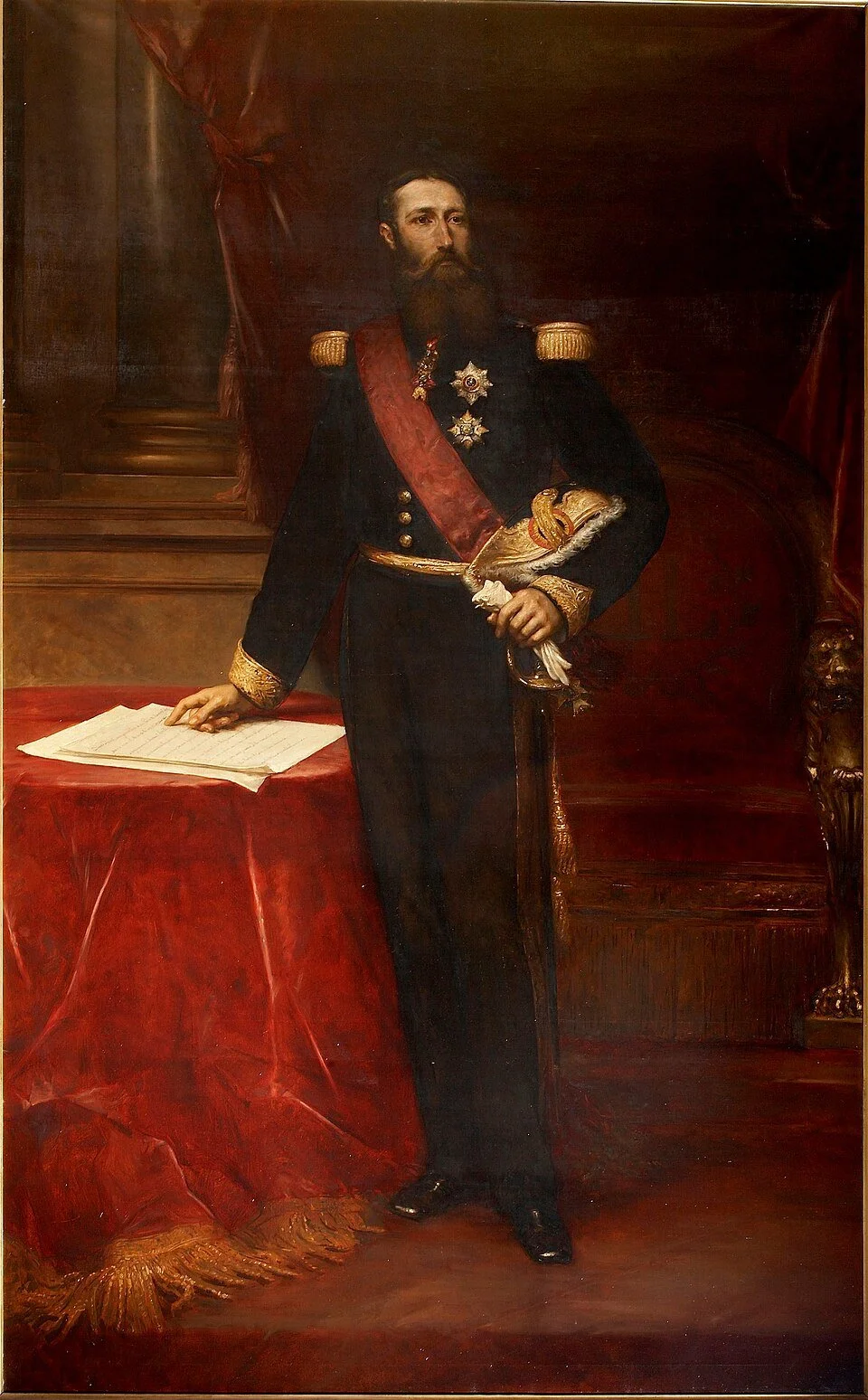
King Leopold II of Belgium by Louis Gallait.
International Brutality
King Leopold’s interest in the Congo started in the mid 1870s after he reviewed a report by Henry Morton Stanley in which he detailed his exploration of the region and he noted how it had access to uncharted natural resources.
Leopold’s seizure of the Congo began in 1876, when he hosted the Brussels Geographic Conference where he publicly established the International African Association. This was the first step in his humanitarian and scientific campaign in the Congo.
He then moved to active exploration of the area. This involved sending Henry Stanley to the Congo where his mission was to establish over 27 principal stations along the Congo River. These stations would act as signals to the local population and his rival European powers that this was his territory. In addition to this he was also instructed to secure the land rights from the Congolese chiefs through cloth and trinket treaties. Stanley would collect more than 450 treaties from the locals in exchange for cloth, alcohol, and local trinkets. In response the chiefs would place an x on the dotted line of a treaty they could not read and ultimately swore over their land and their states’ sovereignty. What appeared to be diplomacy revealed itself as deception.
The impact of these treaties would hit the Congolese in several stages. Firstly, in the 1880s some would realize the deception as local chiefs who resisted the Belgians or did not sign the treaties were either replaced or killed. Secondly, Leopold issued a tax decree in which he would claim all the occupied land and its resources as state property. This meant that the villagers were branded as thieves for harvesting their own resources.
The next phase of Leopold’s plan was to receive recognition for his control of the Congo on the world stage. This recognition would be received through deception; he would use the rising tensions between Britain, Germany, and France to his own end. He went to each country individually and convinced each one that the Congo should remain under neutral Belgium’s control instead of risking it falling into the hands of their rival.
In addition to this he replaced the International association of the Congo with his own political body to govern the territories that Stanley had acquired a few years earlier.
This chapter in Congo’s independence would close when King Leopold declared himself as the sovereign king of the free Congo state in 1885. Over the next few decades the Congolese would revolt and resist the ongoing takeover of their nation by the Belgians - this would result in millions of Congolese deaths through torture, famine and violence. The Congolese would unfortunately not receive full independence until 1960.
Leopold’s Legacy
King Leopold left behind a legacy that was complex and tainted with human suffering and bloodshed. The brutality of his rule in the Congo was so extreme that it drew international condemnation from other European colonists in 1908. His actions have been described by historians as callous, ruthless, and the almost unrestrained pursuit of power and wealth, raising enduring questions about moral responsibility and imperialist madness.
Nevertheless, historians and Belgian records have highlighted areas where King Leopold positively impacted the modernization and economic expansion of Belgium during his 44-year reign. Early in his rule he earned the nickname the builder King for his focus on the urban identity and public health of Belgium. One of his first initiatives involved engineering a plan to cover the heavily polluted Senne River in 1867, to help stop the spread of cholera. In 1873, he commissioned the Royal Green houses in Laeken which helped advance botanical studies, and in 1880, he oversaw the creation of Cinquantenaire park to celebrate Belgium’s 50th anniversary as an independent state.
As his reign progressed Leopold shifted his focus towards public education and the economic expansion of Belgium. During this time his government established a state funded school system, and oversaw the modernization and expansion of Antwerp’s docks, transforming the city’s docks into the world’s first commercial port. By the end of this period, Belgium had expanded significantly in both economic strength and national infrastructure, while political reforms extended universal suffrage to all men.
In the last years of his reign, Leopold’s focus shifted towards social reform and the question of his legacy. His last decade saw the introduction of laws that would change the daily lives of his citizens. Child labor for children under the age of 12 was abolished, and the restrictive worker’s booklet which had restricted their mobility was removed. However, these reforms were met by more controversial measures, including the introduction of compulsory military service where one son per family would have to serve 15 months in the army.
Despite what he did in the Congo, Leopold’s reputation within Belgium remained largely intact. It would take over 90 years for the Belgians to shift their perspective. The catalyst for change started in 1999 when Adam Hochschild wrote a book entitled King Leopold’s Ghost. His book was met with high acclaim due to its in-depth view on Leopold’s colonial atrocities in the Congo. While being widely acclaimed, the book reopened old wounds within Belgian society, particularly for the older conservative generation who still believed that Leopold was an ambitious hero.
In contrast the younger generations alongside many institutions began to question the narrative of their past, and this led to the gradual removal of statues of their former king.
This reckoning reached a turning point in 2020, amid global protests against racism in response to the murder of US citizen George Floyd. In Belgium, statues of King Leopold were either defaced or spray painted red with the words assassin or I cannot breathe. While none were officially destroyed, this would eventually lead to some statues being placed into museum storage. Due to the public’s tenacity, the Prime Minister at the time, Charles Michel, would apologize for the kidnapping of mixed-race children during the 1940s and 1950s. However, no formal apology has been made towards the Congolese people for the atrocities committed under Leopold’s rule, with the Belgian state offering admissions of regret rather than full acknowledgement. It is within the tension between remembrance and reckoning that Leopold’s legacy must ultimately be understood.
Final Thoughts
In the end, the story of King Leopold II resists a simple verdict. He was a ruler who reshaped Belgium’s cities, economy, and institutions, yet he also presided over one of the most brutal colonial regimes in modern European history. These two legacies do not cancel each other out but they do exist side by side, forcing us to confront the uncomfortable reality that progress and suffering are often intertwined.
Leopold’s life and legacy reveals as much about the present as it does the past. The conversation surrounding his actions has shifted from admiration to scrutiny, from silence to debate.
The site has been offering a wide variety of high-quality, free history content since 2012. If you’d like to say ‘thank you’ and help us with site running costs, please consider donating here.