
Zheng He, one of the most remarkable figures in maritime history, was a Chinese admiral, explorer, and diplomat whose seven great voyages in the early 15th century projected the power and prestige of Ming Dynasty China across the Indian Ocean. Born around 1371 in the Yunnan province during the waning years of the Mongol-led Yuan Dynasty, Zheng He was originally named Ma He. He was of Hui Muslim descent, and his family's faith would remain an important part of his identity throughout his life. His early years were marked by turmoil; during the Ming conquest of Yunnan in 1381, Ma He was captured by Ming forces as a boy and was castrated, entering service in the household of Prince Zhu Di, the future Yongle Emperor. His intelligence, resourcefulness, and loyalty soon brought him to prominence within the prince's inner circle. When Zhu Di ascended to the throne in 1402, he recognized Ma He's talents and conferred upon him the name Zheng He, granting him command of an ambitious enterprise that would redefine the scale of maritime exploration.
Terry Bailey explains.
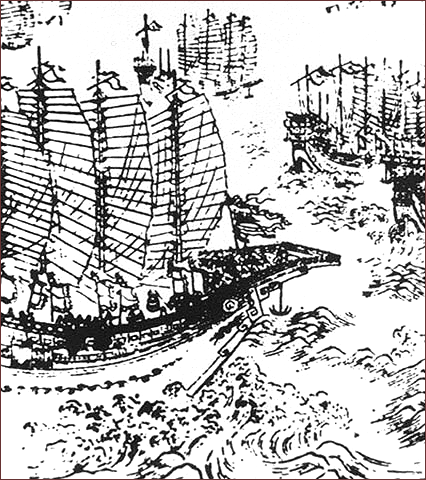
A Chinese woodblock print showing Zheng He's ships.
Between 1405 and 1433, Zheng He led seven massive naval expeditions that reached an extent unparalleled in the pre-modern world. Sailing from the great port of Nanjing and later from Liujiagang and Changle, Zheng He commanded fleets that dwarfed those of contemporary Europe, some comprising over 300 ships and tens of thousands of men. His flagship, often called the "Treasure Ship" (宝船, Baochuan), was said to have been up to 120 meters long, a floating palace of diplomacy and commerce. The first voyages took him to Southeast Asia, visiting ports in modern-day Vietnam, Thailand, Java, and Sumatra before crossing the Indian Ocean to reach Calicut on the Malabar Coast of India.
Later expeditions extended China's reach to Ceylon (Sri Lanka), Hormuz in the Persian Gulf, and the Swahili Coast of East Africa, including Mogadishu and Malindi. These voyages were not primarily for conquest, but rather for diplomacy and trade; Zheng He carried lavish gifts from the emperor, secured tributary relations, and brought back exotic goods such as spices, ivory, precious stones, and even a giraffe, an animal that so fascinated the Ming court that it was described as a qilin, a mythical creature symbolizing virtue and harmony.
The achievements of Zheng He's voyages were multifaceted. They demonstrated Chinese mastery of shipbuilding, navigation, and logistics on a scale never before attempted. The fleets were equipped with advanced magnetic compasses, watertight bulkhead compartments, and sophisticated star maps. Zheng He's role as both an admiral and a diplomat made him an embodiment of Ming China's outward-looking confidence during the Yongle Emperor's reign. He established diplomatic relations with over thirty foreign states and secured China's influence in vital maritime trade routes linking East Asia, South Asia, Arabia, and Africa. His voyages also promoted cultural and religious exchanges; as a Muslim, Zheng He visited mosques and supported communities of fellow believers abroad, leaving inscriptions that reveal his piety and his sense of mission as a servant of the emperor.
Zheng He's later life reflected both the triumph and decline of his era. After his final voyage, which took place around 1431–1433, the political mood in China shifted sharply inward. The enormous cost of the expeditions, combined with renewed threats from nomadic powers on China's northern frontier, led subsequent emperors and court officials to end support for maritime exploration. Zheng He likely died on the return voyage from the seventh expedition, possibly in Calicut or at sea, though some sources claim he returned to China before his death and was buried in Nanjing. His tomb, located on the southern slope of Niushou Mountain near Nanjing, remains a place of cultural significance, though it contains only his clothes and a symbolic cenotaph rather than his actual remains.
The primary sources documenting Zheng He's voyages provide invaluable insight into this extraordinary chapter of history. The most famous of these is the Ming Shi ("History of the Ming"), which records his achievements in official court annals. More detailed accounts come from contemporaries such as Ma Huan, a Muslim interpreter who accompanied Zheng He on several voyages and wrote the Yingyai Shenglan ("Overall Survey of the Ocean's Shores"), describing the peoples, customs, and landscapes encountered along the route. Another chronicler, Fei Xin, composed the Xingcha Shenglan ("Description of the Starry Raft"), while Gong Zhen, another member of the fleet, wrote the Xiyang Fanguo Zhi ("Records of Foreign Countries in the Western Ocean"). These works, written in refined classical Chinese, combine geography, ethnography, and travel narrative, providing an invaluable window into both the material and human dimensions of Zheng He's journeys.
Archaeological evidence has also corroborated elements of Zheng He's story. Excavations at the Longjiang shipyard in Nanjing have revealed slipways and timbers large enough to support the construction of the enormous treasure ships described in the chronicles. Chinese porcelain shards and Ming coins found as far afield as Kenya, Sri Lanka, and the Persian Gulf further attest to the reach of Zheng He's maritime enterprise. In 2010, the discovery of an ancient Chinese anchor off the coast of Malindi fueled debate over the physical traces left by his expeditions in East Africa.
Additionally, stone inscriptions attributed to Zheng He, such as the 1407 Liujiagang stele and the 1431 Changle stele, survive as direct statements of purpose and faith, invoking both the Buddha and Allah in a syncretic reflection of Zheng He's worldview and the inclusiveness of the Ming maritime project.
Zheng He's legacy has endured long after his voyages faded into obscurity. For centuries, China turned inward, its maritime ambitions curtailed by isolationist policies, and the memory of Zheng He was reduced to legend. Yet in modern times, he has been rediscovered as a symbol of peaceful exploration and cross-cultural exchange. His journeys demonstrated that centuries before the European Age of Discovery, China had already mastered the oceans and built a network of contacts that stretched from the South China Sea to the coast of Africa. In Zheng He's wake, the world glimpsed the potential of global navigation, not for conquest, but for curiosity, diplomacy, and mutual enrichment. His life remains a record of the heights that human ambition and organization can reach when guided by vision and confidence in the vastness of the world beyond the horizon.
Zheng He's life and legacy stand as a profound symbol of the power of exploration guided not by conquest, but by curiosity, diplomacy, and a vision of cultural exchange. His seven voyages across the Indian Ocean were not merely feats of navigation or imperial display, they were acts of global connection at a time when much of the world remained isolated within its own horizons. Through his command of the immense treasure fleets, Zheng He demonstrated the technological and organizational prowess of Ming China, showcasing a civilization at its zenith of maritime innovation. Yet beyond the grandeur of his ships and the exotic cargoes they carried lay a deeper achievement: the forging of peaceful relations between vastly different peoples, faiths, and nations across Asia and Africa.
In Zheng He, the threads of history, religion, and empire were uniquely intertwined. As a Hui Muslim serving a Confucian court, he embodied the diversity and tolerance that characterized the Ming Dynasty's outward-facing moment. His voyages not only expanded China's influence but also reflected a worldview in which harmony among nations and respect for difference were integral to the pursuit of greatness. This spirit is echoed in the inscriptions he left behind, invoking both Buddha and Allah, a rare and moving testament to his belief in the universality of human faith and purpose.
The decline of China's maritime enterprise following Zheng He's death marked a turning point in world history. While Europe embarked upon its own age of exploration, the Ming Empire turned inward, allowing the memory of Zheng He's accomplishments to fade into the background of myth. Yet history has revived his story as one of vision and possibility. In the modern era, Zheng He has come to symbolize not imperial ambition, but the idea of global engagement built upon respect, cooperation, and mutual understanding. His voyages are a reminder that exploration can serve as a bridge between cultures rather than a means of domination.
Ultimately, Zheng He's legacy endures not only in the chronicles of his journeys or the relics uncovered along his routes, but in the enduring idea that humanity's greatest discoveries lie in its capacity to reach outward and connect. His fleets may have long vanished beneath the waves of time, but the wake of his voyages still ripples through history, inspiring generations to look beyond the edge of the known world with the same sense of wonder and courage that guided the great admiral of the Ming seas.
The site has been offering a wide variety of high-quality, free history content since 2012. If you’d like to say ‘thank you’ and help us with site running costs, please consider donating here.