Union cavalrymen appeared on the cliffs above the Confederate camp. “Who are you down there” shouted one of the horsemen. “Texans, goddamn you” was the reply. Pleasantries completed, the riders dismounted, clambered down the cliff, brushed aside the few defenders, and secured the camp. The Confederate conquest of the Southwest had come to a screeching halt.
Here, James F. Byrne Jr looks at the 1862 Battle of Glorieta Pass.
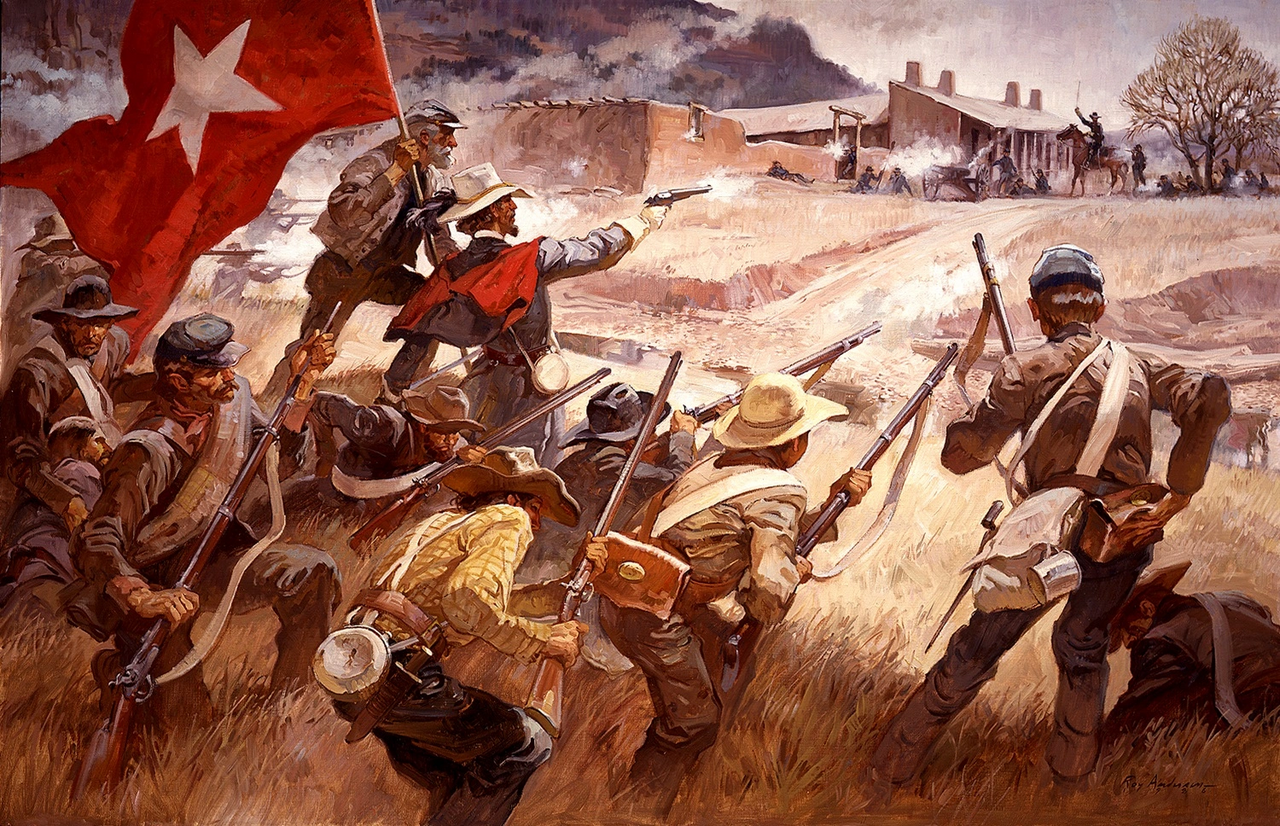
The Battle of Glorieta Pass - Pigeon's Ranch by Roy Andersen.
The outbreak of the Civil War found the U.S. Army occupying ten outposts in the New Mexico territory. Offered command of U.S. troops in the territory, Colonel Henry Sibley instead took ownership of all the arms and supplies he could seize and departed with his plunder for Texas and a commission in the Confederate Army.
Sibley saw the weak Union presence in the Southwest as an opportunity to march into Colorado and then westward to California. Rebel occupation of the Southwest would provide access to mineral resources and Pacific ports. Pursuing his vision of a Confederate manifest destiny, Sibley set up headquarters in San Antonio and recruited a 3000 man army. He struck north up the Rio Grande in February 1862.
Future events were to reveal Sibley’s leadership shortcomings. His tactical acumen did not match his strategic vision, and he failed to fully consider supply requirements when developing his grandiose plans. But his most significant shortcoming was captured in the nickname bestowed on him by his subordinates – the walking whiskey keg.
Sibley’s invasion was opposed by Colonel Edward Canby, who proved adept at husbanding his own combat strength while enabling Sibley’s to wither away. Canby consolidated his scattered forces at Fort Craig, 170 miles north of El Paso, and unsuccessfully attacked Sibley’s column as it approached the nearby Valverde ford. Beaten but not defeated, Canby retreated to his fortifications while Sibley continued north, occupying Santa Fe in mid-March.
Fort Union
Sibley had won a major battle and seized the territorial capital. However, if his campaign were to continue, he needed to capture the supplies at Fort Union, 110 miles north along the Santa Fe Trail. Fortunately for the Union cause, 1000 volunteers from Colorado commanded by Colonel John Slough were moving rapidly south to reinforce the fort. However once at Fort Union Slough disregarded instructions to remain there, and soon moved his command down the trail.
Twenty three miles east of Santa Fe at Glorieta Pass, Slough’s advance guard encountered and drove back Confederate scouts. Informed of the setback, the walking whiskey barrel ordered up additional troops under the command of Col William Scurry. As Scurry advanced, he left the army’s supply train in a small canyon west of the pass. At midday on March 28th the battle was joined at the pass, and Scurry soon gained the upper hand, driving Slough back up the trail.
However, Slough had earlier detached 500 cavalrymen to move over an adjacent mesa and strike the flank of the Confederate column. After hours of meandering, the cavalrymen arrived at a cliff overlooking the supply encampment. Scattering the startled defenders, they set ablaze the captured supply wagons loaded with ammunition, food, and medical supplies. Within an hour the Union force departed, leaving behind smoldering ruins and the shattered dreams of the Confederate conquest of the Southwest.
Up at the pass the main Union force continued to slowly withdraw, leaving the Confederates in possession of the battlefield. However, as one rebel soldier described the situation, “here we are 1000 miles from home, not a wagon, not a dust of flower, not a pound of meat.”
The “victorious” rebel force retreated down the Rio Grande while Canby herded the increasingly bedraggled invaders out of the territory. Following a devastating 1000 mile march the tattered remnants of the Confederate column staggered back into San Antonio. Over 40% of the proud “Texans, goddamn you” who struck the Santa Fe Trail in February, remained there in shallow graves.
Sibley was courts martialed for drunkenness and cowardice in 1863. Elements of his defeated army spent the remainder of the war fighting in Texas and Louisiana. The remnants surrendered in Houston at the end of the war, a long way from the Pacific ports they sought in the heady days of 1862.
Lessons Learned
· Armies need supplies. “Hand waving” logistics planning is seldom an effective approach.
· Do not assume you can live off the land. An arid wasteland provides few opportunities for supplementing needed supplies.
· Tactical victories do not guarantee success. Confederate “victories” weakened the force and left it unable to achieve strategic objectives.
· Victory does not require annihilation. Slough kept his outnumbered force intact and allowed the enemy to self-destruct.
· Do not bring a knife to a gunfight. Sibley’s force was inadequate for the mission of securing half a continent.
· Leadership is a combat multiplier. Rank and file contempt for Sibley’s keen sense of self-preservation eventually hobbled the army’s morale and fighting ability.
· Force protection matters. Scurry’s failure to protect his supply train doomed the entire Confederate campaign.
The site has been offering a wide variety of high-quality, free history content since 2012. If you’d like to say ‘thank you’ and help us with site running costs, please consider donating here.