The dynastic struggle that would later erupt into the Wars of the Roses did not emerge suddenly in the mid–fifteenth century. Its roots lay decades earlier in the complicated aftermath of the reign of Edward III, one of England's most powerful medieval kings. When Edward died in 1377 after a reign of fifty years, he left behind a formidable legacy of military victories and royal prestige. Yet beneath the apparent strength of the monarchy lay a dangerous problem: a tangled web of royal descendants whose competing claims to the throne would gradually destabilize the kingdom. The seeds of civil war had already been planted within the royal family itself, and over the following generations, those seeds would steadily grow into one of the most destructive internal conflicts in English history.
Terry Bailey explains.
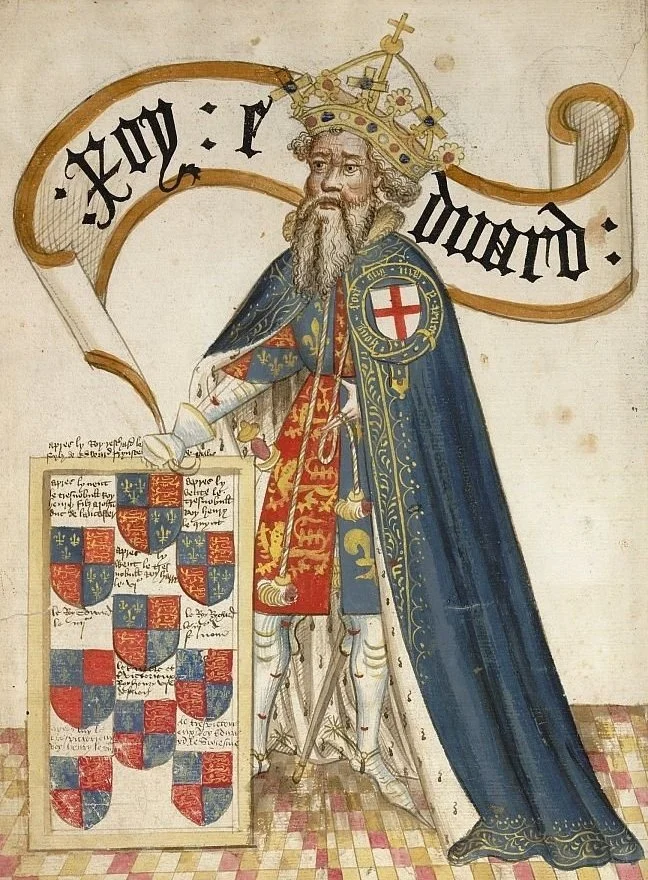
An 15th century depiction of Edward III of England. From the Bruges Garter Book made by William Bruges (1375–1450), first Garter King of Arms, British Library, Stowe 594 ff. 7v.
Edward III had fathered several sons who survived into adulthood, each of whom founded powerful branches of the royal lineage. In the medieval system of dynastic succession, such an abundance of heirs could appear to strengthen a monarchy, yet it could just as easily generate rival claims. The king's eldest son, Edward the Black Prince, was widely admired as one of the greatest military commanders of his age. During the early campaigns of the Hundred Years' War against France, the Black Prince gained fame for his leadership and battlefield skill, particularly in victories such as the Battle of Poitiers. He appeared destined to succeed his father and continue England's military dominance on the continent. Fate, however, intervened. The Black Prince died in 1376 after a long illness, a year before Edward III himself passed away.
The death of the heir apparent created an immediate problem of succession. The Black Prince left behind only one legitimate son, the young Richard II. When Edward III died the following year, the crown therefore passed not to an experienced adult prince but to a ten-year-old boy. Although medieval monarchies were accustomed to child rulers, such circumstances almost always created opportunities for political rivalries to flourish. A king who was too young to rule independently depended upon advisers and regents, and those who surrounded him inevitably competed for influence.
The early years of Richard II's reign were therefore dominated by powerful relatives and leading nobles who sought to guide royal policy. Among the most influential figures was John of Gaunt, Duke of Lancaster, Edward III's third surviving son. Gaunt possessed enormous wealth, extensive estates, and vast political influence throughout the kingdom. The lands and titles associated with the Duchy of Lancaster gave him resources that rivalled those of the crown itself. As a result, the Lancastrian branch of the royal family emerged as one of the most powerful political forces in England.
Another of Edward III's surviving sons was Edmund of Langley, Duke of York. Though less politically dominant than his brother John of Gaunt, Edmund's descendants would later form the basis of the Yorkist claim to the throne. At the time, however, these various branches of the royal family coexisted uneasily within the aristocratic structure of England. The stability of the realm depended heavily on the king's ability to balance the interests of these powerful houses. A strong monarch could maintain harmony; a weak one risked allowing rivalry to flourish.
Richard II struggled to command the authority necessary to maintain such a balance. Although he displayed intelligence and a sense of royal dignity, he often proved politically inflexible and suspicious of the great magnates whose support he required. His reign became increasingly characterized by factionalism and mistrust. Early in his rule England experienced a major social upheaval in the form of the Peasants' Revolt of 1381. This uprising, one of the most dramatic popular revolts in medieval Europe, was fueled by widespread resentment over taxation and economic hardship in the aftermath of the Black Death.
The revolt brought thousands of rebels marching toward London, demanding relief from oppressive taxes and the abolition of certain feudal obligations. Though still a boy, Richard II confronted the rebels personally in an attempt to defuse the crisis. The revolt was eventually suppressed, but the event left a lasting impression on the young king and revealed how fragile social and political stability could be during times of economic strain. England's ruling elite became increasingly aware that the kingdom faced internal pressures that could erupt unexpectedly.
As Richard matured, his style of governance became more assertive and increasingly controversial. Determined to strengthen royal authority, he relied heavily on a small circle of trusted favorites while punishing opponents with severity. This approach alienated many influential nobles who believed their traditional rights and privileges were being ignored. Over time, the king's court became associated with factional intrigue and personal rivalries rather than broad political consensus.
One of the most significant figures drawn into this growing conflict was Henry Bolingbroke, the son of John of Gaunt. Bolingbroke was a capable and respected nobleman who had cultivated strong support among England's aristocracy. In 1398 he became embroiled in a dispute with another prominent lord, leading Richard II to intervene by exiling both men from the kingdom. The situation worsened dramatically the following year when John of Gaunt died. Instead of allowing Bolingbroke to inherit the vast Lancastrian estates, Richard confiscated them for the crown.
This decision proved to be a fatal miscalculation. By denying Bolingbroke his inheritance, Richard effectively transformed a political rival into a determined enemy.
In 1399 Bolingbroke returned to England while Richard was campaigning in Ireland. Initially, he claimed that his goal was simply to recover his rightful lands, yet discontent with the king's rule had become widespread among the nobility. As Bolingbroke advanced through the country, support for his cause rapidly grew.
The political situation quickly escalated into a full-scale revolution. Richard II found himself abandoned by many of his supporters and was eventually captured. Forced to abdicate the throne, he was imprisoned and later died under mysterious circumstances. Bolingbroke then claimed the crown and was crowned as Henry IV, inaugurating the Lancastrian dynasty.
The deposition of Richard II marked a profound turning point in English constitutional history. For centuries the legitimacy of kingship had been based on hereditary succession. By removing the reigning monarch and replacing him with another claimant, the nobility had demonstrated that the crown could be transferred through political force. Although Henry IV justified his claim by emphasizing his descent from Edward III, his hereditary right was not the strongest available within the royal family.
Indeed, another line of descent from Edward III provided the foundation for a potentially stronger claim. Through the descendants of the king's second surviving son, Lionel of Antwerp, later Yorkist supporters could argue that their lineage represented the senior branch of the royal family. Although this issue did not immediately provoke conflict, it created an unresolved question of legitimacy that would later resurface with dramatic consequences.
Henry IV's reign was therefore far from secure. Throughout his rule, he faced rebellions, conspiracies, and political instability. Noble families who had supported his rise to power expected rewards and influence, while others remained loyal to the memory of Richard II. Maintaining authority required constant vigilance and careful political management. Though the Lancastrian dynasty survived these early challenges, it did so in an atmosphere of uncertainty.
The broader political climate of the early fifteenth century further complicated the situation. England remained deeply involved in the long and costly Hundred Years' War against France. Maintaining armies overseas and defending English territories required vast financial resources. Heavy taxation placed increasing strain on the population, while military setbacks undermined confidence in royal leadership.
For a brief moment, however, the Lancastrian monarchy appeared to regain its prestige. Henry IV's son, Henry V, proved to be a charismatic and formidable warrior king. His dramatic victory at the Battle of Agincourt in 1415 revived English fortunes and restored a sense of national pride. Henry's campaigns in France brought new territorial gains and renewed confidence in the Lancastrian regime.
Yet this revival proved short-lived. Henry V died unexpectedly in 1422 at the height of his success, leaving the throne to his infant son, Henry VI. Once again England faced the political complications of a child king. A prolonged minority government placed power in the hands of competing factions among the nobility, each seeking influence over the young monarch.
As Henry VI grew to adulthood, it became increasingly clear that he lacked the political strength and military ability of his father and grandfather. Gentle and deeply religious by nature, he struggled to command authority over the powerful nobles who dominated English politics. At the same time, England's position in France began to collapse. During the final phases of the Hundred Years' War, French forces gradually recaptured most of the territories England had once controlled.
The loss of these lands dealt a severe blow to the prestige of the monarchy. Military failure abroad undermined confidence in royal leadership at home. Many noble families who had once profited from warfare in France found their opportunities disappearing, while the financial burden of past campaigns continued to weigh heavily on the kingdom. Discontent within the aristocracy steadily increased.
Within this unstable environment, alternative claims to the throne began to attract greater attention. Among the most prominent figures was Richard, Duke of York. Through his descent from multiple lines of Edward III's family, York possessed a powerful hereditary claim that rivalled—and in some interpretations exceeded—that of the Lancastrian kings. Combined with his considerable wealth and influence, this lineage placed him at the center of a growing political opposition.
By the mid-fifteenth century, England had become a kingdom strained by weak kingship, economic hardship, and unresolved questions of dynastic legitimacy. The precedent set by the overthrow of Richard II had demonstrated that a king could be removed if powerful nobles united against him. Meanwhile, the decline of English fortunes in France eroded the authority of the Lancastrian dynasty.
Thus the conditions for civil war were already firmly in place. What began as a complicated issue of royal inheritance gradually evolved into a bitter political rivalry between two powerful branches of the royal family. The Houses of Lancaster and York, later symbolized by their rival red and white roses, would soon plunge England into a prolonged struggle for control of the throne. In the decades ahead, battles, betrayals, and shifting alliances would reshape the English monarchy and leave an enduring mark on the nation's history.
Therefore, the Wars of the Roses were not the product of sudden ambition or isolated acts of rebellion, but the culmination of long-developing structural weaknesses within the English monarchy. The reign of Edward III, for all its outward strength and prestige, had unintentionally created a dynastic landscape crowded with competing lines of succession. This abundance of royal heirs, which might have ensured continuity under a strong ruler, instead became a source of instability when authority faltered. The premature deaths of key figures and the repeated accession of child kings—most notably Richard II and later Henry VI—further weakened the crown's ability to manage powerful nobles whose ambitions increasingly outpaced their loyalty.
The deposition of Richard II by Henry IV proved to be a decisive constitutional rupture. In overturning the principle of unquestioned hereditary succession, it introduced a dangerous precedent: that kingship could be claimed and justified through force as much as by lineage. From that moment onward, legitimacy became contested ground, open to interpretation and, crucially, to challenge. The rival claims descending from Lionel of Antwerp and John of Gaunt lingered unresolved, quietly hardening into ideological fault lines within the nobility.
Compounding these dynastic tensions were the broader pressures bearing down on the kingdom. The economic aftershocks of the Black Death, the social volatility exposed by the Peasants' Revolt, and the immense financial strain of the Hundred Years' War all contributed to a climate of uncertainty and discontent. Military decline in France, particularly during the reign of Henry VI, eroded confidence in Lancastrian rule, while simultaneously depriving the nobility of the wealth and purpose that foreign campaigns had once provided.
By the mid-fifteenth century, England stood on a knife-edge. The monarchy, no longer an unassailable institution, depended heavily on the fragile balance of noble support. Into this volatile environment stepped Richard, Duke of York, whose formidable lineage and political influence offered a credible alternative to Lancastrian authority. What had begun as a question of inheritance had evolved into a struggle for power, legitimacy, and survival between two rival houses.
Thus, the outbreak of the Wars of the Roses was less an abrupt descent into chaos than the inevitable consequence of decades of accumulating tension. Dynastic ambiguity, political miscalculation, and social strain converged to produce a conflict that would engulf the English nobility and redefine the monarchy itself. In this sense, the wars were not merely fought over the crown—they were born from the very foundations upon which that crown had come to rest.
The site has been offering a wide variety of high-quality, free history content since 2012. If you’d like to say ‘thank you’ and help us with site running costs, please consider donating here.