
By the mid-1920s, one in six American families owned a car, and the Federal Highway Act of 1921 had funded a national network of roads suitable for automobiles. Europe lagged far behind. Automobiles were still largely a status symbol and even major roads were woefully unsuited for long journeys by car. In the rest of the world, automobiles were rare, and the roads on which to drive them were limited to the areas in and immediately around major cities. Most people in rural India, China, and elsewhere had never seen a car, and the roads they used to get from place to place were suitable only for foot traffic and carts. But driving became intoxicating for a small number of auto enthusiasts who decided it would be possible to travel the world by car, and both of the serious global circumnavigation efforts in the 1920s involved women who felt born to drive.
Laurel Corona explains.
Laurel has written the book Aloha Wanderwell Takes the Wheel (Amazon US | Amazon UK)
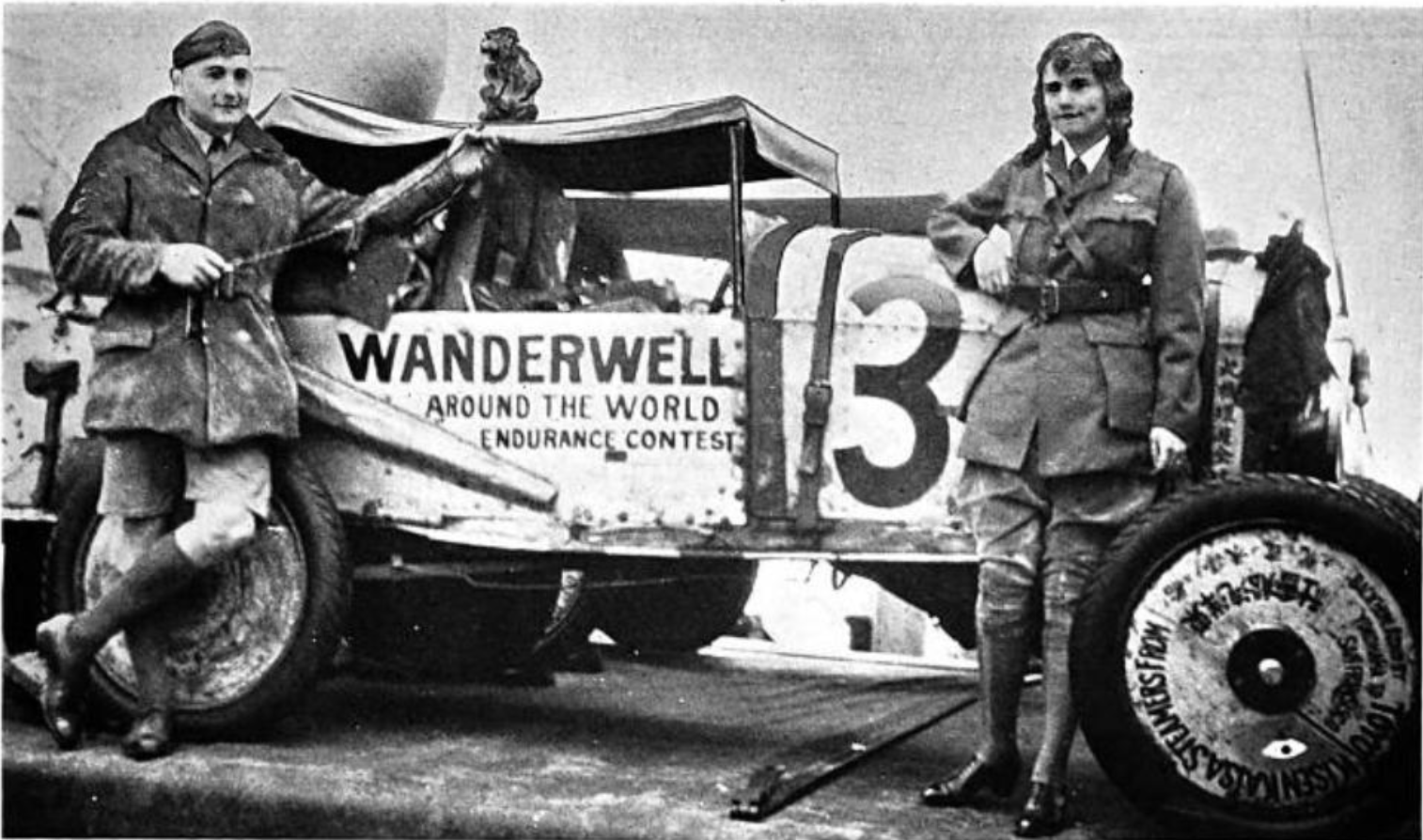
Walter and Aloha Wanderwell with their Ford car. Source: Public domain, "Greetings and Goodbyes" Japan Overseas Travel Magazine 14 (March 1925): 47. Available here.
The Guinness Book of World Records acknowledges that the first woman to drive around the world was Aloha Wanderwell. She was born Idris Hall in Winnipeg in 1906 and spent her childhood in Qualicum Beach, on Vancouver Island, British Columbia. While Idris was in her teens, her mother relocated the family to France, and while in boarding school in Nice, Idris ran across an advertisement Walter “Cap” Wanderwell had put in the local paper for a woman with “Brains, Beauty, and Breeches” to join his around-the-world expedition by automobile. Though only sixteen, Idris got her mother’s permission to join for the short time the expedition would be in France. She changed her name to Aloha Wanderwell and never looked back.
Walter Wanderwell was a pioneer. In addition to his groundbreaking expedition, he was the first to underwrite a travel adventure by making films (in his time still silent and black-and-white) of his travels. At a time when most people did not venture far from their place of birth, audience paid a small admission fee to see his films of faraway parts of the world, while youthful and attractive expedition members hawked brochures and postcards for a little extra cash outside the theaters. Cap was a brilliant, self-taught engineer. Though his cars were called Model Ts, they really were Wanderwell cars. He built the cars using a Model T chassis, relying on Ford parts because Ford had by far the largest distribution around the world and it would make getting parts easier in remote locations. He built them with extra storage for supplies and fuel, and in a later model, a built-in darkroom that could be pulled out on hinges from the trunk to develop their film before they reached their next stop. Construction from aluminum and other lightweight materials made the cars easier to push or drag across inhospitable terrain. This made them painfully bouncy, and the substitution of a tarp for a roof made the journey even more uncomfortable. Most crew quit within a few months from the hardship of the road, but Aloha would continue traveling with Cap for the next decade, eventually marrying him.
Aloha and Walter Wanderwell’s Route Around the World
The route around the world was not meant to be in a straightforward line, and they set no timetable, or even a concrete plan for much of it. In fact, they spend one entire year driving around Europe before setting out for Egypt. After driving the length of Egypt, they went by steamer to India, and she and Cap, now in two cars and without any other crew, drove 1100 miles across India. Teams of oxen dragged them across rivers and marshes, and they battled deserts, monsoons, and nearly impenetrable terrain. From India they went by steamer to Malaysia and after a stop in Singapore they began their drive the length of eastern China. Eventually they arrived in Vladivostok, where Aloha celebrated her eighteenth birthday. They continued on through Japan, Hawaii, and across the United States to Detroit, where the expedition officially ended.
Later Travels
Aloha and Cap went on to travel nearly the entire length of Africa on their “Cape to Cairo” expedition, but were stopped by a murderous civil war in Sudan and ended their African adventure in Mombasa. Next, they undertook another daring expedition in South America, driving from Buenos Aires across the Andes to Lima, where the crew disbanded. Cap and Aloha made the rest of the drive by themselves up through Central America to the United States. It would be their last adventure together. Wanting to try something new, Cap bought a schooner to sail around the world, but in December 1934, an assailant came aboard and killed him. The murder and subsequent trial were the subject of a devastating tabloid frenzy for Aloha, made worse by the insinuations that she was involved, and the shocking acquittal of the obvious suspect. Aloha tried to continue the travel film adventures without Walter, but wasn’t able to adapt to the new technologies of sound and color, and audiences for her personally narrated films waned when she was no longer an ingenue. She married again and settled into a comfortable life in Newport Beach, California, where she died in 1996 shortly before her ninetieth birthday.
Clärenore Stinnes
The other person to lay claim to the title of first woman to drive around the world is Clara Eleonore Stinnes, who went by the name Clärenore. She was the daughter of a wealthy German industrialist, who in her twenties took up auto racing as a hobby. When she began winning shorter races, she decided to enter endurance contests, and in 1925 she became the only woman to win a 2600-kilometer race across western Russia. It was on that race that she decided she wanted to drive around the world. Clärenore had substantial backing for her project, including a cash reserve, a diplomatic passport, two mechanics, a supply truck, and supplies of gasoline and spare parts that were pre-ordered and waiting for her on her scheduled stops along her route. Traveling with her was Carl-Axel Söderström, a Swedish film maker. Their route took them by land across Asia to Beijing. After being stranded for months in the Russian winter, they resumed the drive to Beijing, and returned by ship via Japan, Hawaii, and the United States. Two years after setting out, they returned to Berlin. Stinnes and Söderström married in 1930, and were done with their world travels, retreating to Sweden, where they bought a farm and raised their children. She lived to be 89, dying in 1990.
The Two Journeys Compared and Contrasted
While the hardships of driving in much of the world were comparable, the logistics were different. Clärenore’s journey was planned out meticulously and well financed. The Wanderwell expedition made its way by raising money on the spot. They had only a general sense of their itinerary and often took side trips when they heard about something out of the way that sounded worth exploring. Clärenore’s itinerary was designed to take her in as straight a route as possible. Clärenore and Aloha’s roles were different as well. Clärenore was clearly in charge of her project, and although the strikingly beautiful Aloha was the star of the Wanderwell expedition, Cap was its undisputed leader. Although Clärenore was quite young, still in her twenties at the time she set out, Aloha was only sixteen when she joined the Wanderwell expedition, and her extreme youth is another differentiating factor. Aloha and Cap thrived on the fame and attention they received, whereas Clärenore was more focused on succeeding at the task she had set for herself. And of course, a final difference is that when Clärenore succeeded, she was finished. Cap and Aloha went on to travel the world for ten years total, across five continents, before Cap’s murder put an end to their life together.
Who Was First?
The question of whether Aloha or Cläremore deserves acknowledgment as the first woman to complete an around-the-world expedition by automobile has been contentious. At first glance, it would appear that Aloha is the clear winner, because her journey was complete before Clärenore even set out. However, Clärenore’s journey from Europe to China was entirely by land, and the Wanderwells took freighters from Aden to India and from India to Penang, Malaysia. Because of a civil war in China, one stretch was taken by train for safety. Therefore, Clärenore’s journey was more completely done by car. Some argue, however, that because the oceans make it impossible to drive around the world anyway, the important thing is who got back to their starting point first after driving across every land mass they encountered on whatever route they chose. A semantic argument has arisen as well over what constitutes an expedition. Some argue that because Clärenore’s sole purpose was to drive in as direct a manner as possible around the world, her journey might more properly be called an expedition. The Wanderwells took their time and did so much else along the way that perhaps theirs should be called something else, like a global travel adventure. In fact, in promotional materials for the expedition, Cap gave the dates as “1921-?” Indicating that its purpose went far beyond making the most direct circuit around the globe. Hair splitting aside, the important thing is that the first two successful circumnavigations of the globe both had women at the wheel. Aloha and Clärenore defied the gender expectations of their time and did something thought impossible even for men of their day. Though there is no evidence they ever met, they are clearly kindred spirits who leave behind one of the most fascinating but underappreciated stories in automotive history.
Laurel’s book is out now: Aloha Wanderwell Takes the Wheel (Amazon US | Amazon UK)