
David Livingstone stands as one of the most celebrated figures of the Victorian age, a missionary, explorer, and abolitionist whose name became synonymous with Africa's vast, unmapped interior. Born on the 19th of March, 1813, in Blantyre, Scotland, Livingstone's early life was one of humble beginnings. The second of seven children, he grew up in a small tenement room above a cotton mill where his father worked as a tea salesman and Sunday school teacher. From the age of ten, Livingstone himself worked twelve-hour shifts at the mill, his small wages helping to support the family. Yet even amid such hardship, he displayed an unrelenting thirst for learning, studying Latin and theology late into the night with the aid of a single flickering candle. His self-discipline and curiosity earned him a place at Anderson's University in Glasgow, where he trained in both medicine and theology. It was during this time that he became inspired by the writings and appeals of the London Missionary Society (LMS), whose vision of combining medical work with Christian mission would become the cornerstone of his life's endeavor.

Terry Bailey explains.
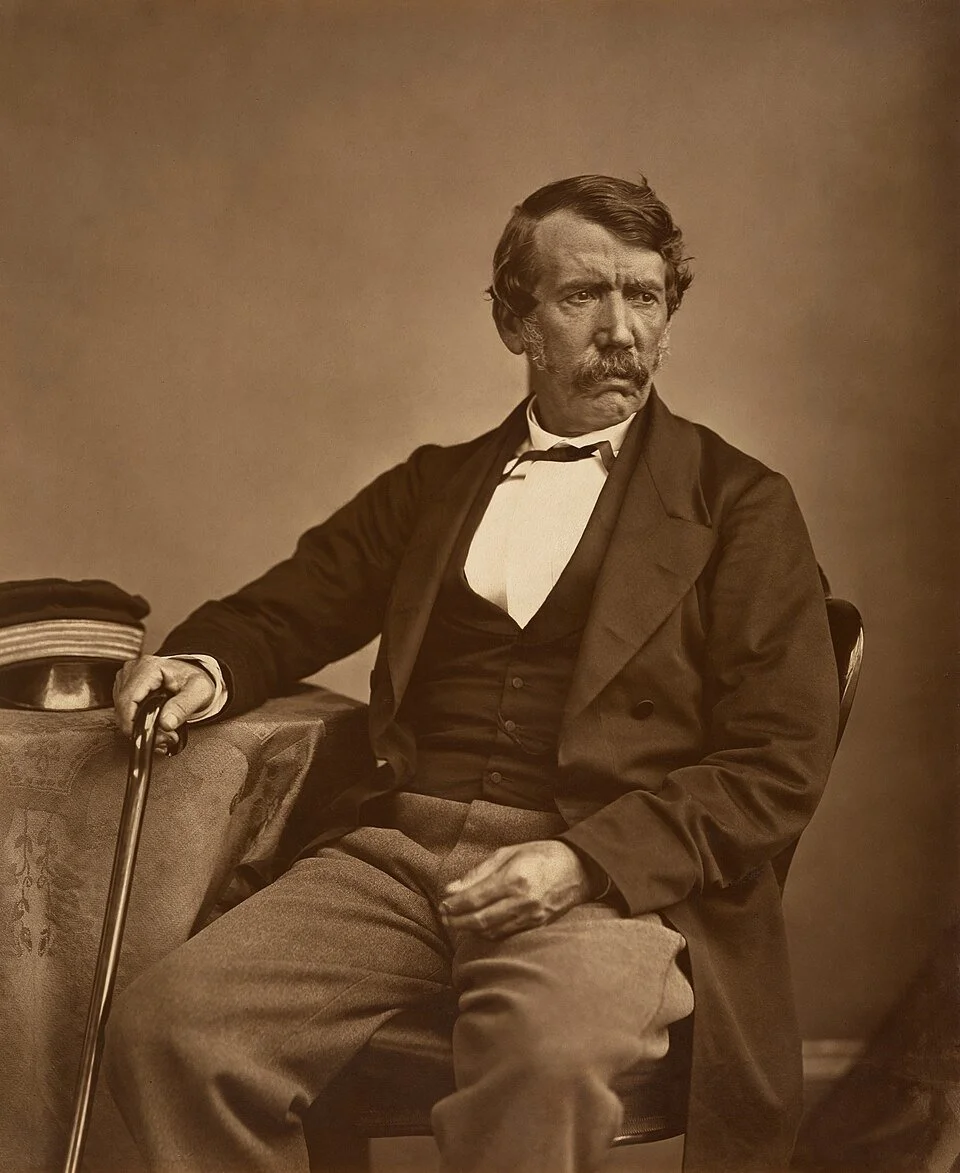
David Livingstone in 1864.

In 1840, Livingstone was ordained as a missionary doctor under the LMS and sailed for Africa, a continent largely unknown to Europeans beyond the coastal regions. His first posting was in the Bechuana country (modern-day Botswana), where he worked alongside the veteran missionary Robert Moffat. There, Livingstone quickly distinguished himself not only for his medical skills and fluency in local languages but also for his belief in establishing missions far inland, away from European colonial influences. His early travels introduced him to the harsh realities of African geography and the challenges of crossing vast deserts such as the Kalahari. Livingstone's marriage to Moffat's daughter, Mary, in 1845 marked the beginning of a partnership often tested by the dangers of exploration and illness.

Livingstone's first great achievement came in 1849 when he crossed the Kalahari Desert to reach Lake Ngami, a body of water previously unknown to Europeans. His reports of this journey captured the imagination of the British public, eager for tales of adventure and discovery. Determined to find new routes for legitimate trade as an alternative to the brutal slave routes that scarred the continent, Livingstone pushed further north. Between 1851 and 1856, he traversed thousands of miles, becoming the first European to cross the African continent from west to east. His expedition from Luanda on the Atlantic coast to Quelimane on the Indian Ocean was a feat of endurance that won him worldwide fame.

It was during these years that Livingstone made one of his most famous discoveries: the great waterfall on the Zambezi River, which he named Victoria Falls in honor of Queen Victoria. The native name, Mosi-oa-Tunya—"The Smoke That Thunders"—he preserved in his writings, noting its grandeur and spiritual significance to local peoples. His detailed journals and maps from this period were meticulously kept, later forming the basis for his book Missionary Travels and Researches in South Africa (1857), a major publication that enthralled readers and established his reputation as both a scientist and a man of faith. The Royal Geographical Society awarded him its gold medal, and his observations contributed significantly to the European understanding of African geography, geology, and ethnography.

Livingstone's later expeditions, particularly the Zambezi Expedition (1858–1864), were less successful but no less ambitious. Appointed by the British government to explore the navigability of the Zambezi River and its tributaries, he hoped to open up routes for trade and Christian missions that would undermine the slave trade. However, the journey was plagued by disease, logistical failure, and tragedy, including the death of his wife Mary from malaria in 1862. Despite these setbacks, his scientific work remained meticulous. He recorded flora, fauna, and mineral deposits, and his notebooks, many of which survive in archives such as the National Library of Scotland bear witness to a disciplined observer driven by both humanitarian and scientific motives.

In the later years of his life, Livingstone became increasingly preoccupied with finding the source of the Nile, a mystery that had fascinated explorers for centuries. His travels took him deep into Central Africa, where he lost contact with the outside world for several years. Rumors of his death circulated widely in Europe until, in 1871, the Welsh-born American journalist and explorer Henry Morton Stanley was dispatched by the New York Herald to find him. Stanley's long and arduous search ended in the town of Ujiji on the shores of Lake Tanganyika, where he greeted the weary, bearded missionary with the now-legendary words, "Dr. Livingstone, I presume?"

The meeting between Livingstone and Stanley became one of the most famous encounters in exploration history. Livingstone, though weakened by illness and years of hardship, was still resolute in his mission. Stanley, impressed by the older man's determination and moral conviction, provided supplies and encouragement. The two men explored parts of Lake Tanganyika together before Stanley returned to the coast with news that Livingstone was alive. Stanley's own life, though often overshadowed by this single encounter, was remarkable. Born John Rowlands in Denbigh, Wales, in 1841, he endured a harsh childhood before emigrating to the United States, where he served as a soldier, sailor, and journalist. His transformation into Henry Morton Stanley came after being adopted by a wealthy merchant of that name. His later explorations, including the charting of the Congo River, would establish him as one of the most controversial and driven explorers of the 19th century.

David Livingstone, however, never returned home. His final years were spent in relentless pursuit of the Nile's source, often under conditions of extreme suffering. His final journals, preserved on fragile paper and sometimes written in berry juice when ink ran out, reveal both his physical decline and his enduring spiritual faith. On the 1st of May, 1873, he died in the village of Chitambo (in present-day Zambia), likely from malaria and dysentery. His African attendants, loyal to the end, buried his heart beneath a tree at the site and carried his embalmed body over a thousand miles to the coast. From there, his remains were returned to Britain and interred in Westminster Abbey, where he was honored as both a national hero and a symbol of humanitarian courage.

The documents, letters, and diaries Livingstone left behind remain invaluable to historians. They not only chronicle a vast and challenging period of exploration but also offer rare insight into the cultural, geographical, and ethical dimensions of 19th-century Africa. Modern projects such as the "Livingstone Online" digital archive have preserved and analyzed these records, revealing details of his linguistic studies, medical observations, and even his evolving views on imperialism and slavery.

David Livingstone's legacy endures not simply as that of a man who charted rivers and crossed continents, but as one who sought to bring moral reform to a world divided by greed and ignorance. His life's work combined faith, science, and compassion, leaving a mark that transcended geography. The image of Livingstone emaciated, resolute, and holding fast to his ideals in the heart of Africa became a powerful emblem of the Victorian spirit of exploration and remains an enduring chapter in the intertwined histories of Britain and Africa.

David Livingstone's life formed a remarkable reflection of the transformative power of perseverance, conviction, and moral purpose. Emerging from poverty in industrial Scotland, he fashioned himself through relentless study and unyielding discipline into one of the most influential figures of the 19th century. His journeys across Africa created some of the most significant geographical and scientific records of his age, expanding European understanding of a continent too often approached with ignorance or prejudice. Yet Livingstone's work was never solely about mapping rivers or tracing mountain chains. It was underpinned by a profound humanitarian mission: to challenge the slave trade, to encourage what he called "legitimate commerce," and to foster cross-cultural understanding at a time when imperial attitudes frequently bred exploitation rather than empathy.

Though his later expeditions were marked by hardship, loss, and controversy, Livingstone's commitment to his principles never wavered. His meticulous notes, journals, and correspondence reveal a man constantly searching for knowledge, for justice, for the elusive headwaters of the Nile, and for ways to improve the lives of the people he encountered. These documents, preserved today in archives and digital collections, allow modern readers to glimpse the complexity of his character: a scientist shaped by faith, a missionary shaped by science, and an explorer shaped by an abiding respect for the African landscapes and communities that defined his career.

His celebrated meeting with Henry Morton Stanley, and the deeply human story behind it, further cemented his image in the Victorian imagination but it was Livingstone's death, and the extraordinary devotion of his African companions who carried his body across vast distances that most clearly demonstrated the depth of the relationships he forged. In life and in death, he crossed boundaries of culture and geography that few Europeans of his era attempted to bridge.

Ultimately, David Livingstone stands not only as a pioneer of exploration but as a symbol of a broader moral struggle. His efforts against the slave trade, his insistence on recording African voices and customs with respect, and his belief that knowledge could serve humanitarian ends distinguish him from many of his contemporaries. While modern interpretations rightly place his achievements within the wider context of imperial history, his intentions and contributions remain significant and enduring. His story continues to resonate because it speaks to universal themes: resilience in the face of adversity, integrity in purpose, and the pursuit of understanding across cultural divides. In this way, Livingstone's legacy extends far beyond the maps he drew or the rivers he traced, it endures as a reminder of the profound impact one determined individual can have on the course of history.


The site has been offering a wide variety of high-quality, free history content since 2012. If you’d like to say ‘thank you’ and help us with site running costs, please consider donating here.

Charles George Gordon, known for exhibiting extraordinary courage and fearlessness in battle, would die a hero’s death in 1885. At the time of his death, he had gained international fame for his service in the British army, ability to inspire others, and his staunch commitment to his faith. Here Marvin McCrary looks at Gordon’s role after China, notably in Sudan in the 1870s and 1880s.

If you missed it, read part one on Major General Gordon in China here.

A depiction of Major General Gordon in Khartoum.

Upon his return to England the question in the minds of everyone was what was next for Charles George Gordon. Gordon was posted to Gravesend in October 1865, as the Commandant of Engineers in charge of renovating the Lower Thames in Gravesend and Tilbury. Shortly after his arrival, Gordon received news that his father was dying. Taking a leave of absence, Gordon hurried to father's bedside and nursed him until he died. This personal tragedy, coupled with the death of one of his brothers, would have a profound effect on Gordon and the development of his stance towards religion. What had been at one time a more superficial approach to faith, Gordon became resolute in his determination to emulate Christian charity in thought as well as deed, and he returned to Gravesend a different person. Gordon's official duties occupied him from morning until the afternoon, after which he threw himself into charity. He visited the sick and dying, gave money to the poor, and taught at the local school. The street urchins were special objects of his concern–he bought them clothes, fed them, nursed them when they were ill, and found them meaningful employment around town. He went on to found, and partly finance, a charitable society aimed at alleviating the plight of itinerant workers. Given his official status in Gravesend, Gordon had many opportunities to enjoy a busy social life, but it would appear that he chose to shun these in favour of what he saw as a higher calling. Reflecting on his time in Gravesend, Gordon would later record in his journal that the years he spent there were the best of his life.

To Africa

Unfortunately, such idyllic times were not meant to last, as circumstances beyond his control would find Gordon having to take up yet another task in the far reaches of the British Empire. In 1882, British forces occupied Egypt to safeguard their investment in the Suez Canal; the canal considerably shortened the trade routes to India and the East. The British set up a colonial administration under Khedive, similar to a viceroy, Isma’il Pasha. The Khedive was known for his lavish spending, as well as his desire to turn Egypt into an extension of Europe. This caused outrage among large numbers of Egyptians, who blanched under what they saw as unwarranted foreign interference in Egypt’s affairs. In occupying Egypt, this led to British involvement in neighboring Sudan, which had been occupied in turn by the Egyptians. Cut off from the civilized world, Sudan was a poverty-stricken land of disease, slavery, and corruption. Although Egypt was committed to the abolition of slavery, the revenue which slavery generated was too tempting for officials to ignore.

In 1871, Gordon had been promoted to full colonel and became the British commissioner on the Danube Commission. In the hopes of diverting foreign eyes, Isma’il  asked for the British to appoint Gordon to the position of governor of Equatoria province in 1873, which was then comprised much of what is today South Sudan and northern Uganda. When offered the same salary as the previous governor, Gordon surprised the Khedive when he asked for a more modest salary of £2,000 per annum. Gordon swept like a whirlwind throughout the province, weeding out corruption, combating injustice, and exposing oppression, ultimately upsetting the slave trade. Through his efforts to ban slavery, Gordon had come into conflict with an Egyptian official. Having thoroughly exhausted himself, Gordon informed the Khedive that he did not wish to return to the Sudan, and he chose instead to return to Europe. The departure of Gordon left a power vacuum the likes of which his successor did not have the capacity to fill, as the officials settled old scores upon the inhabitants of the towns and villages along the Nile. The people withered under the yoke of corruption, providing kindling for the fires of rebellion.

Uprising

In 1882, the year of the British invasion of Egypt, the Mahdi, a messianic Muslim leader, dedicated to a Jihad, or holy war, to cleanse Islam of its impurities, had united various groupings in the Sudan and threatened the whole basis of the Egyptian overlordship there. As more and more Egyptian forces fell back upon Khartoum, at the junction of the Blue and White Niles, the British government came under considerable pressure to solve the crisis. The rise of Mohammed Ahmed, a former boat-builder’s apprentice, who believed himself to be the long-awaited Mahdi, was born of the latent fanaticism within Islam. Like Hong Xiuquan a few decades earlier, Ahmed was able to take advantage of the poverty and hopelessness amongst the people, striking a cord in the minds of those who would listen to him, driving them to action and self-sacrifice with the promise of salvation.

In London, the uprising became a matter of intense political debate, but there was no clear-cut solution as to the best course of action. On one side, there were those who advocated for the abandonment of the Sudan and the withdrawal of British forces from Egypt. The opposition argued against a withdrawal from Egypt, as they saw Sudan as a strategic safeguard to allow Britain to protect her interests along the Canal. Ultimately, the government needed someone to conduct an orderly withdrawal of British and Egyptian troops down the Nile. In Britain, everyone except the Government saw Gordon, a major general by this time, as the natural choice to go to the Sudan as Governor General. Amongst Gordon’s supporters were army officers, evangelical clergymen, Egyptologists, philanthropists and businessmen. Even Queen Victoria and her cousin, the Duke of Cambridge, Commander-in-Chief of the Army, counted themselves among Gordon's ardent admirers. As John Waller writes, Prime Minister William Gladstone was reluctant to call upon Gordon, but in the hopes of placating the public clamor, Gladstone asked Evelyn Baring, British Agent-General in Egypt, whether Gordon would be of any use. Baring had a few days earlier recommended to the British Government that the Sudan be evacuated; any usefulness that Gordon might have would clearly be linked to the supervision of such a withdrawal.

Sudan

At the beginning of 1884, Gordon had no interest in the Sudan, having been approached by King Leopold of Belgium to serve as governor of the Congo. Gordon was prepared to accept and resign his pension, but was later convinced otherwise. Gordon’s good friend, Adjutant General, Sir Garnet Wolseley, was instrumental in changing Gordon’s mind. Wolseley was opposed the Gladstone’s policy in Sudan, and after meeting with Wolseley at the War Office, Gordon left convinced that he had to go to Sudan. Hoping to disentangle himself from the agreement he had made with Leopold, Gordon would subsequently go to Brussels to settle the issue, which left the latter furious. Gordon set out for and arrived in Khartoum in February of 1884 with orders to begin an evacuation of troops. Baring was known to have had his reservations about Gordon, considering his reputation for unpredictability and an inclination for disregarding the rules. Since his earliest days as a student, Gordon possessed an impetuous, headstrong nature which often drew him into conflict with authority figures.

Gordon may have considered his prior experience in help to suppress the Taiping Rebellion beneficial in his struggle against the Mahdi. Coupled with his belief that he was in Sudan as an instrument of God’s will, led to Gordon taking the initiative. Gordon did not obey his orders, because, his journals reveal, he believed that a shortage of suitable boats made evacuation too dangerous. It could be argued that the agreed upon instructions were both overly optimistic and woefully vague. Gordon would perhaps have been better served if he had made withdrawal his foremost concern, but his attempts to somehow reconstruct alternative Sudanese rule as an obstacle to the Mahdi, meant that he delayed withdrawal, and also precipitated a determined and full-scale Mahdist assault upon Khartoum. Altogether, he seemed to confirm the misgivings of those who did not have much faith in him to begin with. Indeed, it seemed as though the government which had appointed him with much trepidation now became exasperated with Gordon’s perceived self-righteousness.

When the Mahdi besieged Gordon in Khartoum in 1884, the government was implored by everyone, including Queen Victoria, to send a relief mission. They refused until October 1884. Gladstone, the prime minister, was furious at Gordon for, apparently, disobeying his orders. The relief column reached Khartoum 2 days after it fell to the Mahdi in late January of 1885. How exactly General Gordon met his end, no one is quite sure. Some think he was killed along with the rest of the garrison; others think he was captured and executed in the camp of the Mahdi. Official records suggest he was captured and a ransom was asked for, and when it was refused, Gordon was killed. In either case, the death of Gordon was met with public mourning. Whether he was desirous of a martyr’s death or not, Gordon’s heroic death ironically provided him with the stardom he had so actively tried to evade during his lifetime. Statues were erected and schools named after him. Copies of his journals, personal reminiscences about him, and biographies sold in their millions right up until the First World War.

What do you think of Major General Gordon’s life? Let us know below.

Now you can read Marvin’s series on the origins of the Mormon Battalion here.

Author’s Note: When I originally outlined what I would like to write about Gordon, I did not intend to examine his life after China, but throughout my research, I found his story to be compelling. It was his personality and character which I found most interesting, and it is hoped that this will serve as inspiration for future study about a great hero. For a more comprehensive and thorough examination, I highly recommend John Waller’s biography.

Sources

Barthrop, Micheal. War on the Nile: Britain, Egypt and the Sudan 1882-1898. New York: Sterling Publishing, 1986.

James, Lawrence. The Rise and Fall of the British Empire. New York: Saint Martin’s Press, 1997.

Waller, John H. Gordon of Khartoum: The Saga of a Victorian Hero. New York: Atheneum, 1988.