Queen Victoria, who ruled Britain from 1837 to 1901 and became one of the most recognisable monarchs in modern history, had nine children. By the time she died in 1901, her descendants sat on the thrones of Russia, Spain, Germany, and several smaller European states. She was known, without irony, as the grandmother of Europe. What she was also, though nobody used the term at the time, was a carrier of haemophilia.
James Hollander explains.
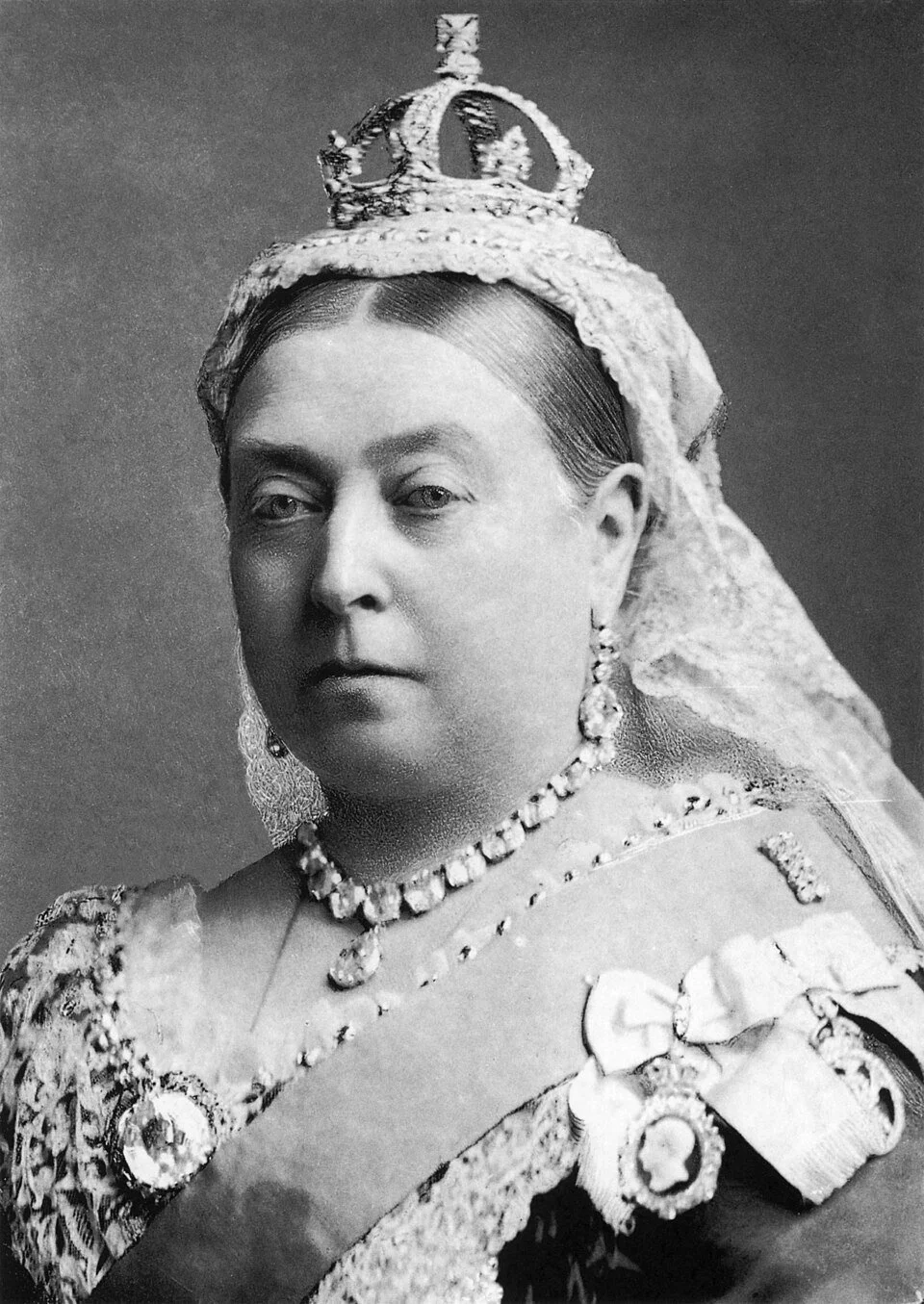
Queen Victoria by Alexander Bassano, 1882. Glass copy negative, half-plate. Source: Public domain, available here.
This article’s sponsor is EasyGenogram – a great tool that allows you to map out family trees and relationships. We highly recommend you give it a try – and you can even see one for Queen Victoria below!
Three of Queen Victoria’s nine children inherited a mutation in the gene responsible for producing a clotting factor in the blood.
Males who inherited it could not stop bleeding from even minor injuries. Females carried it silently, with no symptoms, and passed it to their own children. Victoria herself showed nothing, and neither did Prince Albert, her husband and first cousin. There was no history of the condition anywhere in her family.
Geneticists today believe the mutation arose spontaneously, either in Victoria's own embryonic development or through her father, Edward, Duke of Kent. However it began, what followed from it touched the internal lives of three royal courts over the next sixty years.
The three who carried it
Of Victoria's sons, only Leopold, Duke of Albany, was affected. He lived carefully and with frequent difficulty; a bruise that would heal in days for anyone else could leave him bedridden for weeks. He died at thirty from a brain haemorrhage after a fall.
Of her daughters, two carried the mutation without knowing it: Princess Alice and Princess Beatrice. A third daughter, Helena, and the eldest, Victoria, Princess Royal, apparently escaped it. Edward VII's descendants (the main British royal line) were clear.
The condition passed through Alice and Beatrice into the courts they married into.
Carrier lines from Victoria through Alice and Beatrice to the affected descendants in Russia, Spain, and Germany. Created using EasyGenogram.
Alice's line: Russia and Germany
Alice married Louis IV, Grand Duke of Hesse, and had seven children.
Two of her daughters were carriers.
Irene married Prince Henry of Prussia; two of their sons, Waldemar and Heinrich, were haemophiliacs.
The more consequential line ran through Alix, who became Tsarina Alexandra of Russia after her marriage to Nicholas II.
Their only son, Tsarevich Alexei, born in 1904, was the heir to the Romanov throne. He was also severely affected. Episodes of internal bleeding could last for days. The condition was concealed from the Russian public, as the succession of the empire could not be seen to rest on a child who might not survive to adulthood.
That secrecy created space for Grigori Rasputin, a Siberian mystic who appeared, through methods nobody could fully account for, to calm Alexei's bleeding crises. His influence over Alexandra, and through her, over court appointments and decisions, became a source of serious political instability in the years leading up to 1917.
Beatrice's line: Spain
Beatrice's daughter, Victoria Eugenie, married King Alfonso XIII of Spain in 1906.
Two of their sons, Alfonso, Prince of Asturias and Infante Gonzalo, inherited the condition.
Both died young from bleeding following minor accidents; Gonzalo died in 1934, Alfonso four years later in 1938.
What the science confirmed
For most of the twentieth century, historians assumed the royal condition was Haemophilia A, the more common form.
But in 2009, genetic researchers analysed the remains of the Romanov family and identified a mutation in the F9 gene, confirming it was Haemophilia B, the rarer type, sometimes called Christmas disease. The scientific question was settled more than ninety years after Alexei's death.
By then, the affected lines had mostly ended. The Spanish branch died out. The Russian branch was executed in 1918. The German branch had lost its last known carrier during the Second World War. The mutation that entered the historical record through one woman in the 1840s had run its course across four generations and three royal courts.
Let us know what you think about Queen Victoria below.
Sources
Wikipedia – Haemophilia in European royalty
Rogaev et al. (2009), Science – "Genotype Analysis Identifies the Cause of the 'Royal Disease'"
HemAware – "Why Is Haemophilia Called the Royal Disease?"
Hemophilia of Georgia – "The Royal Disease: A Family History Update on Queen Victoria"
unofficialroyalty.com – Royal Haemophilia Carriers
unofficialroyalty.com – Royal Haemophilia Sufferers in Queen Victoria’s Descendants