
In the decades following the Second World War, the European colonial order unraveled across Asia and Africa. Many territories transitioned to independence through political negotiation, constitutional reform, and international mediation. Yet some imperial withdrawals were bitter, prolonged, and extraordinarily violent. Few examples were as violent or politically explosive as French Algeria, with the war for independence spanning from 1954 to 1962.
Frankie Hayman explains.
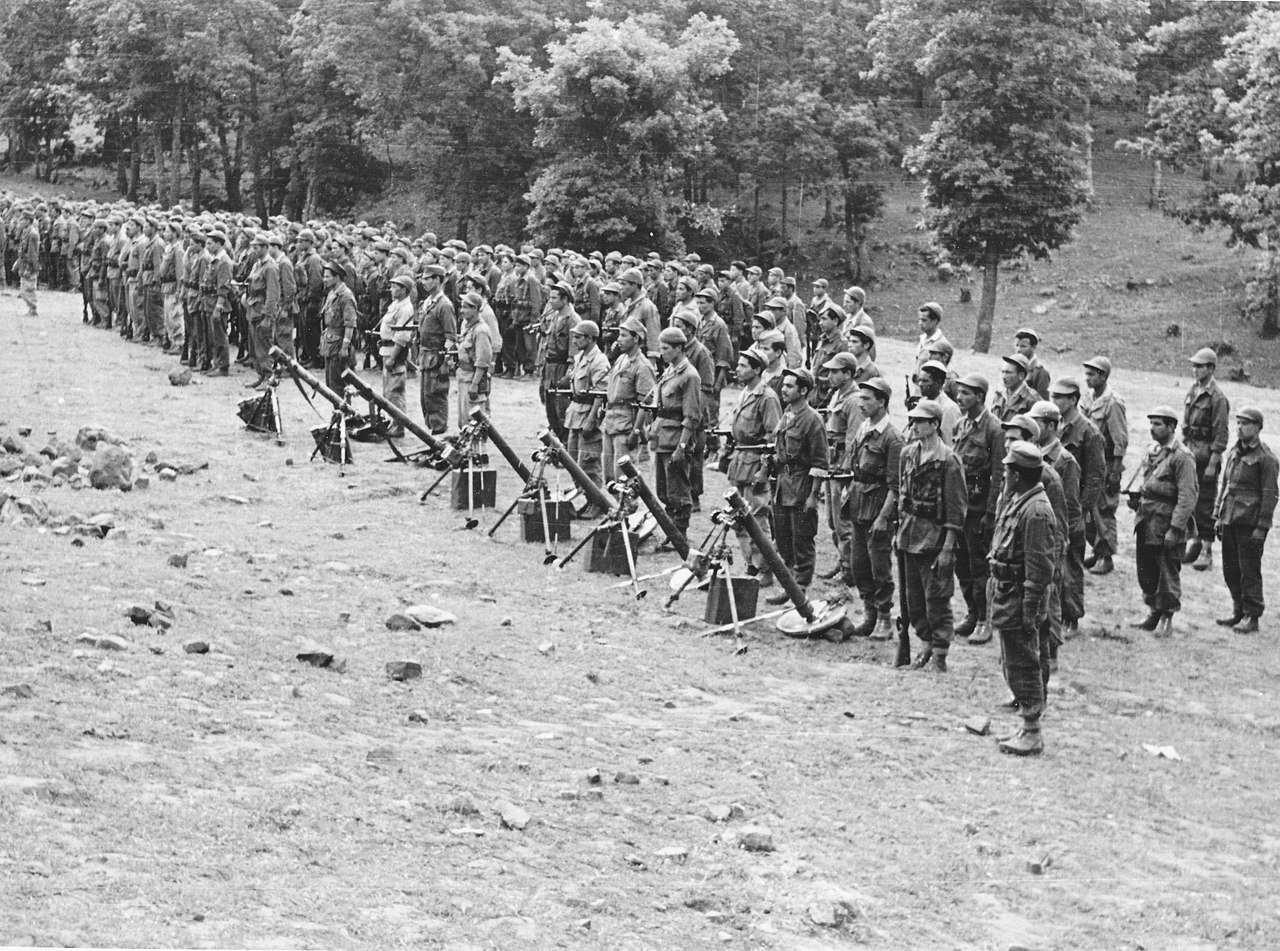
Soldiers of the Algerian National Liberation Army during the Algerian War of Independence. Source/attribution: Zdravko Pečar, available here. Creative Commons license 4.0 here.
During the 1950s, Algeria become the centre of one of the bloodiest struggles of decolonization in the twentieth century. What began as an anti-colonial revolt evolved into a brutal war marked by guerilla attacks, torture, terrorism, military repression, and deep political decisions both in Algeria and in France. By the war’s end, hundreds of thousands were dead, millions displaced, and the French political system fundamentally transformed.
The end of empire became marked by repression, insurgency, and extensive civilian suffering. Although all colonial governments confronted similar global pressures, rising anticolonial nationalism and economic strain, their colonial trajectories diverged sharply from relatively peaceful cases like the Gold Coast or Tunisia. So why did decolonization in French Algeria become so violent? Because Algeria had become so completely colonized that it made separation nearly impossible, it wasn’t treated as a colony but rather as an extension of France itself. Algeria had a large European population, nearly one million settlers known as Pieds-noirs, who lived alongside a much larger Muslim Algerian population that remained politically marginalized and economically disadvantaged, making peaceful reform extraordinarily difficult.
A Colony France Refused to See as a Colony
The violent trajectory of Algerian decolonization cannot be understood without its deeper colonial foundations. From the French conquest in 1830 onward, Algeria developed into a settler colony whose political, economic, and legal structures entrenched inequality long before 1945. French administrators promoted a vision of Algérie française (French Algeria) that treated the territory not as an overseas possession but as an extension of the metropole, culminating in its formal departmentalization in 1848. Yet this assimilationist rhetoric coexisted with a harshly discriminatory regime: Muslim Algerians were governed under the “Code de l’indigénat,” a system of special penalties and collective punishments that are the legal foundation of inequality in colonial Algeria.
In 1869, the initiative was taken in Algeria to try and endow a constitution that would “seek to reconcile the aspirations of the settlers with the interests of the natives” but it was unsuccessful. In Paris, many representatives saw the proposed “political liberties granted to the Muslims as injurious to the French population.” Land seizures further entrenched settler dominance; by the early twentieth century, European settlers controlled the most valuable agricultural land as well as key economic sectors. By 1930, on the centenary of the conquest, French officials openly celebrated Algeria as an irrevocable part of France, while Muslim political mobilization, led by reformers like Ferhat Abbas, was met with suspicion or repression.
These long-standing hierarchies meant that by the end of the Second World War, the basic conditions for a peaceful transition no longer existed: reforms would require dismantling the very social and political order on which settler rule depended. The roots of the Algerian War’s violence thus lay in the colony’s distinctive social and political structure. Unlike other French African territories, Algeria was legally part of France after 1848 and was home to nearly one million European settlers, “pieds-noirs,” who enjoyed full political rights. This demographic imbalance with Muslims and its racialized hierarchy meant that no constitutional reform could satisfy both settler demands for continued dominance and Algerian demands for equality or sovereignty. Settler political parties consistently obstructed reforms that threatened their control, creating a political deadlock by the late 1940s. Such conditions made peaceful decolonization nearly impossible.
Why Algeria Was Different
As Jan C Jensen and Jürgen Osterhammel argue in Decolonization: A Short History, treating French Algeria as a violent exception in the Maghreb, the region of North Africa comprising Morocco, Algeria and Tunisia, would be a mistake. Decolonization in this region, in their view, was interconnected, not three isolated processes. When the Algerian war began, it pushed the French to resolve Tunisia and Morocco more quickly so they could concentrate resources in Algeria, considered the most valuable and therefore the most important to the French empire.
After 1945, France attempted to integrate Algerians into a reformed imperial structure through new constitutions and limited political openings. Yet these reforms were either stalled or hollow. The 1947 Statute of Algeria established that all Algerians were French citizens and established the Algerian Assembly. But it created a dual electorate system that dramatically overrepresented Europeans and effectively ensured Muslim political marginalization. Elections became sites of systemic fraud. Meanwhile, nationalist parties like the MTLD (Movement for the Triumph of Democratic Freedoms) were repressed even as they tried to participate within the political framework. By the early 1950s, the reformist strategy had collapsed, convincing many Algerian nationalists that meaningful change could not be achieved peacefully.
The Turn to Armed Struggle
On 1 November 1954, the FLN (National Liberation Front) launched coordinated attacks across Algeria, inaugurating what became an eight-year war. The FLN demanded the “reestablishment of the sovereignty of the Algerian nation.” This decision did not arise in a vacuum. The FLN’s founders believed armed struggle was the only viable strategy after a decade of failed reforms, increasing police repression, and the massacre of thousands of Algerians at Sétif and Guelma in 1945. Early French responses such as mass arrests, collective punishment, and military reprisals further radicalized the conflict. Over time, the FLN built parallel political structures, mobilized international support, and deployed guerrilla tactics that challenged French sovereignty at its roots.
Counterinsurgency and Escalation
The French Army’s counterinsurgency strategy played a decisive role in intensifying the war. Determined to preserve Algeria at all costs, the army employed practices including torture, disappearances, aerial bombardment of rural areas, and mass internment. The Battle of Algiers in 1957 exemplified this logic: the army dismantled the FLN network in the capital through systematic torture and curfews, causing remarkable amounts of civilian suffering. These tactics produced short-term military success but catastrophic political consequences, delegitimizing France internationally and radicalizing Algerian resistance. Colonial violence generated revolutionary counter-violence, making escalation a nearly inevitable consequence. Mainland French public opinion was shocked to hear about the torture inflicted specifically on young women.
French military strategy during the Algerian War further escalated the conflict and contributed to its prolonged violence. As Terence G. Peterson demonstrates, the French Army adopted a revolutionary warfare doctrine, guerre révolutionnaire, developed by officers radicalized by their defeat in Indochina and shaped by Cold War anxieties. This doctrine treated the conflict not as a conventional colonial war but as a global struggle against communist influence, encouraging the French to adopt methods inspired by the Marxist insurgents they had fought, including psychological warfare, political re-education, and population control.
In practice, these strategies targeted the civilian population as much as FLN fighters, with the army seeking to “remake Frenchmen out of captured rebels.” Peterson argues that these measures were implemented broadly by 1957, particularly during the Battle of Algiers, transforming counterinsurgency into a comprehensive social and ideological campaign. By attempting to remold Algerian society itself, rather than merely suppress the rebellion, the French military heightened the stakes of the conflict, radicalized Algerian resistance, and contributed to the war’s enduring bloodiness. As the review notes, even the French Fifth Bureau, responsible for psychological operations, relied on propaganda to portray the effectiveness of these tactics, underscoring the pervasive, totalizing approach that made compromise nearly impossible and prolonged the struggle for independence.
The OAS and the Radicalization of Settler Politics
Cold War dynamics further entrenched French unwillingness to negotiate. French leaders feared that losing Algeria would embolden Soviet-aligned movements and undermine France’s global standing. The FLN skillfully internationalized the conflict, securing support at the UN and framing Algeria as part of a global struggle against Western imperialism. This heightened French anxieties and contributed to the radicalization of domestic politics, including army revolts and the rise of extremist settler groups like the OAS (Secret Armed Organization).
Such pressures ultimately aided in bringing down the Fourth Republic in 1958: “the great extent to which the French metropole itself became a theater for Algeria’s decolonization was demonstrated by the way the war accelerated the collapse of the Fourth Republic in 1958 and facilitated the creation of the Fifth Republic under Charles de Gaulle. Algeria became independent in July 1962.”
Ideology, Revolution, and Anti-Colonial Thought
Structural inequalities and military repression were not the only drivers of violence. The ideological and intellectual environment of the Algerian struggle also contributed to the intensity and duration of the conflict. Anti-colonial movements in Algeria were not only nationalist but also embedded within a broader Francophone revolutionary discourse that included Islamist thinkers. Influential Muslim figures such as Amar Ouzegane and Malek Bennabi framed the struggle against French rule not merely as a political or territorial contest but as part of a moral and civilizational battle, blending anti-imperial and religious imperatives.
This intellectual framing helped justify and sustain armed struggle, making compromise with the French authorities difficult ideologically. Moreover, the French state’s failure to meaningfully integrate Algerians politically after 1945, combined with the entrenched settler hierarchy, meant that these ideas found a receptive audience among a population increasingly convinced that violent resistance was the only path to sovereignty.
As Krais notes, figures like Malek Bennabi, an intellectual who lived and studied in French Algeria as well as spent time in France, “remained rather critical toward the political elite.” In this way he warned “against a pseudo-revolutionary leadership cult that, in his view, failed to eradicate the root causes of colonizability and, hence, to bring about a true revolution.” In this way, the ideological currents highlighted by Krais underscore how decolonization in Algeria became protracted and bloody: the struggle was reinforced not just by structural inequalities and repression, but also by a revolutionary vision that framed armed conflict as both morally necessary and historically legitimate. The polarization between the colonizers and the Algerian natives was increasingly hostile, as Todd Shephard notes, “To be male and pied noir was enough to be associated with fascist terror.”
Violence Built into the Colonial System
Todd Shepard’s interpretation reframes the Algerian War not simply as an anticolonial struggle but as a crisis of the French nation itself. He argues that the war forced France to redefine who was French and what the Republic meant. In his view, decolonization was “invented” as a narrative only after the war, allowing the French to forget that Algeria had once been fully part of France and that millions of Algerians had possessed French citizenship. This forgetting, combined with de Gaulle’s strengthening of executive power, amounted to a political “counterrevolution” that reshaped French identity, civil liberties, and the meaning of republican legitimacy. The end of empire was thus not only violent on the ground but transformative at the heart of French politics.
The Algerian War was not an accidental descent into brutality but the culmination of a colonial system whose political architecture made violence structurally inevitable. By the mid-twentieth century, France’s project in Algeria was brittle: it combined an assimilationist fantasy with entrenched settler privilege, a universalist republican rhetoric with legalized racial hierarchy, and promises of reform with the sustained repression of Muslim political mobilization.
Ultimately, the Algerian case demonstrates that colonial violence is not an aberration but a likely outcome of a system that requires coercion to sustain political inequality. When that system confronted civic unrest, mass mobilization, international scrutiny, and its own internal contradictions, it collapsed explosively rather than peacefully. Understanding why Algeria’s decolonization was so violent therefore requires moving beyond narrow military or diplomatic explanations to recognize how deeply colonial rule permeated law, land, and political identity.
Now, read about the links between the Algerian War and the Israel-Palestine conflict here.
And if you enjoy the site, join us and get a free introductory book to the Cold War here.
References
Ageron, Charles Robert, and Michael Brett. Modern Algeria: A History from 1830 to the Present. 1st American ed. Trenton, N.J: Africa World Press, 1991.
Jansen, Jan C, and Jürgen Osterhammel. Decolonization: A Short History. Edited by Jürgen Osterhammel. 1st ed. Princeton: Princeton University Press, 2017. https://doi.org/10.1515/9781400884889.
Shepard, Todd. The Invention of Decolonization: The Algerian War and the Remaking of France. 1st print., Cornell paperbacks. Ithaca, N.Y: Cornell University Press, 2008.
Krais, Jakob. “The French Connection: Political Islam from the Algerian War to the Iranian Revolution.” Middle Eastern Studies 58, no. 1 (2022): 214–28. https://doi.org/10.1080/00263206.2021.1937999.
Cooney, Cian. “Revolutionary Warfare: How the Algerian War Made Modern Counterinsurgency. By Terrence G. Peterson.” Journal of Social History, 2025. https://doi.org/10.1093/jsh/shaf093.

.jpg)