The Avignon Papacy (1309-1376) was the period during which seven successive popes resided at Avignon, in modern-day southern France, rather than at Rome. It followed a bitter conflict between the papacy and King Philip IV of France, and the death of Pope Boniface VIII in 1303 marked a decisive shift in the balance of power within the Church. Talia Bega explains — and looks at the problems with the Church in the 13th century.
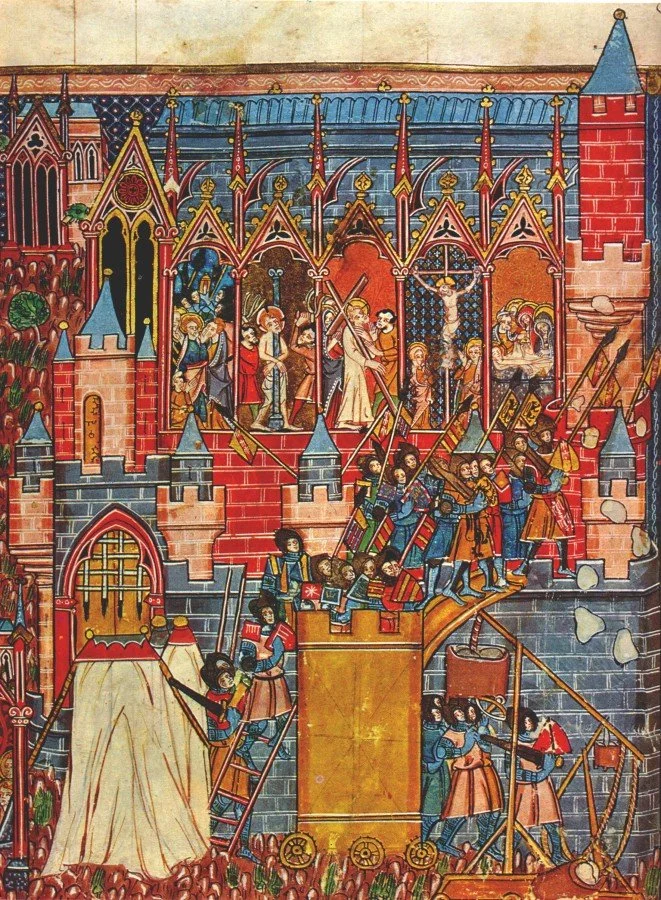
Siege of Jerusalem during the First Crusade. Source: Public domain, Guillaume de Tyr, Historia, BNF ms FR 352 fol. 62, available here.

What was the Church at the Time?

In the Middle Ages the papacy stood at the summit of the Church's hierarchy and wielded an authority that reached deep into government. At a time when Europe's kings were steadily consolidating their power, the Church acted as a check on their ambitions whenever their aims collided with its teaching. Its canon law touched even the conduct of war and the ordinary business of governing. Based in Rome, the pope held the ancient title of Pontifex Maximus, or high priest, and claimed spiritual authority over all Catholics, from questions of law to matters of leadership. After the East-West Schism of 1054 divided the Eastern and Western churches, Catholicism remained the dominant faith of western Europe; but over the following centuries - and especially through the Crusades (1095-1291) - much of the initiative gradually passed to the increasingly centralized kingdoms (Leff 1961, 37). The pope's word carried immense weight, and a ruler who defied it risked excommunication - in effect, banishment from the Church.

Yet monarchs chafed at papal oversight of their every act, and above all at the principle that a war could not lawfully be waged without the Church's sanction (Leff 1961, 37). In France, and especially during the Crusades, the papacy served as a counterweight between throne and altar (Howe 1988, 331). Under pious kings such as Louis IX, personal devotion and asceticism became a way of demonstrating the strength of the faith and of leading his people by example. The thirteenth century, however, brought mounting conflict - the horrors of the later Crusades and the rising power of the Holy Roman Empire - that would challenge the Church anew.

The Crusades grew out of a single pressing question: how could Christendom regain access to the Holy Land - and above all Jerusalem, the site of Christ's crucifixion and resurrection - after these territories passed into Muslim hands?

The First Crusade was a startling success. Preached by Pope Urban II at the Council of Clermont in 1095 as an armed pilgrimage to Jerusalem, it culminated in the capture of the city in 1099 and the founding of the Kingdom of Jerusalem, alongside a cluster of other Crusader states such as the County of Edessa, the Principality of Antioch, and the County of Tripoli. The kingdom had its own Latin patriarch at the head of its church and drew nobles from across Europe to defend it, becoming for a time a stronghold of Latin Christian authority in the East - though rivalries among kingdoms such as France and England limited what it could achieve. Its ascendancy did not last: in 1187 Jerusalem fell to Saladin, and the struggle to recover it would consume the Church for generations, even as the kingdom's own nobility fractured into infighting.

At the start of the thirteenth century Pope Innocent III launched the Fourth Crusade. It became a notorious debacle: instead of striking at Egypt, the Crusaders turned on the Christian Byzantine Empire and sacked its capital, Constantinople, in 1204 (Queller 1974, 461), establishing the Latin Empire that endured until 1261 (Madden 2012, 313). That Christians had made war on fellow Christians appalled contemporaries and drew excommunications, and the campaign left the Church more heavily indebted and secular rulers more powerful over the conquered lands (Madden 2012, 317). Later Crusades fared little better - most disastrously the Seventh, led by Louis IX of France, who was taken captive in Egypt.

The Crusades left a deep mark on the Church, forcing hard questions about how it was to survive and sustain itself. Powerful kingdoms - France, England, and the Holy Roman Empire among them - increasingly cast themselves as its champions, and their rulers cultivated close ties to the Church in order to enlarge their own influence (Queller 1974, 459). Nowhere was that ambition sharper than in the second great pressure on the papacy: the Holy Roman Empire, which seized whatever advantage it could.


The Holy Roman Empire

The Holy Roman Empire did not spring directly from the fall of Rome in 476; it took shape centuries later, conventionally dated to the coronation of Charlemagne in 800 and refounded under Otto I in 962. Centered on Germany but reaching into Burgundy and much of Italy, it cast its rulers as heirs to Rome - indeed as kings of the Romans - and their imperial coronations traditionally took place in Rome, in echo of Charlemagne's. Throughout the Middle Ages these emperors clashed repeatedly with the Church, above all over their claims in Italy. One of the most troublesome was Frederick Barbarossa, whose long series of campaigns in northern Italy - against the cities of the Lombard League and the popes who backed them - brought him into open conflict with Rome. His dynasty's grip on Sicily came only later, through the marriage of his son, the future Henry VI, to the Norman heiress Constance.

Barbarossa's defiance made him one of the first emperors to provoke a serious rupture with the Church, and the contest over imperial authority in Italy carried on into the thirteenth century. Again and again, he sought to extend his power, and again and again he met resistance on every side; only after years of conflict - and a public reconciliation with Pope Alexander III at the 1177 Peace of Venice - was an uneasy peace restored.

Tensions sharpened further with the capture of Richard the Lionheart, seized in December 1192 by Duke Leopold V of Austria as he made his way home from the Third Crusade and handed the following year to Emperor Henry VI, who held the English king for a vast ransom - a striking assertion of imperial power over a fellow monarch, and one the Church condemned. A generation later another formidable emperor, Frederick II, held the crowns of both Sicily and - through his marriage to Isabella II (Yolande) of Jerusalem - the Kingdom of Jerusalem, and was determined to press his authority in the Holy Land. He was excommunicated by Pope Gregory IX in 1227 for repeatedly delaying the crusade he had vowed to lead, and again in 1239 as the breach between emperor and papacy widened (Bird 2022, 87). Frederick's hunger for territory, above all Sicily and southern Italy, which he claimed as the Norman heir, made a collision with the Church all but inevitable, for the papacy was equally unwilling to surrender its authority over the empire (Powell 1963, 493). Significant tension resumed after Innocent IV became pope in 1243, and at the First Council of Lyon in 1245 the pope issued the bull Ad apostolicae dignitatis apicem, which declared Frederick deposed and unworthy to rule and released his subjects from their allegiance (Powell 1963, 490). The sentence changed little on the ground: Frederick fought on, campaigning in Lombardy until his death in 1250.

Such pressure was precisely what the papacy could least afford. Hemmed in on every side, how was it to grow, let alone hold its ground? Sicily remained a source of friction for decades after Frederick's death, and arguably taught later kings that the Church could be defied with impunity. The signs of weakness were unmistakable, not least the papacy's dwindling ability to field armies of its own. These pressures - among many others, from chronic shortages of money to the loss of territory - helped pave the road to Avignon, especially once ambitious monarchs such as Philip IV set out to bend the Church to their will (Leff 1961, 38). The Crusades stand as a vivid example of the damage done across Europe, and of the lessons learned, from the raising of armies to the question of whom to trust. Central as the Church had been, by 1309 it had passed effectively into French hands - a shift that would reshape its diplomacy and, in the eyes of many, shatter its old authority.


The Church on the eve of Avignon

Why dwell on the Crusades and the Holy Roman Empire before turning to Avignon? Together they acted as a catalyst for the decline of a once-dominant Church, exposing the corruption - the bribery and the diplomatic blunders - that ran through the crusading effort and the long struggle with the empire. They also reveal a pattern about power: rulers like Philip IV were now ready to exploit the popes. When Philip sought funds for his campaigns early in the fourteenth century, Boniface VIII refused him - a confrontation that ended in the pope's downfall and, a few years later, in the suppression of the Knights Templar (Théry 2013, 120). Philip, like Frederick before him, saw a Church at its weakest and moved to remake it to his advantage.

The Crusades are the clearest evidence of the strain the Church faced entering the fourteenth century: the Holy Land had been lost for good, and Europe now had to hold together simply to keep the Church intact. The Avignon Papacy that began in 1309 gathered a succession of French popes who governed from Avignon and sought a more centralized authority. Some seventy years on, the papacy would fracture in the Western Schism, when rival claimants - two, and eventually three - split Latin Christendom. The pattern rhymes with what came before; but to understand how matters reached a head in 1309, we must first trace the long road that led there.


Now read about the War of the Breton Succession here.


References

BIRD, JESSALYNN LEA. “PROPHECY, ESCHATOLOGY, GLOBAL NETWORKS, AND THE        

CRUSADES, FROM HATTIN TO FREDERICK II.” Traditio 77 (2022): 31–106. https://www.jstor.org/stable/27191187.

Howe, John. “The Nobility’s Reform of the Medieval Church.” The American Historical Review 93, no. 2 (1988): 317–39. https://doi.org/10.2307/1859921.

Leff, Gordon. “Heresy and the Decline of the Medieval Church.” Past & Present, no. 20 (1961): 36–51. http://www.jstor.org/stable/650135.

Madden, Thomas F. “The Venetian Version of the Fourth Crusade: Memory and the Conquest of Constantinople in Medieval Venice.” Speculum 87, no. 2 (2012): 311–44. http://www.jstor.org/stable/23488041.

Powell, James M. “Frederick II and the Church: A Revisionist View.” The Catholic Historical Review 48, no. 4 (1963): 487–97. http://www.jstor.org/stable/25017141.

Queller, Donald E., Thomas K. Compton, and Donald A. Campbell. “The Fourth Crusade: The Neglected Majority.” Speculum 49, no. 3 (1974): 441–65. https://doi.org/10.2307/2851751.

Théry, Julien . “A Heresy of State: Philip the Fair, the Trial of the ‘Perfidious Templars,’ and the Pontificalization of the French Monarchy.” Journal of Medieval Religious Cultures 39, no. 2 (2013): 117–48. https://doi.org/10.5325/jmedirelicult.39.2.0117.

Posted
AuthorHistory Is Now Magazine
CategoriesBlog Post

The Prussian Crusades were full of thirteenth century intrigue and drama. Here, Robert Van Ness follows up his article on Prussia’s early beginnings and tells us the story…


The Teutonic Knights wasted little time once they began establishing themselves in the unstable Baltic region. They came to crusade against the native Prussian pagans, who had a centuries-long history of proving themselves to be unruly, as well being unaccepting of Catholicism. The native Prussians also seemed untrustworthy of anything coming out of the west, and for good reason. Rome had sent envoys to the area, the Danish had sent armies, and the Poles had signaled intent to take lands for themselves. Each instance involved some degree of bloodshed and/or corruption. The Teutonic arrival, in Prussian eyes, would be no different. The Prussians were correct.

After initial wrangling over territorial disputes, Grandmaster Hermann von Salza sent 7 Teutonic Knights and about 100 lesser troops to take Vogelsang in Masovia. A castle had been attempted in the area a year before, in 1229, but the Prussians massacred the builders. After the Teutons arrived, however, the Prussians could not reverse their negative fortunes. The small army established a foothold, and then they completed the attempted castle. A year later a fresh force of 200 arrived to reinforce the Teutonic claim. Though this action may seem innocuous in the grand scheme, it did signal the beginning of the Teutonic Crusades, and thus a great historical shift in Prussian livelihood, that, when the Crusades were completed would set events in motion. When those Crusades were finished, events were set in motion that would affect Central and Eastern Europe for centuries.


The Beginnings

The Teutonic Order began conducting yearly campaigns into the region after their first venture in 1230. These raids represented a historical shift in that they were coming predominately from the west, out of the Holy Roman Empire, instead of out of the east from Polish or Russian lands. Promises from the Pope and Holy Roman Emperor spurred many Germans to emigrate into the newly conquered lands. This occurrence, accompanied with the consistent, yearly campaigns, ensured success, where every earlier attempt met with failure. Further Teutonic success ensured that the Prussian region would become German.

Normal
0


false
false
false

EN-US
JA
X-NONE


 <w:LatentStyles DefLockedState="false" DefUnhideWhenUsed="true"
DefSemiHidden="true" DefQFormat="false" DefPriority="99"
LatentStyleCount="276">
<…

A map of the tribes encountered by the Teutonic Knights during their Prussian Crusades.

Within two years, the Crusaders were warring against Pomesania. A bit of chance aided the Knights when a Prussian commander defected to the Teutons. He helped steer the Crusaders through Prussian defenses toward the main castle at Rogow. Rogow was no match for the attackers, and once it fell, neither were the other area defenses. Thorn was captured, and then the Pomesanian king, Pepin, was tricked into being surrounded. Pope Gregory IX quickly sent 5,000 immigrants to reinforce the Teutonic conquest during the next year, as the Knights continued their Crusade eastward.

1233 witnessed the largest army to march into the region up to that time. A 10,000 strong crusading army was led by the Knights into the remaining Pomesanian regions. They built a fortress at Marienwerder, from which the powerful army launched various attacks against the Pogesanians, who offered a rather stiff resistance. Yet Teutonic cavalry galloped into the fray during a battle along the frozen Sirgune River, and the Pogesanian front disintegrated. Another Teutonic fortress was quickly built at Rehden to ensure Crusading dominance over the newly subjugated lands.


Growing Pains

These successes, oddly, caused a breech between the Teutons and her allies, most notably Konrad of Masovia, in 1235. Konrad claimed land that was not to be given to him, and the Knights refused to cede the disputed lands to him. Eventually Konrad pulled out of any future crusades, while the Teutons began acquiring the remaining faltering knightly orders in the Baltic, such as the Sword Brothers, who were all but decimated by the Livonians further north of Teutonic claims.

A new ally, Henry III, Margrave of Meissen, arrived to aid the Teutons as they marched along the Vistula River in present day Poland. The newly established immigrant towns also supplied ample support, which allowed the Crusaders the freedom to push further into pagan lands. The Teutons hammered the Bartians, Natangians, and Warmians in successive engagements between the campaigning years 1238 and 1240. 

The attack against the Warmians is of special note, because the Warmians slaughtered a Teutonic outfit, which spurred an even larger crusading force onward against the pagan defenders. When the pagan commander, Kodrune, realized that holding out against the numerically superior force was hopeless, he begged his army to surrender and convert. The Warmians would hear none of it, and killed Kodrune before they were, as Kodrune presciently understood would happen, destroyed.

Teutonic successes brought more Papal recognition in 1243. The newly conquered lands were demarcated across four new provinces - Culm, Pomesania, Ermeland, and Samland. What had once not been Germanic lands were now being inhabited by droves immigrating eastward out of the Holy Roman Empire. But the region was not yet pacified. In fact, the gains made during the initial Teutonic Crusades were threatened by a resurgent Prussian uprising beginning in 1242.


First Prussian Rebellion

A former Teutonic ally, Duke Swantopelk of Pomerellia, was spooked by the rapid crusading gains. Swantopelk then switched allegiances, and began funding, supplying, and training the Prussians against the Knights in 1242. The Teutons also found themselves without their Polish allies in the rebellion, because the Poles were warring with each other over domestic issues. 

For two years the Prussians dragged the Teutons into wooded battles, where the heavier armored knights could not maneuver as easily. Defeat followed defeat for the Teutons, but the Prussians lacked engineering skills needed to erect proper siege-works in order to destroy the many Teutonic fortresses now dominating the countryside. Thus a seeming impasse was reached in 1244, which for the most part lasted until 1249. That is until the Germans used another weapon, politics.

German connections swayed Swantopelk away from the Prussians once again. The new Pope, Urban IV, entered diplomatic wrangling, as did the Polish princes, who wanted to take Swantopelk's land. Swantopelk found himself unable to continue the Prussian resurgence, and was forced to switch allegiances once again. Regardless of the change, the Prussians still won further battles after Swantopelk's defection, but by 1253, the Teutons were once again in control, and they could resume their crusade against the Samland region.


The Crusades Resume against Sambia

Their work was not yet complete in the 1250s; in fact, quite a few more campaigns would be undertaken before the Prussian lands were declared ‘Christianized’, but the seeds of future hatreds were brutally sewn during this period. Notably the Germans, who were not native to the region began dominating the Poles and Slavs, who did claim the Baltic lands as ancestral. In order for the early German settlers to make what was later called Lebensraum the pagan, or less-than-civilized, would have to either convert or die. To that end, the Crusades continued in 1252.

The Sambian peoples had not yet been pacified. A new army led by Heinrich Stango aimed to pierce directly through Samland, but was met head on by formidable resistance at Vistula Lagoon. The Sambians routed the Knights, killed Stango, and awaited a Crusading response. The response came in the form of a concerted Dominican effort to raise a massive army for the time, 60,000 men. The enormous army of Bohemians, Saxons, Moravians, and Austrians met the Sambians at the Battle of Rudau. The defenders stood little chance under such an enormous army. The main Sambian army surrendered, and was hastily baptized. The Crusaders then continued to march into Sambian territory, and either baptized or killed inhabitants along the way to conquering the region by January 1255. As normal Teutonic procedure dictated, a series of fortresses were constructed to ensure Teutonic overlordship. Thus fortresses at Memel, Konigsberg, and Wehlau still exist, reminding the onlookers of the hard-fought era.

The remains of St. Jacob’s Tower in Wehlau (Znamensk).

The remains of St. Jacob’s Tower in Wehlau (Znamensk).

The Prussian Crusades Wind Down

The Prussians, however, had one more trick to play. The Livonian branch of the Order continued to reach northeastward into Samogitia, and had some early success. A cease-fire of sorts was signed to end the fighting for two years, but when that treaty ended in 1259, the Samogitians rebelled. They crushed the Crusaders at Skuodas, which sent shockwaves throughout the pagan region. Other Prussians rallied around the Samogitian victory and also rebelled. Together they ran roughshod throughout the largely unguarded regions of Livonia, Poland, and Prussia, because the Knights were mostly away fighting in the Holy Land during this time. After a year of turmoil the Holy Roman Empire concocted an army to assist the remaining Knights in their effort to quell the uprising, and by 1261 the pagans were being unconditionally beaten. Previously subjugated Prussians had enjoyed considerable surrender terms, but the Knights forced the rebels into total serfdom after this uprising. Once again, to ensure control, the Knights dotted the landscape with more fortresses.

The Knights, and Germanic immigrants into the region, were now certain masters of Prussia and the lower Baltic region. All that remained were a few lesser tribes, who still repudiated Catholicism. Minor battles and small uprisings continued to occur for the next 20 years, but nothing could break the increasingly powerful grip the Teutonic Knights held on Prussia. It was theirs, and would be engineered along Holy Roman designs, and the Knights would use their newly won kingdom to launch other crusades deeper into northeastern Europe. Their involvement redrew, and would redraw European boundaries for future generations with painful side effects as will be seen in subsequent posts.


Now, share the article if you enjoyed it! Like it, share it, or tweet about it by clicking on one of the buttons below!

Posted
AuthorHistory Is Now Magazine
CategoriesBlog Post

Many reasons and paths led to the outbreak of World War One. One of these paths was the growth of Prussia, the state that became the most important part of Germany. In this article, Robert Van Ness tells us of Prussia’s role in the Crusades.


The Great War, perhaps better known today as World War One, turns 100 this year. It has been overshadowed for some by events happening after 1918, which is understandable. Yet a travesty all too often occurs when history teachers or students skip over this watershed historical moment in favor of studying World War Two or events thereafter. World War One was a beginning and ending at the same time. It was a culmination point of nineteenth century nationalistic idealism, but by 1918 that nationalist pride had been all but shattered. Indeed, World War Two would put the final nails in the nineteenth century’s coffin, but World War One created the coffin, and put the corpse therein. How did such a war come about? By 1914, man was supposed to be in a belle epoque, a time when war was unthinkable, especially in highly civilized Europe. But that’s just where the war was centered. Many theories have been postulated such as anti-god philosophies, imperialist expansion, economic blunders, and arms races. None of those theories are wrong, but when any of those theories stand alone, they miss the broader spectrum. This article cannot paint the entire picture alone, but it would like to trace events leading up to June 1914 through one of the major players, Prussia.

Prussia by 1914 was wholly incorporated into the Second German Reich (Empire). Its rise to power was nothing short of breathtaking considering the relatively short period in which the province rose from nothing to world power. And this rise can be traced back to the Crusades.

Normal
0


false
false
false

EN-US
JA
X-NONE


 <w:LatentStyles DefLockedState="false" DefUnhideWhenUsed="true"
DefSemiHidden="true" DefQFormat="false" DefPriority="99"
LatentStyleCount="276">
…

Pope Honorius III.

THE CRUSADES

Prussia’s fight for existence actually begins in part with the Catholic Crusades. Many Germans answered the Pope’s call for a Holy Land adventure in which killing infidels was favorably viewed by God. Germany during this era was part of the Holy Roman Empire, thus when God’s man came calling for help, loyal soldiers came willing to serve. Many knightly orders were founded in the Holy Land such as the Hospitallers and Templars. Their goals included protecting pilgrims, offering medical care, and establishing Christian states. The Teutonic Order, though small, was one of the most important orders in accomplishing these many ambitions.

The Ordo Domus Sanctae Mariae Theutonicorum Hierosolymitanorum was established around 1190 in Acre, one of the main crusading kingdoms, but their time in Acre was quite short lived. After controlling import/export tolls for the region for about 20 years, the Teutonic Knights, as well as other Crusaders, were pushed out of the region by a stern Islamic backlash. The Teutons fled mostly to Transylvania, where they were invited by King Andrew II. While there, the Knights participated in campaigns against the Cumans. The Knights, however, began organizing plans to establish a state of their own.


IN HUNGARY

Hungarian King Andrew II would not tolerate such a force in his lands unless it obeyed him. The Knights stated that their cause was a Christian cause, not solely Hungarian. That being the case, they refused to submit to Andrew, who foolishly expelled his greatest fighting force. Invading Islamic armies would soon overrun a rather hapless Hungary, and remain close by for about 400 years. The Teutons, though, were invited to invade a here-to-for ‘pagan’ region by Pope Honorius III, Emperor Frederick II, and Duke Konrad I of Masovia.

The Golden Bull of Rimini, issued by Frederick II, formally established set lands for the Order at Culm (Chelmo). The Knights simply had to wage war against the pagan inhabitants and win. Many Imperial and Church officials signed the Bull, including Konrad, who churlishly attempted to take the promised lands for himself. His actions almost undid the entire operation, and even threatened to destroy his very own Imperial Duchy of Masovia.

Emperor Frederick II called for Teutonic Crusades into the Baltic.

Emperor Frederick II called for Teutonic Crusades into the Baltic.

Amid such instability, the Teutonic Knights made light work of the campaign. By 1230, after four years of fighting, the Teutonic Knights forced Konrad into signing the Treaty of Kruszwica. Grand Master Hermann von Salza then assumed control of Chelmo and all lands won during the Prussian Campaign. Four years later Pope Gregory IX sent out the Golden Bull of Rieti, restating the order’s claims that they were subject only to the Pope. Thus the newly established Prussian kingdom was subject to no one but God, and the region became a province of the Holy Roman Empire.

The Teutonic Knights organized their new lands into a monastic state soon after the lands were secured. As such a state, the Teutonic purpose was to stage crusades into pagan northeastern European lands such as Estonia, Latvia, Lithuania, Russia, and Poland.

To further aid the cause, the Knights brought the Order of Dobrzyn and the Livonian Brothers of the Sword under their sway. Both groups had been unsuccessfully crusading against the pagans for decades. Their inclusion into the Teutonic state added considerable lands along the Baltic coast, thus ensuring Teutonic, and later Prussian, conflict with Poland and Russia for centuries to come.

Much work was done during this period. The Knights drew from their Germanic homelands, and an influx of German immigrants from all over the Holy Roman Empire migrated into rapidly fortifying cities all along the region’s rivers and Baltic coastline. Together, the immigrants and Knights irrigated the swamplands, built new cities, and began forging a solid, productive state in what was a foreign, unwelcoming land.

These medieval Germans laid the foundation for modern Prussia and Germany. What they did not know at the time was that they were doing much more than that. They were also laying the foundation for future wars including World Wars One and Two.  But to get to that point one must walk through the events leading to the Great War of 1914 - of which Prussia played a huge part.


Did you find this article interesting? If so, tell the world! Like it, tweet about it, or share it by clicking on one of the buttons below.

Posted
AuthorHistory Is Now Magazine
CategoriesBlog Post