In the year 1066, England stood at the edge of one of the most consequential transformations in its history. It was not an impoverished or primitive kingdom waiting to be rescued by a more advanced civilization. On the contrary, England was wealthy, organized and politically sophisticated, with an established legal system, an effective administration, a powerful Church and a highly developed network of towns and markets. Yet within a single year, the kingdom would be invaded from abroad, its king killed, its ruling aristocracy devastated and its political order overturned. By Christmas 1066, England had a Norman king. The Anglo-Saxon kingdom that had developed over centuries had entered a new and turbulent age.
Terry Bailey explains.
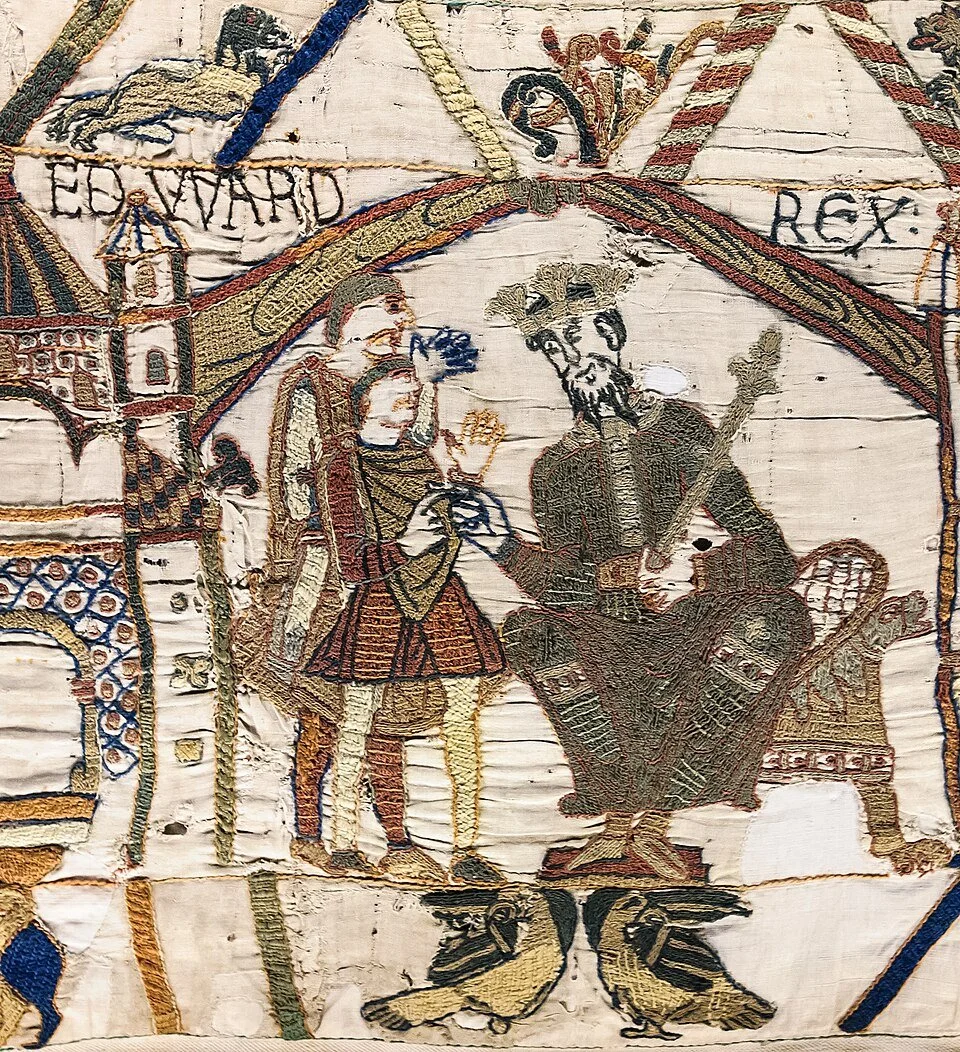
Edward the Confessor being crowned,, opening scene of the Bayeux Tapestry. Source: Public domain, Bayeux Tapestry Museum, available here.
The story of the Norman Conquest, however, did not begin on the battlefield at Hastings. Its origins lay in the complicated political circumstances of the decades before 1066, and particularly in the problem of who should succeed King Edward the Confessor. Edward's death did not simply leave an empty throne. It exposed competing interpretations of inheritance, promises allegedly made years earlier, political alliances, family connections and ambitions extending far beyond England's shores. Three men in particular would eventually claim the crown, while a fourth represented a potentially significant English alternative.
To understand why England became vulnerable to conquest, it is first necessary to understand the kingdom that Edward ruled. By the eleventh century, England was one of the most unified political entities in western Europe. Although its origins lay in the numerous Anglo-Saxon kingdoms that had emerged following the end of Roman Britain, centuries of warfare and political consolidation had gradually produced a single English kingdom. Kings such as Alfred the Great and his successors had strengthened royal authority, while the expansion of Wessex had brought increasing portions of England under one dynasty.
The result was a kingdom that possessed something particularly valuable in medieval Europe: political unity. England was not a loose collection of independent territories. The king stood at the center of government, law and taxation, while powerful regional aristocrats exercised authority beneath him. The system was far from modern, but it was capable of mobilizing considerable resources. Royal officials administered justice, collected revenues and supervised local government, while the kingdom's network of shires provided an effective framework through which royal authority could reach deep into the countryside.
At the heart of this system were the shires and their subdivisions, the hundreds. The shire-reeve, or sheriff, acted as an important representative of royal authority, overseeing administration, taxation and aspects of law enforcement. Local courts dealt with disputes and offences, while written records and royal charters provided a degree of administrative sophistication unusual for the period. England also possessed a remarkably developed monetary economy, with coinage produced at numerous mints and taxes collected across the kingdom.
This organization mattered enormously in 1066. England was wealthy enough to support a substantial military establishment and an elaborate system of government, but that wealth also made it an attractive prize. A successful conqueror would not merely acquire land. He would inherit a kingdom capable of generating considerable revenue through taxation, trade, agricultural production and landholding. Whoever controlled England could command one of the richest kingdoms in northern Europe.
English society was dominated by a hierarchy of land and loyalty. At the summit stood the king, followed by the great earls who controlled vast territories and commanded considerable political and military influence. Beneath them were the thegns, an important class of landholding aristocrats and royal servants. Thegns could possess substantial estates, hold positions of authority and provide military service to the king or their regional lord. Below this elite was the much larger population of farmers, laborers, craftsmen and other inhabitants whose work sustained the kingdom's economy.
Military service was closely connected to this social structure. England possessed the fyrd, a system through which free men could be called upon for military service. The fyrd was not a permanent professional army in the modern sense. Instead, the king could summon men from the various districts of the kingdom when military necessity demanded it. Alongside the fyrd were the king's more experienced household warriors, particularly the elite huscarls who served powerful lords and were equipped for sustained campaigning.
The English military system was formidable when properly mobilized. The shield wall, in which heavily armed infantry stood closely together with overlapping shields, could present an extraordinarily difficult obstacle to an attacking army. Yet the system also had limitations. The fyrd depended upon men leaving their farms and communities, meaning that prolonged campaigns could be economically disruptive. Furthermore, England's military strength depended heavily upon the ability of the king to mobilize forces quickly enough to meet an invasion.
The Church was equally important to the organization of Anglo-Saxon England. Christianity had become deeply embedded within English society, and bishops and abbots were not merely religious figures. The Church was a major landowner, an important center of learning and an essential component of government. Monasteries and ecclesiastical institutions preserved manuscripts, educated clerics and maintained traditions of literacy. Royal charters were produced by literate officials, while churchmen could serve as advisers and diplomats.
King Edward the Confessor occupied the center of this world. He had become king in 1042 following the death of his half-brother Harthacnut, restoring the old West Saxon royal dynasty after the Danish rule associated with Cnut and his successors. Edward was deeply religious and would later become celebrated as a saint, but his reign was also dominated by the political realities of aristocratic power.
Edward had spent much of his youth in Normandy, and his long association with the Norman court would later become one of the most controversial aspects of the succession crisis. He married Edith, daughter of the powerful Earl Godwin of Wessex, but their marriage produced no surviving children. Consequently, the question of who would succeed Edward became increasingly important as the king grew older.
The absence of a direct heir created a dangerous political vacuum. Medieval succession was not governed by a simple, universally accepted rule that automatically transferred the crown to the nearest male relative. Blood relationship mattered enormously, but so did political support, previous promises, oaths, royal designation and the ability to command the allegiance of the kingdom's leading men. In 1066, these factors would collide with devastating consequences.
The most powerful English family during Edward's later reign was undoubtedly the Godwin family. Earl Godwin had risen from relatively modest origins to become one of the most influential men in England. His influence expanded through political alliances and marriage, and his children became deeply embedded within the ruling elite. His sons included Harold, Tostig, Gyrth, Leofwine and Wulfnoth, while his daughter Edith became Edward's queen.
Harold Godwinson emerged as the most powerful of Godwin's sons. He inherited the earldom of Wessex after his father's death and gradually became one of the king's principal political and military commanders. Harold was not merely a wealthy aristocrat. He possessed military experience, extensive connections throughout England and relationships with many of the kingdom's most important nobles. By the beginning of 1066, he was arguably the most powerful man in England after the king himself.
This produced an obvious tension. Edward was king, but Harold's influence was immense. If Edward died without a son, Harold possessed many of the qualities required to become king: English political support, military experience, wealth, aristocratic connections and proximity to the center of government. Yet there were other men who believed the crown belonged to them.
Across the English Channel, William, Duke of Normandy, claimed that Edward had promised him the English crown. William was a distant relative of Edward through the king's mother, Emma of Normandy, and his claim rested heavily upon the assertion that Edward had designated him as his successor. William also maintained that Harold had personally sworn an oath supporting William's claim.
The alleged oath became central to William's case. According to Norman accounts, Harold had travelled to Normandy before Edward's death and had sworn to support William's succession. The precise circumstances remain disputed, and the surviving sources were written after the Norman victory, meaning they cannot simply be accepted without question. Nevertheless, William regarded the matter as settled. From his perspective, Harold had not merely become king unlawfully; he had broken a solemn oath.
There was another formidable claimant in the north. Harald Hardrada, King of Norway, was a legendary warrior and one of the most formidable military commanders of his generation. His claim to England was connected to the complicated succession arrangements following the reign of Cnut. Harald believed that an agreement between the Norwegian king Magnus and the Danish-English king Harthacnut had created a basis for Norwegian claims to the English throne.
Harald Hardrada's claim was less straightforward than William's, but medieval politics rarely depended upon straightforward arguments. Claims could be constructed from inheritance, treaties, promises and precedent, and their strength ultimately depended upon whether a claimant could turn political theory into military reality. Harald possessed something particularly persuasive in medieval politics: an experienced army and the ambition to use it.
There was also Edgar Ætheling, the surviving male member of the old royal family with perhaps the strongest hereditary connection to the English throne. Edgar was the grandson of Edmund Ironside and therefore belonged directly to the ancient royal dynasty. Yet he was young, probably only in his mid-teens in 1066, and lacked the political power necessary to impose his claim.
Edgar's presence demonstrates why the succession was so complicated. If hereditary descent alone had determined the matter, Edgar might have appeared an obvious candidate. Yet medieval kingship was never simply a matter of genealogical mathematics. A king required recognition and support. The great earls, churchmen and other leading figures of the kingdom had to accept the new monarch, and they had powerful interests of their own.
Edward's final days therefore became surrounded by questions that historians have debated for centuries. Who did Edward actually intend to succeed him? Had he promised the crown to William? Did he later indicate that Harold should succeed him? Were promises made under circumstances that affected their validity? How much weight should be given to oaths made under political pressure? And, most importantly, what did the English political community believe should happen when the king died?
The evidence is frustratingly incomplete. Norman and English sources do not always agree, and later accounts were inevitably influenced by the events that followed. William's supporters had an obvious reason to emphasize Edward's alleged promise and Harold's oath, while English accounts naturally viewed Harold's accession differently. The historian must therefore navigate between competing narratives rather than assuming that one surviving account provides the complete truth.
What is certain is that Edward died on the 5th of January 1066. His death transformed a complicated political question into an immediate crisis. The next day, Harold Godwinson was chosen and crowned king. The speed of the succession is significant. England's leading men did not wait for a foreign claimant to arrive. They needed a king immediately, and Harold was the man with the political authority and practical ability to assume the role.
Harold's coronation represented the continuation of English government rather than an abrupt revolution. The kingdom still possessed its established institutions, its earldoms, its Church, its laws and its military organization. But beneath this apparent continuity lay an extraordinary danger. Harold's accession could be interpreted in very different ways depending upon which political perspective one adopted.
To his English supporters, Harold was a powerful and experienced nobleman who could defend the kingdom at a moment of crisis. To William, he was an oath-breaker who had seized a crown that had been promised to the Duke of Normandy. To Harald Hardrada, England represented a kingdom to which Norway possessed a legitimate claim. And behind all three stood the young Edgar Ætheling, whose royal blood gave him a claim that could not simply be ignored.
The situation was therefore extraordinarily unstable. England had a strong government, a wealthy economy and a formidable military tradition, but the very strength of its political system had produced a succession in which legitimacy depended upon competing interpretations of law, custom, bloodline, promises and consent. The kingdom was not weak because it lacked institutions. It was vulnerable because those institutions could not prevent rival powers from challenging the legitimacy of its new king.
Harold understood the danger. He could not know exactly when or where his enemies would strike, but he had every reason to expect invasion. His immediate task would be to defend England against a foreign claimant whose fleet and army could arrive from across the Channel. Yet William was not the only threat. In the north, Harald Hardrada was preparing his own challenge, supported by Harold Godwinson's estranged brother Tostig.
The stage was now set for an extraordinary sequence of events. England had begun 1066 as an established Anglo-Saxon kingdom ruled by Edward the Confessor. It had entered the year with a functioning government, powerful aristocracy and extensive wealth. It now possessed a new king whose legitimacy was already being challenged by two determined foreign rulers.
What followed would turn the succession dispute into one of the most dramatic military campaigns in medieval history. Harold Godwinson would soon discover that defending England required more than simply possessing the crown. Before he could confront William of Normandy, he would have to face Harald Hardrada in the north. The first great battle of 1066 would therefore take place not at Hastings, but at Stamford Bridge.
England had a new king. It also had two powerful foreign rulers who believed, for very different reasons, that the crown belonged to them. The succession crisis had become an international struggle, and the future of England would soon be decided not by argument, diplomacy or ancient promises, but by armies on English soil.
Needless to say, by the beginning of 1066, England was therefore a kingdom caught between political continuity and unprecedented uncertainty. The institutions of Anglo-Saxon government remained intact, the monarchy possessed considerable authority, the Church was deeply established, and the kingdom's economy generated the wealth necessary to support both administration and warfare. England was neither disorganized nor incapable of defending itself. Indeed, the events that followed would demonstrate just how formidable its military and political resources could be. Yet beneath this apparent strength lay the unresolved question of succession, and that question would prove capable of drawing the kingdom into a conflict of extraordinary scale.
Edward the Confessor's failure to leave a surviving son meant that the English crown became the focus of competing claims founded upon different understandings of legitimacy. Harold Godwinson possessed political influence, military experience and the support of powerful elements within England. William of Normandy believed that a promise made by Edward, reinforced by Harold's alleged oath, gave him a rightful claim. Harald Hardrada invoked an entirely different succession tradition and was prepared to enforce his claim with the military power of Norway. Edgar Ætheling represented the hereditary connection to England's ancient royal dynasty, but lacked the political strength necessary to make that connection decisive.
The fundamental problem was that medieval kingship could not be reduced to a single principle. Hereditary descent mattered, but so did royal designation, aristocratic approval, oaths, political alliances, military capability and the customs of the kingdom. In 1066, these principles pointed in different directions. Harold's accession could therefore appear legitimate within the political traditions of England while simultaneously being regarded as illegitimate by William and his supporters. The resulting dispute was not merely a disagreement over who should wear a crown. It was a confrontation between competing concepts of rightful kingship.
This distinction is essential to understanding the Norman Conquest. England did not simply collapse because it was weak, nor was William's victory inevitable from the moment he began preparing his invasion. The English kingdom possessed substantial resources and a military system capable of inflicting devastating defeats upon its enemies. What placed England in an exceptionally difficult position was the geographical reality of having to defend a kingdom against threats arriving from different directions. Harold could not concentrate indefinitely upon a single enemy. His forces would have to move rapidly across a kingdom stretching from the southern Channel coast to the northern frontier.
That danger became reality when Harald Hardrada and Tostig invaded northern England. Harold was suddenly confronted with the necessity of marching north to meet them, setting in motion the events that would culminate at Stamford Bridge. The battle would demonstrate the extraordinary capabilities of the English army, but its consequences would extend far beyond the battlefield. The victory would eliminate one of the major threats to Harold's crown while simultaneously leaving the English king and his army exhausted at precisely the moment when another invasion was approaching from Normandy.
Thus, as the summer of 1066 gave way to autumn, the question that had begun as a dispute over succession was becoming something far more consequential. The future of England would no longer be determined solely by its institutions, traditions or political negotiations. It would be contested through military force. The kingdom that had entered the year with one king and several competing claims would soon find itself fighting for its political survival.
The next stage of the story would take Harold Godwinson and his army south once again, this time towards an enemy who had crossed the Channel with an invasion force assembled from Normandy and beyond. William's expedition would bring together soldiers, ships, horses and aristocratic warriors with a single objective: to secure the English crown. Harold, having defeated one invasion in the north, would now face another in the south.
The road from Edward's death to the battlefield at Hastings was therefore shaped by a remarkable combination of political ambition, disputed legitimacy, military necessity and sheer circumstance. The England of Edward the Confessor had not been destined to disappear, but the unresolved succession had produced an opening through which rival claimants could attempt to reshape the kingdom. By the autumn of 1066, the fate of Anglo-Saxon England would rest upon the outcome of a confrontation that neither Harold nor William could afford to lose.
The first chapter of the Norman Conquest had consequently ended not with England's defeat, but with the kingdom poised for the greatest test it had faced in generations. Harold Godwinson had secured the crown, survived one invasion and defeated Harald Hardrada. Yet William of Normandy remained, his army was now established in England, and the decisive encounter was approaching. The next battle would take place at Hastings, where the competing claims to England's throne would collide and the political landscape of England would be transformed forever.
Enjoyed the piece?
Join thousands of history readers getting occasional updates on new blog posts, books, and video releases — plus a free history book to get you started.
Now, you can read part 1 on Terry’s series on cruel King John here.