In January 1959 Fidel Castro overthrew the Batista government and became Cuba’s new leader. Che Guevara had been a prominent figure in that revolution and was one of the few surviving guerrillas who had been with Castro from the start. With victory achieved, Che now had to decide on his future direction.

His contribution to Castro’s cause had undoubtedly won him the favor of Cuba’s new leader and assured him of a position among the country’s ruling elite. As the decade went on, however, it became clear that Che had different ideas about his role and future, not just in Cuba but in the wider world. He went on to make a very strange mix of choices in the last years of his life, and those final seven years would be a concoction of bewilderment, excitement and tragedy.

Steve Prout explains.

You can read part 1 on Che’s early years here, and part 2 on the his path to being a Marxist revolutionary here.
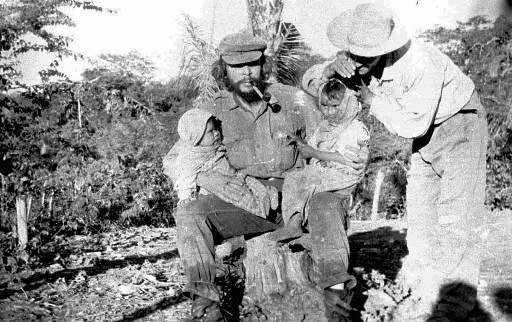
Ernesto Che Guevara in Bolivia in 1967. Source: Public domain, Museo Che Guevara, available here.

Cuba 1960-1964

The Che Guevara of 1959 was a completely different man. He was no longer the “young Argentine vagabond who just happened to have a medical degree scrabbling for work in a foreign country.” He was now a high-ranking official in the new Cuban administration with close access to its leader, Fidel Castro. Over the next few years he would hold several posts: commander of the La Cabaña fortress, where he oversaw the revolutionary tribunals that purged the army of Batista sympathizers; president of the National Bank of Cuba; and Minister of Industries. He had few successes in these roles, and it was at La Cabaña that he acquired his fearsome and ruthless reputation. In the first months after the revolution, Che presided over dozens, and by some accounts hundreds, of executions.

It is a matter of debate whether Che was any more ruthless than other members of the new Cuban government. Neither Che’s own comments nor those of his comrades at the time paint a merciful picture. Asked about Che’s part in the legal process, fellow prosecutor Miguel Ángel Duque de Estrada said simply that “he [Che] was in charge… his word was final.” In the first hundred days of Che’s tenure, no fewer than fifty-five executions were carried out.

His role at La Cabaña, and the vigor with which he applied himself to it, revealed a major change in Che’s personality and moral code. Only six years before the revolution, in 1953, Che had qualified as a doctor, a profession dedicated to the betterment and prolonging of life. By the time he took charge of the tribunals he had clearly abandoned that commitment, privately admitting to his father: “As for my medical career, I can tell you that I deserted it a long time ago.” Perhaps we have our answer. Che could have refused the role, but ambition persuaded him otherwise.

However, the Cuban people were also in a vengeful, unforgiving mood toward the former government, and sought reprisals against those who had supported and carried out the Batista regime’s atrocities. Public demand aside, there was another important reason: Castro needed to ensure that no dissent remained that could undermine his victory in those early, vulnerable days. Che remembered the events that had toppled Jacobo Árbenz in Guatemala in 1954, which he had witnessed first-hand during his second journey through Latin America. In Che’s view, Árbenz had failed to purge his army of dissenters, and they ultimately removed him from power. That mistake could not be allowed to happen in Cuba.

In 1959 the new Cuban government faced a hostile diplomatic environment. The United States was growing increasingly wary of the revolution’s radical direction, and much of Latin America was under heavy US influence. In June 1959 Castro sent Che abroad as an ambassador on a three-month goodwill tour. Like his later tour of 1964–65, it focused on non-aligned countries, which on this occasion included Egypt, India, Japan, Indonesia and Yugoslavia. The priority was to win trade and ease Cuba’s economic vulnerability.

To achieve this, Cuba urgently needed to sell its one major commodity: sugar. Cuba produced around six million tons a year, of which roughly three million tons were sold to the United States under a quota system, a quota the US would cut in July 1960 as relations collapsed. The tour achieved little. It laid some groundwork for trade with Egypt and produced a rice-for-sugar arrangement with Burma, but no major new customers. Some of the fault lay with Che himself. His lack of knowledge of economics and trade put him on the back foot in negotiations, and the outcome was hardly surprising. In short, he was unsuited to the task, though in fairness many others in Castro’s government were probably equally lacking. Cuba would soon turn to the Soviet bloc instead, signing its first major trade agreement with the USSR in February 1960.

On a personal front, Che divorced his wife, Hilda Gadea, and shortly afterwards, in June 1959, married Aleida March de la Torre, whom he had met during the fighting. His marriage to Hilda had been under strain since before the revolutionary campaign in Cuba, and the situation was no doubt exacerbated by Che’s restless ambition. That ambition was undimmed; indeed, he was now heavily focused on a new task: taking revolution to the wider world.


Exporting Revolution

Cuba’s policy of exporting revolution was both a defensive and an offensive strategy. Havana feared that the United States was planning retaliation for Castro’s overthrow of Batista. The US was seeking compensation for American property nationalized by Cuba, valued at around $1.8 billion at the time, and it now had a communist state on its southern flank, an anathema to American ideology. In Castro’s mind, an invasion was only a matter of time, a fear borne out by the CIA-backed Bay of Pigs invasion of April 1961.

In theory at least, exporting revolution was an alternative to the impossible task of taking direct action against the United States. The plan was to create distractions in other countries that would tie up the time and military resources of Cuba’s potential enemies—or, in Che’s later words, to create “two, three, many Vietnams.” If this produced regime changes friendly to Cuba, so much the better. Cuba became a training ground for several clandestine guerrilla organizations preparing to take up arms across the developing world, and it was here that Che believed he had found his new calling.

Between 1960 and 1964 Cuba was actively planning several clandestine operations in Latin America, and those in Argentina and Guatemala reached an advanced stage. From 1962, large numbers of would-be guerrillas from across Latin America arrived in Cuba to train, mentored by Che, seasoned Cuban guerrilla veterans and Eastern Bloc advisers, for example from Czechoslovakia. Che also used the resources available to him at the National Bank of Cuba to fund guerrilla movements in Central America, advancing $20,000 to the Nicaraguans Tomás Borge and Rodolfo Romero, two guerrilla leaders heavily involved in the region.

Argentina was particularly close to Che’s heart as his homeland and the home of his family. Again without Che being present, a Cuban-backed guerrilla force led by the Argentine journalist Jorge Ricardo Masetti was gradually established in Bolivia in preparation for an incursion into northern Argentina. After President Arturo Frondizi was removed by the military in 1962, Che saw an opportunity for such an operation.

By the time the operation began in earnest, however, the political climate in Argentina had changed. The military-dominated interim government had given way to elections in 1963, which brought the centrist Arturo Illia to the presidency, lowering the political temperature and the appetite for revolution. Che’s own opportunity for personal involvement in a campaign was coming, but not close to home. It would be in post-colonial Africa.


The Congo and the Disappearance of Che Guevara

In 1965 Cuba backed the Congo’s various rebel movements against the central government of the Democratic Republic of the Congo, whose army was commanded by Joseph Mobutu. Civil conflict had erupted almost immediately after the country gained independence from Belgium in June 1960, beginning with an army mutiny and the secession of the mineral-rich province of Katanga. The newly elected prime minister, Patrice Lumumba, was unable to contain the unrest. When Belgium sent in troops, Lumumba saw this as a stealthy attempt to preserve its imperial grip on its former colony. He appealed to the United Nations, which sent a peacekeeping force, but when the UN refused to help him end the Katangan secession he turned to the USSR, asking Nikita Khrushchev for assistance, and Soviet aid and advisers were dispatched to the Congo. The Cold War had arrived in Africa, and given the country’s vast mineral wealth—cobalt, copper and much else—this was unacceptable to the West. Lumumba was deposed in September 1960 in a coup led by Mobutu with Belgian and CIA support. After his capture he was handed over to his political rival Moïse Tshombe’s Katangan authorities and brutally murdered in January 1961.

Watching from the sidelines, Cuba believed that the Congo offered an opening for successful regime change. Successes outside the Cuban revolution itself had so far been non-existent, so this time the operation would receive the personal attention of Che Guevara himself. In April 1965 Che was secretly inserted into the country to begin his work. There is little value in recounting the many chaotic engagements of the seven unsuccessful months that followed. Che opened his account of the campaign with the blunt admission, “This is the history of a failure,” and his presence had little or no impact. The diary and other witnesses describe multiple disadvantages: absent leaders, uncommitted fighters, poor logistics, language barriers and insurmountable odds, including Mobutu’s considerable army, supported by the CIA and by elite mercenary units led by the infamous Mike Hoare. Che’s first personal attempt to export revolution had been an abject failure. It was not an auspicious start.

Before his arrival, Che had been given plenty of advice and warnings by African leaders that his venture was highly likely to fail. The Egyptian leader Gamal Abdel Nasser advised him against becoming “a Tarzan, a white man among blacks, leading and protecting them,” as Africa had had enough of white rule and interference. Nasser warned, prophetically, that it would end “badly.”

Nor did his plans convince the African revolutionaries to whom he presented them in detail in Dar es Salaam. The consensus was that they were too ambitious and naive. In Che’s words, the meeting ended “coldly and dismissively,” with his guests “courteously saying goodbye.” His costly idea of using the Congo as an anti-imperialist springboard for guerrilla struggles in neighboring countries was not the kind of revolution that the Congolese, or Africans more widely, desired. He proceeded regardless, and it would not be the last time Che failed to heed advice and warnings.

Che arrived in the Congo in April 1965 and by November had withdrawn to neighboring Tanzania, where he wrote his account of the campaign in Dar es Salaam. If nothing else, it served as a “lessons learned” log for future operations. He was undeterred by the failure and still vehemently supported the idea of exporting guerrilla warfare, but he needed another opportunity. He would get one in Bolivia a year later, but he failed to heed his own lessons, failures and experiences before embarking on that venture.

Mobutu, meanwhile, seized power in a coup in November 1965, just as Che was leaving, and ruled the country (renamed Zaire in 1971) until 1997.


Diplomatic Blunders and a Rumored Rift with Castro

In February 1965, before leaving for the Congo, Che made a public address in Algiers to delegates from across Asia and Africa. The speech was so inflammatory that it riled Cuba’s principal ally, the USSR. In it Che made a series of catastrophic blunders, once again proving that diplomacy was not among his skills.

In the speech Che delivered a clear criticism, if not a rebuke, of the Soviet bloc. He argued that its “mutually beneficial” trade with developing countries was no better than the West’s, and that socialist countries trading at world-market prices were, to a degree, accomplices of imperialist exploitation. By implication he sided with China over the USSR, suggesting that the Chinese displayed a truer socialist morality than the Soviets. Moscow noted his closeness to China and came to see him as “China’s man,” which was unacceptable to the Kremlin.

This rebuke enraged the Soviets, and the ramifications reached Fidel Castro. What was he to do with Che? As it turned out, Che’s own actions provided the solution. Many still wonder whether it was a stroke of good fortune or some stealthy maneuvering behind the scenes that removed Che from Cuban affairs. Che would later regret his actions.

Before Che’s disappearance into the Congo there were rumors of a rift between him and Castro over his open criticism of Moscow. Nothing has been officially confirmed, but the events that followed are suspicious. The rift, if there was one, was driven by a mixture of Che’s loose, tactless tongue and his ardent Marxist beliefs, which put him firmly on China’s side of the Sino-Soviet dispute. Castro shared some of Che’s frustration with Moscow but kept a quiet restraint.


“The Letter” to Castro and the People of Cuba

On April 1, 1965, while preparing for his insertion into the Congo, Che wrote a farewell letter to Fidel Castro. That letter, in Che’s typically flowery prose, would soon work to his detriment. When Castro read it out in public in October 1965 to explain Che’s absence, it effectively detached Che from his comrades: he had renounced all his government titles and his Cuban citizenship, erasing everything he had worked for. In one short letter he had lost his own stage at a time when he arguably needed its support most.

Extracts from the letter read as follows:

“I feel that I have fulfilled the part of my duty that tied me to the Cuban Revolution in its territory, and I now take my leave of you, the compañeros, your people who are now mine.”

If that was not clear enough, he elaborated in true “Che prose”:

“I formally resign my responsibilities in the leadership of the party, my post as minister, my rank as commander and my Cuban citizenship. Nothing legally ties me to Cuba.”

The letter perhaps alludes to tensions with Castro when Che writes: “My only serious failing was not having more confidence in you from the first moments in the Sierra Maestra, and not having understood quickly enough your qualities as a leader and revolutionary.” (The Sierra Maestra mountains were the refuge of Castro and his depleted band in the early stages of the insurgency.) There were suggestions that Fidel had begun to view Che’s activities and position as a diplomatic liability, especially after the Algiers speech angered Moscow. That speech put Castro in a difficult position: although he privately shared some of Che’s reservations about the USSR, it was nonetheless a vital, if not the only, ally on which Cuba depended during its continued international isolation.

Che added, “with a mixture of joy and sorrow,” that “other nations of the world call for my modest efforts” and that he would “carry to new battlefronts” the faith Castro had taught him, to “fight against imperialism wherever it may be.” These hints of grandiosity and egotism show how far Che’s transformation, and perhaps a growing self-delusion, had developed.

The letter was a baffling act, and it leaves readers wondering whether it was driven by an inflated ego, by the fact that Che, given his catalog of failures, was running out of “proverbial rope” as an ambassador and official of the Cuban government, or by both.


Bolivia and the fate of Che Guevara

Cuba was planning a guerrilla operation in Bolivia while Che was busy managing the disaster in the Congo. Cuba had originally planned an operation in Argentina, beginning with small incursions into the north of the country from across the Bolivian border, but the idea had been abandoned after Masetti’s failed attempt of 1963–64 and the change of government in Argentina. By the time Che returned secretly to Cuba in mid-1966, after months in Tanzania and Prague, he had decided to join the new venture. Still smarting from his failure in the Congo, he needed to repair his damaged reputation, both in his own eyes and in those of his peers. He was still traveling incognito and was effectively stateless. The Cuban public was unaware of his return, and his “disappearance” from Cuban life continued.

An advance team of Cuban and Bolivian communists had already established a secret base in Bolivia, on a farm near the Ñancahuazú River. All Che had to do was get into the country, which was no easy task, as his activities and whereabouts were now of great interest to the CIA. Traveling on false papers under an assumed name, Adolfo Mena González, he arrived in Bolivia in November 1966. Little did he know that he was beginning another fruitless and impossible campaign that would end in his capture and death. Masetti himself had disappeared in 1964 and is presumed to have died in the jungle of Argentina’s Salta province, and the authorities were by now aware of Cuban activity in the border regions.


The Bolivian failure

Before Che’s arrival, approaches had already been made to various Marxist groups within Bolivia with a view to creating a united front, but the Bolivian Communist Party did not share the Cuban belief in armed revolution. Che also reportedly received warnings against the whole idea from Argentina’s exiled former president Juan Perón in Madrid. Perón was candid, urging Che to “suspend that plan” and adding: “You will not survive. Search for alternatives.” Once again, however, Che failed to learn from the Congo and proceeded regardless.

Che arrived secretly in Bolivia in November 1966. The Cubans needed the success that had so far eluded them, though it was unclear what form that success would take: outright victory over “US-backed imperialism” or distractions sufficient to tie down US military resources. In the event, the campaign did nothing to slow US efforts against Cuba and Che; if anything, it was an irritation. The USSR, meanwhile, was distancing itself, preferring peaceful coexistence with the West. Cuba’s targets were not ready for revolution, and support for, and belief in, its ambitions were dwindling.

By mid-1967 the situation in Bolivia already looked hopeless. Che and his band were being pursued relentlessly by superior forces—the Bolivian Army, US-trained Bolivian Rangers and their US advisers. His force had dwindled from around fifty men to just over twenty. The local population gave them no support, nor did other communist-aligned groups. Che had no hope of success, and he admitted in his diary that support from the population was non-existent. Of the Bolivian peasants for whom he claimed to be fighting, he wrote: “Talking to these peasants is like talking to statues. They do not give us any help. Worse still, many of them are turning into informants.” Bolivia had already had its own revolution in 1952, which brought land reform and the nationalization of the tin mines, and it wanted any further change to come by peaceful, electoral means, an approach supported even by its own Marxist and communist groups.

The campaign was reminiscent of the Congo in many ways. Che and his small band spent days on the move with little to show for it, and the whole campaign produced no more than a handful of minor victories against small Bolivian patrols, none of which posed any threat to the government. For those interested in every detail, his Bolivian Diary provides it, but it adds little to this article. The Bolivian military redoubled its efforts to eliminate this troublesome individual and his exhausted guerrillas, and to set an example to any would-be imitators.


The Death of Che

On October 8, 1967, after a relentless pursuit, Che was captured by Bolivian forces in the Quebrada del Yuro ravine. A local peasant had revealed the guerrillas’ whereabouts to the army. Che and a handful of his men were taken alive to the nearby village of La Higuera, where he was held under heavy guard, tightly bound, on the mud floor of the village schoolhouse. His captors debated what to do with him as they awaited orders from their superiors. His end would come swiftly.

There are contradictory accounts of Che’s last moments. One is that he died bravely, looking his executioner in the eye in the La Higuera schoolhouse and daring him with the words, “Shoot, coward, you are only going to kill a man.”

Another account concerns his capture the previous day: that he surrendered, calling out to his captors that he was “worth more to you alive than dead.” We will never know the full truth of his final hours. Certainly, photographs taken after his capture show a man visibly shaken and exhausted by his physical ordeal, a far cry from the self-assured diplomat who had graced the world stage.

The last images of him alive unsurprisingly show him dirty, bloodied and barefoot. According to witnesses, including Félix Rodríguez, a Cuban-born CIA officer working alongside the Bolivian Army, Che was disillusioned but unrepentant. He blamed the “provincial mindset of the Bolivian Communist Party” for his failure and hinted that the Bolivian venture had been a mistake. His spirit was not entirely broken: he resisted interrogation and, to the very end, refused to denounce Castro or renounce his beliefs.

Che’s end could have been different. According to Rodríguez, there is credible evidence that the CIA wanted Che taken alive and flown out of Bolivia to Panama for interrogation. This makes sense: Che’s death risked creating a martyr for the communist cause and giving a boost to growing left-wing movements at home and abroad, whereas his capture and imprisonment would have been a significant setback to the revolutionary cause.

The US did not make the final, fateful decision. According to Rodríguez, it was the Bolivian president, René Barrientos, who ordered Che’s execution, which was promptly carried out. Barrientos was determined to deliver a stark warning to other revolutionary groups. Che was executed on October 9, 1967. His bullet-riddled body was flown to Vallegrande and photographed before being buried in a secret location, where it lay undiscovered until 1997. His hands had been cut off for identification purposes. In a sense, this was not the end of Che Guevara. A man of that name had been killed on October 9, 1967, but in his place an iconic image had been born, one that would prove impossible to erase from history.


Assessing Che: Conclusion

It goes without saying that Che’s death immortalized him, and myth and fact soon became blurred. He remains a polarizing historical figure, a dubious honor that comes with a wide mix of supporters, worshippers and critics.

Che Guevara was undoubtedly a remarkable man, but also a restless one. He never appeared to have a life plan beyond seeking greatness and personal triumph. He achieved this, in the enduring image of the anti-imperialist Marxist, on the back of Fidel Castro’s success, almost as if he had simply stumbled upon the opportunities presented to him.

He rarely stayed in any profession or vocation for long. He abandoned his hard-earned medical qualification for the revolutionary adventure with Fidel Castro in Cuba, a country that was not his birthplace. After the fighting, the revolution led him into government and diplomacy, for which he was ill-suited, and his record of achievement there is unimpressive. His two personal attempts at “exporting revolution,” in the Congo and in Bolivia, failed disastrously, the second leading to his death.

We must also never overlook one vital fact: Che was committed to the Marxist cause and closer to the Chinese model of communism, seeing the Soviet version as a diluted form of the doctrine. Whatever its rhetoric, Che’s and Cuba’s anti-imperialism did not deliver freedom: it meant supporting regimes, Cuba’s own included, that were themselves oppressive. The image some retain of Che as a Third World freedom fighter deserves some reflection.


Now, read our highly-rated, fast-paced book on the Cold War here.


Sources

I Embrace You with All My Revolutionary Fervour – Ernesto Che Guevara – Collected letters 1947-1967 – Penguin Modern Classics

Che Guevara – A Revolutionary Life – Jon Lee Anderson – Penguin – 1997

Back on the Road – A Journey into Central America - Che Guevara – 2000 – Vintage Uk

Revolution in the Air – Max Elbaum – 2018 – Verso

The African Dream – Che Guevara – 1999 – Harvill Press

Bolivian Diary – Che Guevara – 2004 – Pimlico
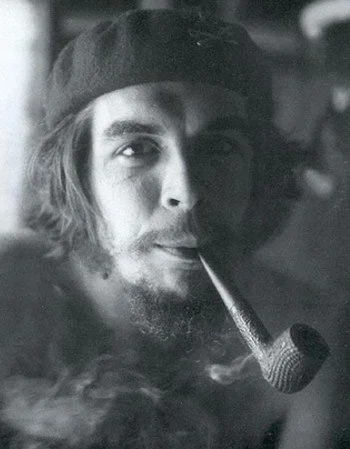
In 1951 Che Guevara was still known as Ernesto Guevara de la Serna. To his friends and family, he was a restless young man, still undecided about his life's direction, who constantly craved adventure and excitement. At this point, he was a medical student with a considerable number of examinations to complete, but he decided instead to travel the length of South America. In this period, we see the transition from Ernesto the restless student and man of letters to the man who would become Che.

Steve Prout explains.

You can read part 1 on Che’s early years here.

Che Guevara in Caballete de Casas, Cuba, 1958. Source: Museo Che Guevara, Public domain, available here.

The Motorcycle Diaries

This first journey began in January 1952 with his trusted friend Alberto Granado and temperamental motorcycle “La Poderosa II.” The two left Argentina for a tortuous adventure around his home continent recorded in the infamous book “The Motorcycle Diaries.” This first journey was very much two friends on a backpacking tour surviving on their wits and lack of money. To go into finite detail will offer no valuable insights as far as the focus of this article is concerned. The reader will be best served going straight to the actual book for more detail. Instead, we pick up after Ernesto’s return from his first trip and his plans changed once again. In the second of these articles, this will follow Che Guevara's life up until his involvement in the successful Cuban Revolution in 1959.

To summarize the first trip the two comrades began in January and February of 1952 working their way through Argentina before they spent the next two months in Chile. The duo then moved through Peru in March of that year before visiting Colombia and Venezuela in the summer months of June and July 1952. The trip finished with a visit to Miami before returning to Buenos Aires. There, Ernesto planned to finish his professional studies.


Introducing Doctor Guevara

In July 1952, Ernesto returned to Buenos Aires. This time it was to finish his medical studies, to which he applied himself in earnest, passing thirteen of his medical exams in November and December 1952. Allegedly according to his father beforehand, Ernesto succumbed to infection after experimenting on human remains required by his studies. Stubbornness had won the day and that same resolve would be applied to later life. One more exam remained in 1953, and he then officially became Dr Ernesto Guevara. He told his father by telephone the good news before then telling them to their dismay that he was going to embark on further travelling. This second trip would change his life. Che Guevara’s story now gathers pace.


Back on the Road, 1953

In July 1953, he set out on his second journey. This time his journey again began in Argentina with his friend Carlos Ferrer, crossing part into Chilean territory and then into Bolivia. At first his journalling and its content was reminiscent of his first trip with the usual privations of his travels such as the limitations caused by his asthma, mechanical breakdowns, and border issues. Eventually in 1953 he reached Central America. The tail end of this journey sent him to Guatemala and then ultimately Mexico, where he had his fateful meeting with Fidel Castro.


Guatemala, 1954

Everything in Ernesto's life would change with his stay in Guatemala. Ernesto had travelled through the region at a tense time. Guatemala, or rather the administration headed by the nation's leader Jacobo Arbenz (1951–1954), had its fair share of problems with the USA and its neighbors. The President had introduced some sweeping reforms in the country during the “Ten Year Guatemalan Revolution” from 1944 to 1954. The reforms improved the lives of over half a million people and the agrarian reforms improved the lot of the agricultural community. The policy of Arbenz’s reforms was for the government to seize idle and uncultivated land and redistribute it to its people. This was a policy that a growing Marxist like young Ernesto would approve of. Ernesto became a staunch supporter of Arbenz in his time in Guatemala.

This did not sit well with the USA and corporations resident in that country such as the United Fruit Company. Those corporations lobbied President Eisenhower and the hawkish John Foster Dulles, Secretary of State to remove Arbenz via the CIA and military action. At the same time, the two US statesmen also feared the growth or strong influence of communism in Guatemala and feared for the financial stakes they had made. They could not let Arbenz continue or allow his ideas to spread throughout the rest of South America.

Ernesto, although intending to travel and fund himself through casual work within the medical profession, found himself caught up in the political furor, which he did not find unpleasant. He was keen to fight on the side of Arbenz and joined an armed militia organized by a communist group. Once the bombing began, he tried to organize this group to perform a number of supporting roles such as guarding the capital and arms negotiations to other resistance. It was all in vain and temporary; after expressing frustration with the lack of action in the group, he abandoned this idea and returned to his medical duties. Following the coup, he again volunteered to fight, but Arbenz took refuge in the Mexican embassy, and his control of his country was lost. All foreign supporters were urgently advised by him to leave Guatemala. Due to their support and involvement with Arbenz, Ernesto had now been targeted by the authorities. However, Ernesto showed no signs of being perturbed by these dangers at all.

In his letters to his mother, he confessed that being around the chaos made him feel a “little ashamed for having as much fun as a monkey” and that had felt “a magic sensation of inviolability” that led him to “lick his lips in pleasure.” This was now a man who had acquired an addiction to adrenaline and danger. His growing penchant for adventure had now been raised to higher and more dangerous levels.

Ernesto met Hilda Gadea, a Peruvian woman whom he later married in the late summer of 1955 in Mexico. Hilda was also a political activist before she met Ernesto, and her work had led her to be expelled from Peru in 1948. This did not help her during her time in Guatemala: swept up in the political turmoil alongside Ernesto, she was incarcerated in a Guatemalan prison on multiple occasions, gaining release each time only after hunger striking. The two seemed very intellectual and politically compatible, but the marriage had underlying issues that would later surface. Ernesto, it has been suggested, initially courted her as she was convenient to him on many levels such as financial support, a useful contact, a roof over his head and more so for “transactional motives” (Che’s actual words from his memoirs cannot be used here).

Meanwhile President Arbenz fled his country and was replaced by a US/Honduran-backed government headed by Castillo Armas. The new President was clamping down on any suspected communist sympathizers and supporters of its former leader. The couple therefore had to leave Guatemala amid the bombings, invasions and the new government clampdowns and headed for Mexico. The couple would both leave and arrive in Mexico separately.

In 1954, Ernesto was still nothing more than a “young Argentine vagabond who just happened to have a medical degree scrabbling for work in a foreign country.” He had acquired a taste for danger, and all that seemed to be needed now was a cause and a leader to cross his path.


Mexico and Fidel Castro, 1955

Even as late as 1955, Ernesto still had his heart set on his travels. His letters home still talked of travelling to Europe and India specifically, which were no doubt genuine, and he could change his mind at “the drop of the proverbial hat.” In a letter to his mother in November 1954, he wrote that he is “desperate to travel around Europe” and in that same letter “as for the United States I have not lost an ounce of hostility.” In explaining how he would still like to visit New York he adds “I’ll leave just as anti-Yankee as when I arrive”. His experiences in Guatemala had clearly affected him as he makes other political observations.

His views on Mexico were interesting. In a letter written in March 1955, shortly after he arrived, it is clear that his anti-Americanism followed him. He blames the upheavals going on in the country as being US instigated when he said, “Mexico has been completely handed over to the Americans.” He adds that the “FBI is much more dangerous than the Mexican police, here they act as they please and arrest anyone without a pretext.” In the meantime, his letters home talked of the struggles of finding work and political commentary.

In reality, much more was going on under the surface. Ernesto pretended in his letters to be pursuing an academic career and falsely claimed to be working on various research projects and pursuing professorships in various educational establishments. His letters up to July 1956 were those of a man with continued wanderlust, various bouts of casual jobbing, and thoughts of establishing a medical career. In truth he was preparing himself for Fidel Castro’s planned invasion and coup of Cuba. In his letter to his mother on 6th July 1956 from Miguel Schultz Prison, which he described as his “delightful mansion,” he admitted “I’ve spent much time stumbling around looking for my truth, having finding my way, and with a draught to perpetuate me, I feel I have closed the cycle”. He refers to his decision to join the cause and support Fidel Castro.

Ernesto in that letter of 6th July 1956 makes further admissions from Miguel Schultz Prison, in which he stated “over the past few months I have maintained the cover of saying I had a job as a professor, whereas in fact I have been dedicating myself to the physical training who must one day set foot again in Cuba”. Che mentions in that same letter Fidel Castro’s arrest, which implicated Ernesto himself thus ending up in prison. He further reveals, “I see my future tied to the Cuban Revolution.” So how did the two men meet and bond?

Ernesto's initial attempts at establishing contact with Castro were tentative, but he eventually met him through mutual associates. At first, on these occasions, Ernesto sat in silence and at a distance, offering little, as if he were in awe of Castro or intimidated by Castro’s overwhelming personality. It was in fact Hilda who asked Castro the bold questions about his exile. Ernesto at this point was far from the future right-hand man of the movement, but he realized that if he were going to make a mark on this world and make a name for himself, he would need Fidel Castro and to be part of his plans for the Cuban revolution.


The beginnings of a revolutionary

Ernesto committed himself wholeheartedly to the cause with a new zeal. His marriage became secondary to his new efforts. He applied strict daily discipline to his diet and gymnasium work. He also conditioned his mind with economic works, Mao and Soviet texts and regularly attended secret meetings of the Mexican Communist Party to discuss the situation in Latin America. All this was in preparation for Fidel’s Cuban assault plans. All this had to be clandestine as the FBI, CIA and Mexican authorities were always fast to swoop down on any communist activity. The danger no doubt appealed to the adventure-seeking Ernesto.

These efforts came to the attention of Castro, who rebuked his small group of forty fellow revolutionaries for not displaying the same zeal as Ernesto. Eventually his colleagues warmed to him and his disciplinarian ways, earning him a leadership title within the small ranks but that would take time, a lot of time. Ernesto immediately sought a remote and safe location to further develop training which he did successfully. He acquired a ranch in Chalco in Mexico. As he left to join his comrades there, he warned Hilda that he might not return.

Ernesto was still to be properly accepted by Castro’s group. He was still seen by this exclusive group as an interloper or a foreigner who had no business in Cuban affairs, much less organize them. He was seen as a scruffy oddball, too self-righteous and altogether disagreeable. Some commented on his lack of hygiene, in particular washing, but instead Ernesto was trying to condition himself and his colleagues for the harsh conditions of guerrilla warfare that would take place once they arrived in Cuba.  In one incident, a member refused to obey Ernesto's orders, and a court martial was instigated by Castro in his support for the man who had now been named by his colleagues as Che (Ernesto will now be referred to as Che).

Che carried on his routines with his characteristic discipline while Fidel Castro left to intensify funding and arms supplies from sympathizers in Cuba and the USA, but he was seized by the authorities in July 1956 and the whole operation looked as if it were about to be derailed... Hilda and other members were detained and charged with plotting a coup and assassination of Batista. Che was ordered by Castro to volunteer his arrest. The whole event made the national news in Mexico. Che was now coming to public prominence as a new article reported on a certain “Dr Guevara as an active member of the Instituto Intercambio Cultural Mexicano-Ruso” who was “the principal link between the Cuban plotters and certain communist organizations.”  These were serious charges and accusations, and Che was now facing the full legal and political backlash in the glare of the world’s media. He was no longer the vagabond in the background. Castro’s contacts had to arrange legal defense and representation and with that came media attention. Che then admitted his involvement with the Cuban revolutionary movement to his parents in the letter of 6th July (as detailed above). Guevara was interrogated several times as the authorities were now concerned over Che’s communist connections.

It gave his family cause for concern, rightfully so, but in a letter to his mother, who expressed worry, he simply replied “I am all the contrary of a Christ. I fight for the things I believe in, with all the weapons at my disposal and try to leave the other men dead…” he went on in a veiled rebuke of his mother’s natural concern “what terrifies me is your lack of comprehension in all of this and your advice about moderation, egotism, etc.”. It appears she had struck a nerve, but Ernesto, now Che, was fully focused.

Whilst incarcerated, Che did not acquit himself well with Castro. Che spoke too openly, carelessly, and too freely on Marxist theories and intentions that he held to his interrogators. He shared loudly his Marxist views on Latin America and the need for armed revolutionary struggle. Castro was furious with this unwanted attention and needless risk that could jeopardize his operation. He had previously denied publicly any association with communist movements and now this was being undermined by Che Guevara. Che's outspokenness was rumored to be a source of quiet frustration for Castro.

Meanwhile, Che started a series of hunger strikes whilst incarcerated. He was one of the last two of Castro’s group to be released. After his release, Che, along with Castro’s group of revolutionaries, went underground in Mexico to continue planning their assault on Cuba and Batista.


Cuba, Guerrilla Warfare and Revolution

The plans did not go well at first. The small band of men had to move around Mexico in a clandestine manner, out of view of the Mexican authorities, US and Cuban agents. Che had effectively left the marital home, warning Hilda again that he might not return. The next time the couple would meet was in 1959 after achieving victory in Cuba where Che would admit an affair and seek a divorce.

Meanwhile Castro had to overcome many financial and logistical problems while the team trained themselves. He needed money for a boat; he needed arms and more committed men. He only had forty at this time. After secretive visits to the USA, he secured $50,000, a boat and forty more men. He would eventually assault Cuba with an initial force of eighty-two men. The landings needed to be coordinated with planned uprisings in Cuba.

In November 1956, with the odds stacked against them, Castro, Che and the rest of the eighty-two men embarked for Cuba. Of those men, only twenty-two remained after most were killed almost immediately in the early stage of the assault, which was going unfavorably for Castro and favorably for Batista. The rebels sought refuge in the mountains.

Morale was low, and while they took stock and sought refuge in the Sierra Maestra mountains under miserable conditions, Che took a different approach to winning over hearts and minds. This is where his intellect was of better use than his weakened physical situation aggravated by asthma and mosquito infection. His next actions secured his promotion and elevation in the ranks. During his time in the mountains, he lived among the poor subsistence farmers. The living conditions were very grim for everyone: there were no schools, no electricity, minimal access to healthcare, and many of the adults were illiterate. Che suggested an alternative but longer path to win over the population: a strategy of “competence, diplomacy and patience".

Che set up infrastructure to serve the needs of the local population and the guerrillas. He set up factories to make grenades, built ovens to bake bread, and organized schools to teach illiterate campesinos to read and write. Alongside this makeshift community, he established health clinics, workshops to teach military tactics, and a newspaper to disseminate information. Che was promoted by Castro to the rank of Comandante of a second army column. Che would acquit himself well in the battles that were to come.


Che the Comandante

Although in combat conditions, Che was never far from his intellectual pursuits. It was something he demanded of his men. An educated guerrilla force was more effective than an illiterate one. He expected higher standards of everyone, which was certainly a trait he displayed consistently in his many roles. He was also known for his ruthlessness and had no compunction in executing traitors, a matter that is still hotly debated by historians today as to whether he was a tyrant or not.


Castro on Comandante Guevara

Castro described Guevara as intelligent, daring, and an exemplary leader who "had great moral authority over his troops” but also a man who took too many risks that bordered on a "tendency toward foolhardiness". The two in public always appeared united, but Che had attracted Castro's disapproval many times, and this would not be the last. We will assess in the final article whether Castro saw him in the post-revolutionary period as a liability.


Che and Guerrilla Warfare

Che took part in a number of battles in the two years up to victory. Not all the battles Che participated in will be recounted, but one in particular stands out. In July 1958, Guevara played a critical role in the Battle of Las Mercedes. His column halted an attacking force of 1,500 men called up by Batista's General Cantillo, whose mission was to surround and destroy Castro's forces. It involved a series of hit-and-run tactics that some military experts praise as evidence of Che's ingenuity. It was a tactic he utilized successfully multiple times. It became an essential part of his book Guerrilla Warfare, published in 1961.

The war was approaching its end. In December 1958, one of the final battles required Che to take the Las Villas province, dividing the island and its opposing forces. Using his guerrilla tactics, he soon took control of the area except the capital, Santa Clara, which required a new approach, as Che was outnumbered by government forces ten to one. He was successful in taking the capital.

On 2nd January 1959, Che entered Havana to take control of the capital. Castro followed some days afterward. This would be the last occasion Che would be successful in combat or in any theatre he became involved in. Castro had won the war, Batista fled, and Che had now achieved iconic status.


Conclusion

In 1959, Che was in the spotlight on the international stage. He had also fallen for Aleida March, a fellow revolutionary he had fought alongside, and was divorced from Hilda soon after. He was now firmly ensconced in a number of government roles to settle Cuba's internal affairs and help complete its revolution. This, however, was not enough. He wanted a stage to himself. His ideas and dreams had grown.

The next article will finish on the post-revolutionary life, a critique of Che's character, his ideas, successes and failures.


Now, read the final part on Che Guevara later years here.

And listen to our podcast on Fidel Castro here.


Sources

I Embrace You with All My Revolutionary Fervour – Ernesto Che Guevara – Collected letters 1947-1967 – Penguin Modern Classics

The Motorcycle Diaries – Che Guevara – 1995 -Fourth Estate Paper Backs

Che Guevara – A Revolutionary Life – Jon Lee Anderson – Penguin – 1997

Back on the Road – A Journey into Central America - Che Guevara – 2000 – Vintage Uk

Guerrilla Warfare – Che Guevara – 1961 – Souvenir Press

Posted
AuthorHistory Is Now Magazine

In 1953, following his July 26 assault on the Moncada Barracks in Oriente province, a young lawyer and the mastermind of the attack in which many Cubans perished, named Fidel Castro, appeared in court to face prosecution. Out of as much desperation as revolutionary zeal, he delivered a powerful, hours-long speech in his defense. As of yet, no record of this speech has been found, and Fidel Castro was unsuccessful in avoiding conviction.

Here, Logan M. Williams considers Castro’s speech and looks at the history, successes, and failures of pre-revolutionary Cuba.

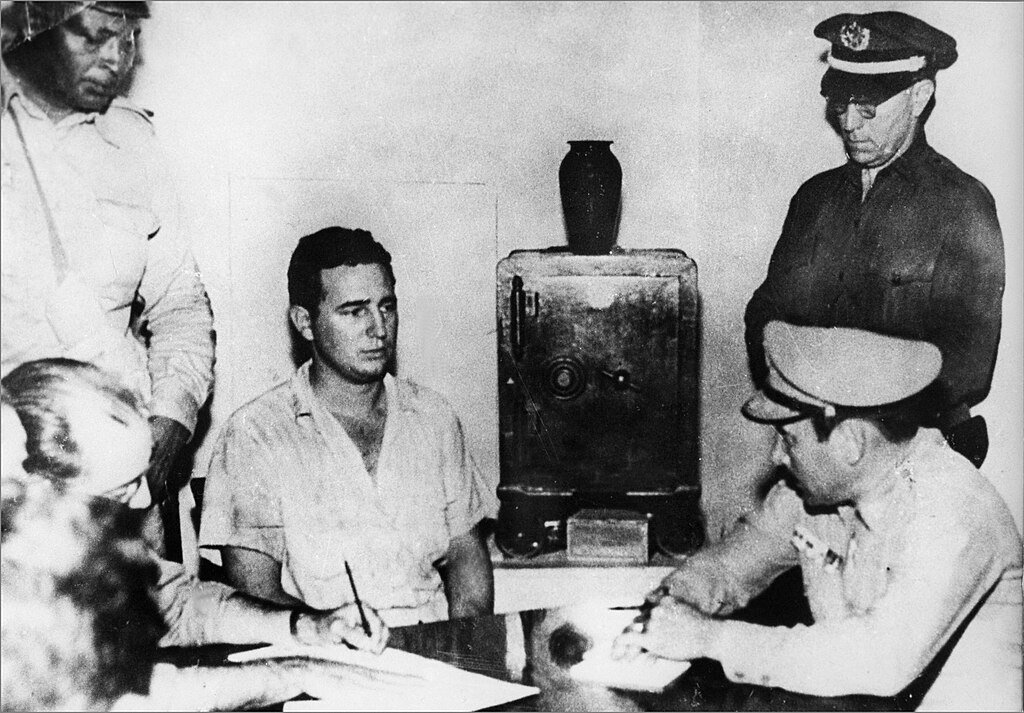
Fidel Castro under arrest after the 1953 attack on the Moncada Barracks.

Castro was sentenced to a term of 15 years imprisonment, of which he only ended up serving less than three, in Cuba’s Presidio Modelo on the Isle of Pines. During his time in prison, he gave newspaper interviews, and continued to participate in the organizing of Cuba’s anti-Batista efforts. While in prison, he also spent a great deal of time reconstructing a “record” – used loosely, because it was not an exact copy or a true record, due to the fact that it contained several embellishments and added phrases – of the speech that he delivered in court on that fateful day. One of the embellishments which he added to the recreated speech is one of the most infamous political phrases of the modern era, and it would become the title of his work: “History Will Absolve Me." The phrase was eerily similar to one used by the German despot, Adolf Hitler, who said when he found himself in a situation much like Castro’s, that the judgement of the “eternal court of history” would exonerate him.

Castro’s recreated speech would eventually transform into a manifesto for his future revolutionary activities and become required reading for militant leftists around the world. In it, Castro expressed the belief that the desperate conditions under which some Cubans suffered, provided justification for the radical nature of his actions. Castro described these conditions as follows: “the people have neither homes nor electricity” and those who were lucky enough to have shelter “live cramped [with their families] into barracks and tenements without even the minimum sanitary requirements.” He stated that “rural children are consumed by parasites which filter through their bare feet from the earth” and that Cuba had “thousands of children who die every year from lack of [medical] facilities.” Castro attributed these social conditions to an indifferent society as well as a corrupt and negligent government. Indeed, denigration of the Cuban Republic period is still a mainstay of Cuban regime propaganda today, which sees this sort of fear-mongering as the only way to justify its increasingly repressive regime.

Pre-Revolutionary Cuba

This propaganda may be effective, as most of today’s world now knows the Cuban Republic of 1902-1959 by its reputation for troubling and potentially neo-colonial relations with the United States or as a period of crime, graft, moral decay, political unrest, and total misery (if they know anything at all). However, this isn’t a complete representation of the era, as Castro himself alluded to in his speech before the court. Of the Cuban Republic, before the inception of the Batista dictatorship in 1952, Castro stated:

“It had its constitution, its laws, its civil rights, a president, a Congress, and law courts. Everyone could assemble, associate, speak and write with complete freedom. The people were not satisfied with the government officials at that time, but [the people] had the power to elect new officials and only a few days remained before they were going to do so! There existed a public opinion both respected and heeded and all problems of common interest were freely discussed. There were political parties, radio and television debates and forums, and public meetings. The whole nation throbbed with enthusiasm.”

He also noted that “the [Cuban] people were proud of their love of liberty and they carried their heads high in the conviction that liberty would be respected as a sacred right.” Within today’s Cuba, Castro’s pamphlet, “History Will Absolve Me,” is not easily found in its entirety.

While certain aspects of Cuban society (particularly the government and political class) may have earned the harrowing reputation presented by Castroist propaganda, the lived experience of the average Cuban who resided on the island in this era – which was actually a period in which Cuba underwent a remarkable transformation and made steadfast progress towards liberal development – tells a vastly different story. Due to the work of a few committed scholars, who have dedicated their time to chronicling the achievements of the Cuban people, we have brought light to the Cuban “Dark Ages.”

Cuban Republic in History

Traditionally, the Cuban Republic is identified as the form of government which existed between the years 1902 and 1959, although this is not entirely accurate, and it doesn’t do justice to the efforts of Cuba’s liberals and independence fighters. The Cuban Republic came into existence for the first time during the second half of the nineteenth century, during the Ten Years War, when the island revolted against Spain. However, it ceased to exist following the defeat of the Cuban separatists, and the complete reimposition of Spanish colonial rule. The Cuban Republic was revived during the Cuban War of Independence, and it experienced several early and remarkable successes in governance, whilst embroiled in a brutally destructive war with Spain. Horatio Rubens, a New York-based attorney who was a personal friend of Jose Martí and who served as a principal advisor to Martí’s Cuban Revolutionary Party as well as the U.S. provisional government during the brief occupation of the island, describes the accomplishments of this iteration of the Cuban Republic in an 1898 journal article for The North American Review. These revolutionaries, amid a war, had built a modern, representative government, based upon republican principles. This new government included a system for the collection of taxes, as well as significant checks and balances, especially upon military authority. In Eastern Cuba which, at this point, was largely poor as well as underdeveloped, and entirely in the control of the revolutionaries (except for major cities), newspapers were published frequently, which was a positive indicator for free speech as well as other democratic freedoms, and schools were even established. Most notably, the Cuban Republic experienced its first election in 1897, ostensibly free from the corruption and political violence which would plague future such elections.

After a brief period of initial occupation lasting from the end of the Spanish-American War in 1898 to 1902, the United States’ provisional government and most of its soldiers departed Cuba; the island nation had finally achieved a measure of autonomy (autonomy is used in this case to indicate the existence of a level of agency and self-government short of complete sovereignty). Most scholars of the Republic during this period in Cuban history stubbornly refuse to refer to it as sovereign Cuba, at least until the 1930s, due to the existence of the Platt Amendment, which formalized the continuation of U.S. dominance over Cuba by restricting the new island nation’s rights in the realm of international relations and by cementing the United States’ right to intervene militarily on the island under certain circumstances. Thus, Cuba’s sovereignty was so constrained until at least 1934, when President Franklin Delano Roosevelt’s “Good Neighbor” policy – and the persistence of Cuban diplomats – brought about the dismantling of the amendment.

The economy

After 1902, however, regardless of the existence of the Platt Amendment, the Cuban Republic was once again free to pursue liberalization and advancement in a Cuban manner. In spite of the many aforementioned plagues and hurdles faced by Cuba’s newly formed state, the Cuban Republic made extraordinary progress in the economic and social spheres; it was fully engaged in the crucible that is liberalization.

Economic data from this period indicate that the Cuban Republic was a middle-income (likely upper-middle income by modern standards) country, with living conditions comparable to some European countries, or to those in the southern United States (which were the poorest states in the U.S. at this time). Consumption rates at certain points during the Cuban Republic measured as high as 70% of most European economies and exceeded those of almost every other Latin American nation. The Cuban Republic’s income per capita before the Revolution of 1959, was well above the average for Latin America; in fact, it was equidistant from the European and Latin American averages. Several consumption-based economic indicators are especially useful in highlighting Cuba’s prosperity during the republican period, mainly those which relate to private ownership of technology and luxury items, as well as those which relate to food supply and nourishment. The Cuban Republic’s rate of private television ownership (measured by the number of televisions per 1000 persons) was nearly 7 times greater than the average for Latin American states, and approximately equal to the European average. Likewise, Cuban private ownership of radios was well above Latin America’s average, as was the rate of private ownership for passenger vehicles. Additionally, during the Cuban Republic period, Cuba regularly led Latin America in food production, as well as per capita daily caloric consumption; whereas, Cuba following the Revolution of 1959 has often lagged behind other Latin American nations in these regards. Finally, the rapid development of Cuba during the Republic era is evident by the fact that for much of that time period, Cuba led Latin America as the region's largest consumer of cement, a resource which is essential for the construction of new infrastructure. Additionally, Cuba’s investment in technology and mechanization during this period drastically exceeded that of its neighbors. In 1920, a time known as the “Dance of Millions” due to its especially high levels of prosperity, Cuba’s investment in these goods accounted for a quarter of the total investment in machinery for the entirety of Latin America (more of a cultural conception than a geographic region, “Latin America” has ill-defined borders, but for context can be estimated as containing approximately between 20-30 different countries.) After presenting many of the above statistics, and in light of the decidedly positive, albeit one-sided, perspective that they offer, authors of the above-cited paper in the Journal of Economic History, Marriane Ward and John Devereux concluded that “The story of Cuba during the twentieth century is therefore the story of how it has fallen in the world income distribution…. Over the last fifty years, Cuba has replicated the failings of command economies elsewhere albeit in a uniquely Cuban fashion.”

Infrastructure

The Cuban Republic’s remarkable success wasn’t limited to solely economic factors, Cuba also made remarkable progress in improving its transportation infrastructure. This helped the Republic to extend the rule of law, as well as healthcare and education opportunities, into the Eastern (largely rural and poor) portion of the island. During the republican period, railroads were constructed which spanned the entirety of Cuba, with the assistance of at least $60 million (likely over $1 billion in today’s currency) in American investment. The Cuban Republic’s relatively well-developed transportation is credited with facilitating much of the Republic’s incredible progress in healthcare. The same article notes that the Cuban Republic was exceptional by Latin American standards due to its ability to provide “relatively easy access to fairly high-quality healthcare for an unusually large share of the population…,” due partly to the government’s investment in social services, and aided by the government's drastic improvement of sanitation as well as water and sewer infrastructure. Before the Revolution of 1959, Cuba’s infant mortality rate was only 33 per 1000, less than a third of the average for Latin America and functionally identical to that of Europe. Additionally, the ratio of medical personnel to population in the Cuban republic was 2.5 times greater than the average for the region and virtually identical to the European average. Life expectancy in the Cuban Republic was 64 years, a full 14 years greater than the average for Latin America, and just five years below that of the United States. The Cuban Republic was also notably dedicated to matters relating to education, and the Cuban constitution – in its various iterations – always provided for free and compulsory education. As a result of this dedication, in 1955, Cuba’s literacy rate was 79 percent, amongst the highest in Latin America. Taking into account Cuba’s significant rural population, largely unreachable by the government at that time (not an unusual problem for developing nations), these feats in medicine and education are truly remarkable.

Human rights

Finally, and most importantly, the Cuban Republic continually made impressive advancements in human rights and liberalization. In Cuba’s 1940 Constitution, widely considered a bulwark of freedom and social justice, Cuban delegates included language which provided for anti-discrimination protections and other liberal principles. Notably, the constitution included unparalleled protections for Cuban women. The United States had, prior to the end of its provisional occupation in 1902, re-imposed the Spanish Civil Code upon Cuba as a stop-gap alternative to the difficult process of drafting a new body of law for the island. The Spanish Civil Code was heavily Catholicized, and thus, held regressive and prohibitive views of women and their role in society. During the short period of its existence, the Cuban Republic made remarkable progress in removing the religious influences from its body of law, and in elevating the status of women in the Cuban society. In the early 20th century, Cuban women catapulted from a position in which the law afforded them little autonomy and no property rights, to being able to own property, vote, divorce their husbands, and organize politically. Laws were also passed which attempted to abolish all forms of discrimination based upon sex, although their implementation proved difficult.

Cuba’s contributions to the cause of human rights during the republican period were not limited to the Constitution of 1940, or to Cuban domestic pursuits; Cuba was essential to the progress of the international human rights movement. In the latter years of World War 2, Churchill, Stalin, and Roosevelt communed to discuss the post-war order, and to construct a world order amenable to their respective interests. The notions underpinning the United Nations, as an international organization dominated by the great powers and designed to serve as the arbiter of their new world order, emerged from these discussions. It was the efforts of various Latin American nations which made the United Nations what it is today: not just an organization designed for ensuring security and stability, but a dedicated, efficacious bastion of human rights. More specifically, it was Cuba’s delegation that assumed a leadership role of the Latin American bloc, at that time the largest group of nations in the original 58-state body, and spearheaded an aggressive charge to re-define the nature of the United Nations as a body primarily dedicated to the defense of human dignity. During the first session of the United Nations, the Cuban delegation became the first to submit a proposal that the United Nations consider issuing an authoritative statement demonstrating its commitment to human rights, a suggestion that ran counter to the immediate interests of the United States and other major members of the body. When the original motion failed the Cuban delegation resolved to pursue it with the United Nations’ Economic and Social Council which, due to the Republic of Cuba’s tenacity, established the Commission on Human Rights for the purpose of drafting an “international bill of rights.” Cuba also submitted a draft such declaration, which inspired the final document, serving as a model in both substance and form. If it were not for Cuba’s novel idea that universal human rights should be listed, so that they might be easily understood, attained, and defended by persons of every walk of life, the United Nations’ Universal Declaration of Human Rights might never have come into existence. Throughout most of the modern era, outside of religious doctrine and certain areas of academia, rights were seldom discussed in the context of “humankind,” “international,” or “universal.” Rather, rights were seen as the prerogative of the nation-state and were outlined in national contexts or documents (e.g., state constitutions.) Cuban, and larger Latin American influence over the United Nations assisted in shifting that paradigm, and it is perhaps the most incredible part of the Cuban Republic’s legacy.

Conclusion

It is important that the presentation of these facts not be mistaken as an effort to obscure the serious shortcomings of the Cuban Republic. It is especially critical that the aforementioned economic statistics not be misused to obscure the gross income inequality under which a segment of the Cuban Republic’s poor languished, or to exonerate those responsible for the political instability which plagued the era. Rather, knowledge of this period is crucial for two major reasons. First, the Cuban regime often boasts about spectacular achievements (particularly in the fields of health care and literacy), and these “achievements” form a central pillar of revolution propaganda, but the above data illustrate that most of these regime “successes” were largely achieved by the Republic which came before. Second, and even more important, this story of the Cuban Republic is the story of a brave people who fought for countless years to achieve some measure of freedom and liberalism, only to have it snatched away from them by a revolution – and revolutionaries – steeped in perfidy. Unfortunately, irony abounds in present-day Cuba which, once a key drafter of the original document, now bans the distribution of the Universal Declaration of Human Rights on the island and severely punished those in possession of the document. Additionally, while Fidel Castro was given the chance to defend himself in open court on July 26, 1953 – in front of relatively fair-minded judges and the press – those who live on the island in the present day are denied that right. While Castro was released from prison after organizing an amnesty campaign from his cell, having served less than 3 years of his 15-year sentence, Cubans are now subjected to draconian prison sentences in medieval prisons. Perhaps this is why many Cubans prefer to refer to the Republican period as “free Cuba,” drawing a powerful juxtaposition with present-day, “un-free Cuba.”

History has yet to absolve Fidel Castro, or the brutally oppressive regime that he left behind, but it seems to be in the process of absolving the principles of the Republic which Castro worked so hard to topple.

What do you think of pre-revolutionary Cuba? Let us know below.

Posted
AuthorHistory Is Now Magazine
2 CommentsPost a comment

At the moment of Fidel Castro's triumphant entry into Havana, Cuba on January 9, 1959, the charismatic revolutionary leader was a relatively unknown quantity. Many are surprised to discover that Castro at first enjoyed much popular support in this country. Early reports on the rebel leader featured positive, if sometimes guarded, reactions. Even Ed Sullivan, America’s premier show man, got caught up in the excitement. He journeyed to Cuba himself to interview the victorious rebel leader shortly after the latter’s entry into Havana. He was but one of myriad journalists who descended on Cuba to cover the exciting changes in the island.

In this series, Victor Gamma returns and considers how the US misjudged Fidel Castro. Here, we look at US assessments of Fidel Castro just before he took power, the 1958 Cuban election, and the early days of Castro in power.

If you missed it, read part 1 on Cuba before the revolution here,

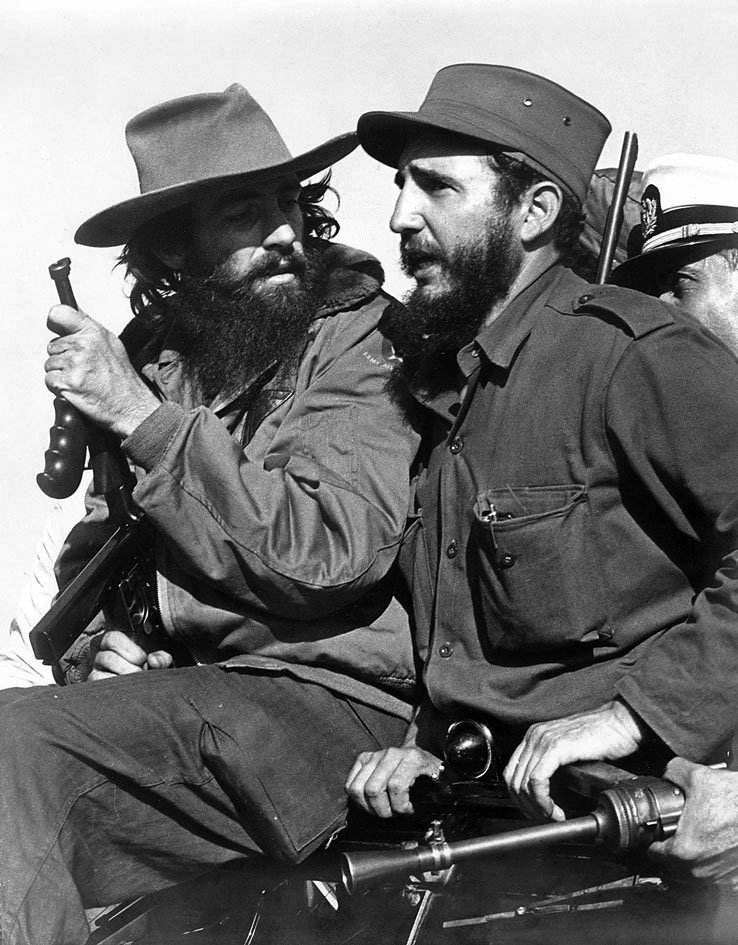
Fidel Castro and Camilo Cienfuegos in Havana in January 1959.

Enter Earl Smith. This non-Spanish-speaking businessman with no diplomatic experience took over duties as American ambassador in Havana in June, 1957. On the urging of his staff, Smith did some traveling in Cuba to get a better feel for the country. Based on his experiences and observations, Smith developed firm views on Castro and the anti-Batista movements, which views were not completely in accord with the CIA. The ambassador did not omit to inform Kirkpatrick that in his view, the CIA mission had allowed itself to fall under the sway of the July 26 movement. Smith urged the CIA to stop giving any encouragement to them. He furthermore accused the CIA of greatly underestimating the strength of the Communist party and its influence in Cuba. The CIA official responded by basically denying Smith’s charges with a bland recital of recent CIA operations, which he characterized as above reproach.

The new ambassador decided to conduct his own investigation into Castro’s background and what he found alarmed him. Smith conducted an intensive process of interviews including a multitude of people, many of whom had known Castro since his youth. He was careful to include those who were anti-Batista, representing different segments of Cuban society. According to Smith “No matter how anti-Batista these people were, they believed Castro would be worse for Cuba than Batista.” Among other reasons, those Smith interviewed stated that Castro was “an unstable terrorist.” Smith's ultimate conclusion was “It was becoming more and more obvious to me that the Castro-led 26th of July Movement embraced every element of radical political thought and terrorist inclination in Cuba.” But despite Smith’s position as ambassador, some personnel in the American Embassy continued to support Castro and relay messages to the State Department indicating that the Castro movement was nothing to fear. Not only that,  in early 1958 Radio Moscow broadcast its support of the effort to overthrow Batista. They continued especially supporting the 26th of July Movement. The State Department was informed of this by Ambassador Smith.

It was only when some rebels, under the command of Raul Castro, began kidnapping Americans that the State Department began to direct the CIA to prevent Castro from attaining power. The CIA then attempted to cultivate an alternative leader, without success.

Democratic process

Another possible solution lay in the democratic process. In 1958, after six years of military dictatorship under Batista, Cuba held a free election and began preparing the way for a peaceful transition of power. Three main candidates vied with each other for the presidency; Andrés Rivero Agüero of the Progressive Action Party, Carlos Márquez Sterling of the Partido del Pueblo Libre. The elections represented an opportunity to get rid of Batista but the US remained non-committal about which candidate to support or what official policy to adopt towards the on-going armed rebellion. Castro seemed to be a viable option. In his first speech on Radio Rebelde on April 14, 1958 Castro repeated many of the cherished ideals of classical liberalism; freedom of the press, republicanism and constitutionalism. He went out of his way to deny his association with communism, “These dictators will not tire of repeating the lie that we are "communists." He began the speech, in fact, with a withering attack on government censorship.  “As hateful as tyranny is in all its aspects, none of them is so irritating and crudely cynical as the absolute control that it has imposed on all the media for disseminating printed, radio and television news.”

On July 16 the American embassy passed along to the State Department the views of one of the opposition candidates, Dr. Marquez Sterling. Sterling communicated to the American Embassy that, in his view, the political situation was the most dangerous the Island had ever encountered. He claimed that the insurrectionists, unable to win on their own, were seeking to create conditions of anarchy that would allow them to seize power. He called Castro “mad” - not the first person to do so. Additionally, ambassador Earl T. Smith, vocally opposed any possible support of Castro. He declared openly that Castro was not someone with whom the US could trust or work with. Despite these warnings, the US did not take a firm position on Castro or the election.

The American embassy in Cuba's attitude was crystal clear, in contrast to the vague official American policy. The embassy represented a valuable front-line perspective which should have guided US policy. On October 3, 1958, just weeks before the election, an embassy dispatch entitled: “1958 Elections; Electoral Outlook Six Weeks Prior to Elections” arrived in Washington. After a thorough analysis of the political situation in Cuba, the embassy urged the following course of action:  "Though the coming Cuban elections will not meet all the standards of an ideal democratic election, they are the best that can be had under the circumstances now prevailing. They are in the Embassy’s view infinitely better than a violent overthrow of Batista and far better than no elections at all. It is therefore in the interest of the United States to encourage them." In other words, the embassy opposed any of the armed opposition, which Earl Smith viewed as illegitimate.

Election

Despite such information, ambivalence continued to mark the US official attitude toward the bearded rebel. There were, however, more red flags. First, there was Castro’s attitude toward the election. Although  he repeatedly proclaimed himself as a proponent of democracy, during the 1958 election he issued repeated calls for a general strike and death threats against all candidates for political office as well as Cubans who wished to participate. As a result, in regions under the control of the insurrection, voter turnout was negligible. Insisting that the election was a US/Batista farce, the rebels issued the “Total War Against the Tyranny Manifesto.” In the uncompromising language of the fanatic, the Manifesto simply ignored the elections and declared “war” on the Batista regime.

The elections took place on November 3rd with Progressive Action candidate Andrés Rivero Agüero winning 70% of the vote. Within days of his victory he met with the US ambassador and expressed his commitment to restore legitimacy and constitutional government in Cuba. The US was prepared to support him with military aid against insurgents. He would never get the chance. The Batista government was in the process of disintegration at that moment and would collapse within weeks. Agüero’s ambitions to restore the Cuban government were thwarted when Batista threw in the towel and fled Cuba on January 1, 1959, leaving the Island to anti-Batista forces.

When the rebels took Havana, a wave of euphoria swept Cuba. Most were hopeful that Castro and his fellow revolutionaries would establish a liberal democracy as he had stated many times. Castro and his revolution also captured the attention and hopes of many foreign observers. Although some uttered dark warnings about the bearded militant, others, mainly in the American media, helped to sway much American opinion in Castro’s favor. They denied Castro’s communism and actively promoted him as an acceptable leader of Cuba. After Castro’s arrival in Havana, American companies continued to act as if nothing would change. Investment in Cuba hit a record high of $63 million. One corporate executive remarked that the responsibilities of leadership would force Castro to “become conservative.”

Optimism

Everyone was caught up in the excitement. Immediately after Castro's entry into Havana, Ed Sullivan journeyed to the island and met the enigmatic rebel. Arriving at about two in the morning, Sullivan conducted and filmed an interview with Castro lasting about six minutes. Sullivan introduced the filmed interview with the comment “Somebody has said that ‘Freedom is Everybody’s Business.’ In the interview Castro came across as a soft-spoken, freedom-loving, responsible leader. Sullivan expressed great optimism about his subject and what it meant for the future of his suffering nation as well as Cuban-American relations.

Not long after Sullivan’s encounter with Castro, The popular show Face the Nation journeyed to Havana to expand on the entertainer’s brief conversation. Their purpose was to have a more serious and thorough opportunity to find out what this new Latin American hero was all about, and if indeed, the revolution was something to be worried about. Again, Castro emphasized his democratic ideals and opposition to communism. The main wrinkle in the generally hopeful mood was over the on-going executions. Once the anti-Batista forces took control of Havana, Batista followers were rounded up and hastily tried.  Summary executions took a gruesome toll as the revolutionary government took terrible revenge against Batista followers.for “crimes a./m gainst the people.” By the end of February 500 had been executed. The “trials” fell far short of American or European standards of justice. At one trial, a lawyer asked that the case against his defendant be dismissed due to lack of evidence. The prosecutor replied, “He has to be shot anyway as a measure of social health.” Horrified observers reacted with concern. When questioned about the executions, Castro’s responses betrayed a complete lack of understanding or sympathy for Western concepts of justice guaranteeing a fair trial. His closest associates, in fact, dismissed these ideals as “bourgeois concepts of justice.” Castro was actually surprised at the international outcry over the executions. “These men are assassins,” he declared, “We are executing murderers that deserve to be shot.” He justified denying due process of law to Batista men, declaring that the evidence was obvious and that simple accusations were all that was needed.

Anti-Americanism

The Consulate at Santiago continued to advise the State Department about conditions in the immediate aftermath of Castro’s ascension to power. They described a rising tide of anti-Americanism, encouraged, in part, by “the pronouncements of Fidel Castro.” An attempt to show films from the United States Information Service was shut down when a member of the audience rose and lectured them on “United States oppression of Cuba.” The consulate also took the opportunity to report the increasing influence of the communists. They were now accepted as a legal party, communist newspapers began to be reestablished and individuals with PSP backgrounds had been appointed to public office.

Time magazine also issued a frank assessment. The opening lines of an article of the January 26 issue warned; “The executioner’s rifle cracked across Cuba last week, and around the world voices hopefully cheering for a new democracy fell still. The men who had just won a popular revolution for old ideals—for democracy, justice and honest government—themselves picked up the arrogant tools of dictatorship. As its public urged them on, the Cuban rebel army shot more than 200 men, summarily convicted in drumhead courts, as torturers and mass murderers for the fallen Batista dictatorship. The constitution, a humanitarian document forbidding capital punishment, was overridden.” The article went on to luridly describe the executions, sounding more like descriptions of Einsatzgruppen activity rather than tribunals of real justice.

What do you think about Fidel Castro’s early days in power? Let us know below.

Now read Victor’s series on whether Wernher von Braun was a dangerous Nazi or hero of the space race here.

At the moment of Fidel Castro's triumphant entry into Havana, Cuba on January 9, 1959, the charismatic revolutionary leader was a relatively unknown quantity. Many are surprised to discover that Castro at first enjoyed much popular support in this country. Early reports on the rebel leader featured positive, if sometimes guarded, reactions. Even Ed Sullivan, America’s premier show man, got caught up in the excitement. He journeyed to Cuba himself to interview the victorious rebel leader shortly after the latter’s entry into Havana. He was but one of myriad journalists who descended on Cuba to cover the exciting changes in the island.

In this series, Victor Gamma returns and considers how the US misjudged Fidel Castro. Here, we look at how the US intervened in other places in the 1950s, and its pre-Cuban Revolution attempts to understand Fidel Castro’s beliefs.

Fidel Castro with his in the Sierra Maestra, Cuba. December 1956.

In April 1959, Castro visited the United States itself, where he appeared on popular American TV shows, gave talks at Harvard and was buoyed aloft on the shoulders of an admiring audience. In the US he generally received royal treatment wherever he went. This included children sporting Castro beards and other manifestations of Castro-mania. This is strange considering the fact that his mortal enemy, Batista, enjoyed the full backing of the US but a few months before.

As we all know, this “honeymoon” period did not last. Before the end of that year, relations between the US and Castro deteriorated beyond the point of no return. The point is: if we had a more clear idea of his ideology, if he were a communist or might become one and would become an ally of the Soviet Union, we would have been justified in acting decisively to keep him from power. An operation similar to that carried out in Guatemala in 1954 or Iran in 1952 could have been mounted. In the tense competition with the Soviet Union, it was imperative to prevent a communist government 90 miles from American shores. But without a clear understanding of Castro's ideology and/or future plans no firm policy was formulated. Instead, US policy would evolve in reaction to Castro's moves. The result of that policy was that in less than two years diplomatic ties between the United States and Cuba severed and relations degenerated into clandestine warfare. Subsequently, Cuba under Castro became a disaster for U.S. foreign policy for decades. Why did the US allow such a hostile regime to take hold so close to our shores? Why were US policy makers not clear on what Castro’s motives were or what the nature of his ideology was until too late? How did we miss the warning signs?

The problem began towards the end of the Batista regime. By 1957, after almost two decades of unwavering support of Cuban regimes, the State Department began to have doubts about continued support of Batista. Batista’s efforts to label Castro as a communist and tool of Moscow failed to gain Eisenhower’s continued support. In the corridors of power, criticism of America’s Cuban policy became more vocal. Such sentiments were even becoming a matter of public record. On August, 17, 1958, Henry Wriston, president of the Council on Foreign Relation appeared on the Mike Wallace Interview. He openly uttered such anti-Batista statements as “we don't like Batista'' and “we would be delighted to see Batista and Trujillo (the dictator of Guatemala) overthrown.” The US went beyond mere distaste. In March,1958 Eisenhower stopped sending arms to Batista, “Obviously Castro had won the emotional support of the Cuban people,” he said later in justification. The CIA had even actually begun supporting opposition movements in hopes of getting rid of an increasingly unpopular dictator. 

The US and Castro

The US enjoyed major success in sponsoring overthrows of regimes in places as diverse as Guatemala and Iran. Unlike in those countries, however, the US had no plan about whom to replace Batista with. To complicate matters, the insurrection movements prowling around in the mountains and jungles of eastern Cuba were of uncertain ideology and attitudes toward the US - and time was running out. Castro’s group, called the “26th of July Movement,” which was the most important of the various anti-Batista movements, threatened yet another violent overthrow of a Cuban government. By the summer of 1958 it was becoming clear that his regimes’ days were numbered. What should US policy be? Some feared that if something were not done soon the threat of violent revolution would materialize and replace Batista with an even worse (and leftist) government. Since Castro was likely to be an increasingly dominant force, it was vital to decide whether to support him or keep him from power.

What did the US know of Castro? Much knowledge came not from official government efforts but enterprising journalists. The long struggle by the barbudos (bearded ones) attracted much sympathy from the American press, Chief among these was New York Times reporter Herbert Matthews. Castro had been reported killed by the Batista regime. But Matthews was able to locate him. After some days with Castro, Matthews sent his report to the Times. On February 24, 1957, the world was electrified by the news: “Fidel Castro, the rebel leader of Cuba’s youth, is alive and fighting hard and successfully in the rugged, almost impenetrable fastnesses of the Sierra Maestra, at the southern tip of the island.” Along with the report Matthew provided the rebel leader’s signature as proof. The article gushed with praise, included a description of Castro as an “educated, dedicated fanatic, a man of ideals, of courage and of remarkable qualities of leadership.” He had not only dramatically revealed that Castro was not dead, he successfully portrayed him in a way that garnered widespread interest and sympathy from readers across the country. Even more importantly for US policy, he also denied that Castro was a communist or that communists were a significant force in his movement. Such reporting built a groundswell of support among the American public.

Less supportive of America

But if the US had done a profile on the indefatigable rebel, they would have known that he blamed the US for many of Cuba’s problems. At his trial in 1952 he defended himself and used the courtroom as a platform to promote his views. Included in his diatribe were such statements as “The United Fruit Company owns land the north to the south socast in Orient Province-but two hundred thousand Cuban families there don’t own an inch of land!” His villains were companies and landowners. As it was, the CIA psychological profile on Castro did not appear until December 1961, much too late. 

During this time, the American embassy in Havana was not much help. From the years 1953-57 under Ambassador Arthur Gardner, strict orders to avoid contact with anti-Batista movements were in force, effectively thwarting any chance to learn more about Castro. Not only that, such a policy put the CIA in an awkward position. It could not utilize embassy personnel and interfered with intelligence gathering. To overcome this problem, that spring of 1957 Washington sent an official fact-finding mission to Cuba to find out more about Castro. After obtaining Ambassador Gardner’s cooperation, the mission, led by CIA officer Lyman B. Kirkpatrick, Jr. set out to fill in the gaps of knowledge about the opposition to Batista. The delegation spent most of its time in Santiago de Cuba, the main town of Castro's home province, Oriente. Here they hoped to obtain first-hand information about Castro's character and philosophy. Basically, the mission did not discover anything alarming about Castro. He came from a large, wealthy land-owning family. He had attended parochial schools, gone to college, and enjoyed baseball. His former teachers had nothing but good to say about him, “He was a good Catholic boy,” said one. Others insisted that he could not possibly be a communist. The team felt that the rebel movement simply reflected the desire of Cubans to be rid of dictatorship and restore a functioning democracy. So as of 1958 the fog around Castro’s political leanings had still not cleared. It was known that he had been involved in leftist politics and that his movement included communists but in the words of Kirkpatrick “we were not sure whether he was an avowed Communist.” Castro himself had refused to make common cause with Cuban communists.

What do you think about American intelligence’s attempts to gather information on Fidel Castro in the 1950s? Let us know below.

Now read Victor’s series on whether Wernher von Braun was a dangerous Nazi or hero of the space race here.

20130801 Cold War Cuba staghound_tank0001_resized.jpg

The American made “staghound” tank occupies a place of honor on the campus of the University of Havana. Local yore says this tank was a Christmas gift from Eisenhower to Batista in 1957. The armored vehicle is one of the few remaining artifacts of the military relationship which the Cuban government had with the United States during the Cold War period.

Unlike Cuba’s later relationship with the Soviet Union, American security assistance did not transform Cuba’s capital city into a militaristic enclave. Instead, during the early period of the Cold War conflict, when the Americans provided military assistance and arms transfers to the Cuban government, the urban form and organization of Havana were transformed through the clash of two domestic forces, the military dictatorship of Fulgencio Batista and the paramilitary urban underground opposing his regime.

During the early Cold War period, Havana’s loyalty to the US was taken for granted and the government was considered a staunch ally in the fight against communism.

Cuba’s trade relationship with the United States dominated the country’s economic system so much so that in 1959 almost 80 percent of the country’s commercial transactions were with the US. The capital city, Havana, was dominant, handling a majority of the country’s imports, with between 60 and 80 percent of the country’s incoming cargo passing through the port of Old Havana.

Still, it is important to note that while it may be argued that Cuba was a client of the United States, the country’s political system was not penetrated in the strict sense of the term.

In other words, while more than half of Cuba’s foreign trade was with the United States, military and aid receipts from the Americans were not more than half its budget. Actually, in some years, US military assistance was quite negligible.

Only after 1972, when Cuba joined the economic arm of the Soviet bloc, COMECON, was the country penetrated both economically and politically by a Cold War superpower.

So, although allied with the US in the 1950s and shaped by the Soviets in the 1960s, it was not until the 1970s — the mid years of the Cold War — that Havana could be called a Cold War City.

By then, Fidel Castro’s rise to power and the American response  had cemented a mutual enmity.


By Lisa Reynolds Wolfe. This article originally appeared on www.coldwarstudies.com, a site about Cold War politics and history that has a particular focus on Cuba.

Photograph by Lisa Reynolds Wolfe 

This article is the first in a regular series of syndicated articles from some of the most interesting history blogs that will appear on the site. 

Now, get a copy of our 250-page book on the Cold War here. It is a fast-paced, fascinating book that we know you’ll enjoy!

Posted
AuthorHistory Is Now Magazine