France spent a decade and billions of francs building the Maginot Line along its German frontier, only for the German invasion of 1940 to drive straight past it. This is the story of how the Maginot Line was built, why it failed, and how its name became a byword for preparing brilliantly for the wrong war.
Nethmi Samaranayaka explains.
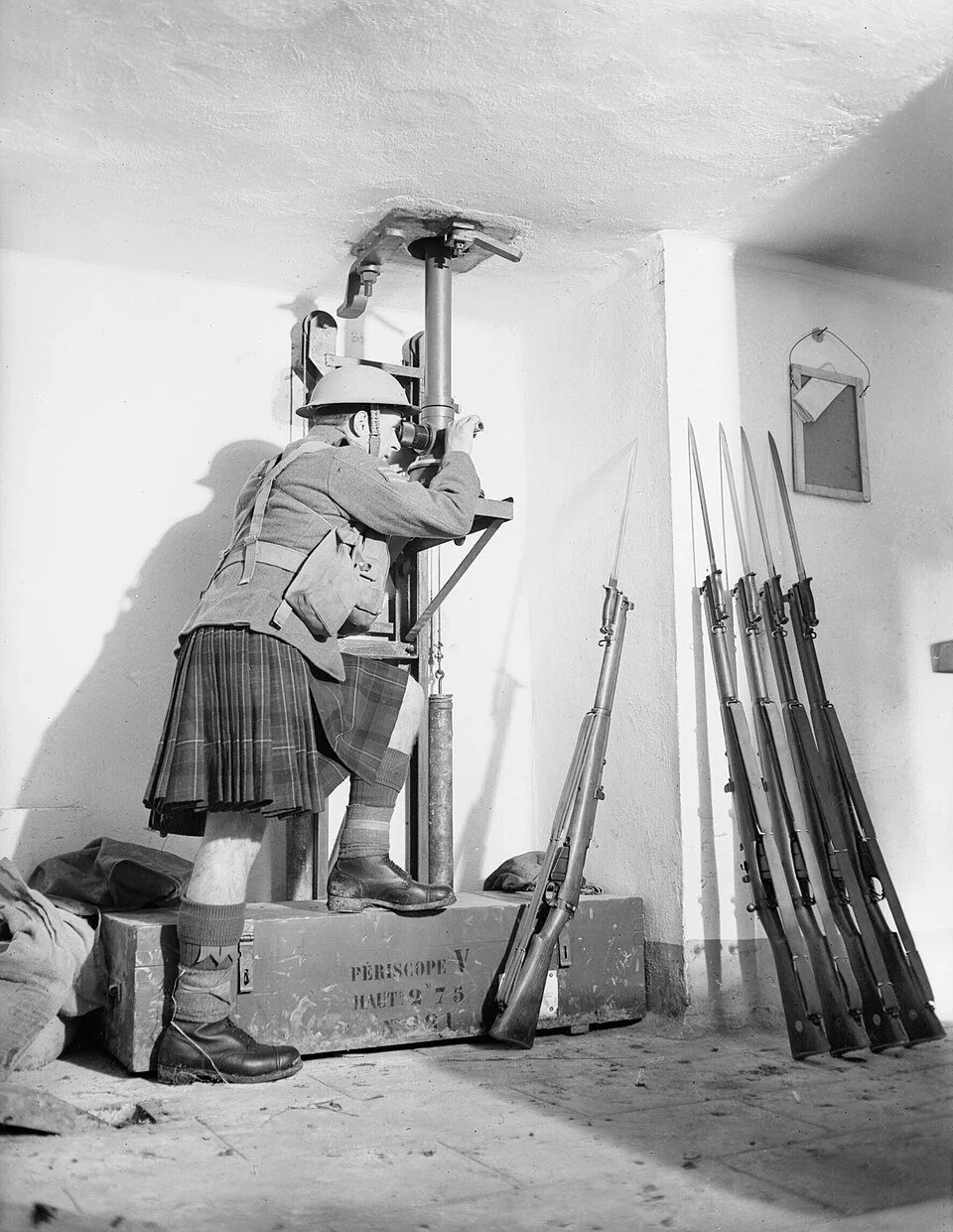
A soldier from the Cameron Highlanders looks through a periscope in the Fort de Sainghain on the Maginot Line, 3 November 1939. Source: Public domain, Imperial War Museum, available here.
Although France and Germany were originally born out of the Treaty of Verdun of 843 AD, which divided Charlemagne's empire between his three grandsons, they had many political and border disputes from that point on. This long-term friction finally led to a war between France and Prussia (the most powerful German state) in 1870-71. Prussia won a crushing victory, which brought the unified German Empire into being. On the other hand, a defeated France had to give up its highly valuable border territory of Alsace and much of Lorraine to Germany. This humiliating defeat slowly hardened the relationship between the two countries into a generational enmity.
Since then, for 43 years, a deep sense of 'cold revenge' (Revanchism) had been building in France. The French were waiting for an opportunity to reclaim their lost border territories and to take revenge on Germany for the humiliation caused to them, while Germany was struggling to protect its newly acquired power and territory. Ultimately, for several reasons, the First World War broke out in 1914, bringing destruction on a scale the world had never seen.
When the war ended in 1918, Germany was severely defeated by the Allied powers. However, the destruction left millions of casualties, an economic collapse and a mountain of debt that could never be fully repaid, for both the victorious France and the defeated Germany.
The Aftermath of War: Humiliation and the Ruhr Occupation
By that time, intoxicated by its own victory, France had already set out to humiliate Germany and impose harsh terms. To recover unpaid reparations, France and Belgium sent troops across the German border in January 1923 and occupied the Ruhr Valley, Germany's primary industrial region. The stripping of coal and other resources from the region deepened German hatred of France.
Germany's economy, meanwhile, had collapsed. With industrial production disrupted and reparations still owed, the German government began printing money without limit. By 1923 this had produced hyperinflation: the Mark was destroyed as a currency and the economy sank to its lowest point.
The Depths of Hyperinflation and Passive Resistance
The catastrophe was severe enough that an ordinary person needed a wheelbarrow of banknotes to buy a single loaf of bread. Hunger spread across the country, along with an acute shortage of work. Since firewood and coal were expensive during the winter, people burned bundles of worthless notes in their stoves to keep warm. Children whose parents could not afford toys stacked the valueless bundles and played with them like bricks.
Even though the German people had nothing to eat, they engaged in 'Passive Resistance', walking off their jobs and launching widespread strikes to stop France exploiting their country's resources. France, which had expected to profit easily, found the results very different. Unable to obtain resources due to the strikes, France borrowed heavily abroad, including from American banks, and brought in railway workers and miners of its own. It also used military force to compel German workers back to their jobs.
Shifts in Global Diplomacy: The Dawes Plan and French Demographics
Britain and America, meanwhile, were displeased by France's unilateral and heavy-handed actions. For that reason, an international committee chaired by the American banker Charles Dawes produced the 1924 'Dawes Plan', which rescheduled reparations and opened the way for the large American loans that restabilized the German economy. Germany gradually became a power in Europe once again.
France, fearing that Germany would rise again, was already facing another crisis at home: a shortage of population and labor caused by the deaths of some 1.4 million French servicemen in the First World War. With too few men to send to a future war, France chose to substitute technology, underground bunkers and concrete for manpower. As a result of this military strategy, feasibility studies begun in the mid-1920s hardened into a firm scheme, and the first works of what became the 'Maginot Line' were under way by 1928-1929.
Genesis of the Maginot Line Amid Global Depression
In late 1929, however, the collapse of the American stock market plunged the world into the Great Depression. Because the international economy rested on American loans and investment, France and Germany fell into the same abyss as everyone else. Even so, the French government succeeded in getting large allocations approved for the project in the name of national security. Accordingly, the enabling law passed the French parliament on 14 January 1930 by 274 votes to 26, allocating 2.9 billion francs over five years, and large-scale construction of the 'Maginot Line' began that same year. By taking on civilians who had lost their jobs in the crisis, France also relieved some of its own unemployment.
France had several objectives in building this defensive shield: to blunt any immediate attack from Germany, to give the French army time to mobilize, and to keep casualties down in a future war.
Economic Strain and Subterranean Marvels
The global economic crisis began to bite in France by late 1931, leaving the government short of funds. It did not back down from its defense plans: despite these obstacles, the largest construction works on the Maginot Line were carried out in the early 1930s.
It was during this time that the lower levels of the forts, the electric railway systems, and the shelters for soldiers were built deep underground in poured concrete. The Line's system of tunnels and chambers ran as deep as 30 meters (about 100 feet) below the surface. Kilometers of tunnel had to be dug simply to move from one fort to the next.
The Human Cost and the Legacy of André Maginot
A large labor force was deployed on the project. Alongside French civilians, the government recruited Italian, Polish, and North African workers in large numbers for the excavation and heavy work of the first few years. Building so far underground proved far more difficult than expected. Constant soil and concrete collapses, machinery accidents, and diseases spreading through the unventilated, enclosed environment cost the lives and health of many civilian laborers and soldiers. In truth, the Maginot Line was not merely a concrete wall but a monument to the sacrifice and hard labor of the men who built it.
However, the French War Minister André Maginot, who secured the funds for the project and drove it forward, died of typhoid fever on January 7, 1932, before the wall he had championed was finished. In tribute to his service, the fortifications were officially named the 'Maginot Line'.
The Rise of Hitler and Wartime Acceleration
By 1933, while the work on France's Maginot Line was continuing uninterrupted, Adolf Hitler became the Chancellor of Germany, which was suffering under the economic crisis. Within months he had dismantled German democracy, banned all other political parties, and made himself dictator.
France, its memories of the First World War revived, took alarm and immediately increased the money set aside for the Maginot Line. Fearing a German attack at any moment, the authorities pushed construction on the border to a round-the-clock pace, deploying civilian workers and military engineers in large numbers.
France also suspected that Nazi spies would steal the plans of the tunnels. Foreign workers were removed from the construction sites, and control of the work was handed to the French military to protect its secrecy.
Life Inside the Bunkers and the 'Phoney War'
Comfortable as the forts looked from outside, life inside them was psychologically punishing. The eight months from September 1939 to May 1940 are known as the 'Phoney War'. Since neither Germany nor France launched a major attack on the other during this period, apart from a brief French incursion into the Saar in September 1939, the soldiers underground had little to do. To fight the boredom, they played cards, read, and listened to the radio.
Months without sunlight, the constant noise of heavy machinery, and the confinement of the underground chambers left the soldiers with acute stress and claustrophobia. Above ground, the false sense of security was reinforced by government and press publicity about the Line's underground cities, modern weapons, and comfortable quarters. The public came to regard it as a miracle no enemy could defeat. The French military leadership, for its part, grew so confident that it preferred idleness to serious training. Sharper young officers pointed out that soldiers and generals alike were growing mentally lazy behind the wall, and warned that an army which believed itself safe would lose its offensive spirit altogether. This became known as the 'Maginot mentality'.
Vulnerabilities in the Defensive Shield
By this time, the main Maginot Line stretched over a distance of more than 390 kilometers from Longuyon to Belfort on the French-German border. However, it did not cover the whole French frontier. Three stretches lay outside it: the Belgian border, the Ardennes, and the Swiss border. The French high command had its reasons for paying them little attention. Switzerland was neutral, and the separate Alpine Line already covered the mountain frontier facing Italy; on the Belgian side, defense pacts meant that French plans - what became the Dyle Plan - called for the army to advance deep into Belgium if Germany invaded. The most notable mistake was France's firm belief that the 'Ardennes' region, consisting of dense, hilly forest, was a natural barrier through which heavy weapons like German tanks could never travel. Once war came, France tried to shore up these weak sectors, such as the Saar, with additional small bunkers and obstacles.
French military chiefs regarded the Maginot Line as an impregnable wall. That confidence bred a deep complacency in the military and the public alike. Such was the faith placed in the wall that the French military had prepared no contingency, even by 1940, for a German thrust through the Ardennes.
Delusions of Security and Outdated Tactics
The French public, which had suffered terrible losses of life and property in the First World War, greeted the Line's completion with relief and came to believe that war would never again reach their homeland. So when the Second World War was declared in 1939, French citizens did not panic; they held to the view that “We have the Maginot wall, the Germans can never enter our country.”
Another primary reason for France to place such blind faith in this defensive line was that its commanders were still trapped in the methods of the last war. Judging by the experience of 1914-18, they assumed the Second World War would also be fought from fixed positions, bunker against trench. As a result, France failed to anticipate German methods such as Blitzkrieg, which combined fast-moving tanks with air power.
French military chiefs were reluctant to think afresh about modern tactics or alternative plans because they had already exhausted their energies and their budget on the Maginot Line. After years of devoting the nation's attention and resources to a concrete wall, France's tactical imagination and military spirit had quietly slipped away.
The Breach of the Ardennes Forest
But in May 1940, the German army moved through the Ardennes forest, helped by French neglect of that sector and by meticulous German planning. France had incorrectly assumed that tanks could not be driven through that dense forest and its hills and had left only a handful of troops on guard; German officers, by contrast, had come there quietly before the war and mapped every dirt road a tank could use.
Although the narrow roads clogged with traffic for kilometers, the Allies failed to spot and bomb it in time, and the German Air Force (Luftwaffe) held the advantage in the skies. Using the radios fitted in their tanks, and the pontoon bridges of skilled combat engineers to cross the rivers, the Germans advanced unchecked. German troops were also issued the methamphetamine stimulant 'Pervitin', which helped crews keep going on very little sleep. They crossed in days a forest that France had expected to hold an enemy for months.
Communication Failures and the Rapid Encirclement
Warnings did reach French headquarters as the Germans crossed the Ardennes, but between outdated communications and the sheer speed of the advance there was no time left to counterattack. French reconnaissance aircraft sent messages to the higher headquarters around May 10 and 11, seeing thousands of German tanks lining up inside the forest, but French commanders dismissed the reports as a German deception. Worse, orders and reports travelled by telephone line and motorcycle rather than radio, so the true situation at the front reached headquarters long after it had changed.
Although French war experts had calculated that it would take an enemy at least two weeks to cross this difficult forest, German crews, sustained by Pervitin, drove day and night at 50-60 kilometers a day and were through it in three, bursting across the French border. Advancing 200 miles across France within 10 days of launching the attack, they reached the English Channel coast near Abbeville, cutting off and trapping the French army (Encirclement). The bitterest irony was that when word came that the Germans had bypassed the wall entirely and driven deep into France, its garrisons were still sitting down to meals underground, wholly unprepared.
Political Chaos and Disgraceful Surrender
When the German army burst through the Ardennes forest and surrounded the Maginot Line from behind, the French political and military leadership fell into panic. Government leaders, including Albert Lebrun, who was the President of France at the time, and Prime Minister Paul Reynaud, left Paris on June 10, 1940 for Tours, moving on a few days later to Bordeaux in the south-west. Maurice Gamelin was removed as commander for his misjudgments and replaced by Maxime Weygand, who could do no more to check the German advance. Ultimately they chose surrender rather than fight on and, after Reynaud resigned on June 16, the elderly Marshal Philippe Pétain was appointed in his place and signed the armistice on June 22.
As news spread that the Germans were driving fast on Paris, the public panicked. Bitter memories of German occupation in the First World War left few with the courage to stay in their homes. A population of between 6 and 8 million ordinary citizens (some 2 million from the city of Paris alone) loaded their clothing, food, and even mattresses onto small children's strollers, bicycles, and handcarts and began fleeing toward southern France. All major roads were blocked with vehicles and people, and this unplanned flight - the Exodus - created a humanitarian crisis and severe food shortages across France.
The Humanitarian Crisis of The Exodus
Germany's Stuka dive-bombers attacked the columns of refugees without mercy. Thousands died on the roads and were buried where they fell. The congestion was so bad that retreating French tanks and vehicles could not get through, and the army was stranded with them. Seeing millions of their citizens starving and bombed on the roads, France's political leaders concluded that there was no alternative to surrender. After the surrender, they returned in sorrow to homes that had been abandoned and wrecked.
Heroic Resistance in Isolation
While the country's political leaders fled in panic, the French soldiers trapped in the bunkers of the Maginot Line behaved with striking discipline and courage. When the German army began surrounding the Maginot Line from behind, tens of thousands of French soldiers in its fortresses were cut off. Many of the casemate guns were sited to fire along fixed arcs across the front of the line and could not be brought to bear on Germans approaching from the rear, although the retractable turrets of the larger forts could traverse a full 360 degrees.
The garrisons did not give up the fight. Knowing they were surrounded, they came out of the bunkers and counterattacked German units with small arms and machine guns. Even when France's capital city, Paris, fell on June 14 and seven German divisions attacked the Sarre sector of the Maginot Line in Operation Tiger, with heavy air and artillery support, the French units there fought back hard and blocked the advance.
When the government broadcast the order to stop fighting, the soldiers refused to believe it - dismissing it as enemy propaganda - and fought on until the end of June. The Germans captured only about 10 of the Line's 58 main forts in the fighting, and the garrisons of the rest fought on after the government had surrendered, still well supplied with food, water, and ammunition. They held their forts and refused to give them up.
The Final Order and Post-War Reflection
Only after senior French commanders came to the forts in person and gave the order in writing did the garrisons - nearly 22,000 men - hand over their positions, under protest, in the first days of July. Afterwards, they were held as German prisoners of war for the rest of the war, in most cases close to five years.
Even today, the Maginot Line, which can be seen along the borders of France, stands as proof of the engineering skill of its age. Its bunkers, communication networks, and mechanized weapon systems - which Hitler's army captured and put to its own use - still impress visitors from across the world today.
Now read about Britain’s alliances with France and the Soviet Union during World War Two here.
References
Ruhr Valley Occupation: https://www.britannica.com/place/Ruhr
Hyperinflation in Germany: https://www.britannica.com/topic/hyperinflation
The Dawes Plan (1924): https://history.state.gov/milestones/1921-1930/dawes-plan
The Maginot Line History: https://www.britannica.com/topic/Maginot-Line
The Phoney War Period: https://www.britannica.com/event/Phoney-War
The Fall of France & Ardennes: https://www.iwm.org.uk/history/the-fall-of-france