In the first of three articles we will focus on the life of one of South America’s most famous historical personalities, Ernesto Guevara, who later became more widely known as the Marxist revolutionary Che Guevara. He was, and remains, a polemic figure in the political arena, every bit as divisive now as during his time in the Cuban Revolution and the Cold War of the 1960s. He has also become an unlikely fashion icon, his face appearing on millions of T-shirts worn by generation after generation. He has been portrayed on screen by famous actors, most notably Omar Sharif and Benicio Del Toro. His impact and legacy have divided students of history and politics alike, who view him as either a symbol of freedom or an oppressive, communist-driven tyrant. Some laud his achievements; others argue that his legend is largely a construction of propaganda and myth.
Che’s revolutionary period will be covered in a later article, but what of his life before that? We will begin with his formative years, up to the point where he set out on his first extensive travels — the journey made famous in the book “The Motorcycle Diaries.” The young man you will read about below appears very different from the figure who would later accompany Castro in the Cuban Revolution.
Steve Prout explains.
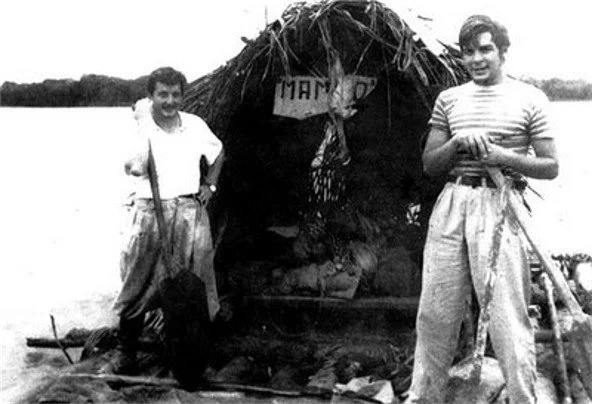
Ernesto Guevara (on the right) and Alberto Granado (left) on the "Mambo-Tango" raft on the Amazon River in 1952. Source: Museo Che Guevara, public domain, available here.
Early family life
Che Guevara was officially born Ernesto Guevara de la Serna on June 14, 1928 in Argentina. He was in fact born a month earlier, in May, but because his parents were not yet married, they persuaded a family doctor to falsify the birth certificate to spare the family social stigma. He was raised in an upper middle-class family. His father, Ernesto Guevara Lynch, was, like Che, an interesting character in his own right. Politically he leant to the left and took part in various political demonstrations. Che would later admit in his memoirs that he had a “combative” relationship with him. Ernesto Senior was highly educated and trained as an engineer, attending university but never graduating. He was also restless, embarking on a string of risky and largely unsuccessful business ventures: a yacht-building company, several construction businesses and a 500-acre yerba mate plantation on the Rio Paraná in Misiones, near the Argentine border with Paraguay. With few exceptions his ventures failed, leaving the family’s finances in a precarious position.
Che’s mother was Celia de la Serna, and her relationship with Ernesto Senior came with its share of challenges. The couple’s intended union did not, at first, get the approval of Celia’s family, who saw Ernesto Senior as unreliable and unsuitable as a husband. Their misgivings were not helped by Celia’s appeals for access to her inheritance to fund Ernesto’s ventures, which would in time prove ruinous to her own finances. They saw Ernesto Senior as a dilettante lacking genuine intentions. The family eventually gave in after the couple threatened to elope. To add to the drama, what the family did not know was that Celia, still unmarried, was already pregnant with young Ernesto.
Then, in June (officially) — or, more truthfully, May 1928 — young Ernesto, the future Che, was born. From early childhood he was sickly, plagued by asthma, a condition that would trouble him throughout his life. It did not stop him from throwing himself into school sports, often to his own detriment. This was, in fact, his attitude throughout his life: he would push on with whatever path he was on, regardless.
Young Ernesto was an avid reader, working his way through a wide range of genres when he was not throwing himself into physical pursuits ill-suited to an asthmatic, such as rugby. As a pupil he did not particularly stand out: his school grades in 1938, aged nine, were deemed simply “satisfactory”. He was an attention-seeker, often carrying out ridiculous pranks — drinking writing ink, eating chalk, or playing matador with a ram. He also took part in his father’s political demonstrations through the 1930s and 1940s.
When he was eleven years old, young Ernesto became involved in his father’s pressure group, Acción Argentina. According to his father, Che spent “all the free time he had outside his playtime and studies collaborating with us.” What exactly young Ernesto did, and the extent of his involvement, is unclear. The 1930s were a turbulent time in Europe and the Far East, and some of that turbulence reached South America. His father was firmly on the side of the anti-fascist movement, although the organisation itself was largely ineffective; Ernesto only protested at a safe distance, and it gained little traction on any single cause. Its main focus was the fear of Nazi infiltration on the South American continent. Events in the Spanish Civil War also divided Argentine opinion. Ernesto Senior himself was a staunch supporter of the Spanish Republicans against Franco, and later of the Allied cause against the Axis in the Second World War. As far as young Ernesto was concerned, however, he could detach himself from these causes as easily as he had become involved. For now, his interest in politics and political ideals lay deeply dormant.
His father, to quote one authority on Che’s family, had “an inescapable sense of Walter Mitty in him” and “desperately wished for a life of adventure and travelling.” He was full of empty boasts. On one occasion he claimed he would take up arms for Paraguay in the Chaco War with Bolivia (1932–35), but nothing came of it. The same was true of his supposed intention to intervene in the Spanish Civil War.
Ernesto Guevara – the student years
For now, young Ernesto concerned himself with other distractions. He was a voracious reader, and reading consumed much of his free time. His reading material was wide-ranging and advanced for his age, including works by Freud, Dumas and other heavyweight authors. His other passion in his formative years was sport. He joined a rugby team organised by Alberto Granado — an older friend, and his future travelling companion — who at first doubted Ernesto’s physical capability. He was an unlikely pick for a trial: not “robust”, and with “very thin arms”. In this period, young Che’s political activities remained minimal, apart from one incident involving Granado and a brief stint of Nazi-hunting in Argentina.
In November 1943, Alberto was arrested at a student demonstration by Argentina’s new authoritarian regime. General Pedro Ramírez had taken oppressive measures to silence any opposition, and Alberto was part of a growing protest movement. He was quickly thrown into a local jail, where young Ernesto visited him. Alberto, then aged twenty-one, asked Ernesto, then fifteen, to join his cause. Ernesto declined to take part in a march, regarding it as futile; he added that he would only join if he were given a gun, since he considered any other form of protest pointless. His political views were inconsistent, swinging between indifference and a kind of latent extremism. The two friends clearly had their political differences, but it did not harm the friendship.
While young Ernesto kept up his reading and pushed through his asthma with all kinds of sporting challenges, the wider political landscape was shifting. In the post-war period, Juan Perón was making his presence felt in Argentina under President Edelmiro Farrell, whose regime combined suspected Nazi sympathies (it later offered refuge to high-ranking Nazi war criminals) with authoritarian control. Ernesto’s family were anti-Peronist, and young Ernesto adopted the same outlook, continuing his father’s amateur Nazi-hunting with a group of old school friends. His father curiously warned him of the risks, yet Ernesto kept at it — though he “was far short of active militancy”, and his interest soon petered out. The regime remained controversial, but Che himself would later say, “I had no social preoccupations in my adolescence and no participation in the political or student struggles in Argentina.” For now, he had the normal teenage pursuits to occupy him: sport, study and, of course, the opposite sex. His distractions were everywhere except in politics.
Che - philosopher, engineer, medical student, traveller
As the war ended, Ernesto, now eighteen, developed a new interest in writing and philosophy. At one point he even began compiling his own philosophical dictionary, which he intended for publication. The first draft ran to 165 pages, and he would continue working on it over the next ten years. During this period his reading became more varied, and he mixed with a social circle of like-minded people on an intellectual and academic path; he was, in many ways, the quintessential student.
In 1946, as Perón took control of Argentina, Ernesto Jr. turned eighteen. It was a time of mixed personal fortunes. Still apolitical, Ernesto took his first job, although he had not yet finished his studies and intended to go further. His father arranged for him to attend a course in soil analysis, which opened a door into the road-construction business. At that point Ernesto had excelled in mathematics and the sciences and was thinking of a career in engineering. The job was a stop-gap for an undecided teenager; in the meantime, it gave him the money to enjoy his teenage years.
At home things were not so bright. The family had run into financial difficulties: Ernesto Senior had been forced to sell his plantation, and a building business he had entered had failed. With the family finances in a parlous state, they sold off their remaining assets and relocated to Buenos Aires. In the meantime, young Ernesto’s parents decided to separate. While all this was happening, young Ernesto’s grandmother, to whom he was close, died. In his sister’s words, he was so grief-stricken it “must have been one of the great sadnesses of his life.”
Amid all this turmoil, Ernesto decided on another change of career. He abandoned engineering and turned instead to medicine, enrolling at the Faculty of Medicine of the University of Buenos Aires. A number of reasons have been suggested for the switch. One is that he was looking for something meaningful after the helplessness he had felt following his grandmother’s death. Some put it down to his frustration at being unable to cure his own debilitating asthma. Others — more plausibly — trace it to his restless, indecisive temperament. This last reading is supported by his own words: he “dreamed of becoming a famous researcher…of working indefatigably to find something that would be definitively placed at the disposition of humanity”, while elsewhere he spoke of seeking a “personal triumph”. He seemed driven, in part, by ego and a desire for prominence.
Within his university circle, he was considered an oddball, an eccentric who ignored the latest fashions and was often deliberately scruffy in his appearance. He was socially awkward and a clumsy dancer — very different from the combative, confident speaker of his later political years.
In between his studies, in 1950, he tried — unsuccessfully — to set himself up as an entrepreneur, first attempting to manufacture a pesticide and then, with a friend, selling second-hand goods. Despite his intelligence, he lacked any real business acumen. That same year, he made a long solo trip around northern Argentina on a bicycle fitted with a small motor, covering over 2,000 miles before returning to his studies. The trip was largely uneventful, but it gave him a taste for further travel. He still had two years of his degree to complete, but true to form his interest was once again beginning to wane.
Of course, going into every minor detail, every failed adventure, failed relationship and passing observation would bloat this article, dilute its value, and miss the main points. The interest lies in seeing Ernesto Guevara’s life before he became that cultural yet polemic icon. The Che we know was many things by this stage, but he was far from a revolutionary. He was, in fact, an unsettled, erratic and indecisive young man, in a family that was itself anything but settled. Up to this point he had been an aspiring philosopher, engineer, entrepreneur and no doubt many other things; but, much like his father, he was unsuccessful in all of them, largely through loss of interest. Even his political dalliances suffered the same indifferent fate. Young Ernesto wanted more — he just did not yet know what “more” was.
Young Ernesto was about to embark on the first of two great travelling adventures around South America. While the first trip was impactful, the second trip would prove career-defining and was published in book form some years later. For now, young Ernesto had only one expectation from life: to study, travel and enjoy himself. Revolution and politics were the furthest thing from his mind. And so, in January 1952, the journey that became “The Motorcycle Diaries”, with his friend Alberto Granado, began.
Now read part 2 on Che’s revolutionary years in the 1950s here.
What do you think of Che Guevara? Let us know below.
Sources
I Embrace You with All My Revolutionary Fervour – Ernesto Che Guevara – Collected letters 1947-1967 – Penguin Modern Classics
The Motorcycle Diaries – Che Guevara – 1995 -Fourth Estate Paper Backs
Che Guevara – A Revolutionary Life – Jon Lee Anderson – Penguin - 1997