Vitus Jonassen Bering remains one of the most compelling figures of the great age of exploration, a navigator whose journeys helped redraw the world's map and whose legacy continues to shape the understanding of the northern Pacific. Born in 1681 in the small Danish town of Horsens, Bering grew up in a modest family but showed early ambition and aptitude for a life at sea. Denmark in the late seventeenth century was deeply connected to maritime trade and naval service, and like many young men of his region, Bering was drawn to the ocean. He entered naval service in his teens and soon began to sail widely, developing both technical skill and intellectual curiosity.
Terry Bailey explains.
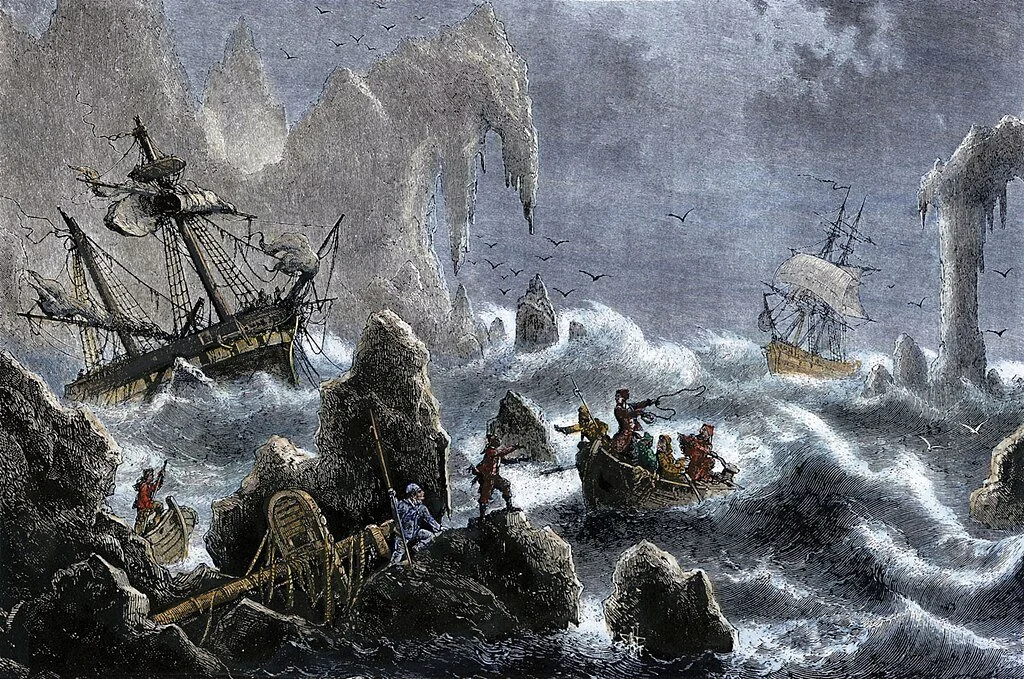
A depiction of Vitus Bering's expedition being wrecked on the Commander Islands in 1741.
Vitus Bering’s decision in 1703 to join the Russian Navy, then being rapidly modernized by Peter the Great, proved the turning point of his life, opening the door to one of history's most consequential careers in exploration. Bering first gained the confidence of the Russian court through disciplined service and steady competence in naval operations, particularly during the Great Northern War. By the 1720s, Russia's ambitions had shifted toward the vast, unmapped territories of Siberia and the Pacific. The question of whether Asia and North America were connected by land remained one of the great geographic uncertainties of the era. In 1724, Peter the Great authorized what became known as the First Kamchatka Expedition, placing Bering in command. His mission was deceptively simple: travel across Siberia, build ships on the remote Kamchatka Peninsula, and set sail eastward to determine the relationship between the continents. The sheer logistical scale of this undertaking, thousands of kilometers of wilderness, extreme climates, and complex local interactions made it one of the most ambitious scientific programs of the eighteenth century.
The First Kamchatka Expedition lasted from 1725 to 1730 and tested every skill Bering possessed. After an arduous overland journey from St. Petersburg to Okhotsk, he supervised the construction of the small vessel Saint Gabriel and, in 1728, sailed north along the coast. Bering's most significant achievement during this voyage was his passage through what is now the Bering Strait, the narrow channel separating Asia from North America. Although he did not sight the coast of the American continent itself, fog and distance prevented the definitive moment, his careful observations confirmed that no land connection existed and that a navigable waterway separated the two continents.
This conclusion, though at the time somewhat understated, had enormous global implications, refuting long-held cartographic myths and opening new horizons for exploration, trade, and scientific inquiry. His success led to an even more ambitious undertaking: the Second Kamchatka Expedition, or Great Northern Expedition, launched in 1733. This was one of the largest scientific expeditions ever mounted, involving thousands of personnel, multiple ships, naturalists, cartographers, and scholars. Its purpose was nothing less than the comprehensive mapping of Russia's vast northern and eastern frontiers and the full exploration of the Pacific coasts of Siberia and the North American continent. Under Bering's command, the expedition produced some of the most detailed charts of the Arctic coastline to date and enriched science with vast collections of biological, geological, and ethnographic data. It also laid the foundations for Russia's later commercial presence in Alaska, expanding European knowledge of the region's peoples, fauna, and natural resources.
The pinnacle of Bering's exploratory achievements occurred in 1741, when he and Aleksei Chirikov each commanded vessels on a voyage east from Kamchatka. During this journey, Bering sighted the southern coast of Alaska, while Chirikov made landfall separately on the Alexander Archipelago. These discoveries confirmed the existence of a large North American landmass far to the northwest, ending centuries of speculation. Along the Alaskan coast, Bering's crew collected valuable geographical information and encountered wildlife unknown in Europe, including the now-extinct Steller's sea cow, first documented by the expedition's naturalist, Georg Wilhelm Steller. The scientific material gathered during this voyage—flora, fauna, coastal descriptions—became an enduring contribution to European knowledge of the Pacific world.
Yet Bering's later life was marked by hardship. On the return voyage from Alaska, his ship, the Saint Peter, was wrecked on what would later be named Bering Island. There, in the treacherous winter of 1741–1742, the stranded expedition struggled to survive. Ill, exhausted, and suffering from what was likely scurvy, Bering died on the island in December 1741. His companions buried him in the sands above the beach, and only in the twentieth century did archaeological excavations uncover what are believed to be his remains. Studies on Bering Island revealed traces of the expedition's encampment, artefacts from the shipwreck, and the physical toll the harsh conditions had taken on the men, adding a poignant material dimension to the historical record.
Although Bering himself wrote relatively little in the form of personal memoir, his official journals, reports, and navigational charts form a crucial part of the documentary legacy of his expeditions. These were carefully preserved in Russian archives and later studied by historians of exploration, providing insight into his methods and the organizational challenges he faced. Much of what is known about day-to-day events, wildlife observations, and interactions with Indigenous peoples comes from the writings of his companions, particularly Steller. Nonetheless, Bering's own meticulous documentation, his coastal measurements, bearings, and hydrographic notes remain indispensable for understanding the achievements of the Great Northern Expedition.
In the centuries since his death, Vitus Bering's influence has only grown. The naming of the Bering Sea, Bering Strait, and Bering Island stands as a testament to his significance, but his deeper contribution lies in transforming Europe's conception of the North Pacific. His voyages shifted the boundaries of known geography, inspired further scientific inquiry, and facilitated cultural and economic links across the northern ocean. Moreover, his expeditions demonstrated the potential of coordinated, state-sponsored scientific exploration on a grand scale, prefiguring the later exploratory enterprises of the Enlightenment and beyond. Bering's life, shaped by quiet determination and monumental purpose, continues to resonate as a story of human endurance at the edge of the known world, a record of the power of curiosity and the relentless pursuit of knowledge.
In reflecting upon the life and legacy of Vitus Bering, it becomes clear that his achievements extend far beyond the geographical features that bear his name. His voyages represent a decisive moment in humanity's ongoing effort to understand the planet, bridging the gap between myth and measurable reality. Bering operated in an age when large expanses of the globe remained uncharted, yet his approach to exploration was grounded in discipline, scientific observation, and a commitment to accuracy. He brought a quiet, methodical determination to endeavors that were anything but quiet or simple, and in doing so helped to usher in a new era of empirical discovery. His journeys across Siberia and the Pacific elevated Russia's geographical knowledge, enriched European science, and altered the world's cartographic worldview, ensuring that future generations would navigate with greater certainty and insight.
Bering's story also encapsulates the human cost of exploration, a reminder that progress often comes at great personal sacrifice. The challenges he faced, from perilous seas to the unforgiving winters of Kamchatka and Bering Island, underscore the resilience demanded of explorers who dared venture into the unknown with limited technology and fragile resources. His death, far from home on a desolate shore, stands as a solemn statement to the risks he willingly shouldered in the pursuit of knowledge. Yet even in death, his contribution did not fade. The archaeological discoveries on Bering Island and the careful preservation of his charts and journals give his work a lasting presence, allowing modern scholars to trace the contours of his expeditions and appreciate the precision of his observations.
Ultimately, Vitus Bering's legacy lies not only in the lands he charted but also in the intellectual landscape he reshaped. His expeditions expanded the boundaries of the known world and helped lay the foundation for future exploration, scientific inquiry, and international exchange across the northern Pacific. Through perseverance and skill, he transformed uncertainty into understanding and mystery into mapped reality. More than two centuries later, his life continues to inspire, proving a reminder that progress is built by those willing to push beyond familiar horizons. In charting the edges of continents, Bering charted the edges of human possibility, leaving behind a legacy as vast and enduring as the waters that now bear his name.
The site has been offering a wide variety of high-quality, free history content since 2012. If you’d like to say ‘thank you’ and help us with site running costs, please consider donating here.