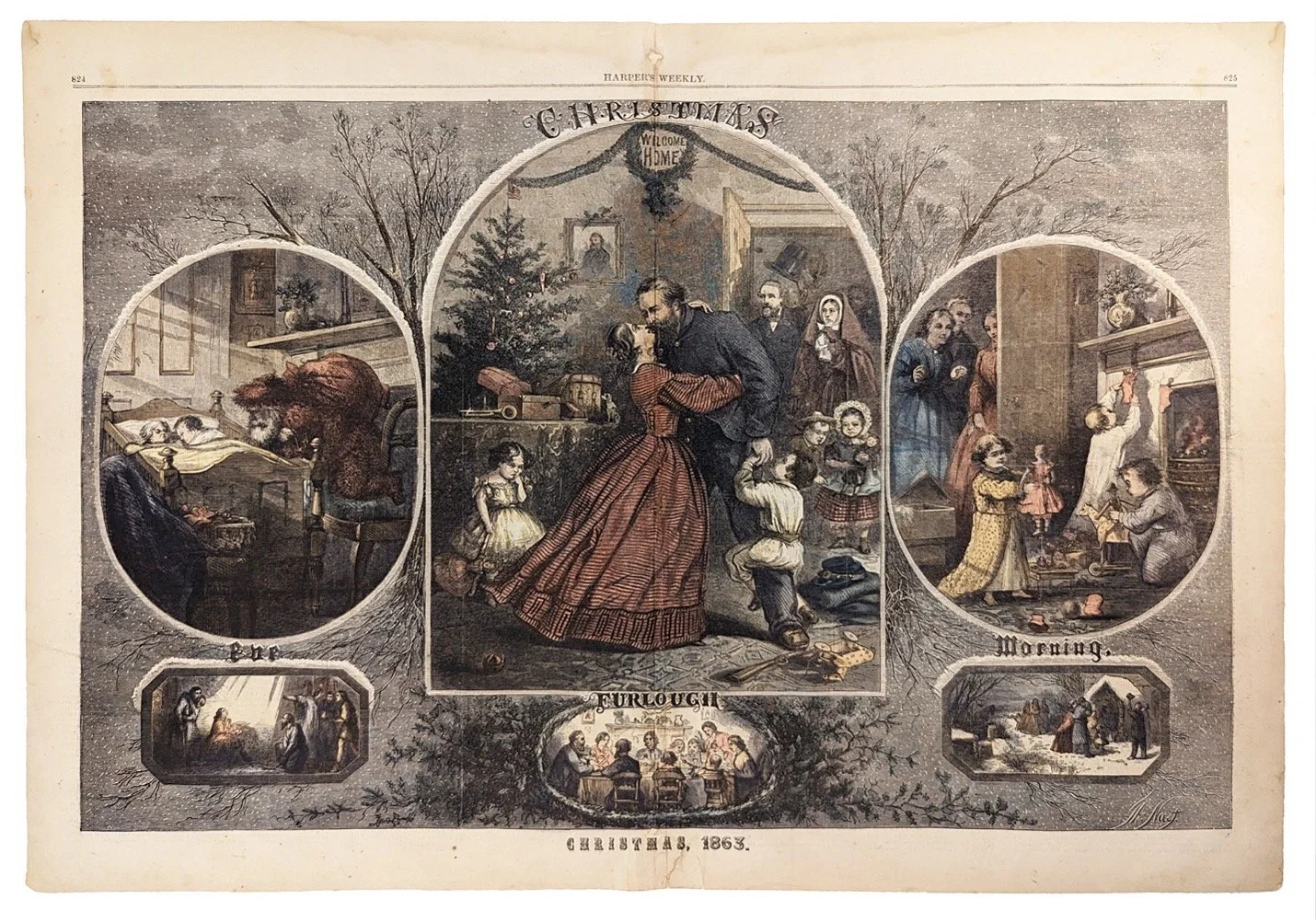
We take for granted that the Christmas Season entails children are home from school, festive meals are being prepared, airports are crowded as people rush home to their families and parties are in full swing, all in anticipation of the jolly old elf Santa Claus’s arrival. Not many people realize though that all of those traditions have their origins in the Civil War.

Lloyd W Klein explains.

The religious nature of the holiday season upon us aside, this time of year has been a time of celebration and gift giving for centuries. The Twelve Days of Christmas and many other traditional songs, as well as Dickens’s Christmas Carol, show that this is a celebration time that goes way back in the European culture. This week we are going to trace how the Civil War led to the making of Christmas as a secular, national holiday.

Unsurprisingly, the story is at base a political one. On Christmas Day 1861, President Lincoln chose to host a party at the White House. It was a crucial political moment because Mr Lincoln had a brewing international crisis that he had to stop before it got out of hand.

On Christmas Day 1862, the country was in a national panic. Setbacks in the war had made it anything but a happy season. On this day, Mr and Mrs Lincoln did something that seems so much a part of the responsibility of the POTUS on this holiday that its astounding that it hasn’t always been traditional. And on Christmas in 1863, the Lincoln’s made yet another gesture of good will to the soldiers in the field.

In 1861 President Lincoln sought to limit an international crisis by throwing a Christmas Party at the White House. The Trent Affair had led to the capture of the appointed Confederate representatives to Britain and France, John Slidell and James Murray Mason. War clouds had started to collect as the British Prime Minister insisted that the US had no right to capture these men on open seas. The capture occurred on November 8 and had become an international scandal after November 18. By Christmastime, there were rumors of British preparations for war and also significant diplomatic efforts were in progress. There were rumors of an invasion from Canada .So, there was a lot for Lincoln to “soft shoe” that day.

In 1862, the Lincoln Family began a tradition to counter the public effects of The Battle of Fredericksburg, which had been a military disaster that spawned a political and public relations catastrophe. “What will the country say?” Lincoln asked. But the POTUS was a political mastermind, and he turned crisis into opportunity, The Lincolns pointedly went the various hospitals around Washington and visited and spoke with the wounded. No president had ever done this before. It showed that Lincoln the commander in chief was a sensitive leader who felt the people’s pain.

The hospital visits were so popular, and so necessary, that Lincoln continued them. He brought his son Tad with him on many such days. Tad was deeply moved by the soldiers. So on Xmas 1863, wounded soldiers received gifts of books and clothing from the White House, with a covering note that said, “From Tad Lincoln”.

And in 1864, General Sherman telegrammed Lincoln on December 22, 1864 announcing the capture of Savanah. By 1865, as the image above shows, Christmas was a celebration of victory in. the war.

The soldiers on the battlefield were far away from home, many had never been outside their county in their lives let alone their state. Union soldiers used salt pork and hardtack to decorate Christmas trees. Others were treated to special meals; a captain from Massachusetts treated his soldiers to foods such as turkey, oysters, pies, and apples; Singing carols was popular, ones that remain popular today, but Christmas cards would not become popular until the 1870s.

When we fly or drive home to Grandmothers House for Christmas, the origin of that tradition is the Civil War Fathers on both sides of the war were often given furloughs to return home for the holiday.

Christmas originates with a significant religious meaning and yet it has become secular in its celebration. Almost no one knows that this trend began in the Civil War. And even more surprising to many, without Thomas Nast, Christmas as we know it probably wouldn’t exist. But Nast wasn’t interested so much in Christmas. He was interested in a much bigger issue.

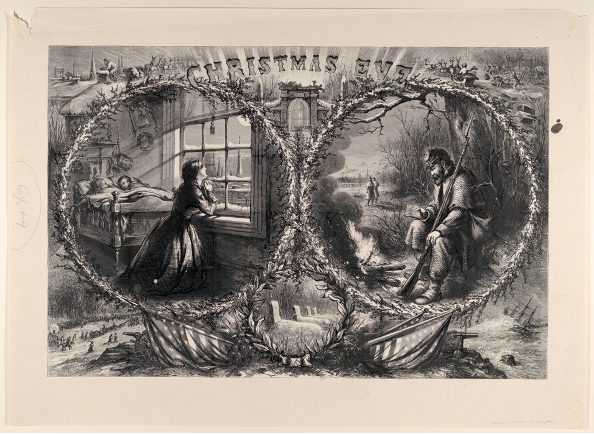
Nast was a cartoonist for Harper’s Weekly during the Civil War. If Nast wasn’t so interested in Christmas, why the recurrent theme? The 2 Nast cartoons depict Christmas experiences during the war. Identify the subjects of each and what was groundbreaking about them.

The fact is that Nast was a first class political cartoonist who was a Union sympathizing propagandist using Christmas to draw on the emotions of the season to bring the country together.

In the top cartoon, "Christmas Eve" (1862), a wreath frames a scene of a soldier's praying wife and sleeping children at home; a second wreath frames the soldier seated by a campfire, gazing longingly at small pictures of his loved ones.

Another illustration features Santa in his sleigh, then going down a chimney, in the top left of the cartoon. Somber scenes below remind of a grimmer reality--an army marching through snow and a row of frozen graves that refers to the Union's recent failure to take Fredericksburg. But there is hope: Santa is coming!

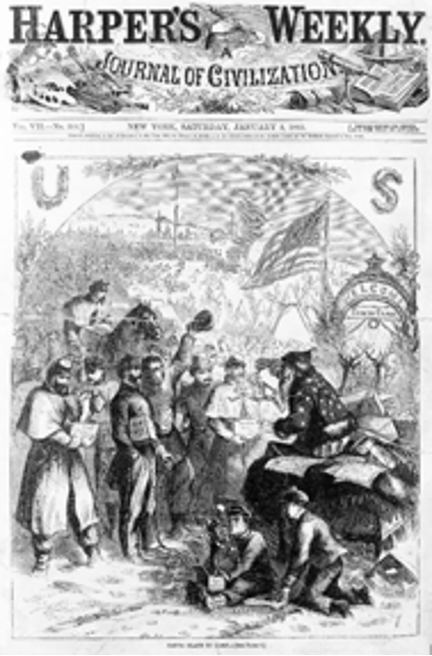
the January 3, 1863 issue of Harper's Weekly, Nast has an early caricature of Santa dressed in an American flag, with a puppet with the name "Jeff" written on it, Nast was inspired by the Belsnickel, part of the folklore in southwestern Germany, You’ll notice his sleigh is drawn by 2 scrawny reindeer.

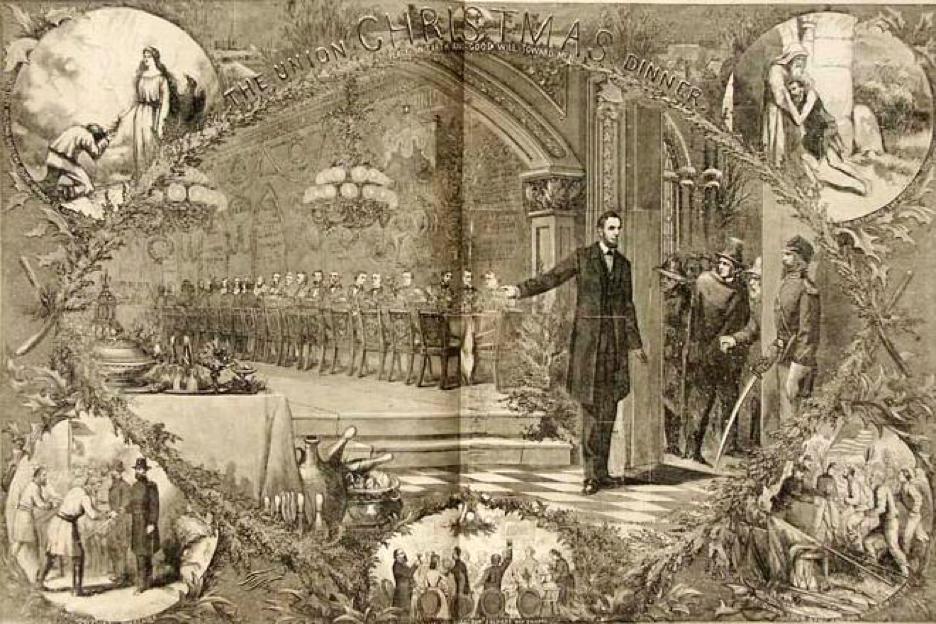
Nast’s 1864 Christmas cartoon in Harper’s. You can clearly see Lincoln beckoning men outside the door into the Christmas feast. But once again, he is making a political point. . Lincoln is seen ushering in the Confederates to re-join the US in a celebratory setting. of a holiday held in common. It is, of course, pure propaganda, but consistent with the war goal of reunification.

Nast’s Christmas cartoons were so successful that he essentially created much of the holiday we know. Nast was not the only one to use Christmas as a propaganda tool. On the Union side, The New York Herald also engaged in propaganda. One illustration published in the paper included Santa Claus fuming that he could not reach southern children, due to the northern blockade. On the Confederate side, The Richmond Examiner described Santa to its young readers as "a Dutch toy monger" who was a New York/New England "scrub" and Hottentot that had nothing to do with traditional Virginian celebrations of Christmas. Nast had successfully made Christmas a Union holiday, and that is propaganda at a very high level.

“In these two drawings, Christmas became a Union holiday and Santa a Union local deity,” writes Adam Gopnik in a 1997 issue of the New Yorker. “It gave Christmas to the North—gave to the Union cause an aura of domestic sentiment, and even sentimentality.” Nast’s 1863 Christmas cartoon showed the couple shown in 1862 reunited.

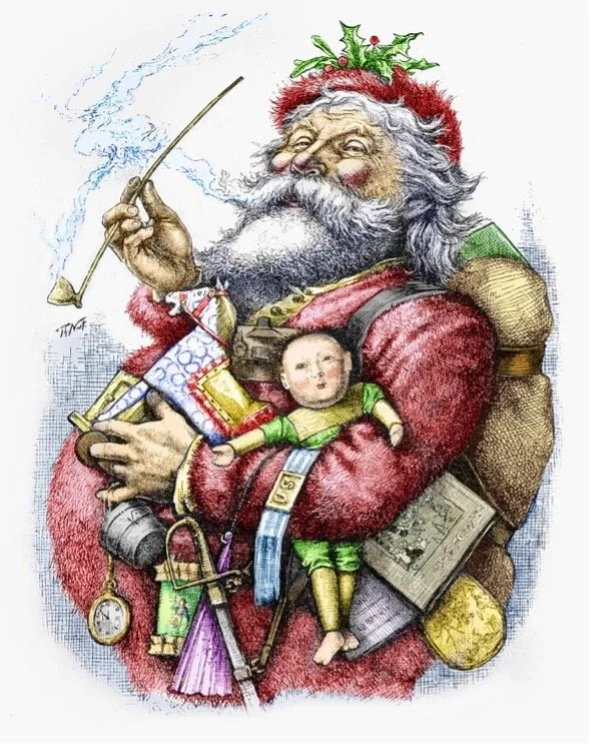
Use of a Santa-like figure for propaganda purposes would eventually lead after the war to the elf myth of the jolly old Saint Nick. Between 1862 and 1886, Nast created thirty-three Santa Claus drawings. The iconic version of Santa Claus as a jolly man in red with a white beard and a sack of toys was immortalized in 1881, depicted by Nast in the cartoon attached, But he also gave the definitive appearance to Uncle Sam, America personified. Notice how they both have white beards, but one is tall and thin and the other short and plump. Nast didn’t invent Uncle Sam, as many people believe, but he did standardize his appearance and affect. Santa Claus derives from Sinterklaas, the Dutch rendering of St Nicholas, which was popularized in the 1823 poem “A Visit From St. Nicholas”.

DGCC: Notice that the Santa in the 1881 cartoon is smoking an old-style Dutch clay pipe and has a Civil War saber (?toy) hanging from his waistband. He is carrying a knapsack on his back, not filled with clothes and war supplies anymore, but with toys. These details are deliberate; Nast is immortalizing a new personification: the former Union soldier is now older, happily smoking an old pipe, and raising a family 16 years after the war’s end. But the old soldier is still in him. Nast knew his business.

It was also Thomas Nast who decided that Santa and his reindeer lived at the North Pole. After the war Nast purposely made the North Pole the home of Saint Nick so that no one else could use him for nationalistic propaganda like Nast himself did.

It’s hard to imagine today, but Christmas was not always considered a “national” holiday.

Because of the recognition that soldiers on both sides of the war, and of all religious backgrounds, found end of the year celebrations as fostering community and country, that view began to change. Politicians started to recognize in the post war period that if they wanted to bring the country together and heal wounds, Xmas was a natural solution.

Puritans and Lutherans viewed non-sectarian celebrations of Christmas during the war as sacrilegious. They believed the day should be dedicated to fasting and prayer, and looked askance at such practices.  In Massachusetts, such parties were considered a waste of money and could be fined.

The legal recognition of Christmas as a national holiday occurred when Representative Burton Chauncey Cook of Illinois introduced a bill in the U.S. Congress after the war. It passed in both houses of Congress, and President Ulysses S. Grant signed it on June 28, 1870. On June 26, 1870, Congress — led by Northern legislators — passed a law that made Christmas (along with New Year’s Day, Independence Day, and Thanksgiving) a federal holiday for federal employees in Washington, D.C. This was later extended nationwide. Ulysses S. Grant signed the law, partly as a gesture of reconciliation between North and South during Reconstruction.


The site has been offering a wide variety of high-quality, free history content since 2012. If you’d like to say ‘thank you’ and help us with site running costs, please consider donating here.

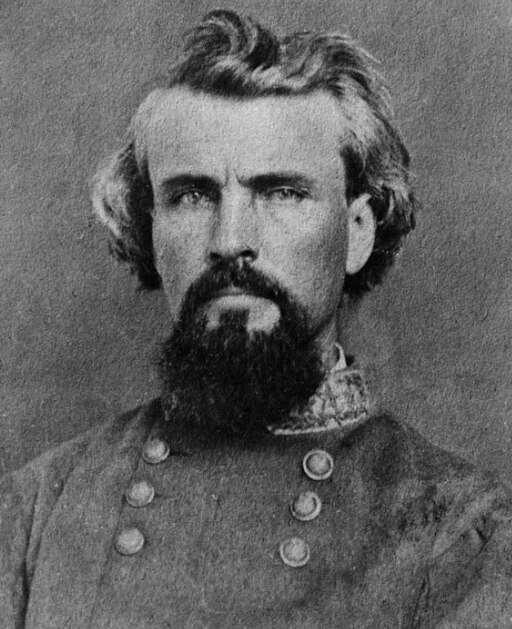
Perhaps the most fascinating Civil War general to Jeb Smith is Nathan Bedford Forest. Many think he is not just the best cavalry general of the American Civil War but among the greatest to ever live. He acquired more confirmed kills in war than any America has ever achieved. No general as high a rank as Forrest killed as many men since the medieval period. He had 29 horses shot from under him and said, “I ended the war a horse up.” He was one of the most feared individuals of the war and was said to be a “Superhuman warrior.” One friend who knew him before the war said he looked unrecognizable in battle. His face and eyes would change.

A natural military genius, Forrest rose from the rank of private to lieutenant general. His willingness to mix personally in combat led to him receiving multiple wounds doctors feared would be fatal, all of which he survived. The famed Civil War author Shelby Foote opined that the Civil War produced two geniuses: Abraham Lincoln and Nathan Bedford Forrest.

Nathan Bedford Forrest.

Pre-war

Born into poverty in Tennessee, Forrest received little formal education and no military training. By 1860, he owned two plantations, traded extensively in slaves, and was one of the wealthiest men in Memphis. He was tall, muscular, and powerful even for his size. An adamant believer in states’ rights and secession, the war was not the first violence he engaged in. Before it even began, he had killed several people.

In 1845, in Mississippi, his uncle was killed in a street fight; in retaliation, Forrest then killed two of his uncle’s murderers with a pistol and wounded two more with a knife someone in the crowd threw to him. There are unconfirmed reports that he killed others on two more occasions, including being severely wounded himself during one such engagement and recovering from what had seemed mortal wounds, as he would do more than once later in his career.


The Civil War

Forrest survived and was involved in some truly miraculous combat situations and multiple brushes with death, earning him an immense reputation as a warrior. When the war began, Forrest raised his own regiment, paid for their equipment, and advertised for recruits in Memphis, writing, “Come on, boys, if you want a heap of fun and to kill some Yankees.” Forrest had no trouble gaining men, as his reputation for toughness, aggression, and bravery had already spread widely. The general once told his men, “I have never, on the field of battle, sent you where I was unwilling to go myself.” And he quickly proved his fearlessness and tactical skill to them.

Early on in the war, Forrest led a cavalry charge against a Union line and single-handedly engaged multiple troops despite receiving wounds. A similar situation occurred later in the war when Forrest was mounted on his horse and attacked by four federals at once, receiving horrific wounds to his head and arm. He was able to retaliate and kill one of his ambushers, stating later, “No damn man kills me and lives.” Yet the situation became even worse for him as three more federals came shooting and stabbing at him. He was now surrounded, and on top of that, his horse was then shot [would eventually prove mortal], but riding on his injured horse, Forrest then jumped a wagon that was blocking his retreat. Thirty paces down the road, he was attacked by yet another federal with a saber. Forrest ended his attacker's life soon after.

In another instance, as the Confederates were chasing retraining federals, Forest found he outpaced his men and was surrounded by dozens of retreating federals; he was shot multiple times, and his horse was once more wounded mortally. But before his steed departed, and among a hail of bullets, he escaped, utilizing his revolver to cut a way clear.

In a dangerous and fortunate battle, where Forrest was riddled with 15 bullet holes in his uniform, and his horse fell dead after sustaining seven bullet wounds. Later that day, he had another horse die from under him. Soon after, he received what doctors initially believed to be yet another mortal wound during a confrontation with a subordinate. However, he would heal and return to command.

Forrest led by example. He would not order his men to do anything he would not do. He often would do a mission when no volunteers would offer. He himself would go on dangerous scouting missions and once crossed a frozen river when none of his men would. In Six Armies in Tennessee, historian Steven E. Woodworth wrote that Forest “would fight anyone, anytime.” Perhaps that was no truer than when Forrest and his command were surprised and surrounded by federal forces. The general commanded his men to “charge em both ways,” and his men did, and many escaped. Forrest also stated, “Never stand and take a charge… charge them too.”


Battle Results

A gifted military genius...he was the prophet of mobile warfare. His campaigns [allegedly] studied by German proponents of the blitzkrieg...His operations are more reminiscent of a 20th century panzer leader, such as Heinz Guderian or Erwin Rommel, than of any commander of his age.

-Barry C Jacobsen The ten Best Generals of the Civil war


Likie Jackson, Forrest always attempted to “Get their first with the most,” and his fast cavalry, adaptability, strategy, ambushing tactics, and fearless leadership led to some remarkable results, especially while raiding. He would conduct swift but decisive assaults on the enemy, often utilizing a cavalry charge. In The Civil War, Bruce Catton wrote,  “Forrest ... used his horsemen as a modern general would use motorized infantry. He liked horses because he liked fast movements.”

Forest sought to outflank his enemy and create chaos; he was vicious and efficient in attacking any weakness in his adversary’s defenses while also being unpredictable. Attacking the weak spot of the enemy mercilessly, Forest stated, “Get ’em skeered, and keep the skeer on ’em.” He would throw his entire force on the enemy, rarely keeping reserves. He led his men as a warrior of old; he did not hang back but showed courage, leading in charges. He was excited about warfare, observers saying he changed physical features and would “come alive.”

Forrest was one of the few Cavalry commanders who could consistently and successfully utilize the Cavalry charge in the Civil War. In part, because he kept somewhat of a bodyguard made up of about 100 of his best soldiers around him at all times, and would use this elite force to strike the enemy at the right place and time to turn the battle in his favor. Some of his remarkable lopsided battle results are as follows.

Due to the massive trouble Forrest was causing to Union supply lines, and his raiding ability and devastation he was causing on isolated units, General Sherman had had enough, and so decided to make no mistakes about it, to hunt Forest down with a vastly superior force, and take him out of the war. Sherman sent Samuel Sturgis, with a command of 3,300 cavalry and 5,000 infantry, along with 22 guns, to "bag" Forrest's command of 3,200 men. Instead, Forrest drove the Federals 58 miles, captured 19 of the guns, all the Federals' baggage and supplies, 200 wagons, 30 ambulances, 161 mules, 20 horses, took 2,000 prisoners, caused 300 killed, 400 wounded, and the destruction/disorganization of the more significant Union force. Confederate casualties were under 500.

One raid in Tennessee caused 3,500 federal casualties, eight artillery captured, 400 horses and mules, 100 wagons, 100 cattle, 3,000 arms stores, destroyed rail, six bridges, two locomotives, 50 freight cars, and captured/destroyed 50 blockhouses. During the raid, Forrest gained 1,000 men from recruitment and from men who had deserted Confederate general Joe Johnston army to join a commander who would fight, General Forrest. Forrest's losses were 300; he returned stronger than he left.

Of another raid, also in Tennessee, a federal newspaper wrote, “Forrest with less than 4,000 men has moved right through the 96th army corps, has passed within 9 miles of Memphis, carried off 100 wagons, 100 beef cattle 3,000 conscripts, innumerable stores, tore up railroad track, cut telephone wire, burned and sacked towns ran over picket lines. Again, with 1,800 in command, Forrest captured 150 federals, killed 25, wounded another 50, captured 200 horses, a few wagons, and 2 artillery, tore up the railroad, and captured rail cars. He rearmed his entire force with better-captured weapons than when they went into the raid. Forrest Lost 3 killed 5 wounded.

In one of his renowned assaults, with only 1,800 men, he captured 2,200 federals (not including killed and wounded), and he lost only 30 men, 150 wounded. In another battle, the Federal losses were 500 prisoners, 10 killed [ 230 soon after], 16 wagons, and three ambulances. Forrest lost only one killed and two wounded. Another time with just 300, Forrest led an attack on a depot. The results were 400 prisoners and the capture of 1,000 horses, 15 wagons, 600,000 rounds of ammo, 100,000 rations, clothes, etc., and $500,000 worth overall.

 In a month-long campaign that destroyed rail, 2,500 federals were killed or taken as prisoners, and once more, his command came back stronger and better equipped than he left. During the four minor skirmishes, he lost 200 men but killed 350, captured 2,000 prisoners, and captured artillery and wagon. Forrest had to release prisoners on many occasions as he had too many to control, often larger than his own force. Forrest once had prisoners help move artillery wagons through rough roads to be set free.

In a particularly daring attack, Forrest charged his command up a hill against a force twice his size, supported by artillery. Remarkably victorious, he took 75 prisoners, recaptured 60 Confederate prisoners, and captured the artillery. These events were just a few of the kinds of lopsided victories and successes Forest achieved.


Deception

Forrest excelled at scouting, ambushing, and deception. He kept the enemy uncertain of his movements and could cross bridges or “impassable” streams when he was “trapped.” He could also be creative; he once used captured Union infantry drums to make his Cavalry force appear more numerous, thereby preventing an attack by the Union. He once used some of the older men in his command to dress as civilians and give false information to the upcoming federals on the whereabouts of his men. Another time he had his men wear captured federal uniforms to gain information from them. Once, while trying to convince a Union commander to surrender, he made his force of 4,500 appear to be 10,000 to the Federal commander, convincing the general to surrender his command. He did things like have his artillery brought up over and over in circles to appear like he had more guns than he did whilst negotiating with his adversary.


Feared by Many

Follow Forrest to the death if it costs 10,000 lives and breaks the treasury. There will never be peace in Tennessee till Forrest is dead.

-William T Sherman


Few, perhaps none would hesitate to call Forrest the most feared individual soiler of the war, the last man you would not to fight to the death against on the field of battle, but also The Civil War Trust's article on Forest reads, "the most feared commander of the war... no Union commander was able to effectively come to grips with Forrest's cavalry during the war." In 10 Best Generals in American History, Barry C Jacobsen referred to him as "Perhaps the most feared general in American history."

Because of Forrest's fighting ability, fearlessness, aggressiveness, unpredictable and lightning-fast raids and assaults, and great success, he became widely seen as the most feared commander on either side of the war. In one instance, an enthusiastic and confident federal cavalry command was prepared to attack the much smaller Confederate cavalry command. Upon receiving notice that it was, in fact, under the direction of General Forrest, the Union officer called off the attack despite the significant manpower advantage.


Where Does Forrest Rank in Civil War Generals?

Having him [Forrest] in an army was something like operating in concert with a band of formidable but unpredictable barbarians allies...could be an excellent cavalryman for practicality any purpose if he could be convinced to pursue his commanders wishes.

-Steven E Woodworth Six Armies in Tennessee the Chickamauga and Chattanooga Campaigns University of Nebraska press


If you were to rank Civil War soldiers just as fighting men, I think Forest would come out on top; if you were to rank the best cavalry commander, he could well be your first choice. Perhaps even If you were to rank generals with a division or less, he might come out on top. However, he was not always reliable enough to work as part of a larger command and perhaps not as great as others with larger groups of men and thus his impact was not as outstanding as a Grant, Jackson, or Lee. So, where does he rank? That, of course, would depend on personal opinion. He is widely regarded as the best Cavalry commander of the war and is usually ranked around 5th overall commander. He excelled in a limited area, such as a division or less, or when allowed to conduct raids. At this, he had no peers. However, he did not have the impact of generals in the regular army on the major battlefields.

Forrest was hard to control and did his own thing. He once threatened to kill Braxton Bragg, the army commander, and so was shipped to Mississippi. This, in part, made it so Forrest could not do what many thought should have been done: work on Sherman's supply during his invasion of Atlanta and turn him back like he did Grant in his first attempt on Vicksburg. Forrest stated in 1864 “There is no doubt we could soon wipe old Sherman off the face of the earth, John, if they'd give me enough men and you enough guns.”

In the end, Forrest is for me tough to gauge. Compared to other great generals of the war. I think with a division to command he would have been as feared as Stonewall, perhaps even more so. But he was more a berserker type general, one you are glad he is on your side and can achieve remarkable outcomes if you let him loose on the enemy, but perhaps not as versatile as a Stonewall Jackson or Robert E. Lee. I think someone like Grant had a larger influence on an entire army than Forest could achieve.


Jeb Smith is an author and speaker whose books include Defending Dixie's Land: What Every American Should Know About The South And The Civil War written under the pen name Isaac C. Bishop,  Missing Monarchy: Correcting Misconceptions About The Middle Ages, Medieval Kingship, Democracy, And Liberty and he also authored Defending the Middle Ages: Little Known Truths About the Crusades, Inquisitions, Medieval Women, and More. Smith has written over 120 articles found in several publications.

Posted
AuthorGeorge Levrier-Jones

In Myths of the Civil War: The Fact, Fiction, and Science Behind the Civil War’s Most Told Stories, Professor Scott Hippensteel brings a unique perspective, applying science and skepticism to common claims about the rifled musket.

Here, Jeb Smith looks at the rifled musket.

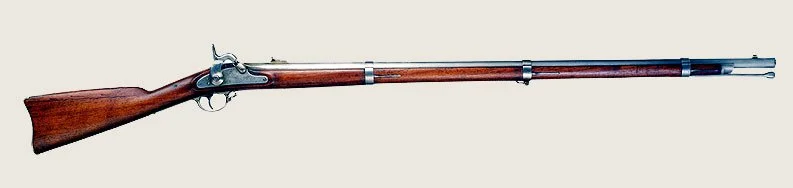
Springfield Model 1861 rifled musket.

Scott Hippensteel begins with “snipers,” pointing out that no such unit existed during the Civil War; the term and function came much later. Instead, those in the role were better described as sharpshooters and acted as skirmishers. He challenges the various claims of kills at 500 yards or greater, demonstrating some of the most famous supposed long-range killings to be inconceivable as actually happening, and suggesting they were in all likelihood from friendly fire, artillery shrapnel, or at best, from numerous skirmishers who would aim in a general direction and one happened to get lucky and strike an officer. He writes, “It was hopeless for a Civil War sharpshooter to aim at and attempt to kill a single specific officer at more than a few hundred yards; the exterior ballistics and accuracy of the available weapons made this task nearly impossible, regardless of the shooting talent of the soldier.”

Very few rifles were equipped with scopes, and fewer still were the trained individuals who could accurately hit a long-distance target even in training. Imperfections in powder, bullets, the rifle, the scope, and more made long-distance shots extraordinarily difficult. The weather, moisture in the air, wind (which can change the landing spot by a few feet even if VERY light), and other factors impacted long-range shots. Furthermore, the precision required to estimate the target’s distance and account for the bullet’s trajectory makes it unlikely that genuine long-distance kills occurred. Some sharpshooters needed to aim 14 feet above the target’s head and precisely measure the distance from hundreds of yards using old glass scopes that themselves impeded long-range shots. Hippensteel wrote, “Additionally, the front sight of these muzzleloaders was broader than any human-size target at five hundred yards. Between the required holdover and the width of the front sight, any view of the intended victim of the sharpshooter is completely obscured at this range.” To say it would be a shot in the dark is an understatement.


Conditions

Further, ideal conditions, perfect weather timing, etc., would not be the same as battle conditions with fog, smoke, and imperfect visibility. As a straight shot in the open was usually never beyond 125 yards, the eye could not accurately estimate a single target’s distance so as to calculate the trajectory for long-range shots. The enemy was rarely visible due to obscuring terrain, smoke and more at more than 100-150 yards.  Even under perfect conditions, with no human error, “perfectly aimed” shots still would often miss.

In addition, the number of steps that need to be done correctly to load the rifled musket, in the correct order, and the right way to fire a shot amid the noise, screams, adrenaline rush, shouting, smoke, confusion, fear, death and fatigue made getting off an accurate shot near-impossible and the performance in battle staggeringly poor. The best commanders could do with these citizen volunteers was often to maintain a steady fire aimed in the general direction of the opposing side, in order to cause enough damage to hold their position or push the others back over time, often due to the latter running out of ammo. After Gettysburg, 32-43% of the rifled muskets found were loaded with multiple bullets and discarded. Many soldiers whose gun malfunctioned picked up other random discarded ones, weapons they might never have fired before. Using ammo that was not meant for the new musket, that alone can cause mishaps.

Hippensteel conducted an in-depth analysis of weapons used in the U.S. military from 1770 to 2000, determining the “total firepower” and the overall killing ability, particularly in the range of up to 150 yards, the “killing zone” where the vast majority of kills occur. Evaluating bullet size, velocity, reload time, and other factors, he discovered that the lowest point occurred when the United States Army first adopted the rifled musket, and that the smoothbore actually puts out more firepower than the rifled musket. No wonder many commanders rejected the latter. Hippensteel wrote, “When the army adopted the rifled musket, the hitting power of the US infantrymen hit an all-time low. This seems strange for a weapon that was about to ‘revolutionize’ warfare…compared to its predecessor, the smoothbore musket, the rifled musket is 15-25 percent slower to load and has a muzzle velocity of only 950-1050 feet per second, compared with the 1,400-1,500 feet per second of the smoothbore.” Meaning that within the range of non-skirmishing Civil War combat, the smoothbore outperformed the rifled musket. Almost all fire occurred at under 200 yards, the enemy was often not visible beyond. And beyond 200 yards, special training was required to account for the low velocity of the weapon.


Differences

Noting the difference between what the rifled musket could do at distance in target practice vs in Civil War battles, he points out that because “Rifled muskets were much more precise …they could produce smaller groups (‘hits’ in target practice within a specific range or distance), because their rifling guided all the bullets to a more localized space downrange. However, this precision did not necessarily make the rifle more accurate in reality, the tight grouping might have been falling short (bullet has a high rate of drop) or long of the intended target because of the difficulty introduced by the parabolic flight path of the bullets.” He continues, “A precision weapon is only useful in combat if it is also accurate, and low muzzle velocity makes accuracy a challenge.” In other words, in actual combat, where you are not simply shooting at an unmoving target, your adjusted total accuracy equals out even if the rifle is more precise in practice. Unless you could allow for the difference, and the vast majority of soldiers could not, you lost the advantages.

In the end, smoothbore is similar overall to rifled for ranges of 75 yards and under, and is even preferred due to the lethality of buck and ball. At ranges of 250 yards or more, rifled is a waste of ammunition, so it is only between 75-250 yards where it has a hypothetical advantage for the typical soldier. But the smoke, terrain, and other effects of battle largely negated that, meaning that most commanders would not have their men fire until 100-150 yards, seeing shooting at longer distances as a waste of ammunition, or attempting to “shock” the enemy with a deadly volley from around 60 yards or under. So very little combat occurred at distances or under conditions to give the rifle musket an edge. Hippensteel summarizes “So the rifled musket had a limited advantage over the smoothbore on some battlegrounds, in some circumstances; it was, for example a better gun for skirmishers.”

Without machine guns or artillery, a company in Vietnam produced the same firepower as a Civil War corps. A brigade in WW1 did the same, also without artillery or machine guns. Further, modern weapons are smokeless and do not decrease visibility as black powder weapons did. The Civil War was not the first modern war. Hippensteel quotes Allen Guelzo: “Whatever the gains bestowed by the technology of the rifled musket…those improvements were only apparent under ideal conditions (which is to say, not in the middle of a firefight).” David Ward wrote, “The rifled musket did not revolutionize civil war operations because the weapon was not used at long range.” Further, diseases were the leading cause of death among Civil War soldiers, not what one considers “modern” weaponry.


Did you find that piece interesting? If so, join us for free by clicking here.

Was the politics of compromise a politics of appeasement?

More than 150 years after the Civil War ended, Americans continue to debate the circumstances that led to the bloodiest conflict on US soil and whether that struggle could have been avoided. The controversy typically centers around the issue of whether sufficient effort was made to arrive at a compromise, thereby precluding the deaths of over 600,000 Americans at the hands of other Americans.

But the real question should be:

Was there too much compromise?

The conflict was, indeed, not based on any failure to compromise; rather, if there was failure, it was in not dealing early on with the contrasting socioeconomics of the northern and southern states. But, of course, at the time there was a perceived need to, at almost any cost, bind the fledgling nation together in the face of great disparity between two economic systems. And this felt need was driven by a fear of losing what the founders had just sacrificed so much to achieve and institute – an independent republic with a democratic form of governance.

F. Andrew Wolf explains.

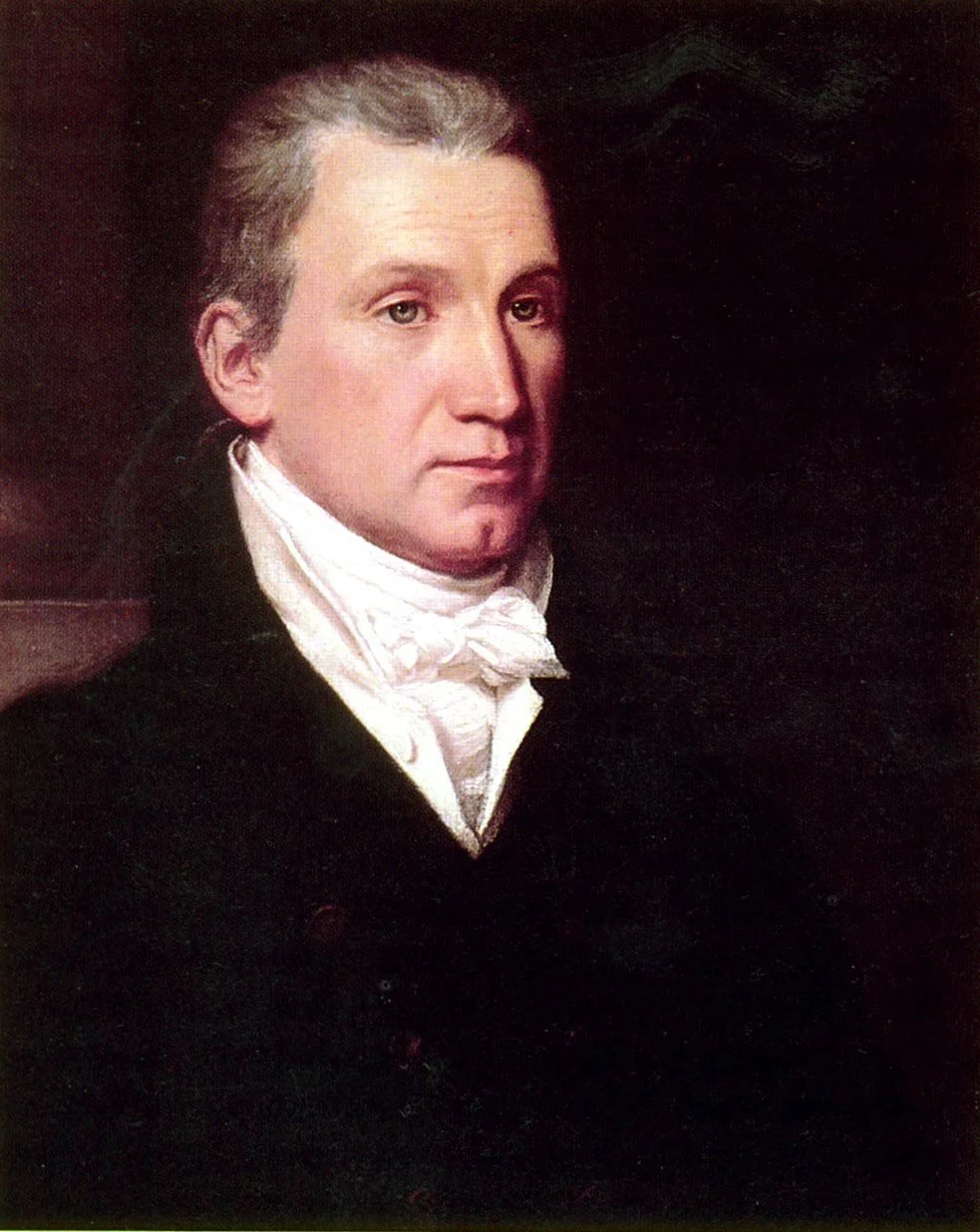
President James Monroe, the president who signed the Missouri Compromise.

US Constitution - the “three-fifths” compromise

The compromises regarding the two vastly different forms of socioeconomics began with the inception of the United States, itself. America’s Constitution famously declared that the institution of slavery would enjoy the status of official recognition in order to secure agreement with the southern states for a binding document.

The socioeconomics between the North and South (land, capital, population, industry, agrarian vs urban interests, types of labor force) were so vastly different that neither was willing to trust the other without a well-delineated form of equitable representation in the Constitution. This was to ensure that the voice of each was fairly heard in the law-making body that dealt with taxation and the subsequent disposition of that revenue. The result was the “Three-Fifths Compromise” for apportionment of representatives regarding the bonded servants in the South. It was agreed that each bondsman (slave) would count as three-fifths of a person for purposes of representation and taxation. Moreover, in rather euphemistic language, Congress was authorized to ban the international slave trade -- but not for another 20 years.

The immediate effect of this “formula” was to inflate the power of the Southern states in the House of Representatives and the Electoral College. These were the states in which the vast majority of enslaved persons lived.

The first Census, taken in 1790 after the Constitution’s ratification, is illustrative. 25.5% of North Carolina’s population was enslaved, as were 35.4% of Georgia’s, 39.1% of Virginia’s, and 43% of South Carolina’s. To offer context to the situation, the 1800 Census showed Pennsylvania's free population was 10% larger than Virginia’s but received 20% fewer electoral votes, because Virginia’s population was augmented by the Three-Fifths Compromise. 

In fact, counting enslaved persons under the compromise added an additional 13 members from “slave states” to the House and eighteen additional electors to the “College.” Is it a coincidence that for 32 of the first 36 years after the Constitution’s ratification, a white slaveholder from Virginia held the presidency?  

The situation was further compounded by the fact that the framers of America’s founding document failed to mention the issue of slavery as an institution even once. David Waldstreicher, professor emeritus in history at the City University of New York and author of Slavery’s Constitution, holds that this failure created ambiguity about the framers’ intentions as well as the constitutionality of both proslavery and antislavery legislation which was to follow.

It can be argued that the Civil War had its genesis in the incipient stages of the founding of America by the early compromises made in the Constitution over the issue of agrarian economics driven by the institution of slavery in the southern states.

This acquiescence to the perceived needs of the South -- to keep the nation bound together -- informed not only the evolution of slavery in America but gave rise to much of the dysfunction in national politics and issues of inequality, still with us today. It makes little sense to talk of a failure to compromise, except insofar as every war or political conflict is a failure to achieve agreement. The original compromises enshrined in 1787 would ultimately touch everything in America from that point on.


Nineteenth century compromises

Through the early to mid-nineteenth century, several agreements between the North and South were hammered out.

The Missouri Compromise of 1820 permitted Missouri to join the Union as a slave state in exchange for Maine entering as a free state. There was the Compromise of 1850 which allowed California’s admission as a free state but also enacted the Fugitive Slave Act, allowing for the kidnapping and re-enslavement of people in free states who had escaped slavery. And the Kansas-Nebraska Act of 1854 allowed western territories to decide for themselves if slavery was to be permitted.

The “Tariff of Abominations,” enacted in 1828 by representatives of the northern states, was a protective tariff aimed at supporting northern manufacturers by taxing imported goods, which worked against and angered southern states. This led to the Nullification Crisis, where South Carolina attempted, unsuccessfully arguing states’ rights, to nullify the tariff, further escalating tensions between the two regions.


Lincoln - the great compromiser

As slavery spread, so did the zeal of the antislavery cause. Abolitionists at the time were often depicted from various sources as suspicious, even dangerous fanatics. But in truth the antislavery movement comprised numerous efforts to compromise when it came to liberating those from the forced labor of involuntary servitude. One idea was that of colonization, which advocated resettling former slaves to South America or Africa (e.g., Liberia), derived from the jaundiced belief that they could never coexist with whites?

One of those advocates of colonization was Abraham Lincoln, offering support for the idea as late as 1862, as Daniel Biddle & Murray Dubin attest in a 2013 article in The Pennsylvania Magazine of History and Biography.

Even as a presidential candidate in the run-up to his election in 1860, Lincoln and his Republican Party colleagues were amenable to any number of compromises to keep the slaveholding South in the Union. One such proposal was the never-ratified Corwin amendment to the Constitution -- permitting the institution of slavery to continue (without federal interference) where it already existed -- but prohibit its establishment in new territories.

Yet, it was the slaveholding states of the South that refused to compromise on this offer, notes Manisha Sinha, historian at the University of Connecticut and author of The Slave’s Cause: A History of Abolition.

There was really only one aspect of the slavery issue where Lincoln could likely have circumvented the war between the states. “Lincoln could have avoided the Civil War if he had agreed to compromise on the non-extension of slavery, but that was one thing Lincoln refused to compromise on…” Sinha asserts.

“When it comes to the Civil War,” she added, “we still can’t seem to understand that the politics of compromise was a politics of appeasement that at many times sacrificed black freedom and rights.”


A culture war

At the center of the disagreement between northern and southern states was also the issue of “class differences” among white-male property owners.

A culture war was brewing between North and South. The North viewed their neighbors as somewhat backwards with little education, little in the way of industry and an aging infrastructure. The South felt denigrated and besieged economically.

Both regions had different visions of what constituted a moral society; yet, both were denominated by Christians who believed in democracy, capitalism and shared a history dating from America’s inception. Where they parted ways was on economics – and that meant slavery.

President Lincoln's election of 1860 was the final blow to the South. Most of his support came from north of the Mason-Dixon line, which put in jeopardy the South's clout in the Union. Southern states viewed the situation as an existential threat to their socioeconomic lifestyle and reacted to preserve it. 

This marked, for years to come, the beginning of the South’s decline in political power in Washington – a poignant footnote to the compromises embedded in the Constitution of the United States some 74 years earlier – ostensibly to keep the South in and the Union intact. But it would take a war between the states and the assassination of a president to finally achieve those ends.


Did you find that piece interesting? If so, join us for free by clicking here.


References 

Nittle, N. (2020, October 30). The History of the Three-Fifths Compromise. ThoughtCo. https://www.thoughtco.com/three-fifths-compromise-4588466

National Park Service. The Constitutional Convention: A Day-by-Day Account for August 16 to 31, 1787. Independence National Historical Park. https://www.nps.gov/articles/000/constitutionalconvention-august25.htm

Census.gov. Return of the Whole Number of Persons within the Several Districts of the United States. https://www2.census.gov/library/publications/decennial/1790/number-of-persons.pdf

Amar, A. The Troubling Reason the Electoral College Exists. Time.com. https://time.com/4558510/electoral-college-history-slavery/

Monroe, Dan. The Missouri Compromise. Bill of Rights Institute.  https://billofrightsinstitute.org/essays/the-missouri-compromise

Mark, H. (2025, June 9). Compromise of 1850. World History Encyclopedia. https://www.worldhistory.org/Compromise_of_1850/

Garrison, Z. Kansas-Nebraska Act. Civil War on the Western Border. https://civilwaronthewesternborder.org/encyclopedia/kansas-nebraska-act

McNamara, R. (2019, July 19). The Tariff of Abominations of 1828. ThoughtCo. https://www.thoughtco.com/tariff-of-abominations-1773349

Longley, R. (2021, October 6). The Corwin Amendment, Enslavement, and Abraham Lincoln. ThoughtCo. https://www.thoughtco.com/corwin-amendment-slavery-and-lincoln-4160928

Posted
AuthorGeorge Levrier-Jones

The American Civil War had a number of critical junctures in 1862. Here, Lloyd W. Klein considers the 1862 Peninsula Campaign and The Seven Days Battles. In part 1 of a 2-part series, he looks at the Peninsula Campaign, including the Battle of Fair Oaks/ Seven Pines.

General Meagher at the Battle of Fair Oaks, Virginia. June 1, 1862.

‘If General McClellan is not going to use the army, I would like to borrow it for a time.’

Abraham Lincoln


As 1861 transitioned into 1862 without any notable military engagements in the Eastern Theater, President Lincoln's patience began to diminish in response to General McClellan's delays. In March 1862, hesitant to engage in a direct confrontation due to concerns about being outnumbered, General McClellan opted for a strategic flanking maneuver via water. His plan involved landing troops on the Yorktown Peninsula, situated between the James and York Rivers, while utilizing the Union Navy to safeguard his supply lines. From this position, he intended to launch an offensive against Richmond. Consequently, 70,000 Federal troops embarked on vessels bound for Fort Monroe, a Union stronghold at the Virginia Peninsula's tip, while an additional 35,000 troops under Irvin McDowell repositioned to Fredericksburg, located 50 miles north of Richmond. Furthermore, approximately 25,000 soldiers were available in the Shenandoah Valley under the command of Nathaniel P. Banks.

In the spring of 1862, General McClellan initiated an advance of Union forces westward from Fort Monroe. The Confederates, benefiting from their interior lines between General Johnston's army near Manassas and the Peninsula, effectively maneuvered their forces to bolster the troops stationed on the Peninsula. President Lincoln harbored doubts regarding this strategy, fully aware that Johnston would likely respond by mobilizing his army to protect Richmond, a movement that would occur more swiftly than McClellan's own. Nevertheless, recognizing that McClellan was finally taking action, Lincoln reluctantly acquiesced to the plan.


Yorktown & Williamsburg

By early April, McClellan was in position. At the campaign's onset, he faced approximately 20,000 Confederate troops near Yorktown, Virginia, the site of Cornwallis's surrender to Washington. The town is located on the York River. With a significant advantage of at least three to one, McClellan was poised for success, especially with an additional 30,000 Federal reinforcements expected to arrive shortly. However, he mistakenly convinced himself that he was up against 200,000 Confederates, leading to inaction on his part.

The Confederate field commander, Major General John Bankhead Magruder, a graduate of West Point, was acutely aware of his disadvantage. In a strategic move, he opted to deceive McClellan by frequently repositioning his troops and dispersing his artillery into single units that fired intermittently. This tactic created the illusion of a much larger force, successfully convincing McClellan to initiate a siege of Yorktown. This decision ultimately provided General Johnston with the necessary time to reinforce his beleaguered troops, effectively thwarting what could have been a decisive Union victory.

McClellan meanwhile awaited the reinforcements he deemed essential to beat an enemy he estimated to outnumber him by three times. Even a basic acquaintance with the 1860 Census would have made clear that was impossible. As McClellan awaited the reinforcements he believed were crucial to confront an enemy he grossly overestimated, he overlooked the opportunity. In reality, Magruder commanded only 11,000 men. Although escaped black slaves who reached Union lines provided accurate information regarding Confederate troop numbers, their accounts were dismissed and not taken seriously by McClellan.

In choosing to lay siege to Yorktown, McClellan miscalculated the situation, believing that Johnston's entire army was positioned against him. This decision resulted in a significant loss of momentum and tactical advantage for the Union forces. Between April 18 and May 2, the Union Army established fourteen distinct positions. McClellan offered various justifications for his reluctance to engage in battle, citing the inexperience of his troops, inadequate supplies, and the necessity of securing Washington from potential surprise attacks. Finally, Magruder abandoned Yorktown after 2 weeks of delaying McClellan.

Following the Confederate withdrawal from Yorktown, the Union division under Brigadier General Joseph Hooker encountered the Confederate rearguard in the vicinity of Williamsburg. Williamsburg is positioned on elevated terrain between the York and James Rivers. Hooker launched an assault on an earthen fortification situated along the Williamsburg Road; however, his forces were repelled. Confederate counterattacks, orchestrated by Major General James Longstreet, posed a significant threat to the Union's left flank. Fortunately, a Union division arrived in time to reinforce the position, marking the Battle of Williamsburg as the first major engagement of the Peninsula Campaign.

Brigadier General Philip Kearny's 3rd Division of III Corps played a crucial role in stabilizing the Federal position, with Kearny famously leading his men onto the battlefield with his sword drawn and reins clenched in his teeth, a technique he had mastered during his training with the French cavalry. Kearny was a seasoned veteran, having distinguished himself in the Mexican War and served in Napoleon III’s Imperial Guard at Solferino, despite having lost his left arm in combat.

In a strategic maneuver, a Union brigade advanced to threaten the Confederate left flank by occupying two abandoned redoubts. Despite receiving multiple orders to withdraw, the brigade's commander resolutely held his ground against enemy attacks and subsequently led a bayonet charge in a counteroffensive. This courageous brigade was led by Brigadier General Winfield Scott Hancock, who earned a reputation for his steadfastness and refusal to retreat. General McClellan praised Hancock's performance as “superb,” a commendation that led to his enduring nickname, “Hancock the Superb.” His leadership and bravery during the battle solidified his status as a remarkable figure in the Union Army.

The battle saw approximately 41,000 Union troops face off against 32,000 Confederates, resulting in an inconclusive outcome that allowed the Confederates to continue their retreat.


Movement up the Virginia Peninsula: McClellan and the Slows

‘If he had a million men, he would swear that the enemy has two millions, and then he would sit down in the mud and yell for three.’

Secretary of War Edwin Stanton


With Richmond as his primary objective, McClellan recognized that a direct land route would necessitate traversing swamps and wetlands during the late spring season. Consequently, he opted to navigate along the Pamunkey River, which flows northward and runs approximately parallel to the Chickahominy River, until he reached the point where he needed to cross it to approach Richmond.

The pace of McClellan's advance was notably sluggish. A significant factor contributing to this delay was his anticipation of support from McDowell’s Corps, which was advancing southward from Fredericksburg to assist in the offensive. However, McDowell was ultimately redirected to the Shenandoah Valley, creating what appeared to be a favorable opportunity for McClellan to initiate his own movements.

McClellan's reliance on inaccurate intelligence reports, provided by his associate Allan Pinkerton, who was the founder of a prominent private detective agency, led him to consistently overestimate the size of the Confederate forces across the Potomac River. He believed that the enemy was now twice as numerous as his own troops. However, the reality was quite the opposite; the Union army outnumbered the Confederate forces by a ratio of at least two to one and perhaps three to one.

In hindsight, it is evident that these delays yielded no strategic advantages.  Particularly regarding the situation at Yorktown, the postponement allowed Johnston to reposition his army effectively. Consequently, McClellan lost the chance to secure an unobstructed route to Richmond and failed to outmaneuver Johnston, resulting in the forfeiture of any potential benefits that could have arisen.

McClellan's tendency to exaggerate the size of enemy forces was so consistent that it suggests a deliberate, possibly psychological, motivation behind his actions. This pattern of inflating enemy troop numbers was a defining characteristic of McClellan's military career. For instance, he claimed to have defeated double the actual number of troops at Rich Mountain, thereby enhancing the perception of his victory. Furthermore, he tripled the count of opposing forces across the Potomac, which contributed to a heightened sense of urgency and ultimately led to his promotion to commander-in-chief. The culmination of this behavior was evident during the Peninsula Campaign, where he significantly overstated enemy numbers, expressed concerns about the resources needed for victory, and when unable to secure those resources, proceeded with operations while attributing any failures to his superiors. This strategy allowed him to portray himself as a victor against overwhelming odds or to deflect blame in the event of defeat.

Despite being provided with accurate assessments of troop strengths, McClellan chose to disregard critical intelligence. He was given correct numerical information by escaped slaves. General John Wool at Fortress Monroe thought he was too slow and gave him more precise numbers Thaddeus Lowe and the Balloon Corps, stationed near Gaines’ Farm, consistently reported the movements of Confederate forces near Fair Oaks, delivering precise information even up to June 1. The reasons behind McClellan's dismissal of these reports remain speculative, but they align with the psychological tendencies previously discussed, suggesting a disconnect between the available intelligence and his strategic decisions.

In a controversial move, Lincoln opted to redirect McDowell's forces from a southern advance to the Valley to support Fremont, despite objections from both McClellan and McDowell. This decision, while aimed at addressing the vulnerability of Washington and providing necessary assistance to Fremont, may have had adverse consequences. Lincoln's judgment was sound in recognizing the threat posed by Jackson's movements, which ultimately led to Jackson retreating further into the Valley to join forces with Lee. However, had McDowell continued his advance, he would have positioned himself advantageously alongside Porter’s V Corps along the Chickahominy River, potentially countering Lee's strategic plans effectively.

The Peninsula Campaign: March to May 1862. Source: Hlj, available here.

Battle of Fair Oaks / Seven Pines (May 31 and June 1, 1862)

General Joseph E. Johnston, known for his cautious approach, conducted a methodical retreat through the Peninsula, engaging in inconclusive skirmishes along the way.  Recognizing his numerical disadvantage, the Confederate army executed a retreat to the northwest, successfully crossing the Chickahominy River, which served as the sole natural barrier separating the Peninsula from Richmond. A Union naval expedition aimed at advancing up the James River toward Richmond had been halted at Drewry’s Bluff, a situation that Johnston adeptly exploited by positioning his right flank at that location. Additionally, he stationed A.P. Hill at the extreme left flank along a bend in the Chickahominy, compelling McClellan to cross the river to reach Richmond. While a segment of the Union army managed to cross, other units remained stationed to the east of the river.

Until this point, President Davis had perceived Johnston's caution as a liability, urging him to take the offensive against McClellan. However, Johnston, fully aware of his inferior numbers, was strategically waiting for an opportune moment to strike an isolated portion of McClellan’s army. At this juncture, two Union corps had successfully crossed the Chickahominy River and were positioned alarmingly close to Richmond, just four miles away, where they could hear the ringing of church bells.

As the Union forces positioned themselves on either side of the seemingly tranquil river, a deluge of rain ensued, resulting in severe flooding that rendered the river and surrounding swamps nearly impassable. This natural disaster effectively divided the Union army; despite the proximity of the two factions, their only means of communication was a bridge located several miles away. Seizing the opportunity presented by the fragmentation of McClellan's forces, Johnston planned to strike the contingent of the Union army stranded south of the river. In a calculated move, he could potentially deploy 22 of his 29 brigades, totaling approximately 51,000 troops, against the III and IV Corps, which together comprised 33,000 soldiers.

During the Battle of Seven Pines, also known as Fair Oaks, which took place from May 31 to June 1, 1862, General Johnston launched an assault against the vulnerable corps stationed there. The offensive occurred at two key locations: the railroad station at Fair Oaks and the crossroads of Seven Pines, situated approximately one mile apart. Although the attacks lacked coordination, they proved to be effective, with General D.H. Hill spearheading the offensive and directing all available reinforcements to the front lines.

The resultant attack was uncoordinated. Johnston launched an offensive against two Union corps that were positioned separately across the Chickahominy River, effectively cut off from the main body of the Union army. His strategy was intricate, yet he failed to provide clear instructions to his commanders regarding the intended sequence of events. The plan involved a demonstration by his left flank while Longstreet was to approach from three different directions, one of which included DH Hill’s division tasked with assaulting a critical crossroads near a cluster of seven large pines, known as Seven Pines.

However, Longstreet deviated from the intended route, mistakenly taking the Williamsburg Road instead of the Nine Mile Road. While some of his troops found themselves in the correct location, they were uncertain about the timing of their assault. Ultimately, only DH Hill’s division, comprising approximately 10,000 soldiers, engaged Silas Casey’s brigade of merely 6,000, resulting in a significant breakthrough. Despite Johnston being a mere 2.5 miles from the front lines, he was unable to hear the sounds of battle due to an acoustic shadow, which hindered his ability to send reinforcements in a timely manner.

Amid this pivotal confrontation, General Johnston was wounded while actively leading his troops. A veteran present at the scene recounted the chaos, stating, "… every deadly projectile which could take a human life and maim and disfigure were showered upon us." As bullets and artillery shells flew around him, a bullet struck Johnston in his right shoulder, followed by a shell explosion that sent a fragment into his chest, causing him to fall unconscious from his horse. He suffered a broken shoulder and two fractured ribs, and his aides promptly transported him to safety, where he eventually regained consciousness.

Upon regaining consciousness, Johnston immediately requested the retrieval of his sword and pistols, which had fallen during his fall. He expressed the sentimental value of the sword, stating, “The sword was the one worn by my father in the Revolutionary War, and I would not lose it for ten thousand dollars.” Drury Armistead of the 3rd Virginia Cavalry bravely ventured back to recover the items. In the meantime, Major General Gustavus Smith assumed command, but the renewed attack lacked the necessary vigor. The following day, General Lee took over leadership, with McClellan expressing a preference for Lee over Johnston.  This misapprehension was due to Lee's early struggles at Cheat Mountain, which led McClellan to question Lee's decisiveness under pressure.

The outcome of the battle was indecisive. The Union forces managed to hold their ground, allowing McClellan to continue his advance toward Richmond. The casualties were substantial, with Union losses totaling 5,031 (including 790 killed, 3,594 wounded, and 647 captured or missing) and Confederate losses amounting to 6,134 (with 980 killed, 4,749 wounded, and 405 captured or missing). This engagement was the second largest and bloodiest battle of the war thus far, following the Battle of Shiloh just eight weeks prior.

Brig Gen OO Howard lost his right arm at Fair Oaks. General Philip Kearny famously quipped that they’d now be able to shop for gloves together, as General Kearny had lost his left arm. Brig Gen Robert Rodes was wounded, and Col John B Gordon took command. Rodes would return to lead his brigade at Gaines’ Mill.

Seven Pines could have been a decisive Confederate victory, but several things went wrong.

Confederate General Joseph E. Johnston had an opportunity to achieve a decisive victory, but a combination of poor planning, miscommunication, and logistical challenges prevented him from doing so. While Johnston’s plan had the potential for success, its execution fell short, and the battle ended inconclusively. The Union advance was stopped but Seven Pines was a missed Confederate opportunity.

Why Johnston Could Have Won Decisively. The Chickahominy River divided the Union Army, with two corps (approximately 33,000 men) on the south side near Seven Pines and the rest of McClellan’s army on the north side. Johnston’s plan aimed to overwhelm the isolated Union corps south of the river before McClellan could reinforce them. This was a sound strategy that could have inflicted a crippling blow on the Union army. Johnston had massed about 51,000 Confederate troops against the Union forces south of the Chickahominy. This gave him a significant numerical advantage in the immediate area, which he hoped to exploit. Johnston planned to strike early on May 31, taking advantage of heavy rains that had swollen the Chickahominy River and delayed Union reinforcements from crossing.

Why Johnston Failed to Achieve a Decisive Victory. Johnston's strategy for the attack required meticulous timing and effective coordination among various Confederate divisions. Unfortunately, the execution of this plan was hampered by ambiguous orders and failures in communication, which resulted in considerable delays and confusion on the battlefield. Additionally, prominent Confederate generals, including James Longstreet and D.H. Hill, misinterpreted their directives, leading to fragmented and disorganized assaults instead of a unified offensive. Longstreet's absence from the battle maps exemplifies this miscommunication, as he mistakenly directed his troops down an incorrect route, inadvertently encountering Benjamin Huger's forces and contributing to the overall chaos. If General Huger had led his division into action at the appointed time and supported Smith Longstreet and Hill, Keyes' Union Corps would have been destroyed. Consequently, the planned morning attack was postponed until the afternoon of May 31, affording Union forces additional time to fortify their defenses.

Johnston should have made better use of Magruder's division. If the Chickahominy had remained high enough to stop Union reinforcements, a different outcome would be expected. If there had been no delay of Longstreet's troops at Gilles Creek, or on the Williamsburg road, or if, at least, if Johnston had been informed when Longstreet did go into action, perhaps the victory could have been more complete. Good staff work and prompt reports would have offset the acoustic shadow and enabled the timely advance of the Confederate left.

The Union troops, under the command of Generals Erasmus Keyes and Darius Couch, demonstrated considerable resilience despite being outnumbered. Their steadfastness allowed them to hold their positions long enough for reinforcements to arrive from the northern side of the Chickahominy River. The timely intervention of Union General Sumner with additional troops played a crucial role in stabilizing the situation. Although the Confederates succeeded in pushing back Union forces in certain sectors, they failed to take advantage of openings in the Union lines, resulting in a missed opportunity for a decisive breakthrough. Instead, the conflict devolved into a protracted and bloody stalemate, undermining the initial Confederate objectives.

A decisive Confederate victory could have severely disrupted McClellan's Peninsula Campaign. Had McClellan been compelled to retreat, the subsequent Seven Days Battles might have been averted, further hindering Union advances toward Richmond. However, the inconclusive nature of the battle ultimately paved the way for General Lee's ascension to command and the ensuing series of confrontations known as the Seven Days Battles, which would shape the course of the conflict.

McClellan continued to cross the river, bringing all of his troops except V Corps and he continued to plan on a siege. His emotional reaction, told in a letter to his wife, was "I am tired of the sickening sight of the battlefield, with its mangled corpses & poor suffering wounded! Victory has no charms for me when purchased at such cost."

After the battle, mosquitos surrounded the area from the rains and floods. Soldiers on both sides became severely ill with an infection whose origin has never been entirely explained. Chickahominy Fever had symptoms of both typhoid fever and malaria, so it is officially classified as a typhomalarial fever, but has at times also been called bilious fever.  It was most likely a form of malaria with GI predilection, or both malaria and typhoid fever, hence the name. It may also have included cases of dengue fever and perhaps shigellosis.


Lee Takes Command

Jefferson Davis encountered numerous challenges during his presidency, often making questionable decisions. However, on the evening of May 31, 1862, as he accompanied General Lee from the battlefield to Richmond and entrusted him with command of the army, Davis undoubtedly made the most astute choice of his presidency.

On June 1, 1862, General Lee assumed command amidst the ongoing battle at Seven Pines. Lee prioritized the long-term strategy over immediate victory, focusing on conserving his remaining forces and devising a new plan. He utilized the battle as an opportunity to reorganize his command structure, removing two brigadiers and rearranging the brigades to enhance their effectiveness.

This period marked the Union Army's closest approach to potentially concluding the war for the next two years. Despite the demoralization of Johnston's troops and the inadequately fortified defenses of Richmond, the well-equipped Union forces under Major General George B. McClellan, who outnumbered Lee's army, failed to mount a serious assault on the Confederate capital. With McClellan positioned between the defenses of Richmond and the Chickahominy River, Lee and Davis engaged in discussions to determine the most effective course of action, with Lee outlining three strategic options: abandon Richmond, prepare for a siege, or launch an attack. His recommendations aligned perfectly with President Davis's expectations.

In the three weeks after taking command, Lee undertook a comprehensive reorganization of his forces and reinforced the defenses of Richmond. He recognized that a purely defensive strategy would be inadequate against the formidable Federal army. Rather than passively waiting for an inevitable attack that he might not withstand, Lee also deemed it unwise to precipitate a siege, a decision that would later contrast sharply with his actions two years hence. Instead, he devised an audacious and strategic plan to take the initiative.

On June 23, Lee convened a meeting with his generals to unveil his intentions for an offensive operation. He articulated his strategy in General Order No. 75, which was disseminated to his commanders the following day. Lee's approach to dislodge the largest army ever assembled in the New World was grounded in a keen assessment of the Federal forces and their vulnerabilities. He posited that the sheer size of the Federal army could be turned into a disadvantage.

The primary goal of Lee's plan was to separate McClellan's main army, which was concentrated south of the Chickahominy River, from its supply lines. McClellan's forces required over 600 tons of provisions daily, presenting a significant logistical challenge akin to sustaining a small city. To execute his strategy, Lee stationed a minimal force to defend Richmond's eastern perimeter while moving the majority of his troops northward across the Chickahominy. His objective was to overwhelm the Union forces near Mechanicsville, whose responsibility was to safeguard the critical Federal supply base. By disrupting their resupply efforts, Lee aimed either to secure a decisive victory over McClellan or compel him to retreat from Richmond.

Lee ordered three separate columns to commence their march on the same morning. Each column was to utilize its own designated route, and engagement in combat would only occur if the commander identified a strategic advantage. This advantage was inherently linked to the performance of the other columns; however, the failure of one column did not obligate the others to engage. General Magruder was tasked with leading 25,000 troops stationed to the east of Richmond, who would serve as defenders should the offensive strategy falter. Major Generals James Longstreet, A.P. Hill, and D. H. Hill were to concentrate their divisions on the left flank of the Confederate line, preparing to assault the right side of the Union forces. The offensive at Mechanicsville aimed to push the enemy southward. Meanwhile, General Jackson's Army was to conduct a covert march to join Lee's forces and target the right rear flank. Brigadier General W. N. Pendleton was given the directive to deploy the reserve artillery and to thwart any attempts to advance on Richmond.

Lee's efforts extended beyond mere planning; he utilized the time to assess the viability of his strategy. He instructed JEB Stuart to conduct a reconnaissance mission to evaluate the vulnerability of the Union army's right flank. On the morning of June 12, Stuart embarked with 1,200 cavalrymen and confirmed the flank's susceptibility. After a comprehensive 150-mile journey around the Union forces, he returned on June 15 with 165 captured Union soldiers, along with 260 horses and mules, in addition to various quartermaster and ordnance supplies. The Union cavalry, which was more decentralized and commanded by Stuart's father-in-law, Col. Cooke, posed little serious resistance, resulting in only one casualty among Stuart's men. This successful maneuver not only bolstered morale but also elevated Stuart's status to that of a celebrated figure within the Confederacy, comparable to Stonewall Jackson, as he was welcomed in Richmond with flower petals strewn in his path.

Concurrently, McClellan grew increasingly apprehensive about the fragility of his supply line. The intelligence gathered from Stuart's raid proved invaluable to Lee. Although the threat to the Union supply line was not as immediate, the reconnaissance revealed that the right flank was indeed vulnerable. Consequently, Stuart's findings guided Lee to recognize that the most strategically advantageous option was also the most tactically feasible, allowing him to capitalize on the Union's weaknesses effectively.

McClellan's Army of the Potomac remained inactive in their positions on the eastern fringes of Richmond. The three weeks that ensued after Seven Pines were largely uneventful. It is perplexing to understand why McClellan chose to remain idle for such an extended period, especially considering the recent change in Confederate leadership.

The 22 days that elapsed between Lee assuming command and formulating his strategy proved disastrous, primarily due to McClellan's inaction during this critical timeframe. He had various courses of action available to him, yet he hesitated in his campaign to capture Richmond during the latter half of June. His misjudgment regarding the strength of Confederate forces in the city deterred him from launching an assault. Instead, he sought additional troops, missing a significant opportunity between June 18 and June 25, when the Confederate defenses around Richmond were relatively vulnerable. McClellan's focus on establishing a new supply route from Harrison's Landing to the James River, intended to bolster his base on the Pamunkey River, ultimately allowed Lee the necessary time to implement his strategy effectively.


McClellan’s Psyche

General George B. McClellan was a charismatic yet arrogant individual, characterized by his diminutive stature and dapper appearance at the age of 34. Before he was appointed the commanding general of the Army of the Potomac, he had achieved victories in two minor skirmishes against Confederate forces in West Virginia. His self-assuredness in his capabilities was evident as he sought to emulate Napoleon, often posing for photographs with his hand tucked into his jacket and surrounding himself with French officers on his staff.

McClellan's Peninsula Campaign was characterized by an overabundance of caution. Despite possessing a numerical superiority, he exhibited a slow pace and hesitated to capitalize on his advantages, which allowed Confederate generals Johnston and Lee to strengthen their forces and successfully counter McClellan's efforts. His persistent indecision and reluctance to engage the enemy enabled the Confederates to summon reinforcements. This hesitance in command proved detrimental, as it enabled the Confederate forces to regroup and repel the advances of the Union army.

The primary shortcoming of McClellan as a military leader was his procrastination. His habitual delays in launching attacks were harmful, as they provided the Confederates with opportunities to regroup and fortify their positions. During the Seven Days Battles, General McClellan's cautious approach resulted in the withdrawal of his troops in response to General Lee's assaults, despite the Union's numerical advantage. This decision ultimately enabled Lee to mount a successful defense of Richmond, thereby avoiding a significant defeat that could have altered the course of the conflict.

McClellan's persistent belief that Lee commanded a much larger force than he did contributed to his overly cautious strategies. His inclination to prioritize the preservation of his army over seizing critical opportunities for decisive engagement allowed Lee to control the tempo and direction of the campaign. Furthermore, McClellan's absence from the battlefield during pivotal confrontations hindered effective communication with his subordinates, which in turn diminished the Union Army's capacity to capitalize on its strengths. While General Johnston sustained severe injuries in battle, McClellan remained detached from the frontline.

McClellan's propensity to postpone attacks suggests a tendency to over-plan rather than act decisively. These delays proved neither advantageous nor justifiable in the context of the campaign. His psychological disposition seemingly impeded his ability to take the initiative, revealing the inherent limitations of the Peninsula Campaign strategy. The operation required maneuvering a substantial army through challenging terrain, including swamps and rivers, and adverse weather conditions further hampered the Union's progress. McClellan's focus on securing supply lines and constructing necessary infrastructure, such as bridges, took precedence over swift movement, leading to significant logistical challenges for the Union forces on the Virginia Peninsula. The fact that he was now positioned to the east of Richmond meant that Washington, DC, to the north, was somewhat uncovered. McClellan faced political pressures and disagreements with President Abraham Lincoln and Secretary of War Edwin Stanton over this issue. Lincoln withheld some reinforcements, particularly the troops under General Irvin McDowell, to protect Washington, D.C. McClellan argued that this decision weakened his ability to launch a decisive offensive.

McClellan’s offensive strategy centered on a methodical siege of Richmond rather than a quick assault. He dedicated significant time to strategically placing his troops and mobilizing heavy artillery, aiming for a gradual and calculated campaign to seize the Confederate capital. In response, the Confederates, led by General Joseph E. Johnston, established formidable defensive structures surrounding Richmond. McClellan exercised caution regarding assaults on fortified positions, prioritizing the thorough preparation of his forces for what he anticipated would be a challenging confrontation.


The site has been offering a wide variety of high-quality, free history content since 2012. If you’d like to say ‘thank you’ and help us with site running costs, please consider donating here.
Posted
AuthorGeorge Levrier-Jones
Categories19th century

Major General James Harrison Wilson served as a Union officer whose impact was felt in various capacities, particularly as an engineer, staff officer, and later as a skilled cavalry leader during the latter stages of the Civil War. His contributions often go unnoticed, despite his involvement in several pivotal roles that exemplify the capabilities of high-ranking Union officers.

Lloyd W Klein explains.

Major General James Wilson.

Born on September 2, 1837, in Illinois, Wilson graduated sixth in his class from the United States Military Academy at West Point in 1860. He began his military career as a second lieutenant in the Topographical Engineers, receiving his initial assignment in the Department of Oregon.


Corps of Topographical Engineers

To fully appreciate Wilson's career shifts and achievements across seemingly unrelated positions, it is crucial to understand the role of topographical engineers. Upon graduating from West Point, he joined a prestigious and select army service. Being chosen for this Corps indicated a high level of skill and promise. Topographical engineers were tasked with producing intricate maps of battlefields and terrain, providing vital information for troop movements and strategic planning. Their responsibilities included surveying land to pinpoint advantageous locations for artillery and defensive structures, as well as overseeing the construction of fortifications and military roads. The maps they generated were essential for organizing supply routes and transportation, significantly influencing the strategies and outcomes of numerous battles by guiding commanders' decisions.

In times of peace, this specialized group was engaged in various critical infrastructure projects, such as building bridges, supervising lighthouse construction, maintaining harbors, and managing fortifications. With the onset of the Civil War, many members transitioned into combat roles, focusing on the development of entrenchments and fortifications while also creating essential maps. Their extensive experience in construction provided them with a solid foundation for making strategic decisions in the heat of battle. Notable Army Engineers from this era included figures such as George Meade, George McClellan, Andrew Humphreys, Robert E. Lee, P.G.T. Beauregard, and Gouverneur Warren.

The expertise of topographical engineers was not only vital during peacetime but became even more pronounced during wartime, as their skills directly contributed to military effectiveness. Their ability to assess and manipulate the landscape for military advantage played a crucial role in shaping the outcomes of engagements. As they adapted to the demands of combat, their contributions to both engineering and military strategy underscored the importance of their work in the broader context of the war. This unique blend of skills and experiences allowed individuals like Wilson to navigate diverse roles throughout their careers successfully.


Civil War 1861-Early 1864

As the Civil War began, he advanced to the rank of first lieutenant and took on the role of topographical engineer for the Port Royal Expeditionary Force. His involvement in the Battle of Fort Pulaski led to his promotion to major. Subsequently, he was assigned to the Army of the Potomac, where he served as aide de camp to Major General George McClellan while also fulfilling engineering duties. In this capacity, he participated in significant battles, including South Mountain and Antietam.

 Following McClellan's dismissal, he was reassigned to the Western Theater, joining Grant's Army of the Tennessee as a lieutenant colonel and engineer. During the Vicksburg Campaign, he held the crucial position of inspector general, overseeing the army's inventory and supplies. Given Grant's limited logistical expertise, he relied heavily on officers like Wilson to ensure that the campaign was well-supplied with food, ammunition, and equipment. The extensive supply line stretching from Jackson across the Mississippi River to St. Louis underscored the significant responsibilities entrusted to Wilson.

After the successful siege of Vicksburg, he was elevated to the rank of brigadier general of volunteers and continued to serve in staff roles during the Battle of Chattanooga. He was later appointed as the chief engineer for the forces dispatched to support Knoxville under Major General William T. Sherman. Throughout these various non-combat roles, it is evident that he was entrusted with substantial administrative responsibilities that were vital to military command and strategic planning. In 1864, he became the chief of the Cavalry Bureau, demonstrating his exceptional skills as an administrator.

In mid-January 1864, Wilson was appointed as the head of the newly established Cavalry Bureau, following a recommendation from Grant. He took on the challenge of transforming this previously ineffective and disorganized administrative office, which had been burdened by bureaucratic inefficiencies and outdated practices, into a well-functioning, resourceful, and reputable agency. Wilson dedicated himself fully to this role, maintaining a rigorous schedule from 8 A.M. to 5 P.M. daily, and often utilized his free time to ride along the capital’s defensive lines, engaging in discussions about enhancing cavalry administration with Assistant Secretary Dana, who was residing in the same boarding house.


Promotion to Combat Duty

Perhaps unexpectedly, General Grant elevated Wilson to command a cavalry division under Sheridan. This promotion was particularly remarkable given that Wilson had no prior experience in combat or in leading troops. However, Grant's decision proved to be astute, as it allowed Wilson to apply his administrative skills in a new and challenging context.

He played a significant role in both the Overland Campaign and the Valley Campaign of 1864.  Although Wilson encountered significant challenges in his early combat assignments, such as at the Wilderness and Third Winchester, his enthusiasm, determination, and innovative ideas shone through. Despite making notable mistakes, his energetic approach and confidence played a crucial role in his development as a leader in the field.


The Chickahominy River Crossing

His cavalry division did not accompany Sheridan during the raid on Trevilian Station. Instead, he took the lead in crossing the Chickahominy River as part of the march towards the James River, aiming to create a diversion within the broader Union strategy. This maneuver was designed to facilitate a crossing of the James River and allow Union forces to position themselves south of Lee’s army. By coordinating with the V Corps, he launched an offensive towards Richmond, targeting areas north of the James River near McClellan's previous battlefields. This tactic misled Lee into believing that Grant's primary assault would occur there, ultimately granting Grant additional time to finalize the crossing and initiate the offensive on Petersburg.

Wilson’s cavalry division was assigned the critical role of probing the Confederate defenses, collecting intelligence, and disrupting their supply chains. This mission involved securing vital crossings along the Chickahominy River and providing support for Union infantry movements. Wilson’s troops played a significant role in securing essential fords and river crossings, which was crucial for the Union's ability to navigate the difficult terrain. The Chickahominy was notorious for its flooding and marshy surroundings, presenting unique challenges for cavalry operations.


The Wilson-Kautz Raid

The Wilson-Kautz Raid was a Union cavalry operation conducted during the Civil War from June 22 to July 1, 1864, as part of the Petersburg Campaign. The raid was led by Brigadier General James H. Wilson and Brigadier General August V. Kautz. Its primary goal was to disrupt Confederate supply lines by targeting key railroads supplying Petersburg and Richmond.

The Union army, under General Ulysses S. Grant, was besieging Petersburg, Virginia. The railroads supplying Confederate forces in Petersburg and Richmond were vital for their survival. The raid aimed to destroy sections of these railroads to sever supply routes and weaken Confederate resistance. The primary targets were the:

·      South Side Railroad

·      Richmond and Danville Railroad

·      Weldon Railroad

.These raids were integral to the overarching Union strategy, designed to undermine the logistical capabilities of the Confederacy. By disrupting these supply lines, Wilson's actions contributed to the Union's efforts to weaken the Confederate war effort significantly. Initially the raid was successful: They successfully destroyed large sections of the South Side Railroad and Richmond and Danville Railroad, burning bridges, tearing up tracks, and destroying supplies.:

The chief action in this raid was a pivotal confrontation near the Staunton River. This engagement was marked by strategic maneuvers and the involvement of various forces, highlighting the intensity of the conflict during that period. On June 22, 1864, Wilson initiated a cavalry raid aimed at crippling the South Side and Richmond & Danville railroads, with a particular focus on destroying the vital railroad bridge spanning the Staunton River. Over the course of the first three days, his cavalry successfully dismantled 60 miles of track, set fire to two trains, and destroyed several railroad stations. Despite the efforts of Confederate General W. H. F. "Rooney" Lee to pursue the Union forces, he was unable to effectively counter their actions.

The battle saw Captain Benjamin Farinholt rallying nearly 1,000 local volunteers, including older men and boys, to confront Wilson's 5,000 well-equipped troops. Although Wilson's cavalry engaged in the fight dismounted, they ultimately faced defeat as "Rooney" Lee's cavalry arrived towards the end of the skirmish, forcing Wilson's troops to retreat.

On their return, Wilson and Kautz’s forces were intercepted by Confederate forces at the Battle of Sappony Church (June 28) and the Battle of Ream’s Station (June 29). At Ream’s Station, the Union cavalry suffered heavy losses as they were cut off and forced to abandon many of their men, horses, and artillery.

The outcome of the raid overall must be considered a tactical loss. While the raid inflicted significant damage on Confederate railroads, much of it was quickly repaired. The Union cavalry suffered heavy casualties, with over 1,500 men killed, wounded, or captured. The raid temporarily disrupted Confederate supply lines and forced them to divert troops to defend railroads. However, it did not achieve its ultimate goal of crippling Confederate logistics.


Transfer to the Western Theater

Sherman had no good choices when it came time to select a cavalry leader for the campaign that would go into legend as the March to the Sea. He had decided on a top-to-bottom reorganization of the various mounted corps reporting to him and, characteristically, brought in an outsider, Major General James H. Wilson, for the job. He needed to keep Wilson in Tennessee accomplishing that task, so to command the mounted force that would accompany his foot soldiers, Sherman had to choose from the roster of officers who had already failed him one or more times. He settled on a candidate that most observers would have rated a long shot at best: Brigadier General H. Judson Kilpatrick.


Battle of Franklin

At the Battle of Franklin (November 30, 1864), Wilson commanded the Union cavalry, playing a key role in protecting the Union army’s flanks and contributing to the Union victory during this pivotal engagement of the Civil War. Securing the Union flanks during the battle was critical in preventing Confederate cavalry under Major General Nathan Bedford Forrest from outflanking or cutting off the Union forces.

Wilson’s cavalry actively skirmished with Forrest’s forces, keeping them occupied and preventing them from effectively supporting the Confederate infantry assault. Although Forrest was a formidable opponent, Wilson’s well-equipped and disciplined cavalry successfully countered his maneuvers, limiting Confederate mobility. After the Union forces repelled the Confederate frontal assault, Wilson’s cavalry played a crucial role in covering the Union army’s retreat to Nashville, ensuring an orderly withdrawal without significant Confederate interference.

Wilson’s effective cavalry operations helped secure the Union position and contributed to the overall Confederate failure. By neutralizing Forrest’s cavalry, Wilson ensured that the Union army could focus on repelling Hood’s infantry assault without the added threat of encirclement or disruption of supply lines. Wilson’s leadership and the performance of his cavalry at Franklin showcased the increasing effectiveness of Union cavalry forces late in the war, particularly in countering Confederate cavalry operations. Wilson is one of the few Union officers to beat Forrest in battle, and he would do so again near the end of the war.


A Different Conception of Cavalry

Brigadier General Emory Upton was elevated to the position of division commander under General Sheridan and tasked with leading the Valley Campaign against General Early. During the course of battle, he sustained a severe injury that nearly resulted in the loss of his leg. Although he received another promotion, he ultimately had to relinquish command of his division. Subsequently, he was reassigned to Nashville, where he collaborated with Major General James Wilson to create a fundamentally different type of military unit. Both Upton and Wilson were innovative and ambitious officers who significantly contributed to the evolution of the Union cavalry into a more formidable fighting force, each recognized for their progressive strategies in warfare. 2. The concept they developed centered around a mobile strike force, consisting of 12,000 infantry equipped with Spencer breech-loading rifles. The strategy involved mounting the infantry on horses to advance into battle, then dismounting to engage in combat as traditional infantry. Upton's approach was to extend his idea of rapid assaults on fortified positions to broader military operations, while Wilson possessed the tactical expertise to implement these strategies effectively. This innovative thinking marked a pivotal transformation in cavalry operations.

Wilson's forces were equipped with breech-loading repeating rifles and employed combined arms tactics effectively. They expanded from a brigade-sized cavalry unit, as utilized by Sheridan at the Battle of Booneville, to a full cavalry corps. This strategy involved a significant number of troops dismounting to engage the enemy while mounted forces executed flanking maneuvers or direct assaults. Sheridan had previously implemented similar tactics, combining infantry and cavalry, at key battles such as the 3rd Winchester, Fisher's Hill, and Five Forks. The essence of this approach lay in the integration of horse-mounted soldiers with repeating rifles or carbines, creating an unprecedented combination of mobility and firepower.

In conflicts where cavalry units were often underutilized, combined with infantry, or assigned to logistical roles, Wilson's tactics represented a significant departure from the norm.

Wilson believed that the seven-shot repeater would transform mounted combat, and he anticipated achieving remarkable success in the field with his thousands of Spencer-equipped troopers.

It's worth noting that Thomas' cavalry commander James Wilson started the war as a Grant protégé but after working under Thomas during those last few months of the war became a big advocate for Thomas.

Wilson’s Raid

Wilson mobilized his 13,480 cavalrymen independently, launching rapid raids against the economic hubs of the Deep South. Notably, regions from central Mississippi to central Georgia remained largely untouched even as the Civil War progressed. As a result, cities such as Selma and Montgomery in Alabama, along with Columbus in Georgia, continued to function as crucial shipping centers and significant sources of Confederate supplies.

Wilson's strategic objectives were twofold: to dismantle this essential supply chain and to thwart any potential Confederate efforts to establish a final stronghold in the region. He bolstered the Cavalry Corps with a substantial influx of remounts—35,000 since early March—alongside necessary equipment, ammunition, and hundreds of Spencer carbines. Wilson believed that the seven-shot repeater would transform mounted combat, and he anticipated achieving remarkable success in the field with his thousands of Spencer-equipped troopers.

He significantly enhanced the Cavalry Corps by introducing a considerable number of remounts—35,000 since early March—along with essential equipment, ammunition, and hundreds of Spencer carbines. On March 22, 1865, Wilson's forces departed from Tennessee and swiftly advanced through Alabama, systematically dismantling railroads, bridges, and factories along their path. By April 2, they had successfully captured Selma, a crucial industrial hub for the Confederacy, after overcoming Forrest’s troops in a fierce confrontation. This victory against Nathan Bedford Forrest, one of the Confederacy's most adept cavalry leaders, effectively diminished Confederate cavalry strength in the area.

The destruction of Selma's foundries, arsenals, and military supplies marked a significant blow to the Confederate war effort. On April 12, Wilson's troops entered Montgomery, Alabama, the former Confederate capital, encountering little resistance. Following this, on April 16, they launched an assault on Columbus, Georgia, seizing the city and obliterating the naval shipyard along with other war-related industries. They also took control of West Point, Georgia, another vital supply center for the Confederacy. Wilson's forces maintained their aggressive campaign until the Confederate surrender in April 1865, capturing Macon, Georgia, on April 20, shortly after the war's official conclusion.

Wilson's Raid emerged as a crucial military initiative towards the end of the Civil War, designed to undermine Confederate resources significantly. This strategic operation dealt a severe blow to the South's remaining military capabilities by targeting and destroying key factories, railroads, and supplies essential to the Confederate effort. The raid hastened the collapse of the Confederacy in the Western Theater and was instrumental in achieving an overall Union victory. It is recognized as one of the most successful cavalry operations executed by Union forces during the war, highlighting their ability to penetrate deep into enemy territory and demonstrating the effectiveness of well-equipped, mobile cavalry units in dismantling Confederate infrastructure and resistance.

Wilson’s relentless cavalry pursuit was by far the longest pursuit of a defeated enemy of a defeated adversary during the Civil War, both in duration and distance. For twelve days, his forces engaged the Confederate rear guard, including encounters with Forrest's cavalry, as they advanced into Alabama. The pursuit was marked by continuous rear guard skirmishes, often occurring in challenging weather conditions and difficult terrain. It was only when the pursuit became untenable that Wilson's cavalry made the decision to return to Nashville.

By the conclusion of the war, the cavalry units under Wilson's command successfully apprehended key figures, including President Davis during his escape attempt and Captain Henry Wirz, the commandant of Andersonville prison. Additionally, Upton played a significant role in capturing Alexander Stephens, further highlighting the effectiveness of their operations. These actions underscored the strategic importance of cavalry in the final stages of the conflict.


Implications

Wilson's Corps emerged as a precursor to the highly mobile armored warfare tactics that would define the Twentieth Century. Troops utilized their horses for mobility but typically engaged in combat dismounted, leveraging the advantages of their repeating carbines to enhance their combat effectiveness. Both Wilson and Upton enjoyed distinguished careers after the war, with Upton becoming a military reformer and theorist, while Wilson transitioned into a general, diplomat, and historian. Their innovative concepts laid the groundwork for modern military strategies, influencing the use of combined arms and mobile strike forces that would be pivotal in future conflicts, including those in Europe, Vietnam, and Afghanistan.

After the war, Wilson returned to a career in engineering and railroads. His later career as a division and Corps Commander in the Spanish-American War and the Peking expedition during the Boxer rebellion adds to his very remarkable career.


The site has been offering a wide variety of high-quality, free history content since 2012. If you’d like to say ‘thank you’ and help us with site running costs, please consider donating here.
The Battle of Shiloh (April 6–7, 1862) almost ended Generals Grant and Sherman's careers. Instead, it is considered their first great victory, a testament to their tenacity and determination.

General PGT Beauregard planned a surprise advance and attack at Pittsburg Landing, on the west bank of the Tennessee River. On the first day, the Confederate Army routed the Union Army and only tenacious defense saved the day. On the second day, Union reinforcements and Rebel confusion led to a complete reversal of the fortunes of day 1.

Lloyd W Klein explains in part 1 in this series.

Battle of Shiloh by Thure de Thulstrup.


Planning and Strategy

Maj Gen Don Carlos Buell and the Army of the Ohio had taken Nashville in February 1862. He was able to claim the city with minimal effort in February 1862, and was promoted to major general shortly thereafter. In March 1862 General Henry Halleck ordered Buell to move south to rendezvous with General Ulysses S. Grant and the Army of the Tennessee at Pittsburg Landing, TN. Union leadership realized that its troops were too spread out, so it was decided to concentrate the troops. Recognizing this impending combining of forces, the Confederates were compelled to act.

After the losses at Forts Henry and Donelson and the abandonment of Nashville, the various Rebel armies converged on Corinth, Mississippi. This was a malarial-infested river town and a poor location for a retreating army.  However, Corinth was the junction of 2 major railroads, the Memphis & Charleston RR and the Mobile & Ohio RR, and hence was a critical railroad crossroads, it was a convenient place to concentrate. Johnston’s command had only about 17,000 troops, so he joined his forces with those under General Polk. Because of Corinth’s centrality, he was able to gather 40-45,000 troops. This was probably sufficient to face Grant alone, who had about 48,000, but not combined with Buell., with an additional 18-20,000. Hence, a pre-emptive action to prevent their joining was a necessity.

Exactly how involved Albert Sidney Johnston was in planning the attack is controversial; it has been suggested that he was totally out of his depth and that Beauregard both planned and led the attack. The broad concept was to attack Grant before Buell joined him. Another error was that the rains had slowed travel from their base in Corinth.  Had they arrived a day sooner General Buell might not have gotten there in time for day 2.

General Charles Ferguson Smith was at the time commander of the Union Army, as Halleck tried to dump Grant behind the scenes. Sherman went upstream with his division to raid the Memphis & Charleston RR, but on the way noted Pittsburg Landing and sent a recommendation to Smith that he occupy it. Smith sent Hurlbut, who occupied the landing. Upon Sherman's return from his unsuccessful raid, he landed there, decided the ground was good, and took charge of the forces around the landing and occupied Shiloh Church, on the west bank. Grant probably made an error in setting up camp on the side of the river closest to the known position of the Confederate Army. Grant’s back was to the river, and he could have been destroyed.

Sherman had set up camp around the Shiloh Church. Grant probably made an error in setting up camp on the side of the river closest to the known position of the Confederate Army. Grant’s back was to the river, and he could have been entirely destroyed. Pittsburg Landing is nine miles upriver (south) of Savannah, and it had a road that led to Corinth, Mississippi. About three miles inland from the landing was a log church named Shiloh (a Hebrew word meaning "place of peace”.  It seemed like a good choice at the time because it was away from the river and on land that was well-drained and open. The area that would become the Shiloh battlefield was somewhat shaped like a triangle, with the sides formed by various creeks and the Tennessee River. The land was mostly wooded, with scattered cotton fields, peach orchards, and a few small structures.

The stealthiness of Beauregard's plan depended on speed. The march from Corinth is less than 20 miles and should have taken trained troops one day to approach and form for an assault. The rebel troops were untrained, to put it mildly, and the march took 3 days. Beauregard's biggest mistake in planning was the initial formation with each Corps spread across the front one behind the other. Commanding such a formation on a Corps level was impossible and not long after the jump off command responsibilities were separated in a more logical distribution of authority. Since the rebels were so untrained, Corps level identity wasn't strong. Beauregard underestimated the length of time to march from their camps to the area of Pittsburgh Landing.  This resulted in many of their troops not having enough rations and they then stopped their initially successful assault in order to feast at the Union campsites. Another error was that the rains had slowed travel from their base in Corinth.  Had they arrived a day sooner Buell might not have gotten there in time for day 2. In fact, the whole idea was to attack Grant before Buell joined him.

No one in the Union Army expected Beauregard to suddenly appear on their south flank. The divisions of Sherman and Prentiss were the least experienced, so when they bolted, it seemed to be a general retreat. Sherman had heard the reports of enemy soldiers in the area but he was concerned that if he entrenched, it would be viewed that his “insanity” regarding the war had returned so he ignored it. The lack of entrenchments was a distinct disadvantage for the Union troops and made the battle a "stand-up" fight for most of the day.

The camp alignment was designed for camping convenience and contributed to a more or less piecemeal resistance at first, but did help in a "defense-in-depth" resistance to the Confederate onslaught. Also having Sherman at the front right from the beginning turned out to be fortunate.

Every West Point trained officer (Halleck , Grant, Smith, Sherman, and McPherson) believed that Johnston and Beauregard would hold their troops behind the Corinth entrenchments and await the Union Army. Every day there were orders from Halleck in St Louis to Grant for him NOT to bring on a battle by any aggressive moves.


Order of Battle

Union Army

Major General Halleck served as the Commander of the Department of the West, with his headquarters located in St. Louis. A member of the Democratic Party, Halleck's intellectual approach contrasted sharply with that of his predecessor, Fremont. Although he was known for his cautious demeanor and did not fully endorse Grant's aggressive tactics, President Lincoln urged him to devise an offensive strategy. It is possible that Halleck harbored some distrust towards Grant, and perhaps even felt envious of the latter's achievements up to that point.

Major General Ulysses S. Grant held the position of commander for the District of West Tennessee and the XIII Corps, operating from the field. After being released from what could be described as house arrest at Fort Henry, he arrived in Savannah, Tennessee, on March 23, 1862. Grant assumed the role of Senior Officer Present (SOP) for the Tennessee River Expedition, which is often referred to as either the Army of the Tennessee or simply Grant's Army. He established his headquarters at the Cherry House, situated on a ridge overlooking Savannah. Following his victories at Fort Henry and Fort Donelson, Grant was promoted to Major General. However, Halleck had recently removed him from field command of the expedition after Grant left his district to meet Buell in Nashville, failed to report on his troop strength, and allegedly did not promptly halt looting at the captured forts. It was later revealed that Halleck's inquiries regarding Grant's forces had not reached him.

Halleck also mentioned concerns about rumors of Grant's potential return to alcohol consumption but ultimately reinstated him to field command. This decision may have been influenced by pressure from Lincoln and the War Department. When Halleck communicated the reinstatement to Grant, he framed it as an effort to rectify an injustice, omitting the fact that the initial injustice had originated with him. In response to Grant's letter expressing concern about possible adversaries between them, Halleck assured him, "You are mistaken. There is no enemy between you and me."

Major General Don Carlos Buell served as the Commander of the Department of the Ohio and the Army of the Ohio, although he held a junior rank compared to General Grant based on their respective dates of appointment. Following the capture of Fort Donelson, Buell's command was placed under the authority of General Halleck, who subsequently ordered him to advance from Nashville to Savannah. By April 1, 1862, Buell's leading division, under the command of Brigadier General Nelson, was still a week away from reaching Savannah. Buell, who had recently transitioned from being Halleck's equal to a subordinate, was recognized for his exceptional organizational skills, making Halleck's decision to assign him to this task a prudent one. In November 1861, Buell was dispatched to the Western Theater of the war in Kentucky, where he took command of the Army of the Ohio. He received directives from President Abraham Lincoln and General George B. McClellan to launch an invasion into eastern Tennessee. However, citing insufficient transportation for his large force of over 50,000 troops, Buell opted to advance on Nashville instead, capturing the city with relative ease in February 1862, which led to his promotion to major general shortly thereafter.

The next in seniority, Major General John McClernand, served as the commander of the 1st Division but had been assigned the role of garrison commander at Savannah. Following him in the chain of command was Major General C.F. Smith, who, while serving as a division commander, took on the responsibilities of the Tennessee River Expedition Commander during a period when Grant was occupied at Fort Henry and McClernand was relegated to garrison duties. Unfortunately, Smith became incapacitated due to a leg injury sustained while attempting to board a rowboat, which prevented him from participating in the Battle of Shiloh. He ultimately succumbed to an infection and dysentery a few weeks later, leading to Brigadier General William H.L. Wallace taking over his position.

Brigadier General William T. Sherman commanded a newly formed division. He was positioned as the forward leader of the Expedition at the Pittsburgh Landing campsite. Previously, Sherman led the 5th Division, but his pessimistic outlook on the war resulted in a breakdown that necessitated a brief leave of absence. After recovering, he established a strong partnership with Grant that would ultimately change the course of the war. At this moment, he was commander of a division under Grant.


The next most senior officer, Major General Lew Wallace, serves as a division commander and is stationed at Crumps Landing, located just upstream from Savannah. The other division commander under Grant's command was Benjamin Prentiss, who led the 6th division.


Confederate Army

Albert Sidney Johnston was a respected officer in the antebellum army, and his decision to join the Confederacy was seen as a significant advantage for the South. A West Point graduate, he gained recognition as a hero during the Mexican War. He rose to the rank of colonel in the distinguished 2nd US Cavalry, where Robert E. Lee served as his lieutenant colonel, and notable figures such as William Hardee and George Thomas held the rank of major. At the onset of the Civil War, Johnston was in command of the Department of the Pacific, which led President Davis to appoint him as a full general, placing him second in seniority, just behind Samuel Cooper. Subsequently, he was assigned to lead the western theater of operations. Following Zollicoffer’s defeat at Mill Springs, Davis appointed PGT Beauregard to serve under Johnston. However, the setbacks at Fort Henry, Fort Donelson, and Nashville raised concerns regarding Johnston's effectiveness. His tenure was marked by a mix of successes and failures; he took command in Tennessee in September 1861 after Polk's breach of Kentucky's neutrality and occupation of Columbus, Kentucky. From his base in Bowling Green, Kentucky, he projected a strong front that unsettled both Major General Robert Anderson and Brigadier General Sherman, who were in charge of the Department of the Ohio, while the current commander, Major General Buell, adopted a notably cautious approach. Nevertheless, Johnston's oversight of the river forts along the Cumberland and Tennessee rivers was lacking, allowing Grant's Tennessee River Expedition to capture both forts and Nashville.

PGT Beauregard stepped down from his position as commandant at West Point to take charge of Charleston Harbor, where he oversaw the bombardment of Fort Sumter and the events at the First Battle of Manassas.

The organizational structure of the Confederate army included the First Corps under Leonidas Polk, the Second Corps led by Braxton Bragg, the Third Corps commanded by William Hardee, and the Reserve Corps under John C. Breckinridge. This assembly essentially represented a reunion of the US 2nd Cavalry, orchestrated by Secretary of War Jefferson Davis, who was joined by the former Vice President of the United States. This alignment was likely intentional, as Davis had been preparing for the impending conflict long before it officially commenced.

The Battle – Day 1

Beauregard underestimated the time necessary to march from their camps outside of Corinth to the area of Pittsburgh Landing.  This resulted in many of their troops not having enough rations. One consequence was that after their initially successful assault, the Confederate forces halted to feast at the Union campsites.

Surprise Attack

Strategically, the rebel assault was definitely a surprise, but tactically it was most assuredly NOT a surprise. Like calling Gettysburg a meeting engagement, it depends on exactly what we mean by the word “surprise”. There was no prepared defensive line and no entrenchments, and no one expected an attack or a battle in that location. Only a few pickets were in place. So from a preparedness perspective, it was a surprise. But there had been a minor skirmish on April 4th. There were myriad reports of Confederates in the area.

At midnight April 5, Colonel Peabody ordered Major James E. Powell to take three companies of the 25th Missouri Infantry Regiment, and two companies of the 12th Michigan Infantry Regiment, on a reconnaissance to Seay Field. Around 5 am, Confederate pickets fired at Powell’s men. When Powell advanced into Fraley’s Field, he ran into Major Hardcastle’s 3rd Mississippi Battalion. When General Johnston heard the sounds of battle, he gave Beauregard a fateful order. Meanwhile, Powell sent back word that he had run into a Confederate force of several thousand. When Prentiss heard this report, he had an odd response. Sherman also had a weird response until an event occurred he could not ignore.

Colonel Everett Peabody had ordered a reconnaissance by 3 companies at midnight on April 5 and a sighting was made. That was when the battle began. Colonel Everett Peabody of the 25th Missouri was a new brigade commander in General Prentiss' new division and were the most southerly camped troops near the Shiloh branch Creek. Because of many days of encountering rebels in the woods and on the roads by pickets and cavalry, Colonel Peabody was very nervous and worried on the night of April 5 into the early morning of April 6. About 1:00 am Peabody sent out Major James Powell of the 25th with a small patrol that soon returned with word he had encountered Confederate pickets very close. Peabody organized a larger patrol and they went out at 3:00am. Powell found Hindman's Confederate division advancing and attacked. One of the ironies of Shiloh was that this large battle began with an attack by Union soldiers. Eventually Powell figured the rebels were too strong and began a fighting withdrawal back to the Union camps. Prentiss at first was outraged that Peabody had provoked an attack unordered, But then realized what it meant.  And Peabody basically saved the Union army by giving them time to prepare. Sherman didn’t believe it until he went forward to see for himself and was wounded slightly while an aide was killed.

At 5:30 am, Johnston ordered a general attack but it took at least 2 hours to organize and even then the alignment was off axis. Hardee and Bragg began the assault with a 3 mile wide line. At 7:30 am, the corps of Polk and Breckinridge moved forward on the flanks, extending the line and causing intermixing of commands. In essence the attack was one very long frontal attack. The idea was to drive the Union camps back to Owl Creek, away from the river (NOT into it, which is a common misconception), which should have meant an attack primarily on the Union left.

At dawn, Confederate forces under General Albert Sidney Johnston and General P.G.T. Beauregard launched a surprise attack on Union troops encamped near Pittsburg Landing in southwestern Tennessee. Johnston aimed to defeat the Union army before reinforcements under General Don Carlos Buell could arrive.

The firing became almost continuous and swelled so Peabody, Sherman, Prentiss, and their men knew something big was happening, but Prentiss and Sherman needed a little more persuading.

Grant maintained in his Memoirs that it was not a surprise attack.  The northern newspapers exaggerated the nature of the surprise at the time; indeed the Union did not entrench but Sherman had been forewarned and elements of the Union army found the southern lines quite soon. Halleck would help Grant cover for whatever surprise it was, in large part because it was a victory in the end. Of course, this view was beneficial to Grant, and also to Halleck at the time, to keep themselves from being embarrassed, or even relieved of command.  It is still controversial whether or not Union soldiers were really bayoneted in their tents and shot in their underwear as was reported in the papers, but most modern accounts say that was an exaggeration.

Grant was having breakfast in Savannah. When he heard the sounds of battle, he ordered General Nelson forward, took his steamboat to Crump’s Landing where he ordered Lew Wallace to prepare to move. then got to Pittsburg Landing at about 9am. He was on crutches, as he had fallen from his horse recently.

The Union forces were caught off guard, with many soldiers still in their tents or eating breakfast when the attack began. The Confederate assault overwhelmed the Union front lines, pushing them back toward the Tennessee River.

The Union army, spread across multiple camps, was unprepared for the intensity of the attack. Many units were quickly overrun, and disorganized Union troops retreated in panic.

The nature of the surprise was exaggerated by the northern newspapers at the time; the Union did not entrench, but General Sherman had been forewarned and elements of the Union army found the southern lines quite soon after their arrival. Despite being routed early, Sherman showed tenacity and skill despite adversity on the first day, proving to himself and to others that he had the emotional and cognitive skills necessary to lead an army.


The site has been offering a wide variety of high-quality, free history content for over 12 years. If you’d like to say ‘thank you’ and help us with site running costs, please consider donating here.
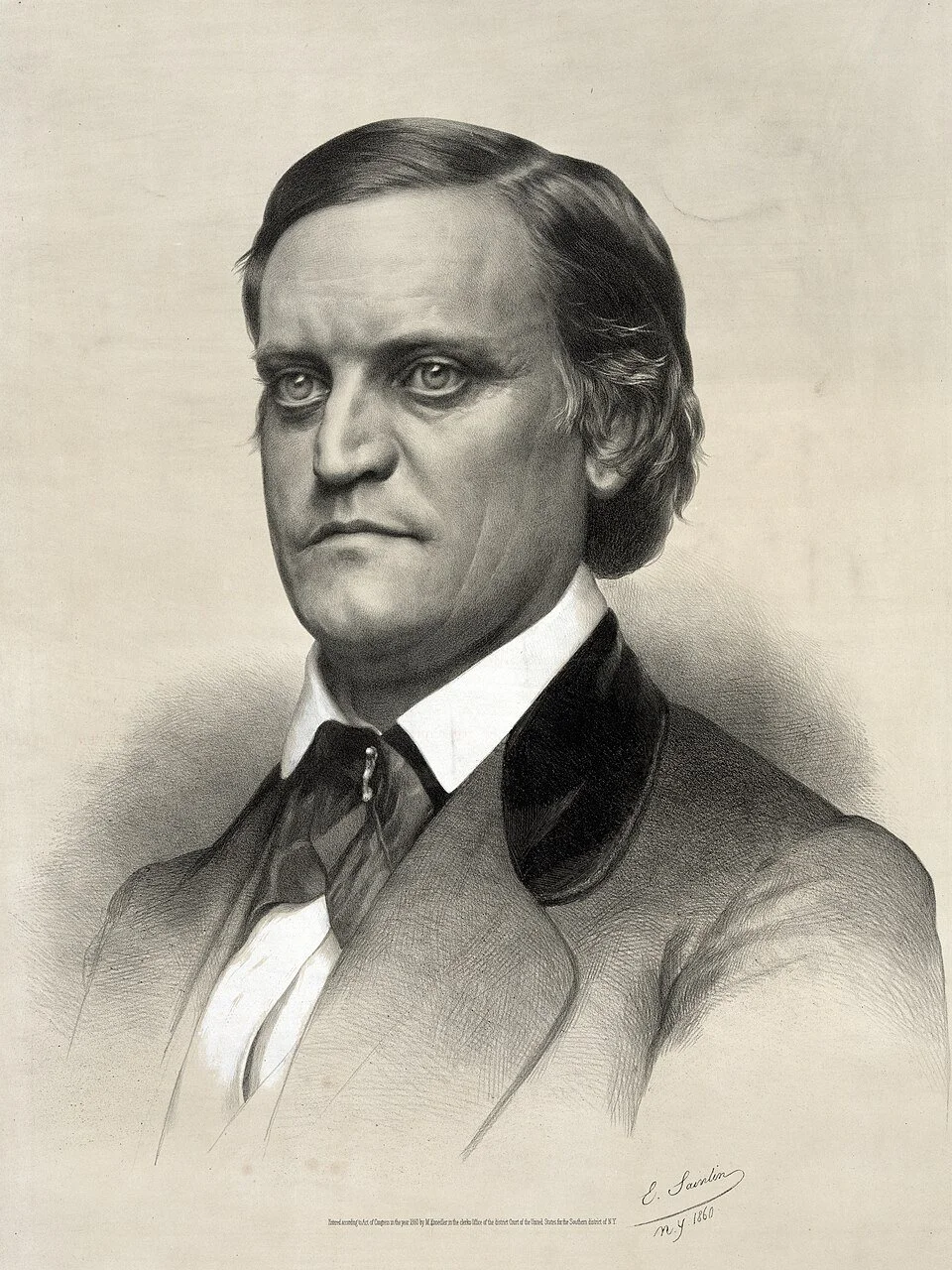


Further Reading:

·       Daniel, Larry J. (1997). Shiloh: The Battle That Changed the Civil War. New York City: Simon & Schuster.

·       James M McPherson, Battle Cry of Freedom. Oxford University Press, 1988.

·       Shelby Foote, The Civil War: A Narrative. Volumes 1-3. Random House, 1963.

·       Ulysses S Grant, The Autobiography of General Ulysses S Grant: Memoirs of the Civil War. Accessed at: https://www.gutenberg.org/files/4367/4367-h/4367-h.htm

·       William T Sherman, Memoirs of General William T Sherman. Accessed at: https://www.gutenberg.org/files/4361/4361-h/4361-h.htm

·       https://www.battlefields.org/learn/civil-war/battles/shiloh

·       http://www.npshistory.com/publications/civil_war_series/22/sec11.htm

·       https://www.historynet.com/battle-of-shiloh-the-devils-own-day/

·       https://www.historynet.com/battle-of-shiloh/

·       https://www.nps.gov/articles/000/was-general-grant-surprised-by-the-confederate-attack-at-shiloh.htm

·       https://www.battlefields.org/learn/articles/battle-shiloh-shattering-myths

Here Jeb Smith argues that General George B. McClellan was the most underrated army commander of the Civil War. While he does not consider him to be a great general or military genius, he thinks the common portrayal of him as a terrible commander is unjust. No other Northern general, people say, exemplifies the stereotype of an incompetent and timid leader as McClellan does. The author argues that this is an unwarranted perception.

Abraham Lincoln and George B. McClellan in the general's tent during the Battle of Antietam on October 3, 1862.

No other general in the war commanded more respect and admiration from his men than George McClellan.”

-John Cannan The Antietam Campaign


Remember that your only foes are the armed traitors,–and show mercy even to them when they are in your power, for many of them are misguided” and later “Bear in mind that you are in the country of friends, not of enemies,–that you are here to protect, not to destroy.”

-George B McClellan May 26 1861 and June 25 1861


Northern Democrats did not see the South as the spawn of Satan but rather as fellow Americans who, in fact, had produced most of the Union leaders up to that point. General McClellan, a Democrat, held tolerant views of the South and sought to avoid needless bloodshed. These perspectives stand in contrast to those of many modern historians and the Republicans of the time, who shaped the narrative to justify the massacres that would follow, as well as the total warfare of 1864 and 1865.


West Virginia and Promotion

Harley six weeks had elapsed... and in that time he had actually created an army and began the first campaign.”

-George b McClellan Commanding General U.S army May 26 1861


George B. McClellan, nicknamed “Young Napoleon” or “Little Mac,” graduated second in his class of 59 at the U.S. Military Academy in 1846. His class included 20 future full-rank generals, and he later returned to West Point as an instructor.

After the war began, he excelled at organizing militia from three states into a cohesive fighting force and saw his first action as a commander of Union forces in what is now West Virginia. This was a departure from his later reputation as a slow-moving, timid general. During a successful campaign in the mountainous region he launched aggressive attacks, dislodged Confederate forces, and captured key positions. He forced the retreat of Confederate troops fortified in the mountain terrain, all while taking minimal losses and securing large supply bases and many prisoners. This success helped preserve the future West Virginia for the Union and prevented the destruction of the Baltimore and Ohio Railroad. President Lincoln was very impressed, which led to McClellan’s appointment to replace McDowell after the latter’s defeat in the Battle of First Manassas[1], and later as the commander of all Union forces.


Organization of the Army of the Potomac

“In a very real sense, McClellan rescued the Union in these early days from dependency and fear. Someone had to rebuild the army and show the country that there was great hope for the future.”

-S.C. Gwynne Rebel Yell: The Violence, Passion and Redemption of Stonewall Jackson Simon and Schuster 2014


The nonmilitary press and President Abraham Lincoln, who was pressured for political reasons, wanted quick action and a fast end to the war. Part of what fueled this was the North's inability (even after First Manassas) to see how determined the South was. They thought this would be a quick, easy conflict. They underestimated the South's resolve to fight and ability to wage war. So, while the press and Lincoln called on Mac for fast action, as a military man Mac understood that the demoralized citizen army needed discipline, training, and organization. He provided these, got rid of poorly-performing generals and instilled spirit and pride in the soldiers while increasing their morale. He came to be loved and revered by his men.

One thing even those who are critical of him admit is that he was a first-rate organizer of the army. Mac took a defeated militia force and turned it into a professional army.


McClellan had started with…a collection of undisciplined, ill-officered, and un-instructed men, who were, as a rule, much demoralized by defeat and ready to run at the first shot. He ended with the finest army ever seen on the North American continent.”

-James V. Murfin Battlefields of the Civil War


Had the North attacked before they were ready, as Lincoln and the press called for, the result would likely have been further defeats and a shattering blow to national morale. As General Sherman stated, Napoléon took three years to build an army, yet “here it's expected in ninety days, and Bull Run is the consequence.”

Mac's offensive plan, as called for by many in the North, was to mass a large army, some said up to 200,000, to march on Richmond and end the war. The Northern people wanted no mistakes after First Manassas. This was Mac's general plan; one that would take time and preparation. Mac also constructed large fortifications around D.C., which had been left almost entirely unguarded by McDowell, including 48 forts and 480 guns. Given that Mac had to train, organize, recruit, and supply a massive citizen army and transform it into a world-class professional army, the time he took to do so was entirely reasonable.


When I was placed in command of the armies of the United States, I turned my attention to the whole field of operations, regarding the army of the Potomac as only one, while the most important, of the masses under my command.”

-George B. McClellan 1861


Further, Mac was commander of all armies and planned for a simultaneous synchronized attack across the Confederacy, which would take further time to plan and put in motion. On August 4th, 1861, in a letter to Lincoln, he laid out his plan that included the main attack to be against Richmond but also simultaneously pushing into Missouri and down the Mississippi, and after Kentucky joined the Union to push into Tennessee, seizing Nashville, and also begin capturing coastal cities such as New Orleans, Savannah and Mobile, then move on to Montgomery and Pensacola. Mac wanted one massive assault to wipe out the South and not a prolonged war; this would take time to prepare. In February 1862 he wrote to Secretary of War Stanton, saying “I have ever regarded our true policy as being that of fully preparing ourselves and then seeking for the most decisive results; – I do not wish to waste life in useless battles, but prefer to strike at the heart.” He did not want years of bloodshed to wear down the South, but brief, decisive action to end the war quickly.


Demotion by Lincoln

Just when Mac felt his army was ready, winter had started in, and Mac was bedridden for three weeks around Christmas. Lincoln wanted action now despite the impassable roads (he would not demand Grant move this early in ‘64) and Mac was accused of being timid. This offensive action was attempted in the winter of ‘62 by Burnside, and the results were Fredericksburg and the “mud march,” which ended in Burnside's removal. Grant, in ‘64, would start his spring offensive in April, later than Mac would his Peninsula campaign. As Grant said, the roads in Virginia would not allow large movements of troops before then, leading William Swinton in Campaigns of the Army of the Potomacto write, “It was inevitable that the first leaders should be sacrificed to the nation’s ignorance of war.”

So Mac started at the average time for spring offensives. No other Union army was campaigning during this winter. Yet, because of Lincoln's urgency and what he saw as a too-cautious McClellan, he demoted Mac to simply commander of the Army of the Potomac. Lincoln also forced corps commanders he had chosen on the Army of the Potomac. Mac wanted to wait to promote generals until he had seen them in battle. This was not the last time a politician interfered with Mac's plans.


Peninsula Campaign Begins

Reduced my force by 1/3, after (bless and do not curse) task had been assigned, its operations planned... it frustrated all my plans... it left me incapable of continuing operations which had been begun. It made rapid and brilliant operations impossible.”

-George B McClellan


“Let me tell you that if your government had supported General McClellan in the field as it should have done, your war would have been ended two years sooner than it was.”

-- General Helmuth von Moltke, Chief of Staff of the Prussian Army and one of the leading military experts of the 19th Century


The Peninsula Campaign began with McClellan's strategic plan for an amphibious operation. Leveraging the North's naval superiority to transport and supply his army, he ultimately aimed for Richmond. Mac anticipated having over 150,000 men for the campaign as he set out for the peninsula. However, once he landed, Lincoln would significantly reduce his army with the other troops spread around the valley, D.C., and the Manassas region.

Mac had wanted more men for the offensive, but Lincoln wanted him to hold men back to guard D.C. Lincoln forced Mac to leave McDowell’s I Corps in D.C. along with the garrison already available. Lincoln now had a garrison of around 20,000 in D.C. and up to 74,000 as far as N.Y. that could be shipped/railed/marched to D.C. if it were attacked. Plus, McClellan had set up world-class fortifications. McClellan, McDowell, Winfield Scott, and every corps commander believed this was more than enough men to guard D.C. and supported McClellan's plan to bring more men, but Lincoln would not allow it for fear of D.C. being attacked. Perhaps out of fear of Stonewall Jackson, it was Lincoln, not the general, who, in this instance, was being overly cautious. In Life and Campaigns of George B. McClellan (1864), author George Stillman Hillard wrote, “From the moment the Army of the Potomac landed upon the Peninsula an uneasy sense of insecurity took possession of the minds of the President, the Cabinet, and the members of Congress.

So Mac landed the army, which was slow-moving because it was massive and carried heavy siege equipment. He faced the largest army the South would field during the war, 88,000 (Grant faced 65,000 in ’64, with a more significant force under him than Mac enjoyed). Once his army landed, he was notified that Stanton had closed all the recruiting depots in the Union. His army would now have to do without either replacements or reinforcements during a major campaign.

This was a massive shock to Mac and the generals in the army. He then was told that McDowell's 40,000 men near Manassas could not be used but must help defend against any possible action towards D.C., despite the fact that Confederates showed no signs of attacking and even burned the bridges south of Manassas as they retreated to defend Richmond. McDowell told McClellan this decision (McDowell protested it) was “Intended [as] a blow to you.” Then McClellan was told the garrison of 10,000 men at Fort Monroe would also be withheld. Even critics of McClellan, like General Heintzelman, said it was a “great outrage” to withhold his army from his command. General Wells said it was the Radical Republicans trying to get Mac to resign. Harper’s Weekly stated, “It is impossible to exaggerate the mischief which has been done by division of counsels and civilian interference with military movements.” Once more, Mac was aggressive, Lincoln and the politicians conservative.


In General McClellan’s opinion, the way to defend Washington was to attack Richmond; and the greater the force thrown against the rebel capital, the greater the security of our own.”

-George Stillman Hillard Life and Campaigns of George B McClellan 1864


Mac was now forced to revise his plans because of Lincoln's caution. In the revised plan, McDowell would advance on Richmond from the north with his 40,000 men and better protect against an attack by Confederate General Joe Johnston if he went north to Washington. However, as Mac argued, the attack on Richmond would force the Confederate army to defend their capital rather than launch a desperate attack on D.C. This disagreement delayed the start of the campaign, with Lincoln getting his way.


“Notwithstanding all that has been said and written upon this subject, I have no hesitation in expressing the opinion, that had not the President and his advisors stood in such ungrounded fear for the safety of Washington, and had not withheld McDowell's forces at a time when their absence was a most serious blow to the plans of General McClellan, the close of the year would have seen the Rebellion crushed, and the war ended.”

-- Allan Pinkerton, chief of the Union Intelligence Service, 1861-1862


Yorktown

Mac moved up the peninsula towards Richmond and was promised McDowell’s men if D.C was free of threat. His army's first encounter was with Confederate General John Magruder and a small Confederate force at Yorktown. Magruder skillfully deceived Mac into believing his force was larger than it actually was. He accomplished this by repositioning the same troops in various locations, acting aggressively, continuously moving small units, using ammunition freely, and setting up dummy defensive positions. This convinced Mac that the Confederate force was more significant than it truly was, prompting him to settle in for a siege while he awaited the arrival of his heavy artillery. Mac was concerned that his inexperienced troops might fail in an assault during the first battle of the campaign, which could damage their morale. Mac eventually captured Yorktown and 80 heavy guns without losses, but the delay gave the Confederates time to organize troops to defend Richmond.


Advance on Richmond

Mac then started to push toward Richmond, and the Confederates gave way. The Union army captured both supply and ordnance during this advance. Mac is criticized for slow movement with a smaller Confederate force in front of him, yet he relied upon his friend and “expert” spy Alan Pinkerton, founder of the Pinkerton Detective Agency. Whatever the value of Pinkerton’s other information, one area in which he failed was in accurately assessing enemy troop numbers. He gave Confederate force numbers from various agents as 160,000, 123,000, 180,000, and even 200,000 in Richmond. And on August 6, Federal General Halleck gave estimates of 200,000 around Richmond. Some northern newspapers working independently gave even higher estimates than Mac did. Because of this, Mac actually believed he was outnumbered.

This was common during the war, with generals thinking the force opposing them was more extensive than it really was. Since this was his information, he believed he was not being cautious but aggressive and daring to continue the campaign, even if at a slow/careful pace. At the time, the enemy numbers were not certain. Mac also waited for his heavy siege artillery to come up from the back, as it was needed to attack Richmond's prominent forts at the Confederate capital.

But without a doubt, the advance was working. Richmond was preparing to evacuate. It forced the Confederates to scuttle the ironclad Virginia, which caused a loss of morale throughout the Confederacy. Confederate General Joe Johnston called General Ewell from Jackson to help in Richmond. McDowell was advancing unopposed north of Richmond. Mac had achieved better success than McDowell, Burnside, Hooker, or Meade advancing on Richmond.


“It was not until 1864 that another Union army, led by Grant, would get as close to Richmond as McClellan did in the spring of 1862.”

--Great Campaigns: The Peninsula Campaign David G. Martin Combined Books PA 1992


The next time the Federals would get this close was under their top general, U.S. Grant. They also fought against a weakened Southern army in ‘64 with a much larger Federal army.

But this time, three things saved Richmond and stopped Mac from capturing the Confederate capital and being hailed as a hero. All three had to happen to stop Mac; two of them were very unlikely and could not have been foreseen.


1] Jackson in the Valley

The most significant contrast between the Virginia campaigns of Grant and McClellan is that Early's offensive did not accomplish its ultimate objective–to relieve the pressure on Lee's army at Petersburg, Jackson's campaign in the Shenandoah valley did. Unlike McClellan before him, Grant would not be forced to alter his designs on the James River one iota.

-Thomas Rowland George B. McClellan and Civil War History


Unlike Lincoln, Mac saw Jackson's valley campaign as a diversion by Lee (now in command of the Southern Army) to pull federals away to help protect Richmond. Richmond was saved because of Jackson's brilliance in the valley. He outmaneuvered and outfought a force over three times the size of his own (17,000- 60,000), defeating them in multiple battles while also threatening D.C.

Jackson knew Lincoln was concerned with protecting D.C. Hence, he knew that aggressive maneuvers would pull men from the peninsula and help save Richmond. Jackson kept 71,000 additional men away from the Richmond attack with his victories and aggressive maneuvering. Lincoln was constantly scared by what Jackson might do, and this prevented McDowell and other troops from helping Mac; the withholding of McDowell would prove decisive.


2] Lincoln Recalling Troops to the Valley


“[It was] Jackson's campaign, and the insane terror it inspired in Washington, which was the true cause of the failure on the peninsula.”

-Colonel Ferdinand Lecomte, quoted in George Stillman Hillard Life and Campaigns of George B. McClellan 1864


Because of Jackson, Lincoln recalled troops to defend Washington and the valley. He also held back McDowell's 40,000 from the attack on Richmond. This “Changed the whole nature of the confrontation near Richmond,” and “The Confederacy was truly handed an amazing gift.” Mac would have rather left Jackson to clear out the valley and even attack D.C. if he wished. Mac had built massive forts with a large garrison to protect the capital.


Here is the true defense of Washington, it is here on the banks of the James.”

-McClellan to Halleck August 4th, quoted in George Stillman Hillard Life and Campaigns of George B. McClellan 1864


After Pinkerton reported a large number of enemy forces to McClellan, he paused his attack due to McDowell's absence. McDowell was supposed to launch an assault on Richmond from the north to prevent the Confederates from mounting counterattacks. McDowell described his recall to the valley as “a crushing blow to us.” Even Lincoln told McClellan, “If you believe you are not strong enough to take Richmond, just know that I do not ask you to try. Just know.”


3] Lee Replaces Joe Johnston

General Joe Johnston, the commanding Confederate general, was injured and replaced by Robert E. Lee. This would change the entire campaign. Mac had been slowly pushing Johnston back towards Richmond, but Lee would take the initiative and attack Mac.


Lee vs Mac

Lincoln’s maneuvers significantly reduced the Mac forces near Richmond attempting to trap Jackson in the valley. Heavy rains swelled the Chickahominy River and created a split the Potomac army, and Lee saw his opportunity.

Lee, whom many consider not only the premier general of the South but of the war, recalled Jackson from the valley to help in the offensive vs. Mac, now with a force nearly equal to his.

Lee would strike the smaller portion of Mac's army and threaten its supply line under General Porter. Porter was supposed to be supported by McDowell from the north to meet up with his flank coming south from Manassas. Had Mac's plan been allowed, the attack would not have been possible. However, when Lincoln sent McDowell to the valley to trap Jackson, Porter was vulnerable, and Lee pounced, enabling its strategic success.


General McClellan wished and had advised that reinforcements should be sent him by water, as their arrival would be more certain. Now that the James River was open, they might have been sent by that route... Richmond could have been approached by the James, and we should have escaped the delays and losses incurred by the bridging of the Chickahominy, and should have had the army massed in one body instead of necessarily being divided by that stream... the capture of Richmond could not be carried out because to the president’s distempered fancy Washington was not safe... McClellan was commanded to extend his right wing to the north of Richmond, in order to establish the communication between himself and General McDowell. This was running a great risk in case General McDowell should not come, because it exposed our right in a way no prudent officer would have done; and, as General McDowell did not come, the enemy did not fail to take advantage.”

-George Stillman Hillard Life and Campaigns of George B. McClellan 1864


Lee attacked in multiple bloody battles, resulting in high losses on both sides. Mac would cause high casualties to Lee during the campaign, inflicting more losses than he received. However, Mac, going from “expert” information, believed he was outnumbered and was in danger of being cut off without help from the north. With Lincoln recalling so many of his troops, he ordered a retreat off the peninsula. Mac telegraphed D.C., stating, “If I save this army now, I tell you plainly I owe no thanks to you or to any other persons in Washington...you have done your best to sacrifice this army.”

The retreat on the peninsula was dangerous, yet McClellan and Porter skillfully conducted it to save their forces from disaster. Mac would withdraw by night and defend a favorable position by day. It was a major strategic victory for the South yet a tactical victory for the Union. Lincoln called it a “half defeat.” Given the force size and causalities suffered, Mac performed better than the future Union commanders of the Army of the Potomac.


-Peninsula campaign stats

-Union Forces 105,000 Casualties 23,900 approx.

-Confederate Forces (inc. Jackson) 88,500 Casualties 29,600 app.


Antietam/Mac Takes Command

I must have McClellan to reorganize this army and bring it out of chaos...there is no man in this army who can man these fortifications and lick these troops into shape half as well as he can.”

-Abraham Lincoln


General McClellan has again assumed the supreme command of the army... His reception by the officers and soldiers was marked by the most unbounded enthusiasm. In every camp his arrival was greeted by hearty and prolonged cheering... Already his... visit to our camps has wrought a remarkable change in the soldiers. His presence seemed to act magically upon them; despondency is replaced by confidence, and all are glad that McClellan will, hereafter direct them.”

-Ellis’s Leaves from the Diary of an Army Surgeon, p. 214, quoted in George Stillman Hillard Life and Campaigns of George B. McClellan 1864


Lincoln's selection of the aggressive Republican general John Pope to lead the army led to the embarrassment at Second Manassas. Pope was then exiled to Minnesota to fight Indians, and Lee turned his attention to an invasion of the North. Meanwhile, Mac had to reorganize Pope’s defeated, demoralized army that was integrated into his command and try to restore morale. Mac was reinstated in command of Pope's army and the Army of the Potomac on September 2nd.  The effect was immediate:


The effect of the news was instantaneous. All of a sudden the federals forgot their defeat, weariness, and hunger and exploded into triumphant hurrahs, multitudes of caps were thrown in the air.”

-John Cannan The Antietam Campaign


Slow to Meet Lee?

A common criticism of McClellan during the Antietam campaign is that he was slow to move the army out to confront Lee's invasion, which allowed Lee to enter Maryland. Lee entered Maryland around September 4-7. Mac had just taken control of a disorganized, defeated army on the 2nd, and “worked a minor miracle in the next few days as he restored the army's morale and organization, and equally significant, its pride and sense of purpose.” No other man in the army could have restored morale and cohesion as quickly as Mac did before the Battle of Antietam. He had reorganized his army and marched to meet Lee by September 9th. Lee had expected a longer time for Mac to prepare, and his fast reaction spoiled Lee's plan to capture Harrisburg, Pennsylvania. In his article Showdown on South Mountain historian Dennis Frye wrote, Pennsylvania was Robert E Lee's target in September 1862. But Maryland and George McClellan got in the way.”


Mac had other reasons to be cautious. General Halleck advised General McClellan to be watchful regarding Washington, D.C., and to wait until General Lee's intentions were fully understood. Halleck believed that Lee was attempting to draw McClellan out, rather than planning a direct attack on D.C. Additionally, McClellan received continual reports from his cavalry regarding enemy troop strength, estimating between 60,000 and 120,000 soldiers. General Porter estimated Lee's army to be 100,000, while General Sumner's assessment was 130,000. This information was accepted by the Union high command, who believed that Lee must have been reinforced in preparation for an invasion.

Mac moved west, forcing Lee to fall back to link with Jackson from Harpers Ferry. Mac helped lead the attack at the Crampton’s Gap, Turner’s Gap and Fox's Gap battles—all victories. At Turner's Gap, CSA losses were 2,300 and USA losses 1,800, even though the attack was up a mountain and through rough terrain. On Sep 16th, Mac trapped Lee by a flank maneuver on Lee's left and captured the road to Hagerstown, forcing Lee's northern invasion to end. Frye wrote, “Lee saw his invasion crumbling. The most important matter now was not Pennsylvania, but preservation of the army.” Mac even took the unpredictable and aggressive General Stonewall Jackson off-guard, causing him to say “I thought I knew McClellan, but this movement puzzles me.”


The Battle of Antietam

The two armies met near Sharpsburg, Maryland, on September 17th. The “cautious” Mac would assault the Confederate lines, leading to the bloodiest day of the war. Mac's plan was to attack both the Confederate left and right simultaneously, followed up with a massive reserve attack in the center.

While not a complete failure the attack failed to destroy Lee, partly due to Burnside's late arrival at the battle. Burnside delayed his assault on the Confederate right, “throwing off the whole plan,” and allowing Lee to shift reinforcements along his line to meet Union forces in the center and left. McClellan sent a half dozen couriers to Burnside to push him to strike more swiftly and threatened to relieve him of command. Yet, Lee's army was nearly breaking in all three sectors.

Mac did not show tactical genius and made some mistakes, but in the end, it was a strategic victory for the North and a tactical draw. He rested on the 18th to resupply (artillery near out of ammo) and gave orders to attack come daylight on the 19th, but the Confederates had left. The battle sent Lee's wounded army back to Virginia and, more importantly, ended any hopes the Confederacy had for European involvement in the war. Thus Frye wrote that “George McClellan saved the union.”


“A man who could take a demoralized army, as McClellan took the combined forces that had been defeated under Pope in front of Washington at the second Bull Run, restore its discipline by the magic of his name and his swift reconstruction of its shattered organizations, and then lead it to victory within fourteen days, after an almost unexampled celerity of movement against the enemy who had crushed it two weeks before--such a man is not to be spoken of or thought of as wanting in the force and vigor of a great general.”

-- George T. Curtis, U.S. Commissioner, historian


Antietam stats

Union Forces 87,000 Casualties 12,401

Confederate Forces 47,000 Casualties 10,316


McClellan Allowed Lee to Escape?

Lincoln heavily criticized Mac for not destroying Lee's army and not following him back into Virginia. However, Mac had sent Porter to harass the enemy retreat, which had initial success, capturing 40 Confederate artillery pieces. However, A.P. Hill counter-attacked, pushing the Union men back across the Potomac. Hill said it was “The most terrible slaughter...a lesson to the enemy, and taught them to know it may sometimes be dangerous to press a retreating army.”

Often, retreating armies fought significant rearguard actions to prevent their own destruction. Civil War battles rarely ended with the destruction of one or other army, only in 1865 when the South was near defeat was an army nearly annihilated. The assumption it could happen in 1862 points more to the expectations of the early-war North than realistic military goals. When the army was criticized for not destroying Lee's forces, a soldier in the Army of the Potomac replied. “Think the rebel army can be bagged? Let them come and bag them. Easy to talk about.” Historian John Cannan said the counter attack showed the federals that the rebels “still had a formidable bite.” Dennis Frye, who studied the Antietam campaign for over 50 years, wrote that ideas that Lee could be easily destroyed were “Myths created by politicians” not accurate judgments based on historical truth.

Further, the Federals were low on supply and had just fought two large-scale engagements. Lee knew where Mac would be unable to supply his army and planned his withdrawal accordingly. Mac was also working off his cavalry’s and Pinkerton's estimates of the Confederate strength. Thinking the Confederates still had equal force, he chose not to push the attack or risk a loss on Maryland soil that would endanger D.C. and the outcome of the war.

Far from defeated, after Lee had fallen back to Virginia he planned to continue the attack again. He sent Stuart’s Cavalry to create a bridgehead at Williamsport, Maryland, to renew the invasion. However, Mac had anticipated this move and sent his own cavalry along with the 6th Corps to prevent such a move. As argued by Dennis Frye, Mac outthought Lee in Maryland.

Later in October, Mac's quick and aggressive move into the Warrenton, Virginia area surprised Lee, splitting Lee's army. Both Lee and Longstreet were concerned. However, Lincoln had given the order two days before, and Mac was removed from command.


Conclusion

“There are strong grounds for believing that he was the best commander the army of the Potomac ever had.”

-Francis Palfrey Antietam, Fredericksburg


While I would not go as far as the above quote does, I would say Mac was the most underrated general of the war. He does not get credit where he should and gets the blame where he should not. I do not see Mac as cautious to a fault as claimed. It was often Lincoln, Stanton, and Halleck being over-cautious about protecting D.C. that interfered with Mac's plans. And his military intel let him down, not his over-cautious nature.


“Look at his campaign in Western Virginia in 1861,–a part of his military career conveniently ignored by his enemies. Here he had a separate command, a defined field of action and was not hampered and trammeled by interference from Washington; and do we see any signs of indecision and want of promptness here? On the contrary, we observe the happiest combination of judgement in design and vigor in execution: one skilful and powerful blow was instantly followed by another, and the result was absolute and permanent military success.”

-George Stillman Hillard Life and Campaigns of George B. McClellan 1864


Lincoln and the press wanted aggression, and the results were First Manassas, Burnside at Fredericksburg, Pope at Second Manassas, and later Hooker at Chancellorsville. No general of the early war could handle the tandem of Jackson and Lee. Extreme events withheld Mac from the capture of Richmond in ‘62.

A fair critical comparison between Mac and Sherman/Grant is favorable to Mac. Later, when Grant/Sherman gained victories, it was more because of the Confederate armies' reduced capability to offer resistance than their ability to be outgeneral Mac.

I believe the real reason for Lincoln's disappointment with Mac was the North's high expectations. Underestimating the resolve of the South and their leadership, the North desired one battle and one victory in Virginia, which would win the war for them. But it took years for them to realize their error, though doubt began early as Lincoln wrote to his friend Carl Schurz in 1862, “I fear we shall at last find out that the difficulty is in our cause rather than in particular generals.”


McClellan's relationship with Lincoln is central to any understanding of why historians judge him as a flawed personality...Lincoln has attained a stature that sets him apart from other mortals”

-Thomas J Rowland George B McClellan and Civil Har History: In the Shadow of Grant and Sherman Kent State University Press


Historians may have viewed McClellan negatively because he opposed and disagreed with Lincoln. He committed the “unpardonable sin” of running against Lincoln in the 1864 election on a peace platform aimed at ending the bloodshed. In 1864 George Stillman Hillard wrote, “The real reasons for which General McClellan was removed were political, and not military.” Historian Dennis Frye said “The Republicans could not allow McClellan to be a victor. They could not allow that to happen. They needed to do everything they could to smear McClellan.”


However patriotic the abolitionist radicals in the north may have been, the very last thing they wanted was for Little Mac to win in the battle for Richmond....the abolitionists would lose their influence.”

-S.C. Gwynne Rebel Yell The Violence, Passion, and Redemption of Stonewall Jackson Simon and Schuster 2014


There is a political element connected with this war which must not be overlooked.”

-Congressional Committee on the Conduct of the War Dec 26 1861 quoted in George Stillman Hillard Life and Campaigns of George B. McClellan 1864


Lincoln acknowledged that he made many errors that undermined McClellan's chances for success. After McClellan, Lincoln refrained from becoming directly involved with his generals. It appears that some historians have unfairly attributed Lincoln's military shortcomings to McClellan.


At this moment a considerable portion of his countrymen have their minds barred against all arguments and considerations in defense of General McClellan, by political prejudice. To deny him all military capacity is part of the creed of a great political party. Most supporters of the present administration hold it to be a point of duty to disparage and decry him.”

-George Stillman Hillard Life and Campaigns of George B. McClellan 1864


Jeb Smith is the author of four books, the most recent being Missing Monarchy: Correcting Misconceptions About The Middle Ages, Medieval Kingship, Democracy, And Liberty. Before that, he published The Road Goes Ever On and On: A New Perspective on J. R. R. Tolkien and Middle-earth and also authored Defending Dixie's Land: What Every American Should Know About The South And The Civil War, written under the name Isaac C. Bishop. Smith has authored dozens of articles in numerous publications, including History is Now Magazine, The Postil Magazine, Medieval History, Medieval Magazine, and Fellowship & Fairydust, and has been featured on various podcasts.


Major Battles and Casualties of Union Generals vs Lee

Union commander/ Battle/ Union Losses/ Lee loses/ Union causality per confederate causality

Pope- Second Manassas 13,879 Lee 8,353 1.65 per

Hooker- Chancellorsville 17,100 Lee 12,151 1.43 per

Burnside- Fredericksburg 13,353 Lee 4,576 2.95 per

Grant- Wilderness 18,400 Lee 11,400 1.61 per

Grant- Spotsylvania 18,000 Lee 12,000 1.5 per

Grant- Cold Harbor 12,737 Lee 4,594 2.8 per

Grant- Total 49,100 Lee 27,900 1.75 per


Meade- Gettysburg 23,049 Lee 28,063 .82 per

Meade- Total [above/Grant] 72,049 Lee 55,963 1.29 per

McClellan- Peninsula 15,849 Lee 20,133 .78 per

McClellan - Antietam 12,401 Lee 10,316 1.2 per

McClellan - Total 28,250 Lee 30,449 .92 per


McClellan was the only Union general to give more casualties than taken when faced with Lee. His average over two battles was only bested once by a Union commander, by Meade (who performed worse overall) at Gettysburg. Mac fought against Lee with, if anything, less of a manpower advantage than Grant would have later on. He also faced the Army of Northern Virginia while it had Jackson, was well supplied, and the South had high national morale, unlike what Grant faced.

How many other Union commanders can claim over two battles with Lee to have won a tactical victory on the first and a strategic victory and a tactical draw on the second while inflicting heavy losses? It is no wonder Lee said Mac was the best he faced. And famed Confederate John Mosby, the “gray ghost of the Confederacy,” said that McClellan was the best Union commander “by all odds.”


[1] The two battles at the same site were referred to as First and Second Manassas by the Confederacy, First and Second Bull Run by the Union. I will stick to Manassas throughout, except that where quotations from the Union side refer to Bull Run this will be left unchanged.

Posted
AuthorGeorge Levrier-Jones
4 CommentsPost a comment

George Armstrong Custer is well-known to every American as a Native American fighter following the U.S. Civil War, particularly highlighted by the events of the Last Stand at the Little Bighorn River, which has become a significant part of American folklore. The leadership he exhibited while commanding the 7th Cavalry, often accompanied by the tune of Garryowen, is familiar to many.

Custer's legacy is marked by deep controversy and division, as he has faced severe criticism for his actions against Native Americans, which many view as genocidal. Conversely, he is also regarded by some as a martyr for the cause of American expansionism. Both perspectives hold validity, rendering him a multifaceted and complex historical figure.

Less well known are Custer's military exploits as a young officer during the Civil War. His aggressive tactics, readiness to lead from the front lines, and ability to motivate his troops contributed to his rapid rise in fame and rank, despite the inherent dangers of his approach. However, this same aggressive disposition also resulted in notable failures and precarious situations.

Lloyd W Klein explains.

General George Armstrong Custer. From a photographic negative in Brady's National Portrait Gallery.

West Point

Custer was born in Ohio on December 5, 1839. He spent part of his youth in Michigan, with a half-sister and her husband, and would consider the state his adopted home. Despite his humble background and youthful indiscretions, a Michigan Congressman secured Custer a place at the U.S. Military Academy at West Point when he was 18. Custer entered West Point as a cadet on July 1, 1857, as a member of the class of 1862, which consisted of seventy-nine cadets engaged in a rigorous five-year program. He graduated at the bottom of his class, ranking 34th out of 34, as 23 of his peers had either dropped out due to academic challenges or resigned to join the Confederacy.

Throughout his tenure at West Point, Custer consistently challenged established norms and regulations. Over the course of four years, he accumulated an astonishing 726 demerits, marking one of the most notorious conduct records in the institution's history. Although he possessed considerable intelligence and talent, he largely disregarded the Academy's disciplinary measures and exhibited a lack of diligence in his studies. His behavior nearly led to expulsion on multiple occasions, and he ultimately graduated last in his class, a designation often referred to as the “goat.” With the onset of the American Civil War in 1861, the duration of the course was reduced to four years, allowing Custer and his classmates to graduate on June 24, 1861, a fortuitous moment for an aspiring military leader.


Outbreak of the Civil War

The United States Army faced a critical shortage of officers at the onset of the Civil War. In response to this urgent need, Custer received a commission as a second lieutenant and was assigned to the 2nd U.S. Cavalry Regiment. His initial responsibilities included training volunteers in Washington, D.C., and shortly thereafter, his unit was deployed to the front lines. During the First Battle of Bull Run, Custer served with his regiment, where Army commander Winfield Scott tasked him to deliver messages to Major General Irvin McDowell.

Following the battle, Custer remained engaged in the defense of Washington, D.C., until he fell ill in October 1861, which led to his absence from the unit until February 1862. Upon his return, he participated in the Peninsula Campaign in Virginia with the 2nd Cavalry, remaining active until early April 1862. His involvement during this critical period was significant as the campaign unfolded. 3. On April 5, 1862, Custer transferred to the 5th Cavalry Regiment, which was involved in the Siege of Yorktown from April 5 to May 4, where he served as aide to Major General George B. McClellan. By late May, he was entrusted with a leadership role that he executed with remarkable success, resulting in a promotion to Captain, although he would later face a demotion. Throughout this time, he participated in all the key battles of the Maryland campaign, further solidifying his military reputation.

During the Peninsula Campaign, on May 24, 1862, during the pursuit of General Joseph E Johnston, General George McClellan and his staff were reconnoitering a potential crossing point on the Chickahominy River. Custer overheard General John G. Barnard mutter, "I wish I knew how deep it is." Custer dashed forward on his horse out to the middle of the river, turned to the astonished officers, and shouted triumphantly, "McClellan, that's how deep it is, Genera!".

In his first battle command, He led an attack with four companies of the 4th Michigan Infantry across the Chickahominy River above New Bridge. The attack was successful, resulting in the capture of 50 Confederate soldiers and the seizing of the first Confederate battle flag of the war. McClellan congratulated Custer personally.


Antietam

Custer consistently maintained a positive rapport with his superiors throughout his military career. His collaboration with McClellan marked a significant turning point in his professional development. It is commonly understood that Custer's tenure under McClellan sparked his fascination with personal publicity, a factor that would have lasting implications for both his military engagements and his subsequent life.

During the Battle of Antietam, Custer served on McClellan’s staff, where he was responsible for the strategic placement of troops as directed by the commander. An order issued by McClellan specifically instructed General Sumner to maneuver Sedgwick and French across a creek at fords that "Captain Custer will show you," highlighting Custer's integral role in the operation. (On page 212 of Hartwig’s “I Dread the Thought of the Place”.)


Pennsylvania Campaign

Between Chancellorsville and Gettysburg, there were huge changes in the command structure of the US Cavalry. Stoneman was relieved of his command and sent to Washington DC to become Chief of the Cavalry Bureau, which was a demotion. Brevet Lieutenant Colonel Alfred Pleasonton succeeded him as the commander of the Cavalry Corps. Additionally, Brigadier General John Buford and his brigade were reassigned to the 1st Cavalry Division, while Brigadier General Wesley Merritt took charge of the Reserve Brigade. The death of Colonel Benjamin Franklin “Grimes” Davis at Brandy Station led to Colonel William Gamble assuming command of Buford's 1st Brigade. Kilpatrick was promoted to command of the 3rd Cavalry Division on June 13.

On June 9, 1863, Custer was appointed as aide to Brevet Lieutenant Colonel Pleasonton, who was tasked with the critical mission of locating General Robert E. Lee's army as it advanced northward through the Shenandoah Valley at the onset of the Gettysburg Campaign. In preparation for the Battle of Gettysburg, Custer played a pivotal role in the Battle of Aldie on June 17, contributing to the Cavalry Corps' operations in Loudoun Valley. His bold maneuvers were instrumental in delaying the Confederate cavalry, which was tasked with monitoring the movements of Lee's Army of Northern Virginia. This engagement served as one of Custer's initial opportunities to demonstrate his capabilities in leading cavalry forces.

The Battle of Aldie on June 17, 1863, marked a pivotal moment in the series of cavalry skirmishes that constituted the Loudoun Valley Campaign, serving as a precursor to the more extensive Battle of Gettysburg. During this engagement, Union and Confederate cavalry forces clashed as General Robert E. Lee's Army of Northern Virginia advanced northward into Pennsylvania. Custer emerged as a key figure in these confrontations, demonstrating his tactical acumen and leadership abilities.

The conflict commenced when Union cavalry, led by Brigadier General Judson Kilpatrick, sought to locate and confront the Confederate cavalry commanded by Colonel Thomas Munford, who was tasked with screening Lee's advancing forces. At this juncture, Custer, a young officer on the rise, was assigned to lead the 5th Michigan Cavalry regiment within Kilpatrick's division. His leadership was crucial as the Union forces aimed to disrupt the Confederate maneuvers.

As the battle progressed, Custer orchestrated several daring charges against the well-entrenched Confederate troops, who had fortified themselves along strategic roads and ridges. His aggressive strategies not only maintained pressure on the enemy but also resulted in significant casualties for his men. Notably, Custer's audacious charge succeeded in breaching a critical Confederate position, leading to the capture of several enemy soldiers and temporarily displacing Confederate forces from the battlefield. Throughout the engagement, Custer's visible presence and fearless leadership galvanized his troops.  The battle ended inconclusively, with both sides holding their ground as night fell. However, Custer’s regiment and the Union cavalry achieved their tactical objective of delaying the Confederate forces. This was important because it slowed Munford's cavalry, preventing them from fully screening Lee’s army, and allowed Union forces to gather more intelligence on Confederate movements.

On June 22, 1863, Pleasanton was elevated to the rank of major general in the U.S. Volunteers. Following a consultation with George Meade, the newly appointed commander of the Army of the Potomac, Pleasanton received directives that would significantly impact the course of the war. He was instructed to replace political generals with leaders who were ready to engage in combat and personally spearhead mounted assaults. Among his aides, he identified three individuals who exemplified the aggressive leadership he sought: Wesley Merritt, Elon J. Farnsworth, both of whom possessed command experience, and George Armstrong Custer. Each of these officers was promptly promoted to brigadier general, with Custer taking command of the Michigan Cavalry Brigade, known as the "Wolverines," which was part of Brigadier General Judson Kilpatrick's division. Notably, Custer, at the age of 23, became one of the youngest generals in the Union Army, despite lacking direct command experience. The so-called "Boy Generals" were poised to make significant contributions in the days to come, with Merritt and Custer embarking on distinguished careers, while Farnsworth tragically lost his life shortly thereafter.

On June 30, 1863, Custer and the First and Seventh Michigan Cavalry were advancing through Hanover, Pennsylvania, with the Fifth and Sixth Michigan Cavalry trailing approximately seven miles behind. Upon hearing the sounds of gunfire, Custer redirected his forces toward the source of the commotion. A courier informed him that Farnsworth's Brigade had come under attack from Confederate cavalry in the town's side streets. After regrouping his command, Custer received orders from Kilpatrick to confront the enemy to the northeast of town, near the railway station. He skillfully deployed his troops and initiated an advance. Following a brief exchange of fire, the Confederate forces retreated to the northeast.  This might seem surprising because Lee and his army were somewhere to the west, but Stuart was looking for Early who he thought was still at York; but Early had left that morning.  Early had gone west that morning on exactly the road Stuart was now taking east. Though this skirmish in itself was of little consequence, it was a major part of the reason Stuart.

Following the engagement at Hanover on June 30, Custer advanced through Abbottstown, Pennsylvania, in pursuit of Stuart. By July 1, the sounds of conflict from Gettysburg, located approximately 14 miles to the west and slightly south, began to reach them late that morning. On the same day, Custer encountered Confederate Brigadier General Wade Hampton at Hunterstown, where a skirmish ensued.

The following morning, July 2, Custer received orders to advance toward Culp’s Hill with the objective of disrupting enemy communications. As he neared Hunterstown in the afternoon, he learned that Stuart was in close proximity and had not yet detected his presence. Demonstrating exceptional courage, Custer took the initiative to scout ahead alone, discovering that the Confederate forces were unaware of his troops' arrival, which allowed him to conduct his own reconnaissance.

Upon returning to his command, Custer strategically positioned his forces along both sides of the road, ensuring they remained concealed from the enemy. He placed the First and Fifth Michigan Cavalry, along with his artillery, behind a low rise further down the road. To lure the Confederate cavalry into his trap, he rallied A Troop of the Sixth Michigan Cavalry, boldly declaring, "Come on boys, I'll lead you this time!" He charged directly at the unsuspecting rebels, who, as anticipated, pursued him. Despite suffering significant losses and being left on foot after his horse was shot, Custer was rescued by Private Norvell Francis Churchill. Ultimately, Custer and his remaining troops managed to escape, while the pursuing Confederates were repelled by rifle and artillery fire, leading to a withdrawal from both sides.


East Cavalry Field

Custer spent most of the night in the saddle, and reached Two Taverns, Pennsylvania, approximately five miles southeast of Gettysburg, at around 3:00 a.m. on July 3. The cavalry skirmishes that took place on this day in 1863 are noteworthy, even though they were not the central focus of the Gettysburg battle. At East Cavalry Field, located three miles east of Gettysburg, forces led by J.E.B. Stuart engaged with Gregg's division and Brigadier General George A. Custer's brigade from the 3rd Division. This encounter resulted in an extended mounted conflict, which included intense hand-to-hand combat, with both factions asserting they had emerged victorious.

Custer's involvement in the cavalry confrontations on the final day of the Battle of Gettysburg stands out as one of his most significant contributions during the war. Commanding a brigade of Michigan Cavalry, he fought valiantly at East Cavalry Field, where he played a pivotal role in thwarting Confederate General J.E.B. Stuart's attempts to launch an assault on the Union's rear during Pickett’s Charge. Custer's renowned charge, accompanied by the rallying cry “Come on, you Wolverines!” ignited a fierce battle that ultimately disrupted Stuart’s strategy and aided in securing a Union victory.

J.E.B. Stuart's cavalry finally arrived on the battlefield late on July 2, but the response from General Lee was less than enthusiastic. Lee instructed Stuart to maneuver behind the Union lines to penetrate their rear. By approximately 11 a.m., just three hours before Pickett’s Charge, Stuart had positioned his forces about three miles east of the Union line, intending to flank the Union left at Cress Ridge. However, Custer's troops, equipped with Spencer repeating rifles, held their ground resolutely, reminiscent of Buford’s brigades on the first day of battle. Consequently, at 1 p.m., Stuart ordered a direct assault led by Fitz Hugh Lee’s 1st Virginia Cavalry.

On July 3rd, Custer was reassigned from Kilpatrick's command to serve under the leadership of Gregg’s division. The overall command structure placed Buford at the helm of the 3rd Cavalry Division, with the majority of his forces positioned far from the conflict occurring in Westminster, Maryland. However, Buford's reserve brigade, commanded by Wesley Merritt, was stationed to the south of Gettysburg. At this juncture, David Gregg had two brigades under his command, one led by McIntosh and the other by Colonel J. Irvin Gregg, his cousin, both of which were deployed along the Baltimore Turnpike. Consequently, Gregg temporarily loaned one of his brigade divisions to Custer’s Michigan Brigade, while Kilpatrick and Farnsworth found themselves southwest of Little Round Top, resulting in a fragmented command structure.

The conventional narrative suggests that the Confederate forces were unaware of the Union cavalry's movements until Stuart signaled Lee with four artillery shots. However, this account raises questions, as Gregg had already established the positions for Custer and McIntosh earlier that day. Furthermore, Pleasonton had informed Gregg of Stuart's proximity, yet he still instructed Custer to return to Kilpatrick. Both Gregg and Custer deemed this order imprudent, leading them to disregard it and prepare for engagement instead.

In response to the situation, Gregg directed Custer and the 7th Michigan to launch a counterattack. Custer took the lead, rallying his men with the call, “Come on you Wolverines.” At that moment, the Virginia cavalry was positioned behind a fence, with over 700 horsemen engaged in combat using sabers, pistols, and rifles. Just as Custer appeared poised to force a retreat among the Virginians, Stuart countered by sending Wade Hampton to launch an attack, compelling Custer to withdraw. During the skirmish, Custer's horse was killed, prompting him to borrow his bugler's mount, which also met a similar fate. In response, Gregg ordered his remaining brigade to charge once more, but after approximately 40 minutes of intense fighting, both sides ultimately retreated. Custer's valor was particularly pronounced as he orchestrated a series of audacious cavalry charges against the Stuart. Despite facing overwhelming odds, His decisive actions were instrumental in thwarting Stuart’s cavalry from launching a surprise attack on Union troops, thereby playing a vital role in securing a Union victory.

This assault was conceived as part of a tripartite offensive that was meant to occur simultaneously, with Early and Pickett launching their attacks in a coordinated manner. This reflects the traditional military strategy of the time. However, a more contemporary interpretation suggests that Stuart was expected to approach Culp’s Hill from the south, while Early’s infantry would advance from the north. It is believed that Lee anticipated that if Pickett’s charge succeeded in pushing back the Union line and Stuart managed to penetrate their rear, it would create significant confusion among Union forces. While Lee recognized the necessity of coordinating his forces for a unified attack, there is no substantial evidence to indicate that he envisioned this operation as an envelopment, particularly given the limited size of Stuart’s contingent.

The casualties incurred during the 40 minutes of intense combat at East Cavalry Field were relatively modest, totaling 254 for the Union—of which 219 were from Custer's brigade—and 181 for the Confederates. Some reports indicate that Custer's losses were as high as 257, marking the most significant cavalry brigade loss in the battle. Stuart commanded approximately 6,000 troops, while Custer had 1,200 and McIntosh had 2,400. Although the engagement did not yield a decisive tactical outcome, it represented a strategic setback for both Stuart and Robert E. Lee, whose objective to penetrate the Union's rear were ultimately thwarted.


Williamsport

The Battle of Williamsport, which lasted from July 6–16, 1863, occurred during Lee’s retreat from Gettysburg. Union cavalry forces, including those under George Armstrong Custer, pursued the Confederate army as it retreated toward the Potomac River, attempting to cross back into Virginia. Custer played a notable role in these engagements, especially in harassing Lee's rear guard and attacking Confederate forces protecting their retreat.

After the Confederate defeat at Gettysburg, Lee's army began retreating southward toward the Potomac River. Custer, commanding a brigade in General Judson Kilpatrick’s division, was part of the Union cavalry tasked with pursuing the retreating Confederates and disrupting their movement. His orders were to engage the Confederate rear guard, disrupt their wagon trains, and prevent them from crossing the Potomac, buying time for Union infantry to catch up.

Custer and his brigade engaged in several skirmishes with Confederate cavalry near Hagerstown and Williamsport. The Confederate forces were defending their supply trains and attempting to hold off the Union cavalry long enough to repair bridges and establish a crossing point at the Potomac River. Custer led his men in multiple aggressive attacks on Confederate positions, targeting both their cavalry and the wagon trains full of supplies. His boldness was consistent with his typical approach, charging Confederate lines in an effort to force them back.

During one of these engagements near Williamsport on July 6, Custer’s brigade became overextended after a particularly aggressive charge. He advanced too far ahead of supporting Union forces and was nearly encircled by Confederate infantry and cavalry. Custer’s position was briefly precarious, as he faced being surrounded and cut off. Despite this, Custer managed to organize a defense and retreat his brigade to a more secure position, avoiding disaster. His men were able to disengage and hold their ground until Union reinforcements arrived.

Over the course of the next several days, Custer and other Union cavalry units continued to pressure the Confederate forces around Williamsport, making repeated attempts to break through Confederate defenses and prevent Lee’s army from safely crossing the flooded Potomac River. While the Union cavalry, including Custer, succeeded in capturing a number of wagons and prisoners, they were ultimately unable to completely prevent the Confederates from repairing their bridges and making their escape into Virginia.

On the morning of July 14, Kilpatrick's and Buford's cavalry divisions approached from the north and east respectively. Before allowing Buford to gain a position on the flank and rear, Kilpatrick attacked the rearguard division of Maj. Gen. Henry Heth, taking more than 500 prisoners. Confederate Brig. Gen. J. Johnston Pettigrew was mortally wounded in the fight.

On July 16, cavalry approached Shepherdstown where the brigades of Brig. Gens. Fitzhugh Lee and John R. Chambliss, supported by Col. Milton J. Ferguson's brigade, held the Potomac River fords against the Union infantry. Fitzhugh Lee and Chambliss attacked Gregg, who held out against several attacks and sorties, fighting sporadically until nightfall, when he withdrew. Custer was involved in these battles.


The Overland Campaign

When Major General Philip Sheridan moved east, the resulting alliance with Custer as his subordinate would produce huge dividends in many battles. On May 6 at 8 AM, Custer, commanding 1st brigade 1st division received movement orders from a position at a crossroads on Brock Road to attack Longstreet in the flank. But Longstreet wasn’t at that location. A huge battle ensued when it turned out he was moving in the vicinity of Fitzhugh Lee’s cavalry. The resulting, really unplanned and surprise firefight at Todd’s Tavern led to Lee’s retreat across the field.


The Battle of Trevilian Station occurred on June 11–12, 1864. It was the largest all-cavalry battle of the Civil War, Trevilian Station saw Custer lead his men in an aggressive attack against Confederate cavalry under Wade Hampton. Although the Union forces were ultimately forced to withdraw, Custer's brigade fought tenaciously.

Over 9000 Union troops faced about 6700 Confederates. It is estimated that the Union had over 1500 casualties including 150 killed, most from Custer’s brigade. The Confederates sustained over 800 casualties.

Custer’s participation at Trevilian shows the danger of his aggressiveness. Custer found himself and his division encircled by Confederate cavalry, yet he chose to stand firm rather than retreat. He inspired his men to maintain their defensive position until reinforcements arrived, allowing his unit to escape a precarious situation.  Sheridan was moving to destroy the Virginia Central Railroad and create a diversion while Grant crossed the James River. But Hampton beat Sheridan to the station, and what ensued was the largest cavalry of the war. Custer’s mission was to circle into Hampton’s rear. Instead, he got trapped and had to fight desperately to get out of it. This action has been called “Custer’s First Last Stand”.

On the first day of the battle), Custer was assigned to lead a brigade in Sheridan’s cavalry corps. As Sheridan’s force moved toward Trevilian Station, Custer launched an aggressive raid ahead of the main Union force. He moved boldly into the Confederate rear, cutting off General Wade Hampton’s Confederate cavalry from their supply trains and capturing over 800 men and Confederate wagons.

However, this aggressive maneuver placed Custer and his men in a precarious position. Once the Confederates realized Custer was isolated, they encircled his brigade. Custer found himself surrounded by Hampton’s cavalry, with no immediate support from the rest of Sheridan's force.

For several hours, Custer and his men were caught in a desperate defensive situation, with their position effectively cut off. His brigade formed a defensive circle to fend off repeated Confederate attacks, using their wagons as makeshift barricades. Despite being outnumbered and surrounded, Custer managed to hold out long enough for reinforcements from Sheridan’s other divisions to arrive and relieve him. During this time, Custer lost his personal battle flag, which was captured by Confederate forces—a symbolic loss, though he managed to avoid the complete destruction of his brigade.

On June 12, the second day of the battle, Custer’s brigade regrouped and continued to fight fiercely as part of the larger Union cavalry force. Sheridan’s troops launched repeated assaults against the entrenched Confederate cavalry at Trevilian Station, but despite their efforts, the Union cavalry failed to break through Hampton’s defenses.

Though Custer and his men fought valiantly, Sheridan’s overall raid did not achieve its primary objectives. Sheridan eventually withdrew, unable to destroy the railroad or link up with Hunter. While the battle was tactically inconclusive, the Confederates held the field, and Custer's performance, though audacious, had mixed results. His initial success in capturing Confederate supplies and disrupting their rear was overshadowed by the fact that his brigade was nearly destroyed during the encirclement.

Overall, Custer’s actions at Trevilian Station were typical of his aggressive, high-risk style of command. Although he narrowly avoided disaster, his ability to lead under fire and maintain discipline in dire circumstances earned him respect, even if the battle itself was a strategic setback for the Union.


Yellow Tavern

In this battle on May 11, 1864, General Philip Sheridan outmaneuvered and outmanned Stuart. In a surprise counterattack, Stuart was mortally wounded by a retreating Union soldier. Custer’s role in this battle was pivotal. During Sheridan’s raid toward Richmond, Custer’s men were heavily involved in the fighting, and the death of Stuart marked a turning point for Confederate cavalry leadership.

Sheridan amassed over 10-12,000 cavalry and 32 artillery pieces, stretching 13 miles long. This provided him with a two-to-one advantage – Stuart had about 4500 men. He had amassed 3 cavalry divisions to fight against 2 brigades. Moreover, Sheridan’s men were armed with rapid-fire Spencer Carbines. Sheridan’s three divisions were commanded by Brig. Gens. Wesley Merritt, David M. Gregg and James H. Wilson. Stuart’s forces included Brig. Gen. Fitzhugh Lee’s division, consisting of brigades under Brig. Gens. Lunsford Lomax and Williams C. Wickham and a brigade of North Carolinians commanded by Brig. Gen. James Gordon from Brig. Gen. William Henry Fitzhugh “Rooney” Lee’s division.

Having arrived just an hour ahead of Sheridan, Stuart chose to defend a low ridgeline bordering the road. Stuart placed his two brigades, under the commanders Lunsford L. Lomax and Williams C. Wickham, in a “Y” formation along the intersection of the two roads. On the Confederate left, Lomax’s men engaged the Union brigades of Thomas C. Devin, Alfred Gibbs, and George Armstrong Custer, and after intense fighting were driven back to the same ridge line occupied by Wickham. The initial Union charge was halted.

Stuart sent Gordon’s brigade to harass Sheridan’s rear. Sheridan wasn’t interested in outracing Stuart, he wanted to give battle. Stuart beat Sheridan to the crossroads of Telegraph Road and Mountain Road, which was necessary for Sheridan to pass through to get to Richmond. At this intersection was an old hotel called Yellow Tavern. He placed Wickham’s brigade on a high ridge and a right angle to Lomax’s brigade to form a pincher movement when Sheridan arrived. As planned, Merritt advanced toward the ridge and Lomax attacked at the flank. But, Merritt had a brigade led by Devin to flank Lomax, forcing a retreat. To protect the retreat, the 5th Virginia regrouped and Devin charged. This led to a stalemate in the area below the ridge.

After a brief lull, Sheridan renewed his attack. His men, both mounted and dismounted, charged amid the roar of a sudden thunderstorm. Custer’s brigade aimed for the center of the Confederate line. Union troops charged across Turner’s Run—a stream that bisected and ran perpendicular to the Telegraph Road—and up the ridge to the Confederate position. Witnessing the devastating break in his line, Stuart immediately galloped to the position of his old command, the 1st Virginia Cavalry. And then the 1st Virginia Cavalry countercharged, driving the Union troops back.

At this moment, at 4 pm, Custer proposed an attack along a small stream called Turner’s Run. Taking the 1st Michigan along with numerous other regiments, he made an initial lodgment in the Rebel line but was overwhelmed when reinforcements came up. In this retreat, a dismounted soldier shot Stuart in the abdomen, passing through him. As the 5th Michigan Cavalry retreated past Stuart, he was shot with a .44 caliber revolver from a distance of 10-30 yards. Stuart was killed by a dismounted Union private in retreat named John A Huff. Huff was a former sharpshooter with Berdan’s sharpshooters. Fitzhugh Lee took command and prevented a disorderly retreat. Meanwhile, Custer sent more men forward, forcing a full retreat.


Shenandoah Valley Campaign of 1864

Custer played a significant role in Union General Philip Sheridan’s efforts to defeat Confederate forces under General Jubal Early. The campaign's objective was to clear the Shenandoah Valley of Confederate control, as it was a crucial agricultural region and an important supply line for the South.

Third Battle of Winchester. In the Third Battle of Winchester on September 19, 1864, also known as the Battle of Opequon, Custer played a key role as a cavalry commander under Major General Philip Sheridan during the Shenandoah Valley Campaign. Custer was in command of one of Sheridan’s cavalry brigades. Custer performed several daring charges during the battle. His aggressive cavalry tactics helped to drive Early's forces back. Custer's success in leading repeated cavalry assaults allowed the Union forces to capture Confederate positions and force a retreat. Custer’s cavalry played a key role in routing Confederate forces, and his aggressive tactics helped deliver a decisive victory for the Union. His division broke through Confederate lines and captured many soldiers and artillery pieces, contributing to the campaign's overall success. His role was primarily to flank and harass the Confederate forces under Lieutenant General Jubal Early. The Union cavalry was tasked with cutting off Confederate escape routes and striking the enemy from unexpected angles while the Union infantry pressed the Confederate center and left.

Custer’s cavalry was directed to attack the Confederate right flank. This proved to be crucial as the Confederate line was already buckling under pressure from Union infantry assaults. Custer’s aggressive push on their flank contributed to the eventual collapse of Early’s forces.

As the Confederate line broke, Custer’s cavalry was among the first to exploit the breakthrough. He led his men in a vigorous pursuit of the retreating Confederate soldiers, cutting down those who fled and capturing prisoners, artillery pieces, and other valuable supplies. His men played a significant role in turning the Confederate retreat into a rout.

Custer's cavalry captured several artillery pieces during the battle, further demoralizing Early’s troops and preventing them from re-establishing defensive positions. This loss of artillery was a major blow to the Confederate forces, who were already struggling with inferior numbers and resources.

This battle was a decisive Union victory, and Custer’s cavalry, including his aggressive leadership and ability to inspire his men to press the attack, was a key factor. This victory opened the way for further Union advances in the Shenandoah Valley, helping to secure Sheridan's objectives in the region and weakening the Confederate war effort.


Battle of Fisher's Hill. Following Third Winchester, Sheridan’s forces pursued Early’s retreating army to Fisher’s Hill. On September 21-22, 1864, Custer's cavalry helped to flank the Confederate army, contributing to the Union victory. His rapid movements and aggressive use of cavalry were critical in keeping pressure on the retreating Confederate forces.

Battle of Cedar Creek. Custer's most celebrated actions during the Shenandoah Campaign occurred at the Battle of Cedar Creek on October 19, 1864. Initially, Early’s Confederates launched a surprise pre-dawn attack on the Union army, routing them from their camps and driving them back. Sheridan, who was away from the battlefield at the start of the attack, famously rallied his forces upon his return and began a counterattack in the afternoon.

During the battle, Custer commanded a cavalry division and played a pivotal role in Sheridan’s afternoon counteroffensive. On September 25th, Grant asked Sheridan to send either Torbert or Wilson to Georgia to take over the cavalry there. Sheridan chose Wilson and put Custer in command of Wilson’s 3rd Cavalry Division in time for Cedar Creek.  His leadership helped stabilize Union forces and allowed them to regroup after the initial Confederate assault. As Sheridan’s forces pressed forward, Custer's division launched aggressive cavalry charges that shattered the Confederate flanks. His relentless attacks helped turn the tide of battle, leading to a decisive Union victory. Many historians credit Custer’s bold charges as crucial in breaking Early’s army and turning a near Union disaster into a triumph.

Custer’s role in Sheridan’s Shenandoah Campaign, particularly at Cedar Creek, solidified his reputation as a brave and effective cavalry commander. His aggressive tactics were well-suited to the fast-moving and chaotic nature of cavalry warfare, and his actions contributed significantly to the Union's victory in the Shenandoah Valley, which deprived the Confederacy of a vital region and disrupted their plans to divert Union attention away from General Robert E. Lee's forces around Richmond.


Appomattox

Custer’s cavalry had a key role in blocking the retreat of General Robert E. Lee’s Army of Northern Virginia during the final days of the war. Custer’s men captured Confederate supply trains and were among the first to receive Lee’s flag of truce, leading to the surrender at Appomattox Court House, which effectively ended the war. During the closing days of the war, Custer’s relentless pursuit of the Army of Northern Virginia and Gen. Robert E. Lee helped to hasten their surrender. When Sheridan's troops overran Confederate defenses at Five Forks on Saturday, April 1, 1865, Lee decided to abandon the Petersburg defenses and, in doing so, to vacate Richmond. Once this decision was made, the war was essentially over.

The prelude to Five Forks was the day before, March 31. Recognizing that Five Forks was the key to control of the Southside RR, Union forces moved around the Confederate left flank. Two simultaneous battle movements, resulting in two separate actions, resulted. At the Battle of Dinwoodie Courthouse, Sheridan attempted a flanking maneuver. At the same time, Warren moved west on White Oak Road, where a battle ensued.

Lee anticipated these movements perfectly. He sent Pickett and cavalry under Fitz Hugh Lee to meet Sheridan. Although surprised, both Union attacks prevailed and the Confederate forces suffered 1500 casualties, a huge loss considering their dwindling numbers. They retreated to Five Forks.

After the Battle of Dinwiddie Court House, V Corps infantry began to arrive near the battlefield to reinforce Sheridan's cavalry. Pickett's orders from Lee were to defend Five Forks "at all hazards" because of its strategic importance. On March 30, Warren had occupied a crucial crossroads at Five Forks where Boydton Plank Road crossed Quaker Road.  Sheridan’s cavalry, meanwhile, was rapidly advancing in a left turn aimed at Five Forks.

Lee knew Grant wouldn’t make a frontal assault, and deduced his opponent’s best option. Lee ordered Pickett’s infantry to attack Warren and Fitzhugh Lee to attack Sheridan. These attacks came as a surprise, as the Union did not see these responses. Although Dinwiddie was a tactical victory for Fitzhugh Lee, by that evening, Sheridan and Warren had merged after having caused over 1500 casualties. At Five Forks, Sheridan had defeated Pickett, who famously was not present at the battle, instead being engaged in a shad bake (because of an acoustic shadow, he never heard the fighting).. The Union force inflicted over 1,000 casualties on the Confederates and took up to 4,000 prisoners while seizing Five Forks, a vital supply line and evacuation route. The end was near, and Custer had played a significant role.

During the closing days of the war, Custer’s relentless pursuit of the Army of Northern Virginia and Gen. Robert E. Lee helped to hasten their surrender.  After a truce was arranged, General Custer was escorted through the lines to meet General Longstreet, who described Custer as having flaxen locks flowing over his shoulders. Custer said, “In the name of General Sheridan I demand the unconditional surrender of this army.” Longstreet replied that he was not in command of the army, but if he was, he would not deal with messages from Sheridan. Custer responded it would be a pity to have more blood upon the field, to which Longstreet suggested the truce be respected, and then added “General Lee has gone to meet General Grant, and it is for them to determine the future of the armies.”

Custer was in attendance at the McLean House to witness the surrender. Pictured is the furniture upon which the surrender was signed by Generals Lee and Grant at the McLean House at Appomattox. The White table and wicker chair were those used by Lee. It was purchased by General Ord who donated it to the Chicago Historical Society. it is currently on display at the Chicago Historical Museum. The leather chair and round table were used by Grant. General Sheridan bought Grant’s furniture from the McLeans and presented it to General Custer's wife as a souvenir. She used it for several years in her home, then donated it to the Smithsonian. Sheridan included a note praising Custer's gallantry. Think about how truly awesome that is, and how much Sheridan must have valued his contributions.

On April 15, 1865, Custer was promoted to major general in the U.S. Volunteers, making him the youngest major general in the Union Army at age 25. He would go on to higher glory and a crushing defeat, in the Indian Wars of the 1860s and 1870s. His background with Sherman and Sheridan, who would both go on to become Commanding Generals of the United States Army, positioned him ideally for a leading role in that conflict.


The site has been offering a wide variety of high-quality, free history content for over 12 years. If you’d like to say ‘thank you’ and help us with site running costs, please consider donating here.
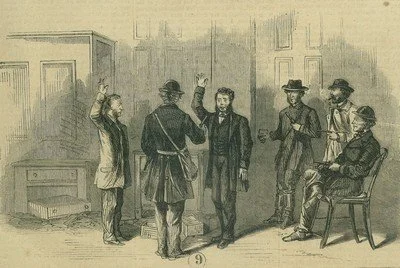


References

·       Ambrose, Stephen E. (1996). Crazy Horse and Custer: The Parallel Lives of Two American Warriors. New York: Anchor Books.

·       "George Armstrong Custer". American Battlefield Trust. November 4, 2009. 

·       Wert, Jeffry D. (1996). Custer: The Controversial Life of George Armstrong Custer. New York: Simon & Schuster.

·       Wittenberg, Eric J. (2001). Glory Enough for All : Sheridan's Second Raid and the Battle of Trevilian Station. Brassey's Inc.

·       https://www.history.com/topics/early-us/george-armstrong-custer

·       https://www.americancivilwarstory.com/george-armstrong-custer.html

·       https://www.historynet.com/george-custer/

·       https://www.history.com/topics/early-us/george-armstrong-custer

·       https://www.battlefields.org/learn/articles/custers-first-last-stand

The Battle of Gettysburg during the U.S. Civil War is usually considered a victory for the North; however, alternative arguments can be made. Here, Jeb Smith considers whether Gettysburg was really a major defeat for the Confederacy.

Bayonet charge by the Union’s 1st Minnesota against Confederate forces on July 2, 1863. By Dan Troiani, available here.

In his lecture series on the U.S. Civil War, renowned historian Gary Gallagher explained that the South in 1863 did not perceive the Battle of Gettysburg as a defeat but rather as a draw. Even though it ultimately fell short of its primary objective, to achieve a significant victory over the Army of the Potomac and thus bring about peace talks, many Southern leaders saw the campaign as a success because it pulled the Federals out of Virginia, providing its war-ravaged farmlands much-needed rest. It also maneuvered the war to the North where Confederates lived off of Northern farms and supplies. Famed cavalry general Jeb Stuart wrote his wife, "Gen Lee maneuvering the Yankees out of Virginia is the grandest piece of strategy ever heard of.”

Gary Gallagher mentioned how the Battle of Gettysburg was not driven from the field for the South; they simply failed to remove the Federals from their positions on Day 3. Since they made an orderly retreat rather than being driven from the battlefield, the engagement was viewed by most at the time as a draw. Some Southern soldiers (and the populace, newspapers, etc.) viewed it as a victory since they won day 1, driving the Federals back, and maintained their positions on days 2 and 3. In Jeb Stuart: The Last Cavalier Burke Davis wrote, “There was not a spirit of defeat in the army this morning; men waited hopefully for Federal attack on their hill.”


Battle

Gallagher described Day 1 as one of the great attacking victories of the war, with Southern forces successfully pushing back two Federal corps and inflicting heavy losses. On Day 2, the outnumbered South launched an attack against Federals who were entrenched on high ground, managing to cause more damage than they sustained. Federal General George Meade was so bloodied after Day 2 that he considered retreating and made plans to do so, but his subordinates persuaded him to stay. As Confederate General James Longstreet was quoted as saying in the Ken Burns Documentary on the Civil War, “When the second day's battle was over General Lee declared it a success.”

By the end of the three-day bloodbath, the Federals had suffered such enormous casualties (the largest of any battle of the war) that they did not mount a significant offensive in Virginia for 10 months.

Many see Gettysburg as a major defeat because Lee never invaded the North again. Yet this had more to do with the cumulative loss of manpower to all Southern armies and a drop in morale coupled with larger, more aggressive Northern armies. At the time, nobody knew Lee would not invade again, and some thought he would. General Jeb Stuart wrote his wife on July 13th “We return without defeat to recuperate and reinforce when no doubt the role will be reenacted."

Further, Confederate General Jubal Early invaded the North in ‘64, at one point threatening Washington D.C., and Lee sent Longstreet and two divisions to Tennessee after Gettysburg, enabling Braxton Bragg to take the offensive there and win the battle of Chickamauga. If Lee had just suffered a significant defeat or thought himself in danger, why would he send his top corps with two veteran divisions to the Western theatre? Why not consolidate defensively? Instead, he was still thinking offensively. And Lee showed the South had plenty of fight left in ‘64.


Loss?

Others say the South lost the war at Gettysburg; I don't see how this is so. Gettysburg, combined with Vicksburg, was a big blow to Southern manpower. However, it could also be argued the South was already finished when Stonewall Jackson died. But still, regardless of Jackson and the results of Gettysburg and Vicksburg, Lincoln was not likely to be reelected (Peace Democrats would have triumphed) until General Sherman captured Atlanta and Jubal Early (who was making headlines) was defeated in the Shenandoah Valley. Those events, along with Admiral Farragut’s earlier triumph at Mobile Bay, secured Lincoln's reelection and won the war for the North, not Gettysburg. The high casualties of 1864 and battles like Gettysburg (union losses of 23,000) almost cost the Union the war, and the people of the North desired peace, until new Union victories restored popular morale.


Jeb Smith is the author of four books, the most recent being Missing Monarchy: Correcting Misconceptions About The Middle Ages, Medieval Kingship, Democracy, And Liberty. Before that, he published Defending Dixie’s Land: What Every American Should Know About The South And The Civil War. Smith has authored dozens of articles in various publications, including The Postil Magazine, History is Now Magazine, Medieval History, Medieval Magazine and Fellowship & Fairydust, and featured on various podcasts.

Posted
AuthorGeorge Levrier-Jones
4 CommentsPost a comment