In the turbulent landscape of fifteenth-century England, where bloodlines alone could not secure a crown and loyalty shifted as swiftly as the winter wind, few men wielded power as effectively—or as dangerously—as Richard Neville, Earl of Warwick. Remembered in history as "the Kingmaker," Warwick occupied a position unique in the political fabric of his age. He was not a king, nor did he seek the crown for himself, yet he possessed the wealth, influence, and military authority to determine who would wear it. In an era defined by dynastic instability and civil war, Warwick became the living embodiment of political power untethered from kingship. His rise alongside Edward IV of England would mark one of the most dramatic and consequential partnerships of the Wars of the Roses—one that would ultimately collapse into betrayal and bloodshed.
Terry Bailey explains.
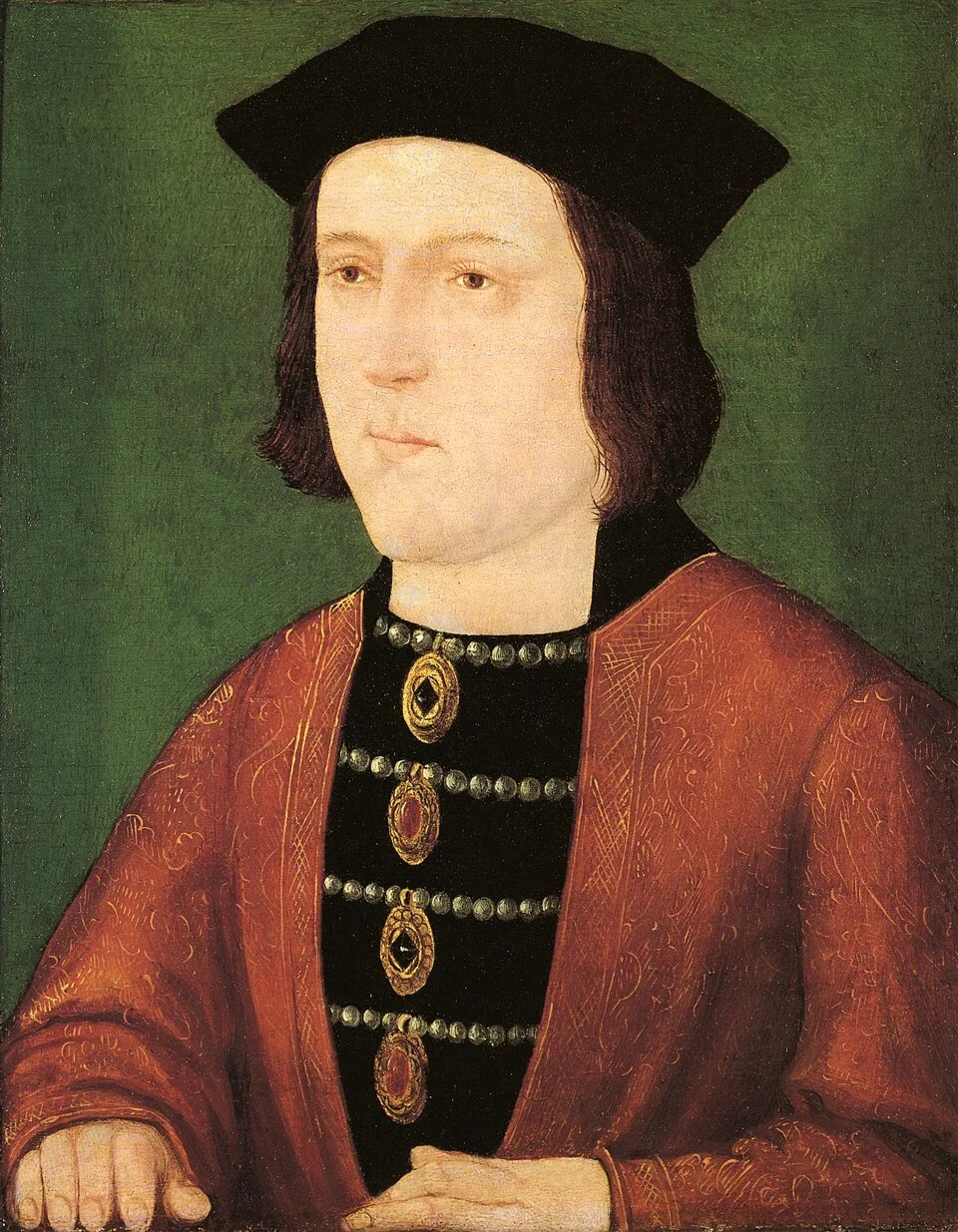
King Edward IV.
The turning point came in the brutal winter of 1461, at the Battle of Towton, a confrontation so savage that it still stands among the bloodiest ever fought on English soil. Snow fell relentlessly across the battlefield, driven into the faces of Lancastrian troops by a bitter wind that favored the Yorkist advance. Arrows darkened the sky, and the fighting descended into a chaotic melee of steel and desperation. Contemporary accounts suggest that tens of thousands fought, and thousands died, their bodies later found frozen where they fell or swept into the nearby river. It was a battle not merely for victory, but for survival.
Warwick's role in the campaign was indispensable. A seasoned commander and political strategist, he had already laid the groundwork for Yorkist success through alliances, recruitment, and careful positioning. Yet Towton belonged, in spirit and in consequence, to Edward. Barely out of adolescence, Edward demonstrated a ferocity and confidence that electrified his troops. Standing tall above most men, he was both a physical and symbolic presence on the battlefield, rallying his forces with a determination that left no doubt as to his fitness to rule. When the Lancastrian lines finally broke and Henry VI of England fled into exile, the crown effectively changed hands amidst the snow and slaughter. Edward's coronation soon followed, but it was Towton that truly made him king.
In the years immediately following his accession, Edward IV appeared to justify every expectation Warwick had placed upon him. Unlike the gentle and pious Henry VI, whose inability to command had contributed so heavily to the outbreak of civil war, Edward possessed an instinctive grasp of kingship. He understood the necessity of strength, the importance of rewarding loyalty, and the need to project authority in a fractured realm. Under his rule, a measure of stability returned to England, and for a time, Warwick stood at the center of this restored order. Acting as the king's chief advisor and diplomat, he directed foreign policy, negotiated alliances, and maintained a delicate balance among the powerful nobles whose ambitions could so easily reignite conflict.
Yet this partnership, so formidable at its height, contained within it the seeds of its own destruction. Warwick had grown accustomed to dominance, to shaping policy and influencing the direction of the realm. Edward, however, was no puppet. As he matured, he began to assert his independence, making decisions that increasingly sidelined his former mentor. The breaking point came not on the battlefield, but in the realm of marriage and diplomacy. In 1464, Edward secretly wed Elizabeth Woodville, a widow of comparatively modest rank. The decision sent shockwaves through the political elite. Warwick, who had been negotiating a prestigious marriage alliance with a foreign power, found himself publicly undermined and privately humiliated.
The consequences of this union extended far beyond personal affront. The Woodville family, suddenly elevated by the king's favor, began to accumulate wealth, titles, and influence at a remarkable pace. Marriages were arranged, offices distributed, and positions secured, often at the expense of established noble families. For Warwick, this represented not merely a loss of prestige, but a direct threat to his authority. The court, once his domain, was becoming increasingly dominated by rivals whose loyalty lay not with him, but with the queen and her kin.
What followed was a slow and inexorable drift toward rebellion. Warwick's frustration hardened into resentment, and resentment into action. By the late 1460s, he had begun to conspire against Edward, seeking allies among those disaffected by the king's policies. In a striking reversal of allegiance, he turned to the Lancastrians, forging an alliance that would have seemed unthinkable only years earlier. Central to this new strategy was his relationship with George Plantagenet, Duke of Clarence, the king's ambitious and discontented brother. Through marriage and intrigue, Warwick sought to reshape the political landscape once more, this time not to elevate Edward, but to replace him.
The rebellion reached its zenith in 1470, when Warwick achieved the extraordinary feat of restoring Henry VI to the throne during the Readeption of Henry VI. It was a moment rich in irony and fraught with instability. The Kingmaker, who had once dismantled Lancastrian rule, now resurrected it in a bid to reclaim his influence. Yet the restoration was built on fragile foundations. Henry VI remained as incapable of effective rule as ever, and it was Warwick who wielded real authority behind the scenes. The kingdom, however, had already endured too much turmoil to accept such arrangements indefinitely.
Edward IV, driven into exile by this sudden reversal, proved once again that he was not easily undone. Regrouping abroad, he gathered support and returned to England in 1471 with renewed purpose. His campaign was swift, calculated, and ruthless. The decisive confrontation came at the Battle of Barnet, fought under conditions as chaotic as Towton had been a decade earlier. Fog shrouded the battlefield, leading to confusion and fatal miscalculations. Amid the disorder, Warwick's forces faltered, and the Kingmaker himself was killed while attempting to flee. His death marked the end of one of the most powerful political careers of the age.
Edward's victory did not end at Barnet. Weeks later, he secured his position definitively at the Battle of Tewkesbury, where the remaining Lancastrian forces were crushed. The death of their leaders and the subsequent elimination of Henry VI extinguished the immediate threat to Yorkist rule. Edward was restored to the throne, this time with a clearer understanding of the dangers posed by overmighty subjects and shifting loyalties.
The events of 1470–1471 laid bare the precarious nature of kingship during the Wars of the Roses. Authority rested not solely on lineage or divine right, but on the ability to command loyalty, maintain alliances, and navigate the treacherous currents of noble ambition. Warwick's rise and fall illustrated this reality with stark clarity. He had possessed the power to make kings, yet not the means to secure lasting stability. His ambitions, once aligned with Edward's success, ultimately contributed to the very instability he sought to control. For Edward IV, the lessons were profound. His second reign would be marked by greater caution and a more deliberate consolidation of power. No longer would he rely so heavily on magnates whose influence rivalled his own. Instead, he sought to strengthen the monarchy by balancing competing interests and asserting his authority more directly. The scars of betrayal, however, remained a defining feature of his kingship.
The legacy of Richard Neville, Earl of Warwick is one of striking contradiction. He was at once a loyal servant and a dangerous adversary, a creator of kings and a destroyer of regimes. His life encapsulates the volatile interplay of ambition, loyalty, and betrayal that defined the Wars of the Roses. Through his actions, the crown of England was won, lost, and won again, each transition marked by bloodshed and uncertainty. The story of the Kingmaker is therefore not merely a tale of individual ambition, but a reflection of a kingdom in crisis—a realm where the structures of power were in flux and the boundaries of authority constantly tested. In such an environment, even kings could not stand alone, and those who raised them could just as easily cast them down.
In the final reckoning, the story of Richard Neville, Earl of Warwick is not simply that of a man who rose to unparalleled influence and fell spectacularly, but of an age in which the very nature of power was uncertain, contested, and dangerously fluid. His life reveals the inherent instability of a political system in which personal ambition could rival royal authority, and where the bonds of loyalty were so essential to medieval governance and as fragile as they were expedient. Warwick's ability to elevate Edward IV of England to the throne, and later to unseat him in favor of Henry VI of England, demonstrates not only his extraordinary capability but also the perilous weakness of the crown itself during the Wars of the Roses.
Yet for all his power, Warwick ultimately proved unable to control the forces he helped to unleash. His shifting allegiances, driven by wounded pride and political necessity, deepened the very divisions he had once sought to manage. In attempting to dominate the machinery of kingship, he exposed its vulnerabilities and, in doing so, ensured that his own position could never be secure. His death at the Battle of Barnet was therefore more than the fall of a single magnate; it marked the end of an era in which overmighty subjects could so directly shape the fate of the realm.
For Edward IV, the lessons were indelible. His restoration and subsequent reign reflected a more cautious and calculated approach to governance, one shaped by the recognition that unchecked noble power posed an existential threat to royal authority. The king who emerged after 1471 was no longer the young warrior of Towton. Still, a monarch tempered by betrayal, determined to consolidate his rule and prevent the re-emergence of figures like Warwick. In this, the Kingmaker's legacy endured, not in continued influence, but in the structural changes his rise and fall compelled.
Ultimately, Warwick's career stands as both proof of individual capability and a warning about its limits. He could create kings, but he could not create stability; he could command armies, but not lasting loyalty; he could reshape the political landscape, but not control its consequences. His life encapsulates the paradox at the heart of the Wars of the Roses: that power, when divorced from legitimacy and balance, becomes as destructive as it is formidable. In the shifting, blood-soaked theatre of fifteenth-century England, the Kingmaker proved that to hold the fate of kings in one's hands was not to master destiny, but to be consumed by it.
The site has been offering a wide variety of high-quality, free history content since 2012. If you’d like to say ‘thank you’ and help us with site running costs, please consider donating here.