
The Winged Hussars of the Polish Lithuanian Commonwealth dominated the battlefields of Eastern Europe from the 16th to the 18th centuries. Sporting massive artificial wings on their armor, these aristocratic warriors were among the most feared and cohesive cavalry forces in European history.
Here, Brian Hughes tells us about the Polish Winged Hussars.
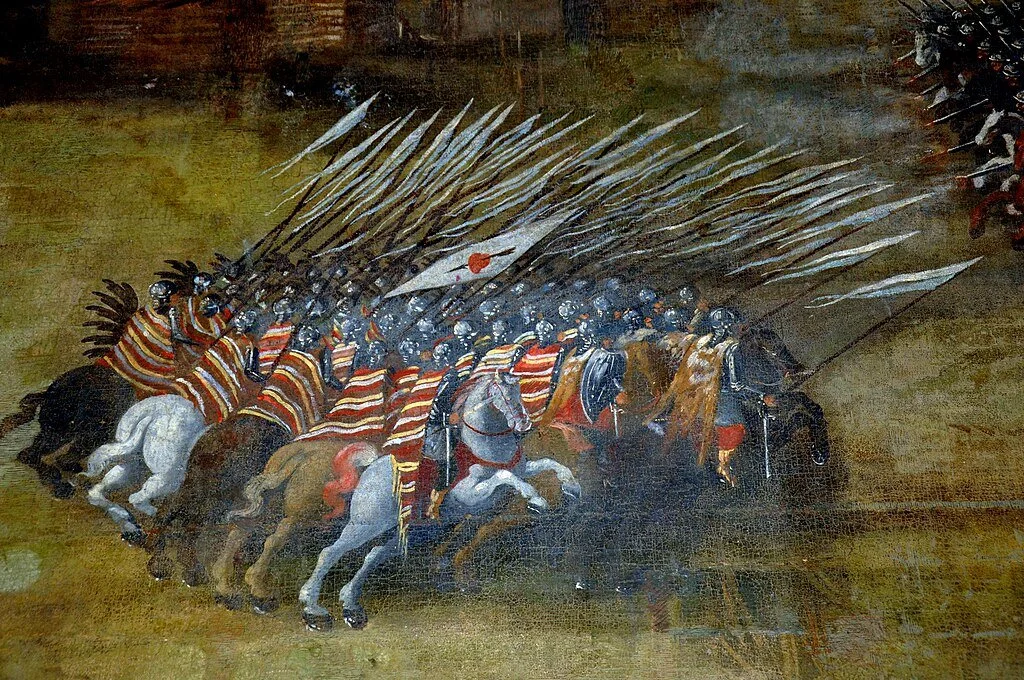
A Hussar formation at the 1610 Battle of Klushino. By Szymon Boguszowicz.
Origins
Eastern Europe has a deep equestrian and cavalry tradition, due in part to its topography. Active from the 16th to the 18thcentury. The Winged Hussars showed a consistently remarkable ability to seemingly defy the odds snatching victory from otherwise imminent defeat.
Eastern Europe has a rich history and tradition of elite horsemanship. Much of the region is comprised of plains and flat grassland advantageous to horse rearing. Successive waves of elite horse warriors such as the Huns, Magyars, and Tartars had raided and settled the area at various times. Likewise, much of the warfare that defined this region throughout the Middle Ages and early modern era involved larger cavalry forces than the more heavily populated and more urbanized parts of Western Europe.
Hussars derive their name from the Hungarian “Huserones” and originated in the Kingdom of Hungary sometime in the late 15th century as a light cavalry force. The name later became incorporated by a whole host of Central and Eastern European countries such as Serbia, The Holy Roman Empire and Poland becoming renowned as some of the best light horse units in all of Europe.
The Polish Lithuanian Commonwealth was one of the premier states in Early Modern Europe. Engaging with a host of enemies mainly the Ottoman Turks, Swedes and Russians, a series of drastic military reforms were undergone to bolster and safeguard its territory and people as the state grew and became more vulnerable. These included but were not limited to modernizing land and naval forces and modifying its already prolific cavalry.
Drawing on the litany of pre-established equine traditions, the Winged Hussars as they became known drew their ranks from the upper classes and nobility and adapting their role into a heavy shock cavalry instead of the more traditional nimble light horse tactics of their predecessors.
Riding in tight formation these heavily armored horsemen could smash into enemy formations with lethal efficiency thus enabling infantry and lighter cavalry units to exploit the gaps and gain tactical advantages ensuring victory. The Winged Hussars displayed impressive capability in the diverse geographical and climatic conditions from which they operated.
Arms and Armor
The Winged Hussars were well armored, well equipped and rode expertly bred war horses. One reason in which their ranks were filled almost exclusively by nobles was the sheer cost of such expenditures.
Wings: The signature and iconic wings worn by the Hussars were fashioned out of feathers from a variety of raptor birds, mainly Eagle and Falcon. Originally the wings were placed on their saddles before being fastened onto the backs of their armor. The purpose was twofold. In an era of extravagant military arms and uniforms the Wings were visually impressive on parade grounds and intimidating foes. The Wings also may have produced an odd and terrifying din when the Hussars charged, frightening enemy soldiers and horses in the process.
Armor: Hussars were clad in heavy steel armor typical of the era and often sported exotic animal furs such as leopards and saddles decked out with fine silk and lace. Beneath their armor and hides Hussars typically donned red or crimson short coats called zupans with helmets encrusted with gems or plumed with exotic feathers. The Winged Hussars took great pride in their appearance on and off the battlefield.
Horses: Expensive warhorses typically Polish-Arabian breeds were the predominant mount used by the Winged Hussars. These horses were both incredibly strong as they could carry a heavily armored rider in addition to their great endurance with long marches ranging across a variety of terrain in and around Central and Eastern Europe.
Weapons: They were well trained, well-armed and capable of wielding a lance, (kopia) saber, (szabla) and various firearms with expert lethality. The Hussars could combat a variety of foes. From conventual infantry and cavalry units which defined 16th and 17th century European armies to the expert light cavalry of the Tatars.
Notable Battles
Khlushino: One of the finest victories performed by the Winged Hussars was the Battle of Klushino fought on July 4th, 1610. The heavily outnumbered Polish-Lithuanian force of about 6,000 with the bulk of the army of 5,000 Winged Hussars crushed a Muscovite army of over 30,000. Over the course of a five-hour battle the Winged Hussars superior training, tactics, and troop cohesion made it possible to smash their adversaries’ lines, disintegrating their forces and routing them in the process.
Vienna: The Winged Hussars most renowned moment came in September 1683 at the Siege of Vienna. For weeks the Ottomans under Mustapha Pasha had been battering the “Golden Apple of Europe” coming closer to victory with each passing day. Finally, a coalition of predominantly Catholic Holy League Forces arrived to lift the Siege. John Sobieski King of Poland an experienced soldier led a contingent of roughly 4,000 Winged Hussars. Devising a plan Sobieski outflanked the Ottoman Camp and along with his Winged Hussars led what was possibly the largest cavalry charge in the history of Europe at the head of some twenty thousand horsemen devasting the Ottoman expeditionary force and relieving the city in the process.
The site has been offering a wide variety of high-quality, free history content since 2012. If you’d like to say ‘thank you’ and help us with site running costs, please consider donating here.