Keeping a watchful eye over Philadelphia for nearly 255 years — Fort Mifflin is much more than just a decaying structure overlooking the Delaware River. It’s the site of Philadelphia bravery during the American Revolution — and its faded white masonry walls still bear the battle scars of American Freedom from 1777 — just as the unearthed cell (Casemate #11) found in 2006 and believed to encapsulate both graffiti as well as a coin and wine bottle from the Civil War.
Michael Thomas Leibrandt explains.
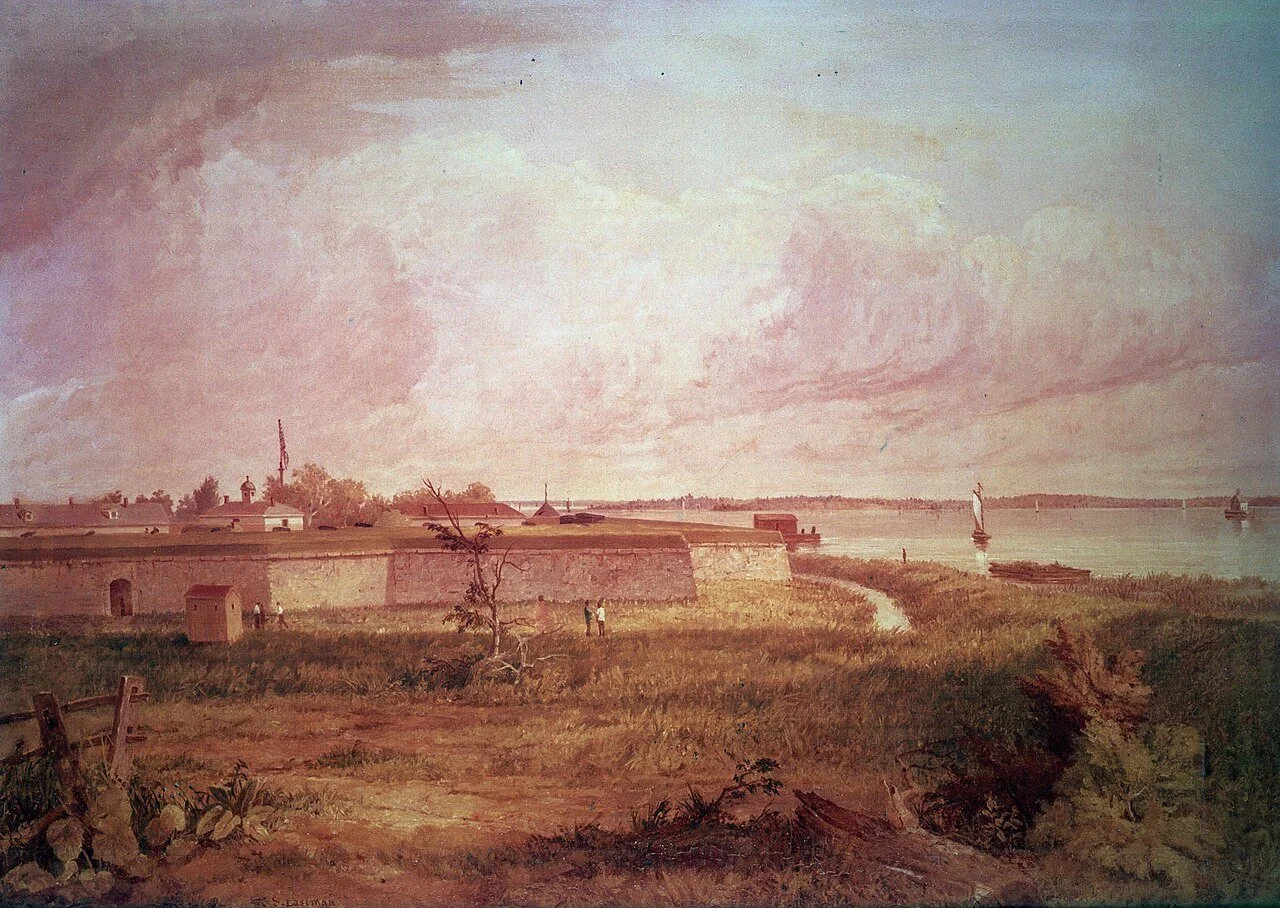
Fort Mifflin by Seth Eastman. Source: Public domain, available here.
If you want to see the true measure of the humble beginnings of American democracy and resolve — visit Independence Hall. If you want to see military determination and heroism in the face of nearly insurmountable odds in order to defend the Delaware River— then visit Fort Mifflin. And that very heroism — may have saved General George Washington’s Continental Army.
First constructed on Deep Water Island in the Delaware River in 1771 — Fort Mifflin was originally named Fort Mud at the time of the American Revolution. The British — after defeating Washington’s Army at the Battle of Brandywine in 1777 — may have captured Philadelphia with hardly a shot fired. But at Fort Mifflin — they found an unyielding resistance.
Some four hundred American soldiers had entrenched in Fort Mifflin — hampering British efforts for control of the Delaware. From his headquarters in Philadelphia — General Howe ordered the British fleet up the Delaware River to supply his army in Philadelphia. The resistance of those brave four hundred Patriots from within the Fort was challenged by what is considered to be the largest cannonade in all of the American Revolution — culminating with a massive bombardment on November 10th of 1777. Under the cover of darkness each night — French Major Francois de Fleury oversaw repairs to the Fort.
With only ten cannon left to defend the Fort — Commanding officer Major Thayer and his men abandoned Mifflin on November 15th — famously setting the fort ablaze in the night sky with the American Flag still fluttering in the darkness. The result of the efforts of those Americans in Fort Mifflin who defended against the British — Washington’s Continental Army was able to make it to winter encampment at Valley Forge.
The British would hold the Fort until their retreat from Philadelphia in June 1778. After the Revolution — Fort Mud was actually rebuilt and in 1795 — it was renamed after Continental Army Officer and Pennsylvania Governor (Thomas) Mifflin. When repairs to Mifflin were finally complete in 1863 — it actually held Confederate prisoners — including a significant number from the Battle of Gettysburg from across the state. The Fort actually endured a prisoner rebellion in 1863 and an ultimately doomed tunnel escape in 1864 also by inmates. One prisoner was even executed there in 1864.
Fort Mifflin’s role was a bit different during the First and Second World Wars. Funds were allocated for the repair of Fort Mifflin and a railroad was constructed which would serve to connect Fort Mifflin to both of the Depots of the Army Corps of Engineers Depot and the Naval Ammunition.
The Army declared the site as a (national) historical monument in 1915 and finally decommissioned it in 1954. Threeyears ago — a replica cannon was stolen from Fort Mifflin’s 14-foot exterior wall. Ownership of Fort Mifflin was transferred to the city of Philadelphia in 1962.
Today — visitors can still see Fort Mifflin for themselves for nearly ten months of the year. Tours are available, events are scheduled regularly during certain months, and weekends even have a ceremonial cannon firing at Philadelphia’s aging Fort from a bygone era being celebrated around America this year. For Philadelphia — Fort Mifflin means a lot more than just that.
Michael Thomas Leibrandt lives and works in Abington Township, PA.