In 1816, a quiet property dispute in Virginia produced one of the most powerful rulings in American constitutional history. Two centuries later, the decision in Martin v. Hunter’s Lessee still determines who gets the last word on the Constitution.
Randall Griffin explains.
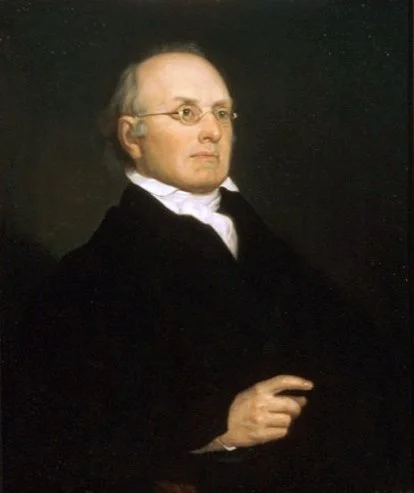
Justice Joseph Story. Painting by George Peter Alexander Healy.
Who Owns the Northern Neck?
From the late 1680s to the 1700s, the British Crown granted vast tracts of land in Virginia to the Fairfax family.
During the Revolution, Virginia passed a law that allowed for the confiscation of Loyalists’ property. When Thomas Fairfax, 6th Lord Fairfax of Cameron - despite staying neutral during the Revolutionary War to protect his land - died in December 1781 without an heir in Virginia, the state moved to seize his property.
Part of his property was called the Northern Neck, a massive tract of roughly 300,000-acres along of the northernmost of Virginia’s three peninsulas on the western shore of the Chesapeake Bay.
But international agreements complicated things. The Treaty of Paris (1783, which ended the Revolutionary War) and Jay’s Treaty (1795) both protected the property interests of British subjects living in America, essentially nullifying the Virginia confiscation.
The nephew and heir of Lord Fairfax, Denny Martin Fairfax, a British subject who had never lived in Virginia, hired attorneys James and John Marshall and, in the case of Hite v. Fairfax (1786), won recognition as Lord Fairfax’s legal heir.
A year later, the Virginia legislature voided the Fairfax land grant and confiscated the property, granting a portion (739 acres) to David Hunter.
Martin, who had sold his land interest to John and James Marshall, challenged the confiscation. He initially won his court case (Fairfax’s Devisee v. Hunter’s Lessee), but lost on appeal to the Virginia Supreme Court, which upheld the confiscation by ruling that the federal treaties did not cover the dispute in question.
In 1810, the Virginia Court of Appeals upheld Hunter’s claim to the land.
The case was appealed to the Supreme Court, which, in 1813, reversed the Virginia Court of Appeals’ decision. Finding that the Treaty of Paris and Jay’s Treat applied in the dispute, the Court remanded (sent back) the case back to the Virginia court to litigate.
But the Virginia Court, instead of reconsidering the case, set the stage for one of the most important legal battles in American history.
The Legal Battle Begins
The Virginia Supreme Court ruled that the US Supreme Court did not have authority over cases beginning in state courts, arguing that Section 25 of the Judiciary Act of 1789 (which established the federal judiciary) was unconstitutional. The Virginia court ruled that both state and federal courts were of equal standing and the supreme decider of the law in their own governments, neither having superiority over the other.
What began as a land dispute had become something much bigger: is Section 25 of the Judiciary Act, which grants the US Supreme Court appellate review over state court cases involving federal law, unconstitutional?
The Virginia courts had said yes, but the Supreme Court said no. Justice Story, writing in a unanimous decision, ruled that federal treaties superseded state laws under Article VI of US Constitution (the Supremacy Clause) and, along with the appellate jurisdiction in Article III, gave federal courts the power to review state decisions involving federal law or the Constitution.
Justice Story rejected the claim that the state and federal courts were co-equal interpreters of the Constitution.
Ultimately, the Supreme Court stated the importance of having a single, coherent interpretation of the Constitution and federal laws rather than each individual state interpreting its own versions.
Justice Story specifically called out Article III, which states that the Supreme Court may review state court decisions.
Article III, Section I: The judicial power of the United States, shall be vested in one Supreme Court, and in such inferior courts as the Congress may from time to time ordain and establish.
Article III, Section II: The judicial power shall extend to all cases, in law and equity, arising under this Constitution, the laws of the United States, and treaties made, or which shall be made, under their authority… to controversies between two or more states; between a state and citizens of another state; between citizens of different states; between citizens of the same state claiming lands under grants of different states, and between a state, or the citizens thereof, and foreign states, citizens, or subjects.
Justice Story ruled Congress had specifically granted the Supreme Court the power under Section 25 of the Judiciary Act to review state court decisions when federal issues were involved.
Critics of Martin v. Hunter’s Lessee argued that the decision gave too much authority to the federal judiciary. Virginia judges flatly rejected the Court’s authority, declaring that “the appellate power of the Supreme Court of the United States does not extend to this court.” At the same time, long-standing fears about judicial power resurfaced. As the Anti-Federalist writer ‘Brutus’ had warned decades earlier, the Supreme Court could become “exalted above all other power in the government.” Yet Justice Story defended the ruling as essential to national unity, cautioning that without federal review, “the Constitution… would be different in different states.”
The Supreme Court further upheld its authority in the 1821 case of Cohens v. Virginia, which addressed whether the Supreme Court had the power to hear appeals concerning state criminal cases.
Why Martin v. Hunter’s Lessee Still Matters Today
Two centuries after Martin v. Hunter’s Lessee, the Supreme Court still acts as the nation’s final referee, stepping in when state courts and federal law collide. Many court cases we’re familiar with today come from this 1816 ruling.
Miranda v. Arizona (1966)
Anyone who has watched a police procedural can probably recite the Miranda rights. The reading of a citizen’s rights during arrest grew from a landmark case involving Ernesto Miranda, whose confession was used against him in an court.
In 1966, Arizona police arrested Miranda for kidnapping and rape. After hours of police questioning, he confessed and signed a written statement. Miranda was not advised of his Constitutional rights, especially that he had the right to remain silent or the right to counsel.
The Arizona courts upheld the conviction. The Supreme Court reviewed the case, and in a 5-4 decision ruled that Miranda’s Fifth Amendment rights had been violated, creating the famous ‘Miranda warning.’
Bush v. Gore (2000)
Most of us remember the disputed 2000 presidential election between George W. Bush and Al Gore.
The case centered on the vote in Florida, where the margins were tiny – only a few hundred votes out of almost six million. Because the margin was so slim, the Florida Supreme Court ordered a manual machine recount, where disputes arose on whether the manual recounts would continue if several counties’ ballots were unclear (inventing the phrase ‘hanging chads’).
The situation dragged on until December 12, 2000, when the Supreme Court, in a 5-4 decision, overruled the Florida Supreme Court and ordered the manual recount stopped. The Court cited that the way the recounts were being conducted in the various counties with no consistent statewide standard violated the Equal Protection Clause. The Court also said that there was not enough time to establish a new recount system before the deadline for selecting presidential electors.
Using the authority it gained from Martin v Hunter’s Lessee, the Supreme Court overturned the Florida supreme court ruling. Bush won Florida by 537 votes, and the state’s electoral votes made him President.
Obegefell v Hodges (2015)
Obergefell v. Hodges is considered the landmark decision that legalized same-sex marriage nationwide.
Several same-sex couples across the country had challenged state laws banning same-sex marriages or the refusal to recognize marriages performed in other states. One plaintiff, Jim Obergefell, sued the state of Ohio after it refused to list him as the surviving spouse on his husband’s death certificate.
In another 5-4 decision, the Supreme Court overruled the various state’s laws. In finding that marriage is a fundamental liberty protected by the Fourteenth Amendment, the Court ruled states must allow same-sex marriage and recognize those marriages performed in other states.
Each of these cases shows the same fundamental rule established in Martin v. Hunter’s Lessee, in that state courts may decide cases involving federal law, but the Supreme Court has the ultimate authority to review and correct them if necessary.
What began as a quarrel over confiscated farmland in Virginia two centuries ago ultimately answered a question that still shapes American law today: when state courts and federal law collide, who has the last word?
Later cases since have strengthened Court’s authority, but Martin v Hunter’s Lessee laid the foundation for the Supreme Court to be the last guardian of constitutional rights. By reviewing state court decisions when necessary, the Supreme Court ensured that for generations the civil rights granted under the Constitution would be enforced uniformly nationwide.
The site has been offering a wide variety of high-quality, free history content since 2012. If you’d like to say ‘thank you’ and help us with site running costs, please consider donating here.