The long and violent struggle known as the Wars of the Roses did not end with a gradual fading of hostilities, nor with a negotiated peace between exhausted rivals. Instead, it concluded in a single, decisive moment of shock and finality on the 22nd of August 1485, at the Battle of Bosworth Field. Here, amid the marshy terrain and uncertain loyalties of Leicestershire, the fate of England was determined not only by arms, but by allegiance, timing, and the calculated risks of two very different men. The outcome would extinguish the Plantagenet dynasty and usher in the Tudor age, but the peace it promised would prove far more fragile than it first appeared.
Terry Bailey explains.
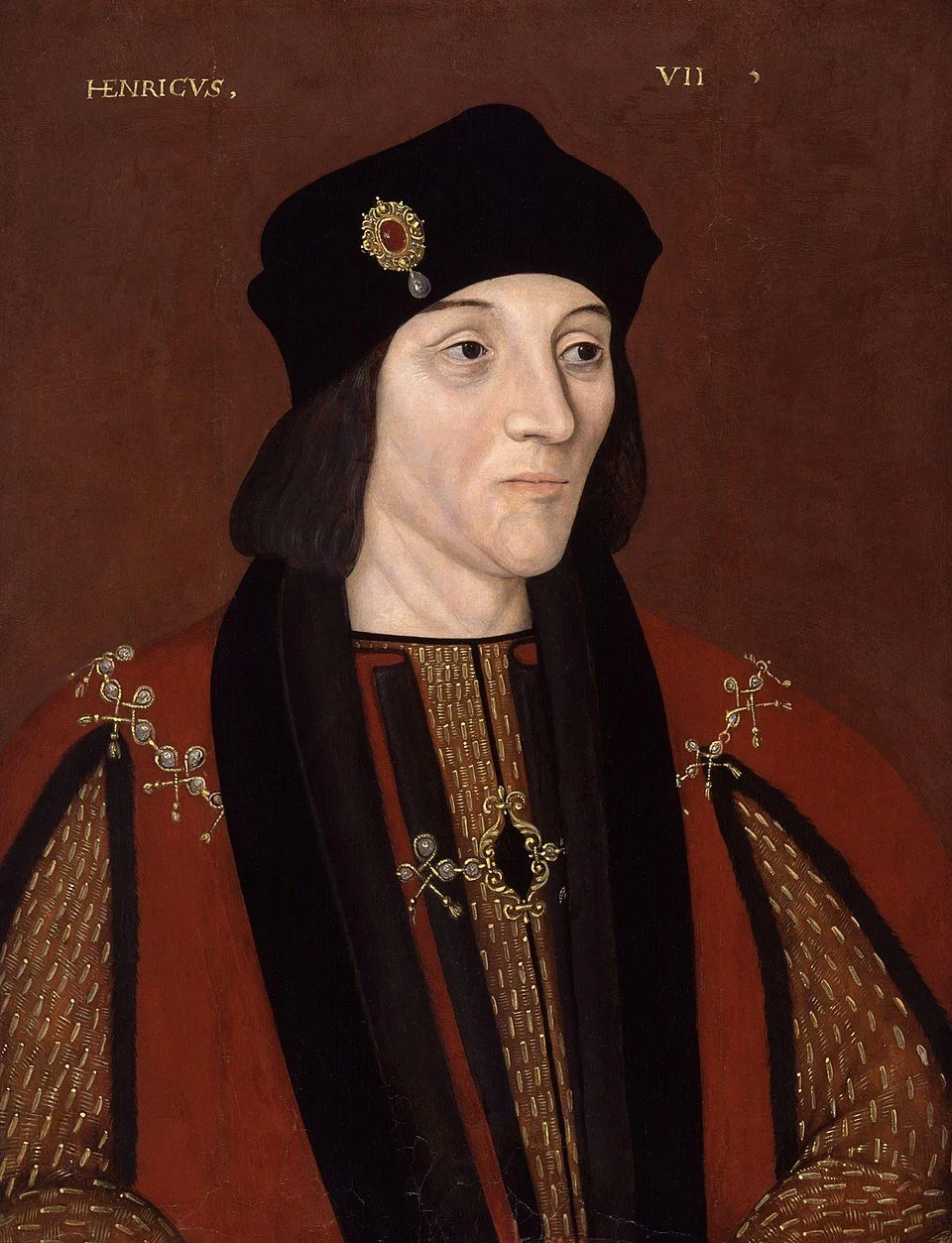
King Henry VII.
By the summer of 1485, the Yorkists' hold on England, though seemingly secure, was built upon uneasy foundations. Richard III had seized the throne in 1483 following the death of his brother, Edward IV, declaring Edward's sons illegitimate and assuming the crown himself. His reign, however, was immediately shadowed by controversy. The disappearance of the young princes in the Tower of London cast a long and damaging pall over his legitimacy, fueling rumors and alienating potential supporters. While Richard demonstrated administrative competence and military capability, he struggled to command the unqualified loyalty that his position required in such a volatile political climate.
Across the Channel, a claimant with a far weaker but symbolically potent claim was prepared to challenge him. Henry VII, then Henry Tudor, had spent much of his life in exile, primarily in Brittany and France. His claim to the throne came through his mother, Margaret Beaufort, a descendant of John of Gaunt through the Beaufort line—legitimized but originally born out of wedlock and barred from succession. In purely legal terms, Henry's right to rule was tenuous at best. Yet in the context of a kingdom exhausted by war and disillusioned with Yorkist leadership, his claim offered something more compelling: the possibility of change, and perhaps stability.
Henry's invasion in August 1485 was not the beginning of a vast campaign, but rather a calculated gamble. Landing in Wales, he gathered support as he advanced into England, drawing to his cause those disaffected with Richard's rule. His army, though smaller and less experienced than that of the king, was bolstered by a sense of purpose and by the expectation—never entirely certain—that powerful nobles might shift their allegiance at the decisive moment. Among these were the Stanley family, whose loyalties would prove critical.
The battlefield at Bosworth was not a grand stage prepared for a set-piece engagement, but a landscape shaped as much by uncertainty as by strategy. Richard III commanded the larger force and occupied a strong defensive position. Confident in his military experience, he sought to bring the matter to a swift conclusion. Henry, by contrast, relied heavily on his commanders, particularly the experienced John de Vere, Earl of Oxford, to manage the tactical realities of the engagement. The tension that morning was palpable, not merely because of the impending clash, but because of the unknown intentions of the Stanleys, whose forces remained conspicuously detached from the initial fighting.
As the battle unfolded, Richard seized the initiative in a move that has since become legendary. Spotting Henry on the field, he launched a direct cavalry charge aimed at killing his rival and ending the contest in one decisive stroke. It was a bold and characteristically aggressive maneuver, reflecting both Richard's confidence and the precariousness of his position. For a brief and electrifying moment, success seemed within his grasp. Yet warfare in this period was rarely governed by courage alone. At the critical juncture, the Stanleys intervened—not in support of their king, but against him. Their forces closed in, surrounding Richard and cutting off his retreat.
What followed was brutal and final. Richard III was unhorsed and killed in the thick of the fighting, becoming the last English monarch to die on the battlefield. With his death, organized resistance collapsed, and the Yorkist cause effectively disintegrated. According to tradition, his crown was recovered from the field and placed upon Henry's head, a symbolic act that transformed a contested claimant into a king by right of conquest. Yet victory on the battlefield was only the beginning of Henry's challenge. His claim to the throne, while now backed by force, required careful reinforcement. Conscious of the need for legitimacy, Henry moved swiftly to consolidate his position. He dated the start of his reign to the day before Bosworth, thereby technically rendering those who fought against him guilty of treason. More importantly, he fulfilled a key promise that had helped secure support for his invasion: his marriage to Elizabeth of York. As the daughter of Edward IV, Elizabeth represented the Yorkist line, and their union symbolized the reconciliation of the rival houses.
From this marriage emerged one of the most enduring symbols in English history: the Tudor rose, combining the red of Lancaster and the white of York. It was more than mere heraldry; it was a carefully constructed message of unity and renewal. Henry VII understood the power of symbolism in shaping perception, and he deployed it effectively to present his reign as the culmination of peace rather than the continuation of conflict. Despite these efforts, the years following Bosworth were far from tranquil. The underlying tensions that had fueled decades of civil war did not simply vanish with the death of Richard III. Yorkist sympathies persisted, and they soon found expression in a series of challenges to Tudor authority. The first major threat came in the form of Lambert Simnel, a boy presented as the Earl of Warwick, who attracted significant support both within England and abroad. This rebellion culminated in the Battle of Stoke Field, where Henry's forces secured a decisive victory, effectively ending large-scale Yorkist resistance.
A more prolonged challenge emerged in the figure of Perkin Warbeck, who claimed to be one of the lost princes. Supported at various times by foreign courts, Warbeck represented not merely a military threat, but a symbolic one, reviving the unresolved questions surrounding the legitimacy of Richard III and, by extension, Henry VII. Henry's response to these threats was measured and pragmatic. He combined firm military action with diplomatic efforts to isolate his opponents, while also employing an increasingly sophisticated network of intelligence and surveillance to detect and neutralize plots.
Central to Henry's success was his determination to curb the power of the nobility, whose private armies and shifting loyalties had been a defining feature of the Wars of the Roses. Through legal and financial mechanisms, he sought to enforce loyalty and limit the capacity of magnates to act independently of the crown. At the same time, he worked to restore the financial stability of the monarchy, rebuilding royal revenues and reducing dependence on Parliament. This careful consolidation of power marked a significant step toward a more centralized and controlled system of governance. And yet, for all his achievements, Henry VII's reign retained an undercurrent of caution, even suspicion. The memory of civil war lingered, shaping both his policies and his outlook. Trust was a rare commodity in a kingdom that had seen allegiances shift with deadly consequences, and Henry governed accordingly, favoring stability over grandeur and security over risk.
The Battle of Bosworth Field thus stands not merely as the end of a conflict, but as a moment of profound transformation. It marked the close of the medieval era of feudal dynastic struggle and the beginning of a new phase in English history, one characterized by stronger central authority and the gradual emergence of the modern state. The fall of the Plantagenets and the rise of the Tudors reshaped the political landscape, setting the stage for the sweeping changes of the sixteenth century.
Bosworth was both an ending and a beginning. It brought to a close the bloody contest between Lancaster and York, but it also revealed how fragile the resulting peace would be. Henry VII's triumph was not simply a matter of victory in battle; it was the foundation of a dynasty that would endure, adapt, and ultimately transform England. Yet that foundation, laid in the uncertainty of war and secured through careful strategy, would always carry the imprint of the conflict from which it emerged.
In the final reckoning, the Battle of Bosworth Field must be understood not as a neat conclusion to the Wars of the Roses, but as a decisive rupture that forced England onto an entirely new trajectory. The death of Richard III did more than end a reign; it extinguished the last vestiges of Plantagenet rule and closed a chapter of English history defined by feudal loyalties, dynastic fragmentation, and the persistent fragility of kingship. In his place, Henry VII emerged not as the obvious heir to a settled crown, but as a pragmatic survivor who recognized that victory in battle alone could never secure a throne so long contested.
Henry's achievement, therefore, was not merely in winning Bosworth, but in what followed: the careful, deliberate construction of legitimacy in a kingdom still haunted by division. His marriage to Elizabeth of York, the symbolic unification of Lancaster and York, and his systematic suppression of rebellion were all part of a broader effort to transform conquest into continuity. Yet the very need for such measures underscores a central truth of the post-Bosworth world—peace was not inherited, but manufactured, and always under threat. The pretenders, conspiracies, and lingering Yorkist sympathies that defined the early Tudor years reveal how close England remained to renewed instability, even as the outward symbols of unity took hold.
What ultimately distinguishes this moment in history is the shift it represents in the nature of English monarchy. The lessons of the preceding decades were not lost on Henry VII. Where earlier kings had relied on personal loyalty and martial prowess, Henry cultivated control—over finances, over nobility, and over the mechanisms of governance itself. In doing so, he laid the groundwork for a more centralized state, one less vulnerable to the centrifugal forces that had torn the realm apart. The crown, under Tudor rule, would become not merely the prize of noble contention, but the focal point of an increasingly structured and enduring authority.
And yet, Bosworth's legacy is inseparable from the violence that birthed it. The Tudor dynasty, for all its future grandeur, was founded upon uncertainty, opportunism, and the brutal calculus of survival. Its early stability was hard-won and carefully maintained, always mindful of the past that threatened to resurface. In this sense, Bosworth was not a clean break from history, but a moment in which the old world gave way reluctantly to the new, its shadows lingering long after the war had fallen silent.
Thus, Bosworth stands as both culmination and commencement: the final act of a dynastic struggle that had defined a generation, and the opening scene of a new order that would redefine England itself. From the blood-soaked ground of Leicestershire emerged not just a king, but a dynasty whose influence would extend far beyond the immediate aftermath of civil war. The Tudors would go on to shape the political, religious, and cultural identity of the nation, but their story—like that of Henry VII himself—began in uncertainty, forged in conflict, and secured only through vigilance, calculation, and an unyielding determination to ensure that the chaos of the past would never again so easily return.
The site has been offering a wide variety of high-quality, free history content since 2012. If you’d like to say ‘thank you’ and help us with site running costs,please consider donating here.