
A 26-year-old Union brigade commander risked being court-martialed when, without orders, he rushed his four regiments to the summit of an undefended hill at a crucial moment during the Battle of Gettysburg. The Harvard graduate’s valor may have saved the Army of the Potomac – but it cost him his life. Timothy M. Gay explains – in part 1 of 2.
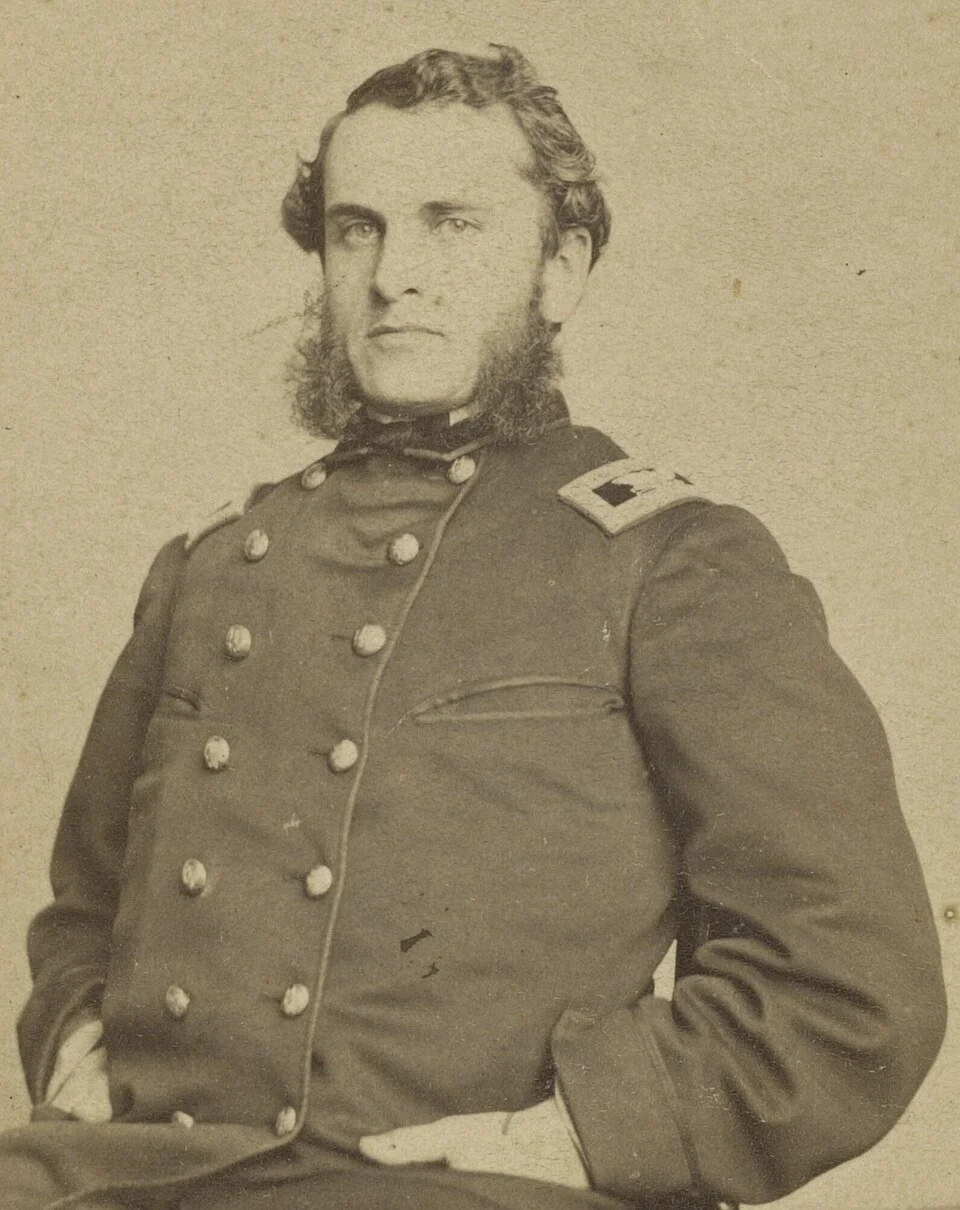
Colonel Strong Vincent. Source: Public domain, Library of Congress, available here.
The bugle blare ordering the men to break camp that steamy Wednesday evening could not have come at a worse moment. Having not eaten a restful meal in days, the 1,300 soldiers of the Third Brigade, First Division, Fifth Corps of the Army of the Potomac had just settled down to supper when the dreaded “Assembly!” call came screeching through their campground.
Now the infantrymen weren’t just ravenous, they were spitting mad. No doubt muttering curses while gulping a last bite of salted beef, they doused their fires, struck their tents, grabbed their equipment, and scrambled into formation. A dozen miles off, they could hear sporadic cannon fire. At first the noise was muffled, like distant thunderclaps from the summer storms that stalked them on their grueling trek north from Virginia. But as the Fifth Corps’ ten brigades – nine infantry, one artillery – hustled west, kicking up clouds of dust in what was already searing heat, the sounds grew sharper and more ominous.
General George Sykes, who had taken command of the corps just days before when President Lincoln elevated Major General George Meade to overall head of the Army of the Potomac, pushed his men past the brink of exhaustion. By the middle of the night, one Fifth Corps soldier recalled, “all human endurance was on the verge of utter collapse.”
Private Oliver Willcox Norton, a former northwestern Pennsylvania schoolteacher, was lucky. As a bugler, color bearer, and orderly, Norton was given a horse to keep abreast of the Third Brigade’s commanding officer. But almost every other enlisted man in the corps that night was struggling to stay upright, dragging one foot in front of the other.
Squinting their eyes in the purplish predawn, the men could make out a pair of hills to their left, a slight ridge dead ahead, and a mound to their right. They knew that beyond that high ground, a fierce battle was raging outside a crossroads called Gettysburg. It was now Thursday, July 2, 1863.
Third Brigade veterans had no illusions about the cataclysm that awaited them. At Gaines’ Mill in June of 1862, mired in the swamplands of Virginia’s Chickahominy River, they were caught in an ambush, losing close to half their men. Eight weeks later at Second Bull Run, many of them were forced to make a reckless charge into Confederate General Stonewall Jackson’s entrenched line; again, they suffered horrific losses. Four months removed from the Manassas debacle, under withering fire at Fredericksburg, elements of the Third crept as far up Marey’s Heights as any Federal unit. In frigid weather, they spent the better part of two days hunkered down within a stone’s throw of the Rebel front, trying to drown out the cries of wounded comrades. When their mates expired, as Michael Shaara described in The Killer Angels, they used the dead bodies as macabre shields against enemy fire.
Halfway through another year, their new brigade leader was predicting that a decisive clash was on the horizon. “We move tomorrow for the Pennsylvania border,” he had written two days earlier to his 25-year-old bride. Seven months pregnant with their first and only child, Elizabeth Carter Vincent was at their home some 330 miles northwest in Erie, Pennsylvania. Like her husband, “Lizzie” was a graceful equestrian. Acquaintances marveled at what a handsome couple they made while riding in tandem. Lizzie was also an accomplished scholar in an age when few women received formal educations; she was fluent in four languages and a devotee of religious art.
“A general battle must ensue soon,” the colonel penned in what proved to be his final letter to his wife. “[The enemy’s] fate is sealed.”
Lizzie’s husband did not suffer fools gladly. He knew his stern visage and burly frame were intimidating – and learned to use them to full effect. Thick-necked and barrel-chested, he had powerful arms, deep-set eyes, and a pair of bristly side whiskers that matched a flinty temper. As a youngster, he had won more than his share of fistfights and wrestling bouts.
It wasn’t just the Army of Northern Virginia whose fate was sealed in the early summer of 1863. At noontime on July 1stas the brigade crossed into his native commonwealth, the colonel ordered that the tattered colors of the Pennsylvania regiment under his aegis – the 83rd Infantry, the outfit that two years earlier he had helped organize – be unfurled, including a banner with its designated corps insignia, a crimson Maltese Cross. The cross symbolized the Fifth Corps’ devotion to God in eradicating evil; in the Union Army’s troop identification system, the color red meant it belonged to the corps’ First Division.
With the 83rd’s flags fluttering, the colonel rode through the brigade, directing his men to give three cheers for the Keystone State. “Hip, hip, hooray, Pennsylvania!” they hollered three times, happy to be north of the Mason-Dixon Line for the first time in more than a year. As dusk descended and the brigade neared its campsite outside Hanover, the colonel again ordered that the 83rd’s colors be uncased, but this time with a drum corps providing ceremonial pomp.
Once the sun disappeared that evening, Private Norton in all likelihood serenaded the men with “Taps,” the mournful end-of-day bugle call he had cowritten a year earlier with General Dan Butterfield. Butterfield, a veteran Fifth Corps officer, was now serving as General Meade’s chief of staff.
Norton and his old cohorts in the 83rd Pennsylvania were an eclectic mix. They hailed from different parts of the commonwealth, but mainly from Erie and its neighboring counties: Warren, Crawford, Venango, and Mercer. Before the war, Norton had taught school in Girard, a farm village southwest of Erie. Besides teachers and farmers, the 83rdincluded boatsmen, blacksmiths, bricklayers, barmen, carpenters, wagon drivers, railroaders, store clerks, shop owners, a few foundry workers, and a smattering of immigrants from Ireland and Germany – plus one notable second-generation Scottish-American. They fought with such ferocity in so many battles that at war’s end it was determined that only one regiment in the entire Union Army – the Fifth New Hampshire – had suffered a higher casualty rate.
They were proud to be called “Mud Turtles,” after an episode early in the war when one of its charges stuck a small Confederate flag onto a turtle's flipper and let it waddle around in the muck, to the cackling amusement of men from other units.
But none of the Mud Turtles were cackling as their colors were being presented at sunset on the outskirts of Hanover. To the martial thump of drums, Colonel Strong Vincent, the Third Brigade’s brand-new commander and the former head of the 83rd, removed his hat, bowed his head, turned to his adjutant, a lieutenant of Scottish descent from Meadville in Crawford County named John M. Clark, and uttered: “What death more glorious can any man desire than to die on the soil of old Pennsylvania fighting for that flag?”
*
“What death more glorious?” It’s such a poignant phrase that authors James H. Nevins and William B. Styple used it as the title of their 1997 book about the unflinching young man who sacrificed his life for something beautiful and profound: the preservation of the American Republic.
Did the 26-year-old Strong Vincent, a Harvard graduate and scion of one of Erie’s most prominent families, truly wax thatpoetic the evening before being mortally wounded? Well, none of us were there, so it’s impossible to know.
We know this much, however: amid all its bloody fratricide, the mid-19th century was an intensely romantic age. As filmmaker Ken Burns lovingly captured in his series The Civil War, combatants and non-combatants alike – from Abraham Lincoln to the spouse of the lowliest private – tended to emote in lyrical terms, often citing biblical passages and classic verse.
Indeed, a National Park Service essay on the Battle of Gettysburg suggests that Vincent’s “glorious death” prophesy may have been inspired by poet Thomas Babington Macaulay. The Englishman’s epic 1842 work, known informally as Horatius at the Gate, saluted the Roman martyr’s courage in defeating the invading Etruscans in 509 BC. During Vincent’s schoolboy days at the private Erie Academy, Horatius was surely assigned as must-memorize literature:
Then out spake brave Horatius,
The Captain of the Gate:
“To every man upon this earth
Death cometh soon or late.
And how can man die better
Than facing fearful odds,
For the ashes of his fathers,
And the temples of his gods.”
Still, the enlisted man who ascribed the death musing to Vincent – his orderly Norton who, a half-century later, wrote a pair of memoirs that had a lasting effect on Civil War scholarship – was doubtless eager to trumpet his dead boss’s heroics. The “Taps” cocomposer may have exercised some literary license. Perhaps Vincent’s actual words that evening were a bit more prosaic.
But there was nothing prosaic about Vincent’s gallantry the next night astride Little Round Top. Colonel Joshua Lawrence Chamberlain and his 20th Maine Regiment – heralded by Shaara, Burns, a host of other chroniclers, and not incidentally, the publicity-and-legacy-seeking future governor, Chamberlain himself – are justly revered for their twilight stand on Little Round Top’s southwestern slope. Too often overlooked, however, is the brigade commander who, with Minié and cannon balls shrieking through the air and thousands of wild-eyed enemy infantrymen clambering up the hill, brilliantly positioned the 20th Maine, the 83rd Pennsylvania, and his two other regiments, the 44th New York and the 16th Michigan. Despite his Horatius-like role in repelling the attackers, Vincent got nary a mention in Professor James McPherson’s Battle Cry of Freedom, the much-admired book that cracked the bestseller lists.
Amid the pandemonium that night, Vincent had the presence of mind to tell Chamberlain that his 360 Mainers now represented the extreme left flank of the Army of the Potomac. Any retreat whatsoever, Vincent admonished, could spell catastrophe.
“You understand?! You are to hold this ground at all costs!” Vincent yelled into Chamberlain’s ear as the bedlam below grew louder. Then the Pennsylvanian raced off to rally the rest of his troops.
Within minutes, the Rebels were threatening to swamp the right side of the Third Brigade’s line; they were as close to Vincent’s position as he had gotten to theirs at Fredericksburg. He leapt atop a boulder, brandishing the riding crop that Lizzie had given him as a keepsake, bleating, “Don’t yield an inch, men! Don’t yield an inch!”
Seconds later, he keeled over, shot through the hip and groin.
*
It would have come as no surprise to Thomas Babington Macaulay that the ashes of Strong Vincent’s forebears burned deep. Ancestors on both sides of his family fought in the American Revolution. His paternal great-grandfather, Cornelius Vincent, along with two of his sons, Strong’s great-great uncles, were captured in 1779 by British infantry at the Battle of Fort Freeland in Northumberland County, Pennsylvania; all three were exiled to a prison camp in Quebec, where they spent the next three years in captivity. His maternal great-grandfather, Timothy Strong, enlisted in a Litchfield County, Connecticut, volunteer outfit at age 55 and helped underwrite the Patriot cause.
Strong Vincent was born in Waterford, a picturesque village a dozen miles south of Erie, in the spring of 1837, the first-born child of Bethuel Boyd (B.B.) Vincent and his wife, Sarah Strong Vincent. Seven siblings were to follow, but only four survived their childhoods. Waterford is most noted for being the home of Fort LeBoeuf, the frontier outpost where a cheeky 21-year-old Virginian named George Washington delivered Great Britain’s ultimatum to the French in 1753, helping to trigger the French and Indian War.
The Erie County of Strong Vincent’s boyhood was a hotbed of abolitionism and a haven for escaping slaves. Runaways were hidden in “safe homes” in Waterford, Erie, and other places, fed hot meals, then concealed in horse-drawn wagons or spirited through the woods, eventually being smuggled onto Lake Erie ships bound for Canada and freedom
The Vincents, originally “Van Sants” as Strong Vincent biographer Hans G. Myers has documented, were prosperous Huguenots who fled religious persecution in France, arriving in the New World in 1687. His mother’s clan, the Strongs, had been in the colonies even longer: they were direct descendants of the Puritan settlers of Massachusetts Bay. Strong Vincent’s great-great-great grandfather, the felicitously named “Elder John” Strong, was born in Somerset, England, around 1605. He emigrated to Massachusetts in the 1630s and lived another seven decades, purportedly fathering 18 children with two wives!
Strong Vincent’s paternal grandfather, Judge John Vincent, made a fortune by establishing mercantile and freight routes through the wilderness between Waterford and Erie and later along the lake between Erie and Cleveland, exacting fees for the use of his roads, wagons, and vessels.
His maternal grandfather, Captain Martin Strong, grew up on the family farm in Connecticut before moving to New York State’s Genessee Valley, where he mastered the science of land surveying. In 1795, after surviving a harrowing trip on horseback, he moved to Presque Isle, a peninsula jutting into Lake Erie. For much of his journey, he had to look out for highwaymen and rogue Iroquois warriors.
Martin Strong soon became northwestern Pennsylvania’s leading territorial surveyor, eventually acquiring huge tracts of land, becoming a Waterford/Erie power broker and an intimate of John Vincent. When John Vincent routed his Waterford Turnpike around Martin Strong’s property, Martin – no fool, he – cashed in by establishing a nearby tavern and tollgate. Martin Strong was also a leader in the local unit of the Pennsylvania state militia, which earned him the title of “Captain.”
John Vincent, meanwhile, despite his lack of formal education, was appointed a magistrate, obtaining the “Judge” honorific. When the Judge’s son married the Captain’s daughter in 1834, it was a major event in Erie County social and business circles.
That son, B.B., became an industrial entrepreneur in Waterford and Erie. By 1840, B.B. co-owned Vincent, Himrod & Co., a Mill Creek iron foundry that produced stove plates, scale weights, railroad spikes, and other necessities that fueled the 19th century economy. The acquisitive B.B. also founded a bank and served as a manager of the Erie Canal Company, the commercial enterprise behind the 360-mile-long New York State waterway, completed in 1825, that transformed the northern half of the young Republic by linking the eastern seaboard to the Great Lakes.
Both families were devoutly Christian. The Vincents were pillars of St. Peter’s Episcopal Church in Waterford, where young Strong was baptized, and later of St. Paul’s Episcopal in Erie after B.B. moved the family to the fledgling city of some 45,000 souls in 1843. The Strongs, for their part, built an ecumenical place of worship on their Erie County farm that they christened “Union Church”; the family encouraged its use by all Christian denominations.
Boyd Vincent, Strong’s younger brother who became an Episcopal minister, recalled decades later what it was like growing up in a rigorously Christian household. “Bible reading, family prayer, study of Sunday-school lessons, strict Sunday observance, carefully regulated amusements,” Boyd shared in a reminisce unearthed by Nevins and Styple.
Close to six feet tall and weighing 225 pounds, B.B. Vincent was not to be messed with. “When [Father] said ‘Come’ we came, and when he said ‘Go’ we went,” Boyd wrote.
The Vincents and the Strongs were surrounded by – and in some capacity, almost assuredly part of – a secret network devoted to ending the scourge of slavery. Erie County historical societies and Myers, author of the 2022 book The Lion of Round Top, have chronicled that B.B. Vincent’s business partner, William Himrod, was for decades one of northwestern Pennsylvania’s leading abolitionists and a key “conductor” along the Underground Railroad that snuck escaped slaves into Canada.
Erie was the terminus, scholars say, for several branches of the Underground Railroad that tapped old Seneca and Delaware Indian trails. The Senecas’ ancient Brokenstraw Path, for example, went through Sugar Grove near the New York State line in Warren County before meandering around Corry, Union City, and Waterford in Erie County.
Many hundreds, perhaps thousands, of slaves from the 1830s through the 1850s gained their freedom via Pennsylvania, Ohio, and New York State Native American trails like the Brokenstraw. Sugar Grove became such a wellspring of abolitionism that the great Frederick Douglass, himself a former slave, spoke at an anti-slavery convention there in 1854.
Did the young Strong Vincent witness escaped slaves being hurried from one home to the next or rushed onto boats anchored along Lake Erie? Almost certainly. Were the Vincent homes in Waterford and Erie used as safe houses? We can’t know for sure, but given the family’s religious convictions and personal and political connections, it’s a distinct possibility.
Moreover, young Vincent would have heard the Underground Railroad discussed at length at family and church gatherings, especially after slave catchers and federal marshals, emboldened by the Fugitive Slave Act of 1850, which made it a serious federal crime to harbor or aid escaped slaves, began harassing activists like his father’s close friend and business partner.
*
Photography was still in its relative infancy when war broke out in 1861. Picture-making was so primitive that it’s hard to distinguish one Civil War portrait from the next. Whether Reb or Yank, they’re eerily similar: the soldier stuck a hand in his uniform pocket, or inside open coat buttons, and struck a menacing pose – body erect, eyes narrow, mouth unsmiling.
The evolving insignias and epaulets affixed to Vincent’s uniform in one portrait shot after another reflect his promotions through the ranks, from second lieutenant all the way up to colonel in just over two years. There’s no photograph of Vincent as a brigadier general, since he was given that final honor as he lay dying in a Gettysburg farmhouse that, like scores of other dwellings in and around that benighted village, had been turned into an emergency hospital.
His friends recalled that Vincent took great pride in his muttonchop side whiskers; they were so thick and luxurious that they almost met under his chin. At least when having his portrait taken, Vincent kept his lower jaw and upper lip cleanly shaven.
Since a host of eyewitnesses – superiors, subordinates, even enemies – attested to Vincent’s courage, not just at Gettysburg but in earlier encounters, it’s easy more than a century and a half later to consider his Revolutionary War lineage, study the forbidding aura captured in photographs, and perceive greatness.
“There’s no doubt about it,” we tell ourselves. “This young man was destined to lead soldiers in battle.”
But was he?
*
In truth, there was little in Vincent’s boyhood to suggest future battlefield genius. As a youngster at Erie Academy, he was an indifferent student. To teach his 14-year-old son a lesson, his father let Strong leave school to work in the family foundry. After toiling for a few weeks around a red-hot furnace, Strong and B.B. decided the young man’s talents would be better suited to the foundry’s counting room. At a tender age, he began overseeing much of the factory’s labor force, report Nevins and Styple.
Within a couple of years, the Vincents realized that the youngster needed a stronger technical education to help grow the family business. At age 17, he entered the Scientific School at Trinity College in Hartford, Connecticut, then run by his family’s lodestar, the Episcopal Church.
His academic records at Trinity have not survived, but his time in Hartford had its share of controversy. As a sophomore, Vincent began courting Lizzie, Miss Elizabeth Carter, a teacher at Miss Porter’s finishing school in Farmington that – scandalously for that era – taught its female students actual academic subjects, not just social niceties. On one of Vincent’s visits, a security guard at the school apparently said something disparaging about his lady friend – or at least Vincent interpreted the remark as such. It violated Vincent’s code of chivalry, which back in the 19th century was grounds for fisticuffs – and often much worse. Vincent proceeded to pummel the man, which got him into Dutch with Trinity’s Episcopal leadership.
Vincent either was expelled or decided to leave Trinity of his own volition – it’s unclear. Either way, he ended up transferring to Harvard. But instead of entering the Massachusetts school as a junior, he chose – or more likely, Harvard chose for him – to begin his career in Cambridge as a sophomore, essentially “repeating” a grade.
“In light of the event that precipitated his departure from Trinity, it is not known how Vincent managed his way into Harvard,” Nevins and Styple observed, before drolly adding: “Of course, it is possible that his father’s wealth may have made his Harvard welcome more cordial.”
Regardless of the circumstances surrounding his admission, Vincent made his mark at Harvard. Contemporaries remember him as a popular figure around campus, a young man whose commanding baritone could be heard from one end of Harvard Yard to the other.
“He looked many years older than he really was, and in every respect his mind corresponded to his body,” a classmate recalled. “One would have said, on hearing him converse, that he was twenty-five years old.”
But old habits die hard. He was still a middling student, although his grades improved as graduation neared. His final rank in the class of ’59 was squarely in the center – 46th out of 92 students. Vincent’s files also reveal that he was regularly reprimanded for skipping prayer sessions and for indulging his tobacco habit on the grounds.
He continued to court Lizzie through his Cambridge years. The couple became engaged at some point in 1860, after he returned to Erie to study law under the tutelage of William S. Lane, one of the area’s most successful attorneys.
B.B. Vincent, as historian Myers has revealed, served as a delegate to the 1860 Republican convention that surprised many by nominating former Congressman Abraham Lincoln of Illinois instead of Senator William H. Seward of New York. Strong Vincent then joined his father in campaigning hard for the Railsplitter that fall against Democratic nominee Stephen Douglas and a host of other contenders in what proved to be an incendiary election. The Vincents’ work paid off: Lincoln romped to victory in Erie County with more than seventy percent of the vote and carried the commonwealth with room to spare.
*
Even before the new president formally asked for volunteers to combat the South’s move toward secession, militia units sprung up all over Pennsylvania, including one originally known as the Wayne Guards in Erie County. Radical separatists began firing on Fort Sumter in Charleston Harbor at dawn on April 12, 1861. As soon as he heard of South Carolina’s belligerence, Strong Vincent – according to the research of George Deutsch, the former executive director of the Erie County Historical Society – joined what was now called the “Erie Regiment,” a 90-day enlistment unit organized by Colonel John W. McLane, an Erie native and veteran of the Mexican War. Although transferred to Pittsburgh to be closer to the early fighting in Virginia, the Erie Regiment missed First Bull Run and disbanded before seeing any action. McLane and Vincent, a newly commissioned second lieutenant, then organized a new northwestern Pennsylvania unit that ultimately became the 83rd Regiment. It stayed in the war for the duration.
Vincent persuaded Lizzie that they should get married before he was sent to the front lines. They were wed on April 25, 1861, at the Reformed Dutch Church in her family’s hometown, Jersey City, New Jersey. A week after the ceremony, Vincent was promoted to first lieutenant.
Oliver Norton, the bugler from Erie County, was among the 83rd’s early enlistees. “My first impression of [Vincent] was not favorable,” Norton recalled in his memoirs. “I thought him a dude and an upstart.”
But Norton’s perspective changed once he saw the first lieutenant in action on the drill field. “I soon came to know that he wished to impress on that mob of green country boys, by example as well as precept, the proper way for a soldier to stand and move. It was the beginning for the regiment of a military education.”
Vincent’s own military education was strengthened that fall by a series of tutorials on maneuvers and tactics taught by Colonel McLane. McLane’s protégé became such a stickler for detail and preparation that some of his charges viewed him as a martinet. On George Washington’s 130th birthday in February of ’62, Vincent read aloud to the regiment Washington’s famous Farewell Address.
Norton was far from the only private who worried that a well-bred “gentleman” like Vincent might cower when commanding men in battle. But it didn’t take long for Norton and comrades to recognize that Vincent could translate his insistence on discipline into effective action on the battlefield.
Another member of the 83rd who developed an intimate relationship with Vincent was the regiment’s eventual adjutant, First Lieutenant John M. Clark. Clark had been born in 1837 in Meadville, a village of some 3,000 people forty miles due south of Erie in Crawford County. He was 24-years-old when he signed up for the Erie Regiment and then re-upped with the 83rd. His father was a Scottish immigrant who’d moved his brood from a Connecticut farm to northwestern Pennsylvania. The elder Clark continued to farm in Meadville and also served as a justice of the peace. His son John studied at Allegheny College and clerked for an iron foundry and a pair of grocery establishments in Erie County before the war broke out.
Once the Erie Regiment was disbanded, word circulated in the area that Colonel McLane was organizing a new three-year enlistment outfit. A host of men from Warren County, for example, traveled to Erie to sign up in July and August. Some made the 60-mile trip by horse or horsedrawn wagon; others rode the Sunbury and Erie Rail Road, which had inaugurated passenger service in Warren two years earlier. Most of the Warren County men who joined what soon became the 83rd Pennsylvania Infantry Regiment were assigned by McLane and Vincent to serve in Companies A and D.
Clark was among the Crawford Countians assigned to Company I. Soon enough, Second Lieutenant Clark became First Lieutenant. It appears he was elevated to regimental adjutant in the aftermath of the Gaines’ Mill melee in June of ’62. After Vincent became the 83rd’s head that fall, Clark became his right-hand man.
Vincent must have had implicit faith in the Scottish-American. Clark served as Vincent’s chief administrative and personnel officer. It was Clark’s job to manage Vincent’s paperwork and to ensure that orders from the brigade and divisional command were promptly carried out.
The Vincent-Clark partnership worked well in one battlefield crisis after another, especially during the nightmarish assault on – and retreat from – Marye’s Heights at Fredericksburg. Miraculously, both emerged more or less unscathed from one of the war’s most horrific killing fields.
*
The 83rd was officially mustered into service in September 1861, with McLane as its commanding officer and Vincent as his top aide. Most of its first year was spent in training, often in concert with its Third Brigade compatriot, the Albany-based 44th New York Infantry. The two regiments became so closely linked that they became known as “Butterfield’s Twins,” after their brigade and eventual division commander, General Butterfield, Oliver Norton’s songwriting partner.
The Twins’ baptism under fire came, sadly, in May and June of ‘62 in and around Hanover Court House, Virginia, amid Major General George McClellan’s ill-fated Peninsula Campaign. The Twins and other Union regiments were routed at Gaines’ Mill in what became known as the Battle of the Seven Days. McLane was killed in the Chickahominy wetlands along with five dozen other men from the 83rd. Two hundred more were wounded or captured.
Vincent missed the action at Gaines’ Mill because he had contracted “Chickahominy Fever” – a form of malaria that felled thousands of soldiers on both sides that spring and summer – and was confined to a field hospital bed. When Vincent got word that his regiment had been decimated, he defied doctor’s orders, jumped onto his horse, and raced off to Gaines’ Mill, arriving in time to see his bloodied men in full retreat. Vincent, still feverish, soon collapsed and had to be rushed back to the hospital. He nearly died, spending months in critical care. He was transported by medical boat to New York City, where he was met by his wife and father. The group then spent three weeks in Jersey City so Strong could be nursed at Lizzie’s family home. He improved enough to be taken home to Erie to continue his recovery.
It wasn’t until October 1st of ’62 that Vincent could rejoin the 83rd. The men were then encamped in Sharpsburg, Maryland, where most had been held in reserve at the Battle of Antietam two weeks earlier. Vincent was viewed in such high esteem that, even in his absence, the soldiers of the 83rd elected him their regimental commander.
Two months later at Fredericksburg, Vincent vindicated their faith. Once the Union high command realized its attack had failed, Vincent did a masterful job guiding his men off Marye’s Heights on a bitterly cold December night. He waited until the moon had been obscured by a cloud before ordering the retreat, undoubtedly saving many lives.
The men in the 83rd and other Third Brigade regiments had been so eviscerated at Fredericksburg that many were kept off of Chancellorsville’s front lines in early May of ’63. By the time it began marching north six weeks later for what became the Gettysburg campaign, the brigade had been refortified with men and equipment – and, as of June 28, had itself a new commanding officer.
Earlier that year, lawyer Vincent was offered the position of Judge Advocate for the Union Army. He turned down the appointment, telling his superiors that he had joined the military to fight, not litigate.
The magnitude of what was at stake brought out something in Vincent he may not have known he had. Raised in a strict Episcopal household and educated at Trinity and Harvard, he prided himself not only on his knowledge of history and literature but his grasp of moral urgency.
“Surely the right will prevail,” Vincent had written to Lizzie when he left for war in 1861. “If I live, we will rejoice over our country’s success. If I fall, remember, you have given your husband to the most righteous cause that ever widowed a woman.”
Now read more on the Battle of Gettysburg here.
Timothy M. Gay is a Pulitzer-nominated author of five books and dozens of articles about history and culture. His most recent book is RORY LAND, which looks at the life of golf superstar Rory McIlroy through the prism of Ireland’s troubled past. A graduate of Georgetown University, Gay grew up in Warren, Pennsylvania, the proud home of a host of Little Round Top heroes in the 83rd Pennsylvania Infantry Regiment.

.jpg)