Many historians debate Hannibal’s decision not to march his army to Rome immediately after the near-complete victory in the Battle of Cannae. Hannibal did not believe he could mount a successful siege on the city of Rome and chose a conservative approach to resupply his army and coerce the Roman allies to abandon their ties with Rome. This, however, did not work out, and after 13 long years of campaigning in Italy, Hannibal was recalled to Carthage, where he was finally defeated in the Battle of Zama by Scipio Africanus of Rome. Sudhir Devapalan explains.

Part 1 in this series on the Punic Wars is here.
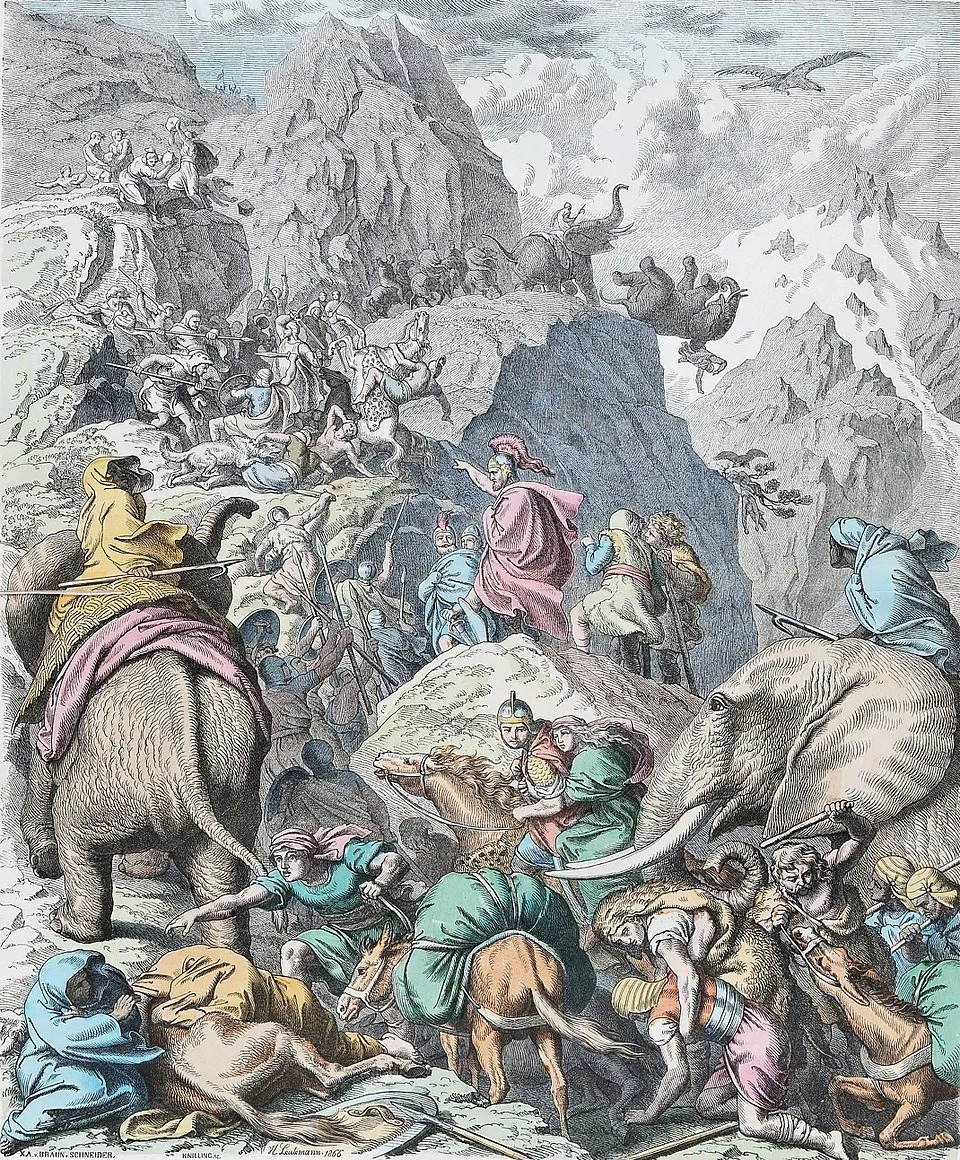
An 1860s depicton of Hannibal and his army crossing the Alps. By Heinrich Leutemann.

Hannibal Inflicts Crushing Defeats on Rome in Italy

At the onset of the Second Punic War, Hannibal crossed the Alps with his army, comprising 37 war elephants, taking the Romans completely by surprise. Once in Italy, he recruited troops from the local Gauls and went on a rampage, inflicting a string of crushing defeats on the Roman army. The Battle of Trebia (218 BC) was the first major battle fought in Italy, where Hannibal taunted the Romans to cross the freezing Trebia River and fight the battle on his terms. With a small ambush force, he attacked the confused Romans in the rear, causing a rout. Rome lost 26,000 casualties in Trebia.

In the Battle of Lake Trasimene (217 BC), he outwitted the Romans again. He created a false sense of security for the Romans by lighting fake campfires at a distance, which prompted them to cross a narrow valley through thick fog. With near-zero visibility, the Romans were shocked to see the end of the valley blocked by Carthaginian troops. With the sound of a trumpet, he instructed his troops to attack the Roman troops from the top of the valley where they were hidden. Outnumbered and hopelessly surrounded, the Romans were routed as they were either cut down or drowned in the lake trying to escape in heavy equipment. The Romans lost 15,000 killed and 15,000 captured at Trasimene.


The Coup de Grâce at Cannae

The earlier defeats in Trebia and Lake Trasimene created an existential dread in Rome. Morale was low, and people wanted to handle the Hannibal problem. In times of crisis, Rome would elect a dictator with absolute power to handle these situations, and this time, they appointed Fabius Maximus as their dictator to deal with Hannibal. However, Fabius chose a more passive approach of avoiding battle and keeping him contained. This Fabian Strategy was very unpopular in Rome as the people wanted Hannibal to be dealt with quickly. As soon as his term as dictator was over, they appointed consuls Varro and Paulus, who promised to take a more direct approach.

Their chance came at the Battle of Cannae in 216 BC. Rome had gathered the largest army it had ever assembled, with 80,000 infantry and 6,000 cavalry. Hannibal had about 40,000 infantry and 10,000 cavalry. Gisco, a Carthaginian general, is said to have commented on the huge size of the Roman army, to which Hannibal is said to have responded with the following quote to lighten the mood:

"Another thing that has escaped your notice, Gisgo, is even more amazing—that although there are so many of them, there is not one among them called Gisgo."


The Battle of Cannae was Hannibal’s masterpiece and the zenith of his military career. He intentionally left his center vulnerable and arrayed them in a convex formation. The cavalry was at the flanks, and when the battle started, the superior Carthaginian cavalry chased off their Roman counterparts. The Carthaginian infantry was, however, hard pressed and on the verge of collapse. Sensing victory, the Romans broke formation and went in for the kill, funneling all troops to the center to break the Carthaginian lines with their sheer weight in numbers. The tide turned, however, when Hannibal instructed his reserve Iberian troops on the wings to engage the Romans on the flanks. Their escape was sealed when the Carthaginian cavalry swung back around and hit the Romans in the rear, completing the trap. What resulted was a massacre that led to about 50,000 to 70,000 Roman casualties.


The Scale of the Losses in Cannae

The Battle of Cannae was more than just a defeat for Rome. They had funneled in all their troops and resources to crush Hannibal, but their entire army was erased from the face of the earth. Rome’s leadership was gutted in this battle. One of the consuls, Paullus, was killed during the intense fighting. 28 out of the 40 tribunes (senior ranking officers), 80 members of the senate or magistrates, and 200 Roman knights (equites) were among the casualties. About 20 percent of all Roman fighting men between the ages of 18 and 50 were killed that day in Cannae. This was one of the darkest days in Roman history, as any specific Roman citizen had lost a loved one or was impacted by this loss in some way.

Rome’s armies were defeated, and their morale was near collapse. The road to Rome lay open for Hannibal. The Romans were in shock and disbelief. They began preparing for a siege, which they expected was to come. However, Hannibal did not march on Rome. He chose to consolidate his position in southern Italy by coercing Rome’s allies to defect to Carthage. Some of Hannibal’s generals criticized Hannibal for his inaction. His cavalry commander, Maharbal, is said to have commented,

"Assuredly, no one man has been blessed with all God's gifts. You know how to win a victory, Hannibal, but you do not know how to use one."


Rome Does Not Surrender

Hannibal believed that Rome would sue for peace after the loss at Cannae. Any city-state that had incurred a loss of this scale would have definitely capitulated. However, Rome stayed defiant. When Hannibal sent an envoy to discuss peace terms, this was rejected by the Roman Senate. The Romans passed a resolution to prevent the ransom of captured Roman soldiers in Cannae. Rome began to recruit new legions quickly to defend the city. The mere mention of the word peace was banned. Rome would fight till the bloody end.

Rome took drastic measures to ensure that talks of peace or defeat were not encouraged,

●   The mention of the word "peace" was banned.

●   Guards were stationed at the gates to prevent citizens from escaping the city.

●   Rome banned the ransom of its soldiers captured by Hannibal.

●   In a fanatical religious move, two Gauls and two Greeks were buried alive in the Forum Boarium.

●   Mourning was limited to 30 days to prevent loss of morale.


Why Did Hannibal Not March on Rome?

Hannibal chose not to attack the city of Rome due to several valid reasons. He did not believe that his army was capable of capturing the city or holding the city, even if victory was possible. He did not have the resources needed to lay siege to a city for an extended period of time.


1. Lack of Heavy Siege Equipment

To successfully siege a city, Hannibal needed siege equipment like catapults, siege towers, and rams. Hannibal’s army was fast-moving and suited for fights in open fields, not for protracted sieges. They did not have a base of operations to build or the raw materials needed for the above-mentioned heavy siege equipment. Without proper siege engines, there was no way Hannibal could force the city to surrender or breach its walls.


2. Rome’s defenses

Rome was able to recruit recruits by recruiting people below 17 and above 45, arming slaves with the promise of freedom, and even freeing criminals and debtors in exchange for military service. Rome was surrounded by the Servian Wall, which was massive and a huge obstacle for Hannibal and his army. The city defenses included,

●   An 11 kilometers (7 miles) Servian Wall, which was about 10 meters (33 feet) high and 3.6 meters (12 feet) wide.

●   An Earthen Rampart (Agger).

●   Deep trenches or moats in front of the wall.

●   War Engines: The city also had catapults and ballistae to throw stones and heavy bolts at the attackers.


3. Logistics And Supply Issues

This was the primary issue faced by Hannibal. Rome was 250 miles away from Cannae, and he needed to keep his exhausted army supplied and fed during the long journey, which could potentially take over two weeks. Rome was following the Fabian Strategy again and would constantly harass Hannibal and prevent him from securing supplies by destroying crops and supply depots if they could not be defended. With the Roman navy controlling the seas, he could also not be supplied reliably from Carthage.

A siege in Rome could potentially take one to two years. This was based on a lesson he had learnt earlier in Saguntum, where the smaller city had held out for 8 months. Hannibal did not have enough supplies to last even a week for his army. Rome, on the other hand, had enough grain supplies to last a year. He could not afford to bleed his army in a long siege and had no way of ending it quickly.


4. Refusal of Reinforcements From Carthage

The Carthaginian senate initially allocated a substantial amount of supplies and troops for Hannibal, but this was hampered by logistical issues. With the Roman fleet still ruling the seas, it was not easy for the Carthaginians to supply troops. Hannibal also struggled with capturing deep-water ports in Italy. After the defeat of Hannibal’s brother Hasdrubal in the Battle of Dertosa (215 BCE) in Spain, Carthage decided to supply troops to the Spanish front instead. Many people in the Carthaginian Senate did not favor Hannibal like Hanno II the Great. They did not want to risk investing in expensive wars and were afraid of Hannibal’s influence.


5. Threat of Being Attacked by Relief Armies

Rome had other legions in Italy and overseas. If Hannibal was sieging Rome for a long period, then he was at risk of being attacked by both the defending Romans and the attacking relief army. This would put him in a risky position.


Conclusion

Analyzing the issues in sieging Rome, Hannibal decided that it was best not to attack Rome at that moment. He undertook a different approach to bleeding Rome of its allies in Italy. He believed that if he could make the allied cities believe that Rome was not capable of protecting them from the Carthaginian army, they would defect to his side. However, this did not work out as many of Rome’s allies did not defect. Although some major cities like Capua did defect, Hannibal was not able to protect these cities from Roman revenge, as his army was small. Eventually, Rome would engage Carthage in Spain and Northern Africa, and Hannibal would be forced back to Carthage. The Second Punic War would end in Roman victory at the Battle of Zama, where Scipio defeated Hannibal.


Did you find that piece interesting? If so, join us for free by clicking here.

Posted
AuthorGeorge Levrier-Jones
CategoriesBlog Post

Whether the pun in the title made you laugh or cringe, it is fitting for the event that this article is about, the Battle of Cannae—indeed an uncanny defeat. Here, Nathan Richardson explains what happened in the 216BC battle between the Roman Republic and Carthage, part of the Second Punic War.

The Death of Aemilius Paulus at the Battle of Cannae. A 1773 painting by John Trumbull.

In 216 BC, the Roman Republic faced not only defeat, but the possible dissolution of their empire. The foreign armies of Carthage, Rome’s rival from across the Mediterranean on the North African coast, tread on Italian soil. Hannibal Barca, one of history’s most renowned and daring generals, and Carthage’s best hope of victory, cowed Rome’s allies and threatened Rome herself. Having traveled from the Iberian Peninsula, through southern Gaul (modern-day France), across the nearly-impassable Alps, and down into Italy, Hannibal rampaged into the very heart of the burgeoning empire of Rome. Hannibal smashed three Roman armies in quick succession: the Battles of Ticinus (in 218 BC) Trebia (also in 218) and Trasimene (in 217) (Goldsworthy, 22-27). The Carthaginian general, whose father had reportedly made him swear eternal enmity for Rome, seemed undefeatable (Goldsworthy, 15). Each battle the Romans fought brought them closer to complete destruction. Each time the Roman army faced the Carthaginians in the open field, Rome’s vital manpower was further depleted. Each defeat, additionally, began to erode the various Italian cities’ confidence in Rome to defend them. In the north of Italy in the Po River Valley, many recently-conquered Gauls living there flocked to Hannibal’s side and threw off the Roman yoke (Keppie, 25-6). Rome stood determined still, yet the question remained whether Roman resilience would outlast Hannibal. Rome buckled under these crushing defeats, yet far darker days lay ahead.

Fabius’ Plan

In response to this crisis, the Romans elected a dictator to see them through the trials ahead—a man named Quintus Fabius Maximus Verrucosus (in the future, simply Fabius). Fabius realized that Hannibal would likely defeat the next hastily-prepared Roman army just like the last three. He saw no point in throwing another army of untested Romans against Hannibal’s experienced and hardy mercenaries and allies. Therefore, Fabius resolved to keep his army in being, and carefully avoided pitched battles with Hannibal—all the while shadowing the Carthaginians and attempting to disrupt their supplies. Hannibal, no doubt, preferred to annihilate one hastily-assembled and ill-trained set of legions at a time—until Rome was forced to sue for peace. Yet Fabius did his best to not do Hannibal the service of fighting him in the open. If Fabius could keep this up, he would slowly deprive Hannibal of food and wear down his multi-ethnic army (Goldsworthy, 27-32). Hannibal, after all, was quite vulnerable. He was an invader in a foreign land, and many of his men would only fight so long as they were paid and taken care of (Goldsworthy, 46). If the Romans haunted Hannibal’s steps, kept him from properly resupplying, and provided Hannibal’s men no source of spoils, their morale would eventually decline, and Hannibal could possibly be destroyed or driven out of Italy.

However, the Roman people soon began to tire of Fabius’ strategy, interpreting them as hesitancy or even cowardice. Cunctator (“the Delayer”) was the moniker the people soon gave him (Keppie, 26). According to the Greek historian Plutarch, Hannibal, aware of Fabius’ unpopular strategy of non-engagement, purposed to further discredit Fabius. To do so, he sacked and burned the lands surrounding Fabius’ personal holdings, yet left Fabius’ property untouched—going so far as to post guards around Fabius’ property to ensure it stay unmolested. When word of this reached Rome, Fabius’ reputation took a serious downturn, and slanderous rumors of treason circulated around Rome (Plutarch, 217). Once his six-month term as dictator expired, Fabius left the army and returned to Rome (Goldsworthy, 31). Not only did Fabius leave office deeply unpopular, but his strategies would be disregarded by his successors.

With the dictator out of power, Rome again appointed two Consuls to lead her through this crisis. These two Consuls were Paullus and Varro. Responding to the impatient voices of Rome, the two Consuls hastily raised a new army, this time made of eight legions and troops from various allies of Rome (probably in the form of light infantry and cavalry), and set forth to meet Hannibal. This army that Paullus and Varro led was indeed massive, numbering around 75,000 men. Their army outnumbered Hannibal’s force nicely, which numbered only 40,000 men (Keppie, 26). If all else were equal, an army with such a numerical advantage must surely win a pitched battle. However, Hannibal’s skill as a tactician, as well as the Roman consuls’ poor decisions, would hobble Rome in taking full advantage of her superior numbers. Additionally, Rome’s hastily formed force, man for man, was far from the Carthaginian’s army’s equal.

The Battle

The Romans and the Carthaginians met by the Aufidus River (now called the Ofanto) near the town of Cannae in southeast Italy. The ground chosen by the Romans favored the Roman situation, since the Aufidus running on the Roman right and rough land on Roman left limited the space open on either flank for Carthaginian cavalry (which was superior to the Roman’s) (Goldsworthy, 99). Additionally, the ground offering little room for maneuver complemented the Roman tactics for this battle. Their plan was blunt: they would launch a full-frontal assault and attempt to use their enormous numbers to brute-force their way through the Carthaginian line. However inelegant it might be, the plan’s lack of complexity did not ask too much of the poorly trained and hastily organized army the Roman’s fielded (Goldsworthy, 113-16).

Between the two Consuls, Varro is typically depicted as the braggart fool who bumbled his way into Hannibal’s trap, and Paullus as the martyred prudent commander. Though it is difficult not to blame the day’s commander for the calamity about to befall the Roman army, especially since Varro was most certainly the bolder of the two commanders, this characterization is likely an exaggeration at least (Goldsworthy, 84, 72-3). However, it must be remembered that neither consul had ever commanded such a massive force (this was one of the largest armies Rome would ever put into the field), and both consuls were entirely outmatched by Hannibal in generalship (Goldsworthy, 66, 64).

Hannibal’s arrangement of troops was key to the Carthaginian success. Contrary to the Roman’s expectations (and possibly good sense), he placed his least experienced and least reliable troops (the Celtiberians from modern-day Spain) as his center in the battle lines. He also arrayed these troops in an arc, bowing out towards the Roman lines. These troops provided a very tempting focal point for the Roman charge. So, with a deliberately weak center, Hannibal posted his best troops, his Libyan heavy infantry, on either flank (Keppie, 26). On each far flank, both sides posted cavalry on either side. Though vastly outnumbered in terms of infantry, Hannibal did possess more cavalry and of higher quality than the Romans mustered. This equestrian superiority would become another key element of Hannibal’s victory (Keppie, 26).

In typical ancient warfare form, the battle commenced with light infantry of both sides armed with javelins, bows, or slings running forward and attempting to break up the enemy’s formations with projectiles. The light infantry also served another purpose: they helped to screen the movements of the main army from the enemy’s view. If the Roman commanders had been able to see Hannibal’s arrangement of troops, they may have realized what kind of trap lay in store for them. Thus, light infantry assisted in blinding the commanders on either side from having a complete picture of their enemy’s designs (Keppie, 26). Further, Plutarch states that a strong wind blew sand into the eyes of the Romans during the battle, giving the Carthaginians a further edge over the Romans (Plutarch, 223).

Trap

Paullus’ and Varro’s army blundered forward, intent on smashing through the weak Carthaginian center. While this drama played out in the center, the Roman and Carthaginian cavalry engaged in a heated melee on the flanks. The cavalry situation was less in Rome’s favor. On the Roman right, Hannibal’s allied Celtic cavalry beat the Roman cavalry on that side, and forced the Romans to flee. Meanwhile, on the Roman left, the Roman cavalry managed to hold off Hannibal’s Numidian cavalry. But the Roman left soon broke and fled when the victorious Celtic cavalry, abandoning their pursuit of the Roman right’s horsemen, turned against the Roman left’s cavalry (Keppie, 26). Thus, the Roman cavalry on either flank were beaten and driven off, leaving the Carthaginian cavalry unopposed.

While the Roman cavalry fought and fled the field, the Roman infantry, though still superior in numbers, pushed themselves further and further into Hannibal’s trap. As the Romans pressed forward, Hannibal’s center fell back and began to break, inverting the arc that the Carthaginian line formed. However, this arc did not break. Instead, the formerly concave arc turned convex. Every step forward the Roman center made was one step farther into Hannibal’s trap. As Hannibal’s center fell back with the Roman push, the Libyan infantry, on the extreme ends of the line, began wrapping like tentacles around the Roman flanks, eventually transforming the orderly host of Roman infantry into a disorganized mass of men, where all semblance of formation disappeared, and the enemy were suddenly present on three sides—Celtiberians in the front and Libyans on either flank (Keppie, 26).

The Roman Legions’ fate was sealed with Hannibal’s final move: the victorious Carthaginian cavalry charged the Roman rear. With just-victorious Carthaginian cavalry nipping at their heals, the Roman infantry in the rear began to melt away. The poor Romans in the very front did not flee—they could not. The veteran Carthaginian infantry bore down on them, and a massive noose, encompassing tens of thousands of Romans, began to tighten. They were pushed into a tighter and tighter mass, so much so that the legionnaires could not properly use their weapons. Many men were forced to stand and wait for all the men in front of them to be hacked down before they met their own end (Goldsworthy, 177). Only about 10,000 managed to escape the slaughter and limp dejectedly back to Rome. The rest, over 50,000 Romans, were slaughtered where they stood or as they fled (Goldsworthy, 183). Among the lucky survivors was Varro, the impatient Consul who fell for Hannibal’s trap so nicely. Paullus, on the other hand, died with his men.

Aftermath of Defeat

The defeat Rome suffered at Cannae was colossal. A large proportion of Rome’s men of fighting age had been slaughtered. A defeat such as Cannae would have been the end for almost any other empire. Yet, Rome was not like other empires. Rome did not sue for peace. A galvanized Senate and People of Rome were more determined than ever to rid Italy of Hannibal and the world of the hated Carthage (Goldsworthy, 197). New armies were raised, and the Fabian strategies resumed (Keppie, 28). Hannibal, having doubtlessly suffered heavy casualties at Cannae (though light compared to the Romans), did not follow up his victory with a march on Rome, against the advice of his more aggressive generals. One of his generals is recorded by Livy as having told the great Hannibal, “Truly the gods do not give everything to the same man: you know how to win a victory, Hannibal, but you do not know how to use one” (Goldsworthy, 189). Instead, Hannibal focused on trying to turn more Italian cities (allies of Rome) to his side in order to get the men and supplies he needed. Though many flocked to his banner after Cannae (notably, Italy’s second-largest city, Capua), not enough of them did. Rome still held firm, and so would many of Rome’s allies (Keppie, 28). The war continued in Italy for over a decade more. In 204 BC the famed Roman general Scipio Africanus made an invasion of North Africa from Sicily, with the intent of assaulting the city of Carthage itself. He was not known as Africanus then, but his upcoming campaign in North Africa would soon earn him that title. In response to this threat, Hannibal was recalled from Italy to defend the seat of the Carthaginian empire (Goldsworthy, 202). In total, Hannibal and his army had ravaged Italy for nearly fifteen years—fifteen years of brutal, bloody conflict across many battlefields. Yet, Cannae would be the one battle that Rome remembered the clearest as one of their darkest days—though a dark day that was not the end of Rome.

Influence of Cannae

Hannibal executed a near-perfect encirclement of eight Roman Legions by the Aufidus River in southeast Italy. In awe of this achievement, generals throughout history have attempted to replicate it. The “double-envelopment”, “Pincer movement”, or simply “encirclement” became the dream of every ambitious general. German General von Schlieffen planned (unsuccessfully, as it would turn out) to achieve a double-envelopment of the Allied forces in the First World War. So too did US General Schwarzkopf in the Gulf War. Hannibal’s double-envelopment was and is the ultimate winning-stroke that many commanders throughout history have sought for, yet rarely achieved. Many generals throughout history have looked all the way back, over two thousand years ago, to the Battle of Cannae for inspiration (Goldsworthy, 205-6).

What do you think of the Battle of Cannae? Let us know below.

Posted
AuthorGeorge Levrier-Jones
CategoriesBlog Post

Child sacrifice, while completely repugnant and bizarre to modern eyes, has happened at times in history. In this article, Joe Greenslade investigates the practice of child sacrifice among the ancient Carthaginians. Did they really sacrifice living children? Or did they undertake practices that were somewhat less sinister?

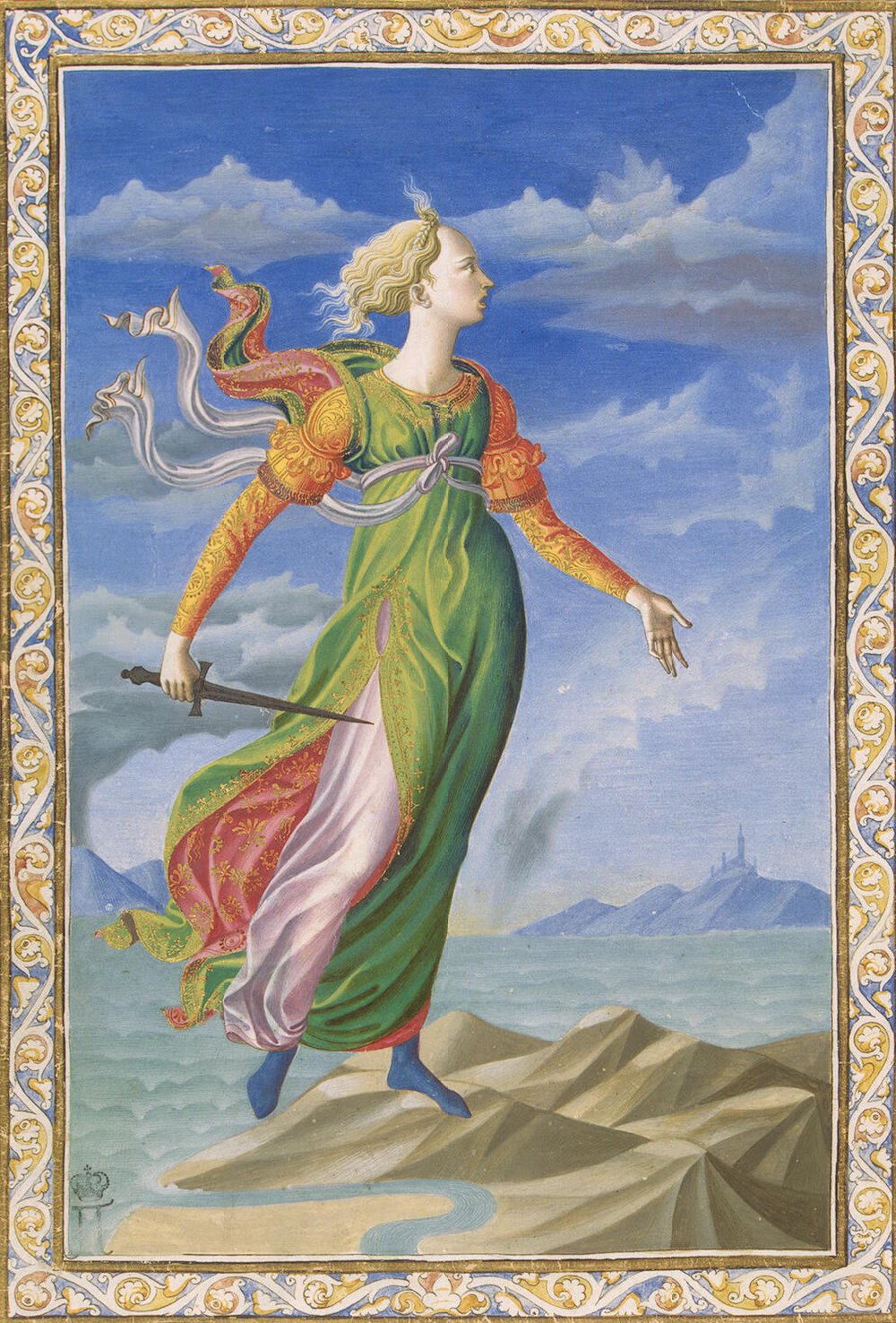
The painting Allegory of Carthage by Francesco di Stefano.

The painting Allegory of Carthage by Francesco di Stefano.

An overview

In the modern world the thought of people conducting human sacrifice is morbid, un-thought of, and despicable.  Before we explore if and why the Carthaginians carried out human sacrifice, it is important that we take a moment to view the mind-set of the ancient Carthaginians. We must not judge them by modern standards; neither must we condemn them as child killing murderers until we have properly explored the evidence provided.

The peoples of the ancient worlds did not know science, not as we knew today.  They rationalized everything that happened with religion.  If there was an outbreak of disease, the gods were unhappy.  If a harvest failed, the gods were unhappy.  If a military campaign failed, it was because the commander had not offered the correct sacrifices before he left.  Everything was rationalized with religion.  In the Greek, Roman, and Carthaginian worlds the gods could be appeased by sacrifice.  The personal sacrifices were usually smaller animals, but the state sponsored sacrifices consisted of larger beasts, usually cows or bulls.  These sacrifices usually revolved around festivals, as the populace would eat the meat in the aftermath.

Although human sacrifice was frowned upon even in the ancient world, with Gelon of Syracuse and the Persians insisting the Carthaginians stop, there were still practitioners.  The Phoenicians were known to have carried out human sacrifice.  This helps us understand roots in Carthaginian sacrifice because it was the Phoenicians that originally set up the colony in North Africa that became Carthage, and in doing so it seems they took it upon themselves to continue the sacrificial practices of their forbears.


The literary evidence

The evidence for child sacrifice comes in the form of literary and archaeological evidence. This points to the Carthaginians using human sacrifice prior to the destruction of the Romans in 146 BC.  We have many ancient sources, mostly Roman, who chronicle the Carthaginians as child sacrificers.  For example Diodorus Siculus tells us of the process.  Diodorus insists that there was a statue with down facing arms that stood over a pit of fire. The young were placed in the arms of this statue and let go, where they rolled down the arms and into the pit.  This process was conducted to appease a Carthaginian deity, most likely Tanit or Baal Hammon.  Plutarch, a Greek biographer who was writing during the period of Roman dominance, wrote that street children would be bought and used for sacrifice.  Quintus Curtius tells us that this practice only died out when Carthage was destroyed, which potentially shows us that the Carthaginians always conducted this ritual.

The problem with these literary sources is that they were written some time after Carthage was destroyed.  They would have been writing with the knowledge that Carthage was an enemy of Rome, so could have been biased.  They were also not contemporary, so would have relied on earlier sources to complete the picture.  Finally, Livy and Polybius, two major sources, fail to mention even briefly that the Carthaginians carried out human sacrifice.  This is important in Polybius’ case because his work was focused on Rome’s conflict with Carthage.  In fact he was supposed to be at Scippio’s side when Carthage was destroyed in 146 BC.


The archaeological evidence

The archaeological evidence is more useful than the literary evidence.  We can put our hands on it, investigate it, see it.  The principles evidence comes from a site in Carthage known as the Tophet.  It was found and excavated in 1921 by P. Gielly and F. Icard.  The excavation revealed many burial urns that contained the ashes and bones of young infants along with some animal remains.  The jump was easy to make; the Carthaginians practiced child sacrifice.  This belief was further enhanced when certain steles at the graveyard were excavated.  One such stele was inscribed with amounts of coin paid by wealthy parents on behalf of their sons.  This could tie in with Plutarch’s works, as street children could have been sought out instead of the wealthy children.  Perhaps poorer families were chosen, families who could not afford the coin.  Another stele seems to show the parents taking pride in having their child sacrificed. It reads “It was to the Lady Tanit Face of Baal and to Baal Hammon that Bomilcar son of Hanno, grandson of Milkiathon, vowed his son of his own flesh.  Bless him you!”

This seems to suggest that these parents had a stele set up to commemorate the sacrifice.  The slightly unsettling aspect of this engraving is that it does not even include the child’s name - just the father and his ancestors.  The stele seems to be a testament to the father.  Another stele has an engraving depicting a priest carrying a baby, most likely to its doom.  These finds of the Tophet seem to fully allow us to believe that the Carthaginians ritualistically sacrificed children to appease their gods.  The literary evidence coupled with this archaeological evidence seems to offer no escape for the Carthaginians, who were of course condemned.  But there is quite a persuasive argument that could still yet exonerate the Carthaginians.


The problem

What could possibly cast doubt in the face of such evidence, both archaeological and literary, you ask?  It is tough to work out, and if you have by now then I salute you, it took me a while longer.  You see, there is an argument that suggests these children were already dead when they were offered up for sacrifice.

Bomilcar was perhaps offering up a child that had been stillborn, or had died of a disease.  It is still a form of offering, giving up his dead son’s body - an argument used by Schwartz in 2012.  He put forth the theory that the Tophet was an infant cemetery for those who died young, stillborn and even fetuses.  Schwartz argues that they were offered for sacrifice after death.  He tried to prove this by investigating the teeth of the deceased to ascertain an age of death; by doing this he could cross reference his finds with the high child/infant mortality rate to help prove they were already dead at the time of offering.

Schwartz’s argument is compelling, but it does not change the fact that the Carthaginians believed that the gods could be appeased by the burning of children, being alive or dead.  If this is the case, the ancient sources can be forgiven for thinking the offerings were still alive; indeed, they still could have been, Schwartz’s argument could be wrong.  Whether the children were alive or dead before they tumbled down the arms of the statue into a pit of fire, we’ll never know for certain. I’ll leave each of you to make up your own decision.

The ancient world was a brutal place, but we must not judge them too harshly.  Human sacrifice still has a place in modern society.  The Hindu practice of Sati, for example, where the wife of the deceased husband was placed on the pyre and burned alive along with the body of her husband, was practiced as recently as 2006.

Maybe modern times aren’t so different from ancient times after all.


Do you think others should know about this article? If so, tweet about it, like it, or share it by clicking on one of the buttons below…

Bibliography

Anderson, J (2013). Daily Life through Trade: Buying and Selling in World History. California: ABC-CLIO. 35-37.

Brown, S (1991). Late Carthaginian child sacrifice. Sheffield: JSOT Press. 21-24

Church, A. Gilman, A (1998). The Story of Carthage. New York: Biblo & Tannen Publishers.

Hoyos, D (2010). The Carthaginians. New York: Routledge 94-104

Lancel, S (1997) Carthage: A History. New York: Wiley.

Langdon, S. (1904). The History and Significance of Carthaginian Sacrifice. Journal of Biblical Literature. 23 (1), 79-93.

Markoe, G (2000). Phoenicians. California: University of California Press. 94-95.

Miles, R (2010). Carthage must be destroyed. London: Penguin. 68-98.

Schwartz J.H., Houghton F.D., Bondioli L. & Macchiarelli R. (2011). Bones, teeth, and estimating age of perinates: Carthaginian infant sacrifice revisited. Available: https://www.academia.edu/8420896/Bones_teeth_and_estimating_age_of_perinates_Carthaginian_infant_sacrifice_revisited. Last accessed 26/01/2015.

Scullard, H (1955). Carthage. Greece & Rome, Second Series. 2 (3), 104-106.

Soren, D (1991). Carthage: uncovering the mysteries and splendours of ancient Tunisia. New York: Simon & Schuster. 120-130

http://news.bbc.co.uk/1/hi/world/south_asia/5273336.stm (Indian Sati)

Amazing buildings have been destroyed due to mortars, terrorism, free will and the musings of politicians. It seems mad to us now, in an age when preservation is a priority, that buildings of historical significance have been torn down without any governmental say-so. In every part of the globe, our lands are littered with the remains of what's been left behind, or the spaces where things 'could have been'.

So what are we, as historical tourists, missing exactly in our archaeological passports? What should have been that is no longer here? Hollie Mantle explains…


Sophienkirche - Dresden

World War Two attacked few cities to the same extent it ravaged the German city of Dresden. While people were captured, fled or hid in basements, the city around them, and its beautiful baroque architecture, was being blitzed by a persistent rain of bombs.

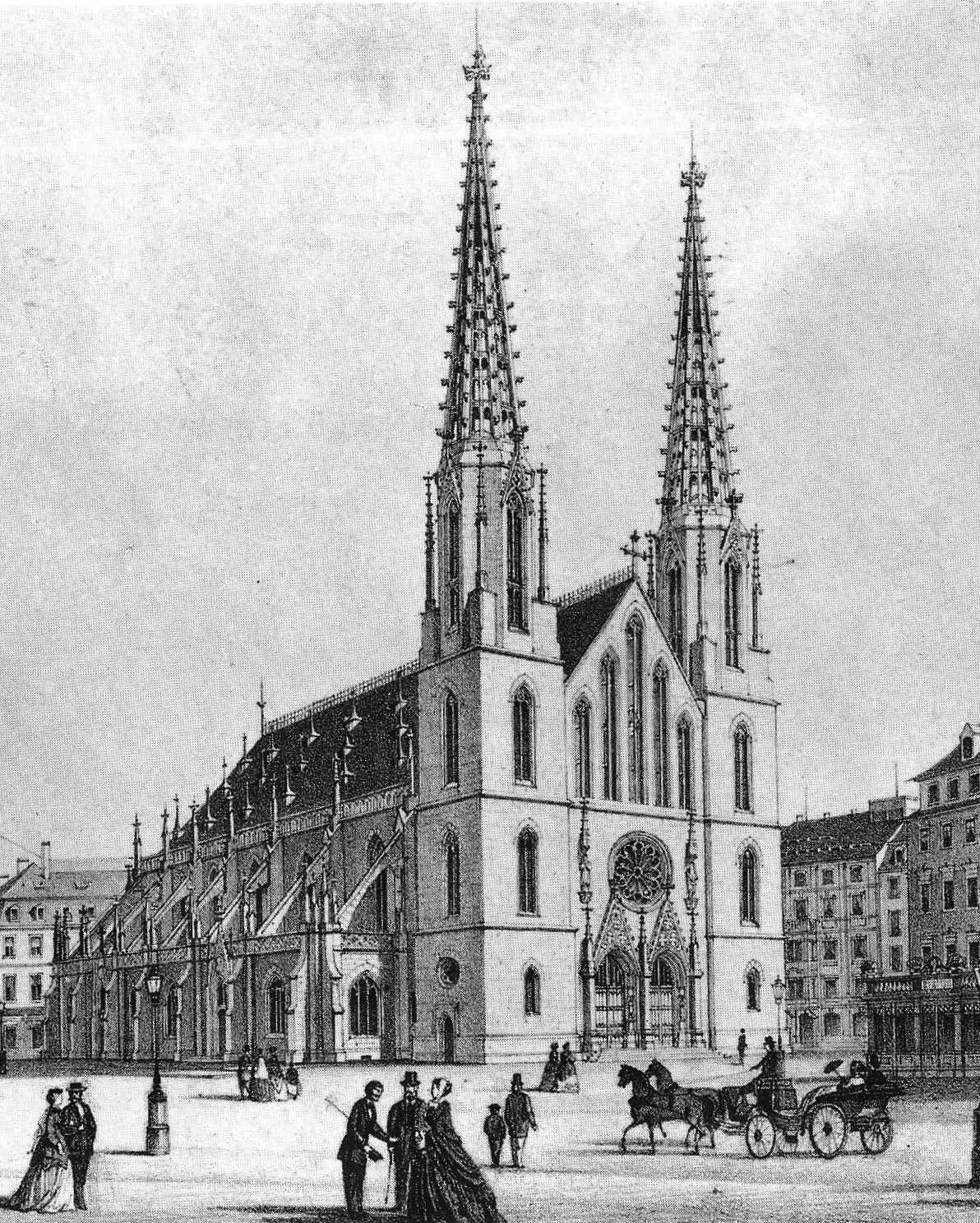
Whilst the destruction of baroque architecture was undoubtedly an utter tragedy, one building of unusual note was also left in disrepair by the war. The city’s gothic Sophienkirche, with twin neo-gothic spires, was the admiration of local people. Though the bombs blasted some of the church’s exterior, however, it was not the war which eventually saw to the church’s demise, but the fateful words of a contemporary politician, who said: ‘a socialist city does not need gothic churches’. And so, in the early 1960s, the Sophienkirche was demolished.

The area where the Sophienkirche existed is now a much more unsightly collection of 1990s-style buildings, and not worth a trip for travellers. In the middle of the city, though, the beautiful Frauenkirche cathedral was restored in 2005, and should feature high on any tourist’s ‘to-do’ list.   

Dresden's Sophienkirche.

Dresden's Sophienkirche.

Carthage – Tunisia

It surprises most to hear of the wide presence of Ancient Roman ruins in northern Africa, and that one of Ancient Rome's most famous sites in fact lies in Tunisia. The ancient city of Carthage was a hot bed of shipbuilding and imports of jewels, glassware, gold, and ivory. However, the city – which was only second to Rome in its splendor in the region – was destroyed around 146BC in the Third Punic War against Rome, after which point the Carthaginian Empire was defeated . After its demise, the city was rebuilt by the Romans, but was eventually destroyed for the second time several centuries later by the Muslim conquest.

Today Carthage lies in ruin in modern Tunisia, and is a great pull for tourists visiting the country. The outlines of homes, palaces and the harbor can still be seen, giving a glimpse of the grandeur of this historic Mediterranean empire. For those who want to avoid the capital, the coastal towns of Sousse, with its ‘Medina’, and Hammamet, are brimming with ancient ruins and museums that will give you a rounded overview of the country’s history.


The Library of Alexandria - Egypt

The loss of this great library, which stood in the city of Alexandria in Egypt, still represents the destruction of public knowledge for many historians. Why, how and when it was exactly lost is difficult to establish, but most books on the subject point fingers at Julius Caesar, Emperor Theodosius I or the Muslim Army of Amr ibn al ‘Aas as culprits, and suggest it was destroyed by fire.

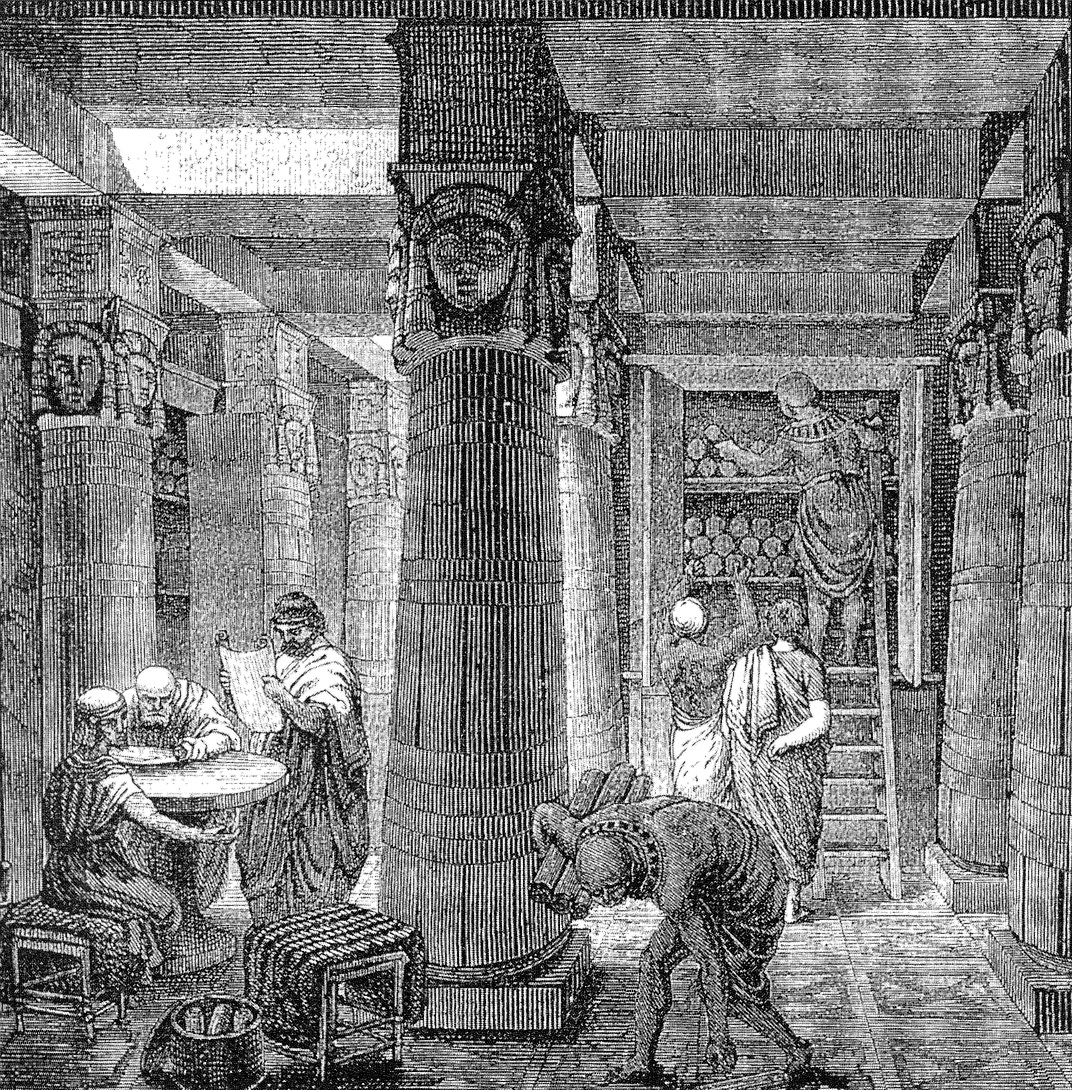
In the last centuries of the period before Christ, the library was the greatest in the ancient world. It had reading rooms, lecture halls, gardens and shelves brimming with papyrus scrolls containing all the knowledge of ancient times. When it was destroyed, some scrolls were preserved and moved to other locations, but most suffered damage again in their second homes.

For visitors wanting to see the ruins now, that is not possible. There are none. Instead, the Biblioteca Alexandrina, a modern library built to commemorate the Library of Alexandria, stands in its place, though with less of the glory of its predecessor. 


The Library of Alexandria

The Library of Alexandria

Shakespeare’s House - Stratford upon Avon

Tourists flock to an English town to see the site where the world’s most famous wordsmith was brought into the world.

After his childhood, however, Shakespeare moved to London, where he began his career as an actor and writer – though very few records can mark him down in one particular place at a given time.

As a wealthy, middle aged man, though, we do know this: Shakespeare bought a home in Stratford. New Place was purchased in 1597 for the great sum of £60, and was home to his wife Anne and his children, until he too eventually returned there in 1610, to commence his retirement. It was also the unfortunate stage for his death, six years later, in 1616.

So why do we not visit and revere this home, where the adult Shakespeare housed his family during the prime of his career?

When Anne Hathaway later died in 1623, the house was sold and passed into different hands, before becoming the property of Francis Gastrell. Angered by visitors pestering the outside of his home to see the site where Shakespeare lived, Gastrell tore the place down in 1759.

The piece of land where New Place once stood is protected by the Shakespeare Trust, but is unfortunately just that; a space. All we have now are artists’ drawings and our imaginations to attempt to conjure an image of “the forms of things unknown”.


Ancient Aleppo Markets - Syria

Due to the recent conflict, the cost of disruption and human lives in Syria far outweighs the damage to buildings. But the ancient Aleppo Markets, registered by UNESCO as a World Heritage Site, have suffered tremendously during city wide fights, eventually becoming engulfed in flames that destroyed the majority of the ancient 'souk'. Somewhere in the region of 700-1,000 shops were destroyed, as water strikes meant that containing the fire was nigh on impossible. What was once a huge tourist attraction within this thriving city is now just a marker of the tragedy that has taken over and ripped the country apart.


Did you enjoy this article? If so, tell the world! Please like it, share it, or tweet about it by clicking on one of the buttons below!