
Called upon to surrender the Delaware River fortification of Fort Mercer, Patriot Colonel Christopher Greene responded, “We ask no quarter and will give none.” Pointing to the American ramparts, Hessian Colonel Carl von Donop of the besieging force made a bold proclamation of his own declaring, “Either that will be Fort Donop or I will be dead.” On October 22nd, 1777, both commanders would make good on their stirring words.
Here, James F. Byrne Jr look at the 1777 Battle of Fort Mercer in the American Revolutionary War.
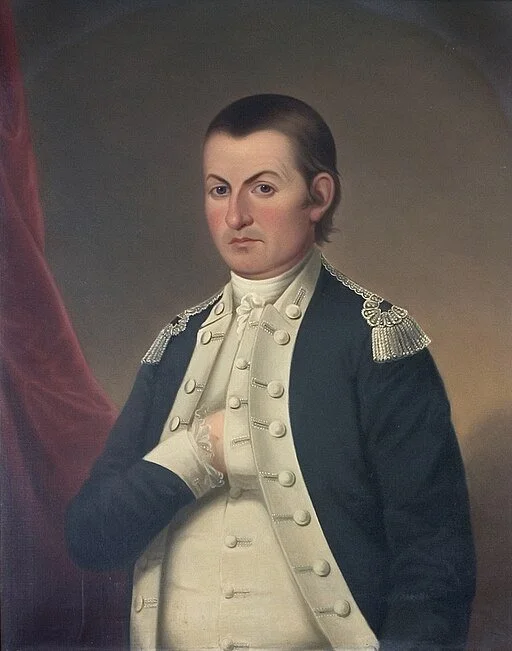
Patriot Colonel Christopher Green. Painting by James Sullivan Lincoln.
Following the defeat of the Continental Army at Brandywine, the British occupied Philadelphia. British General Sir William Howe controlled the American capital, but not the supply route needed to support his large force. Howe needed the Delaware River to move supplies. Unfortunately for his plans, the Patriots controlled a section of the river four miles south of the capital with two forts and a small fleet. Howe’s operations to clear the river resulted in a strategic victory, but not before his forces suffered a humiliating tactical disaster in one of the most lopsided American victories of the Revolutionary War.
Patriot defenses at Red Bank (a strategic bend in the river) consisted of Fort Mercer on the New Jersey shore and Fort Mifflin located on a nearby island. Fort Mifflin boasted 28 guns mounted in a log palisade. Fort Mercer consisted of earthen ramparts supporting 14 guns and manned by 400 Continentals under the command of Colonel Greene.
An eclectic but formidable naval squadron of sloops, schooners and row galleys protected the forts. The squadron also overwatched significant obstacles consisting of iron tipped timbers anchored to the river bottom.
Howe elected to launch a joint naval and land assault to clear his riverine supply line.
Two thousand Hessians under the command of Colonel von Donop would seize Fort Mercer. Von Donop had the misfortune to be in charge of the Hessian garrisons in New Jersey when Washington crossed the Delaware and captured the outpost at Trenton. He eagerly viewed the coming assault as an opportunity to reburnish his tarnished reputation.
Offense
On October 22nd the British offense commenced. A fleet which included six ocean going vessels made its way up the Delaware and ran into shallow waters, underwater obstacles, and a hornet’s nest of small, maneuverable, Patriot warships. Two of the British behemoths ran aground and were destroyed the next day.
Simultaneously with the Royal Navy’s fiasco, the Hessians entered the fray. Approaching Fort Mercer from the Jersey shore von Donop launched an assault after only a cursory reconnaissance. Colonel Greene, a veteran of both Bunker Hill and Quebec, was well served by his scouts and knew of the Hessian advance. He withdrew his men from the outer walls into an internal redoubt protected by a ditch and extensive abatis (sharpened, felled trees). Observing the abandoned outer positions, von Donop assumed the Americans were withdrawing and launched an immediate attack.
The Hessian scaled the abandoned outer parapets and found themselves blocked by extensive abatis, a wide ditch, and American artillery and infantry positioned along the main walls of the fort. The Hessians lacked the tools to cut through the abatis or cross the ditch and milled around helplessly while the Americans poured fire into their ranks. Perhaps the final straw, ships of the American squadron moved into position to join in the bloodletting. In less than 30 minutes the Hessians retreated, having suffering 700 casualties. American losses were less than 40.
Context
Three weeks later, the British deployed additional artillery, infantry, and warships around Red Bank, leading the Americans to scuttle their fleet, destroy their fortifications, and withdraw. Their logistic waterway secured British supply vessels reached Philadelphia on November 26th. The British (now well supplied) spent the winter of 1777-78 in the relative comfort of Philadelphia. However, it had taken seven weeks to clear the American defenses from the Delaware and required the commitment of much of the British force. While Howe orchestrated this operation, Washington was able to rest and resupply his bedraggled army in relative peace, and move into austere but safe winter quarters at Valley Forge.
As for the commanders who fought at Fort Mercer, they were remarkably prescient. Colonel Greene’s brilliant defense ensured he had no need to seek quarter. As for Colonel von Donop, he was not able to grace Fort Mercer with his name, but he did indeed fall while leading the assault, and subsequently died of his wounds.
Lessons Learned
Combined Arms do not Guarantee Victory – The British assault included overwhelming artillery, infantry, and naval forces, and failed overwhelmingly.
Don’t Forget Nothing – The Hessians lacked the tools needed to breech Patriot obstacles and suffered accordingly.
Weapons Deployed Must Meet Tactical Requirements - Large British warships were unable to adapt to river conditions or the highly maneuverable Patriot squadron.
Obstacles Covered by Fire may be Insurmountable - Patriot fires converted their obstacle belt into a death trap.
Deception is a Combat Multiplier – Patriot withdrawal from the outer defenses led to the Hessian ill-planned, disastrous assault.
Know What You are up Against – Inadequate reconnaissance resulted in the overwhelming defeat of the Hessian attack.
Courage is Necessary but not Sufficient - von Donop led his troops from the front, but his leadership skills did not match his bravery.
The site has been offering a wide variety of high-quality, free history content since 2012. If you’d like to say ‘thank you’ and help us with site running costs, please consider donating here.