Many historians debate Hannibal’s decision not to march his army to Rome immediately after the near-complete victory in the Battle of Cannae. Hannibal did not believe he could mount a successful siege on the city of Rome and chose a conservative approach to resupply his army and coerce the Roman allies to abandon their ties with Rome. This, however, did not work out, and after 13 long years of campaigning in Italy, Hannibal was recalled to Carthage, where he was finally defeated in the Battle of Zama by Scipio Africanus of Rome. Sudhir Devapalan explains.
Part 1 in this series on the Punic Wars is here.
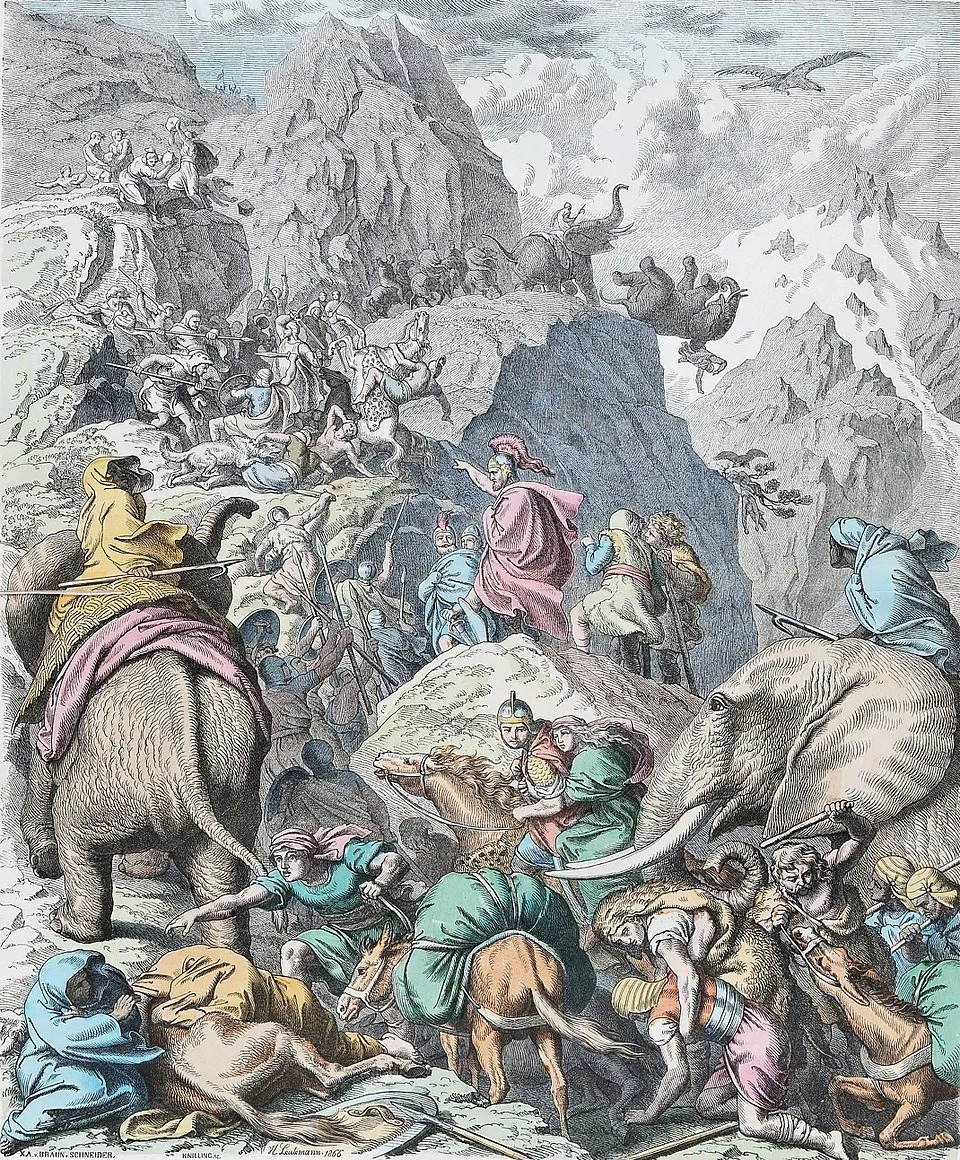
An 1860s depicton of Hannibal and his army crossing the Alps. By Heinrich Leutemann.
Hannibal Inflicts Crushing Defeats on Rome in Italy
At the onset of the Second Punic War, Hannibal crossed the Alps with his army, comprising 37 war elephants, taking the Romans completely by surprise. Once in Italy, he recruited troops from the local Gauls and went on a rampage, inflicting a string of crushing defeats on the Roman army. The Battle of Trebia (218 BC) was the first major battle fought in Italy, where Hannibal taunted the Romans to cross the freezing Trebia River and fight the battle on his terms. With a small ambush force, he attacked the confused Romans in the rear, causing a rout. Rome lost 26,000 casualties in Trebia.
In the Battle of Lake Trasimene (217 BC), he outwitted the Romans again. He created a false sense of security for the Romans by lighting fake campfires at a distance, which prompted them to cross a narrow valley through thick fog. With near-zero visibility, the Romans were shocked to see the end of the valley blocked by Carthaginian troops. With the sound of a trumpet, he instructed his troops to attack the Roman troops from the top of the valley where they were hidden. Outnumbered and hopelessly surrounded, the Romans were routed as they were either cut down or drowned in the lake trying to escape in heavy equipment. The Romans lost 15,000 killed and 15,000 captured at Trasimene.
The Coup de Grâce at Cannae
The earlier defeats in Trebia and Lake Trasimene created an existential dread in Rome. Morale was low, and people wanted to handle the Hannibal problem. In times of crisis, Rome would elect a dictator with absolute power to handle these situations, and this time, they appointed Fabius Maximus as their dictator to deal with Hannibal. However, Fabius chose a more passive approach of avoiding battle and keeping him contained. This Fabian Strategy was very unpopular in Rome as the people wanted Hannibal to be dealt with quickly. As soon as his term as dictator was over, they appointed consuls Varro and Paulus, who promised to take a more direct approach.
Their chance came at the Battle of Cannae in 216 BC. Rome had gathered the largest army it had ever assembled, with 80,000 infantry and 6,000 cavalry. Hannibal had about 40,000 infantry and 10,000 cavalry. Gisco, a Carthaginian general, is said to have commented on the huge size of the Roman army, to which Hannibal is said to have responded with the following quote to lighten the mood:
"Another thing that has escaped your notice, Gisgo, is even more amazing—that although there are so many of them, there is not one among them called Gisgo."
The Battle of Cannae was Hannibal’s masterpiece and the zenith of his military career. He intentionally left his center vulnerable and arrayed them in a convex formation. The cavalry was at the flanks, and when the battle started, the superior Carthaginian cavalry chased off their Roman counterparts. The Carthaginian infantry was, however, hard pressed and on the verge of collapse. Sensing victory, the Romans broke formation and went in for the kill, funneling all troops to the center to break the Carthaginian lines with their sheer weight in numbers. The tide turned, however, when Hannibal instructed his reserve Iberian troops on the wings to engage the Romans on the flanks. Their escape was sealed when the Carthaginian cavalry swung back around and hit the Romans in the rear, completing the trap. What resulted was a massacre that led to about 50,000 to 70,000 Roman casualties.
The Scale of the Losses in Cannae
The Battle of Cannae was more than just a defeat for Rome. They had funneled in all their troops and resources to crush Hannibal, but their entire army was erased from the face of the earth. Rome’s leadership was gutted in this battle. One of the consuls, Paullus, was killed during the intense fighting. 28 out of the 40 tribunes (senior ranking officers), 80 members of the senate or magistrates, and 200 Roman knights (equites) were among the casualties. About 20 percent of all Roman fighting men between the ages of 18 and 50 were killed that day in Cannae. This was one of the darkest days in Roman history, as any specific Roman citizen had lost a loved one or was impacted by this loss in some way.
Rome’s armies were defeated, and their morale was near collapse. The road to Rome lay open for Hannibal. The Romans were in shock and disbelief. They began preparing for a siege, which they expected was to come. However, Hannibal did not march on Rome. He chose to consolidate his position in southern Italy by coercing Rome’s allies to defect to Carthage. Some of Hannibal’s generals criticized Hannibal for his inaction. His cavalry commander, Maharbal, is said to have commented,
"Assuredly, no one man has been blessed with all God's gifts. You know how to win a victory, Hannibal, but you do not know how to use one."
Rome Does Not Surrender
Hannibal believed that Rome would sue for peace after the loss at Cannae. Any city-state that had incurred a loss of this scale would have definitely capitulated. However, Rome stayed defiant. When Hannibal sent an envoy to discuss peace terms, this was rejected by the Roman Senate. The Romans passed a resolution to prevent the ransom of captured Roman soldiers in Cannae. Rome began to recruit new legions quickly to defend the city. The mere mention of the word peace was banned. Rome would fight till the bloody end.
Rome took drastic measures to ensure that talks of peace or defeat were not encouraged,
● The mention of the word "peace" was banned.
● Guards were stationed at the gates to prevent citizens from escaping the city.
● Rome banned the ransom of its soldiers captured by Hannibal.
● In a fanatical religious move, two Gauls and two Greeks were buried alive in the Forum Boarium.
● Mourning was limited to 30 days to prevent loss of morale.
Why Did Hannibal Not March on Rome?
Hannibal chose not to attack the city of Rome due to several valid reasons. He did not believe that his army was capable of capturing the city or holding the city, even if victory was possible. He did not have the resources needed to lay siege to a city for an extended period of time.
1. Lack of Heavy Siege Equipment
To successfully siege a city, Hannibal needed siege equipment like catapults, siege towers, and rams. Hannibal’s army was fast-moving and suited for fights in open fields, not for protracted sieges. They did not have a base of operations to build or the raw materials needed for the above-mentioned heavy siege equipment. Without proper siege engines, there was no way Hannibal could force the city to surrender or breach its walls.
2. Rome’s defenses
Rome was able to recruit recruits by recruiting people below 17 and above 45, arming slaves with the promise of freedom, and even freeing criminals and debtors in exchange for military service. Rome was surrounded by the Servian Wall, which was massive and a huge obstacle for Hannibal and his army. The city defenses included,
● An 11 kilometers (7 miles) Servian Wall, which was about 10 meters (33 feet) high and 3.6 meters (12 feet) wide.
● An Earthen Rampart (Agger).
● Deep trenches or moats in front of the wall.
● War Engines: The city also had catapults and ballistae to throw stones and heavy bolts at the attackers.
3. Logistics And Supply Issues
This was the primary issue faced by Hannibal. Rome was 250 miles away from Cannae, and he needed to keep his exhausted army supplied and fed during the long journey, which could potentially take over two weeks. Rome was following the Fabian Strategy again and would constantly harass Hannibal and prevent him from securing supplies by destroying crops and supply depots if they could not be defended. With the Roman navy controlling the seas, he could also not be supplied reliably from Carthage.
A siege in Rome could potentially take one to two years. This was based on a lesson he had learnt earlier in Saguntum, where the smaller city had held out for 8 months. Hannibal did not have enough supplies to last even a week for his army. Rome, on the other hand, had enough grain supplies to last a year. He could not afford to bleed his army in a long siege and had no way of ending it quickly.
4. Refusal of Reinforcements From Carthage
The Carthaginian senate initially allocated a substantial amount of supplies and troops for Hannibal, but this was hampered by logistical issues. With the Roman fleet still ruling the seas, it was not easy for the Carthaginians to supply troops. Hannibal also struggled with capturing deep-water ports in Italy. After the defeat of Hannibal’s brother Hasdrubal in the Battle of Dertosa (215 BCE) in Spain, Carthage decided to supply troops to the Spanish front instead. Many people in the Carthaginian Senate did not favor Hannibal like Hanno II the Great. They did not want to risk investing in expensive wars and were afraid of Hannibal’s influence.
5. Threat of Being Attacked by Relief Armies
Rome had other legions in Italy and overseas. If Hannibal was sieging Rome for a long period, then he was at risk of being attacked by both the defending Romans and the attacking relief army. This would put him in a risky position.
Conclusion
Analyzing the issues in sieging Rome, Hannibal decided that it was best not to attack Rome at that moment. He undertook a different approach to bleeding Rome of its allies in Italy. He believed that if he could make the allied cities believe that Rome was not capable of protecting them from the Carthaginian army, they would defect to his side. However, this did not work out as many of Rome’s allies did not defect. Although some major cities like Capua did defect, Hannibal was not able to protect these cities from Roman revenge, as his army was small. Eventually, Rome would engage Carthage in Spain and Northern Africa, and Hannibal would be forced back to Carthage. The Second Punic War would end in Roman victory at the Battle of Zama, where Scipio defeated Hannibal.
Did you find that piece interesting? If so, join us for free by clicking here.