
During the height of the air war over Europe, large groups of American heavy bombers climbed out of East Anglia almost every morning. For many people living in the region, the sound and sight of those aircraft became a familiar part of the conflict. The United States Army Air Forces depended heavily on the B-17 Flying Fortress and the B-24 Liberator for its daylight strategy, and their departures became routine. What rarely receives the same attention is the role of a handful of older bombers that helped bring order to these departures. These were the assembly ships, painted in bright and sometimes unusual colors so crews could spot them quickly against the English sky.
Richard Clements explains.
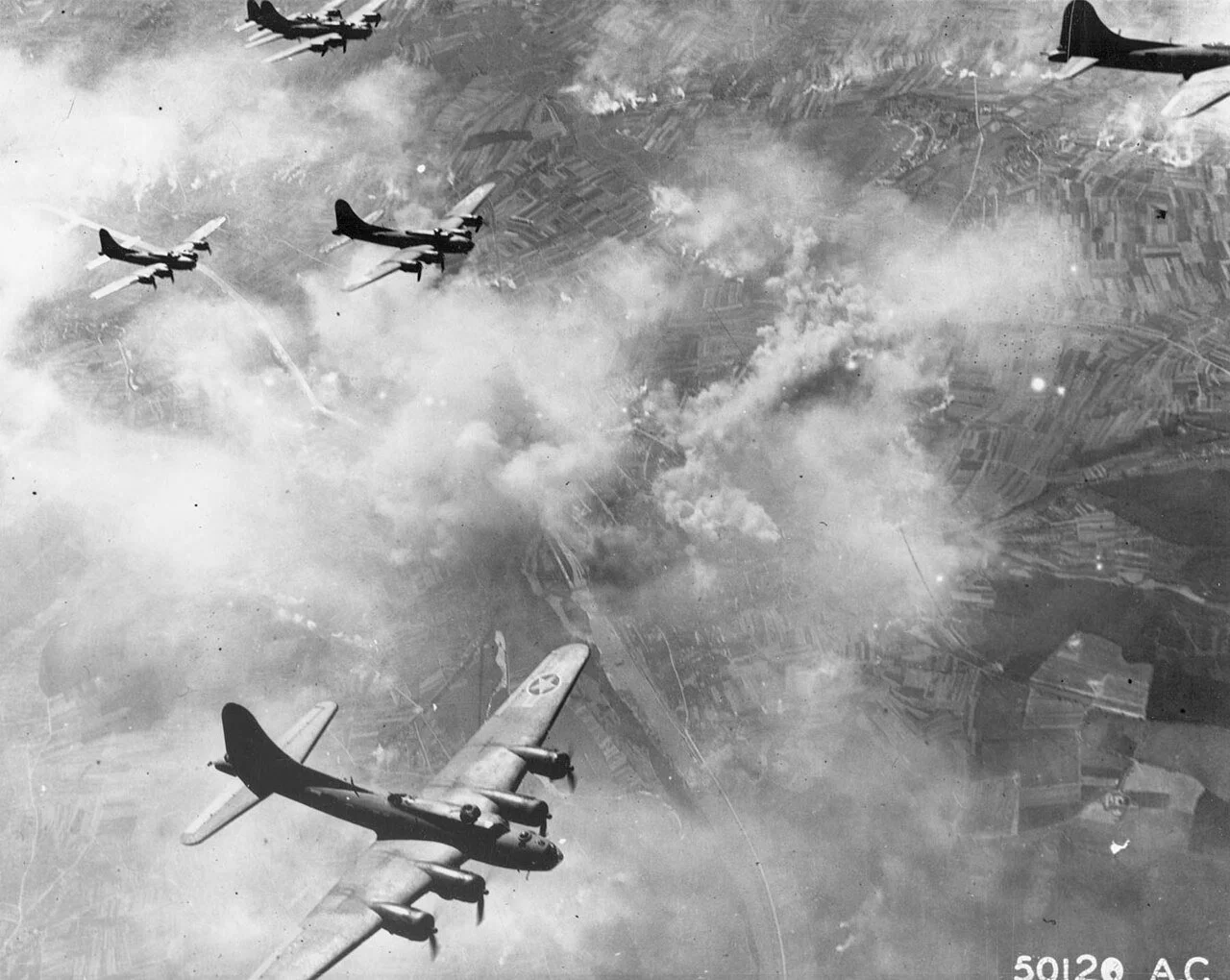
Boeing B-17 Flying Fortress formation. Schweinfurt, Germany - August, 17, 1943.
Boeing B-17 Flying Fortress formation. Schweinfurt, Germany - August 17, 1943.
The Challenge of Bringing Order to the Skies
From 1943 onward, the Eighth Air Force expanded its operations across East Anglia. Airfields were spread across Norfolk, Suffolk, and Cambridgeshire, and each one sent aircraft into the same busy morning sky. Every bomber had to find its place in a larger group, climb steadily, and keep to the timetable. Weather often interfered, and crews still adjusting to British conditions sometimes struggled to identify other aircraft in the haze.
The result was predictable. Aircraft sometimes climbed into the same airspace. Near misses were reported frequently. Several bombing missions suffered delays because the formations failed to gather quickly enough. Although ground control could guide departures, it could not solve the issue of identifying other aircraft in the air. Another solution was needed, one that crews could see without relying on radio contact or clear skies.
A Practical Innovation in a Growing Air War
The answer was the assembly ship. These were older bombers nearing the end of their combat life. Some had battle damage that made long missions impossible, while others had simply become worn. Instead of being scrapped immediately, many were converted into highly visible airborne rally points. Each bomb group had one, sometimes two, depending on operational needs.
The idea was straightforward. The assembly ship took off first and climbed into a holding pattern above its home base. Newer aircraft took off next and circled until they spotted the brightly painted machine overhead. Once enough aircraft had gathered, the assembly ship guided the formation into the correct climbing pattern and direction of travel. After completing the task, it returned to base. It did not cross the North Sea or accompany the mission toward its target.
This method saved time, reduced the risk of accidents, and helped maintain the tight formations required for mutual defense.
Color Schemes Designed to Be Impossible to Miss
The thing that makes assembly ships so memorable today is their appearance. Because they never flew into enemy territory, camouflage was unnecessary. Visibility became the priority. Groups across the Eighth Air Force began to develop their own designs, often with considerable imagination.
One aircraft might be painted bright yellow with red chevrons. Another might have wide black spots across a silver fuselage. Some had candy-striped tails. Others carried oversized geometric shapes or checkerboard patterns. A few used contrasting panels of green and white. The design language varied, but every scheme aimed at the same goal. Crews had to recognize the ship instantly, even in bad weather.
These color schemes created some of the most distinctive aircraft of the Second World War. They were not meant to impress the enemy or hide from it. They were meant for the airmen who needed to find their group quickly at dawn.
Conversions and Modifications
The aircraft chosen for this role were usually B-17s or B-24s. Each type required a fair amount of modification. Guns were removed, which reduced weight and made the aircraft easier to climb. Armor plate was often taken out for the same reason. Much of the interior was removed, along with equipment that was no longer needed. Lightening the aircraft made it easier for the assembly ship to get up early and remain overhead long enough for the rest of the group to form up.
Some groups gave their assembly ships names that embraced their unusual appearance. The 458th Bomb Group operated a B-24 known as “Spotted Cow”. Another group had “The Green Dragon”, painted in a vivid green finish with yellow markings. There were others, including “The Jolly Roger” and “Fightin’ Sam”. The names added a touch of character, but the paintwork did most of the talking.
Routine Work That Never Reached the Headlines
Assembly ships rarely appear in wartime newsreels or photographs. Their work was uneventful by design. They did not fly through flak or fighter attack. They were not part of the dramatic footage that accompanied raids on Berlin or the Ruhr. Yet their flights were essential. A large formation needed clarity and coordination. Without it, missions risked breakdown long before reaching the target.
Veterans often described the sense of relief that came with spotting the brightly colored aircraft circling above the base. In the low morning light, with engines warming and visibility uncertain, that visual cue gave crews a clear point of reference. They knew exactly where to go and how to start the long climb eastward.
Safety, Training, and an Air War Under Pressure
The arrival of assembly ships also made the morning departure routine noticeably safer. With so many aircraft circling the same patch of sky, the chance of a collision was never far from anyone’s mind. These brightly marked bombers gave crews an instant point of reference, which helped ease the congestion. They also became useful for newcomers. Pilots fresh from training in the United States often relied on them as they learned how to join and hold formation. It was an early step in understanding the discipline that large-scale operations demanded.
In addition, the system helped keep missions on schedule. The Eighth Air Force operated under strict timing. Multiple groups needed to cross the coast within narrow intervals. Delays could disrupt the larger plan. By ensuring orderly assembly at the start of each mission, these ships supported the wider strategic effort.
A Short Life and a Quiet End
When the war in Europe came to an end, most of these aircraft were taken apart or scrapped. Their bright paintwork, once an essential guide for dozens of aircrews, faded from the airfields almost overnight. Only a small number of photographs survived, tucked away in various archives and in a few private collections. They show a brief and unusual moment in the air war, when a practical need produced something unexpectedly creative.
Today, these aircraft give a modest but useful glimpse into a part of Allied operations that rarely comes up in broader accounts.
A Forgotten Chapter Worth Remembering
The story of the assembly ships shows how major military efforts depend on far more than the frontline aircraft that usually attract most of the attention in wartime histories. Yet the work done behind the scenes, whether through supporting aircraft, trial solutions, or improvised ideas, often proves just as important. The striking paint schemes on these older bombers might seem unusual today, but they grew out of the very real difficulties faced by crews trying to find one another in poor visibility. When an airman spotted one circling above the field, it was a clear sign that the day’s climb east was about to begin.
Their time in service was short, but the impression they left remains striking. Few wartime aircraft looked anything like them, and none were given the same specific job. In a campaign that relied on coordination and discipline, the assembly ships played a modest but essential part.
The site has been offering a wide variety of high-quality, free history content since 2012. If you’d like to say ‘thank you’ and help us with site running costs, please consider donating here.
References
Bowers, P. M. Boeing B 17 Flying Fortress. Smithsonian Institution Press, 1995.
Freeman, R. A. The Mighty Eighth. Arms and Armour Press, 1970.
Johnson, R. B 24 Liberator at War. Ian Allan Publishing, 1978.
Roeder, G. H. The Censored War. Yale University Press, 1993.
USAAF Eighth Air Force archival photographs and formation records, East Anglia, 1943–45.