
In Ancient Rome, life after dark became different. The streets were uneven, the vigils patrolled, and fire was very important. Here, William McGrath explains what happened in Ancient Rome at night.
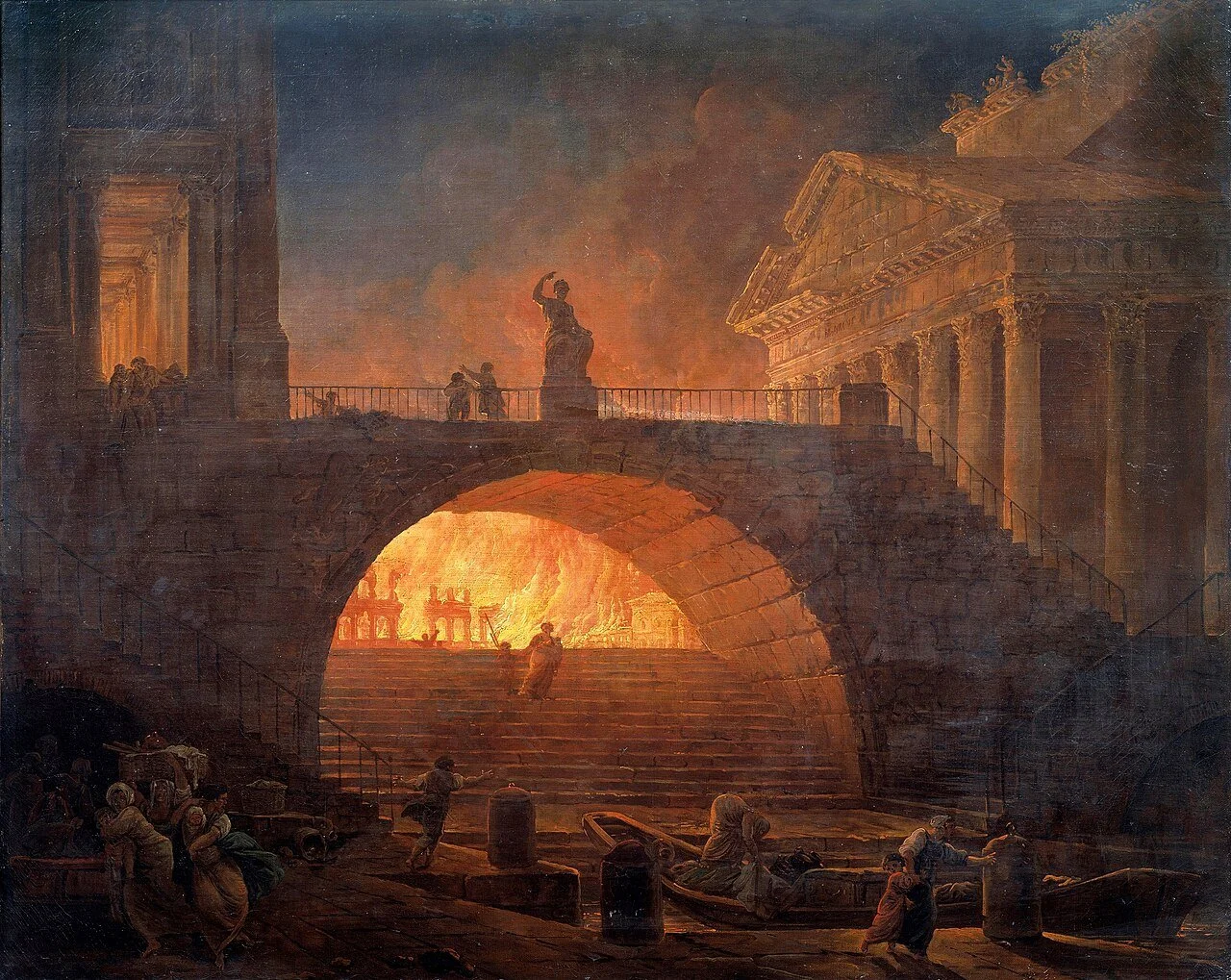
The Fire of Rome, 18 July 64 AD. By Hubert Robert.
A man steps into the street and pauses.
The light behind him fades quickly as the door closes. Ahead, the road is already swallowed by shadow. The stone beneath his feet still holds the day’s warmth, but the air has shifted. Rome is changing.
Darkness changes everything.
Street lighting is scarce and unreliable. Oil lamps flicker weakly in doorways and at intersections, leaving long stretches of street in dim shadow. The roads twist and narrow, forming blind corners and tight passages where sight is limited and sound becomes uncertain. Even familiar routes feel different once the light begins to fade.
The ground itself becomes a hazard.
The streets are uneven, worn by years of traffic. High kerbs rise sharply at the edges, designed to manage water and waste but easy to misjudge in low light. A single step taken too quickly can turn an ankle or send someone stumbling into the road. Movement requires care. Every step must be placed deliberately.
Most citizens avoid travelling at night unless they must.
Carts still move through the streets, taking advantage of quieter hours to transport goods. In the darkness, their approach is often heard before it is seen. The rumble of wheels, the creak of wood, the sharp command of a driver. Pedestrians press themselves against walls to let them pass, guided more by sound than sight.
Night sharpens the senses.
Footsteps echo more clearly between close walls. Voices drift from open windows above. A conversation half a street away can carry through the still air. Smell becomes stronger as the heat of the day fades. Damp stone, lingering waste, cooling ash from ovens that have only just gone quiet.
Yet the city does not sleep.
Life shifts inward. Families gather in lamplit rooms, their world shrinking to the space within the walls. Outside, taverns remain open in certain districts, their light spilling briefly onto the street each time a door opens. Deliveries continue. Movement persists, but it is reduced, cautious, contained.
Safety depends on watchfulness.
The vigiles move through the streets, their lanterns small but steady points of light. They patrol slowly, listening as much as looking. Their presence changes the atmosphere. Voices lower as they pass. Movement pauses. They bring order simply by being seen.
Fire is never far from thought.
In a city built so closely together, risk is constant. People do not need to see flame to imagine it. A smell, a sound, a sudden shout can turn stillness into alarm. At night, when sight is limited and reaction is slower, that fear feels closer.
The vigiles remain alert to it.
They watch the upper levels of buildings. They pause at doorways. They listen for anything out of place. Their patrol is not hurried, but it is deliberate. The city rests more easily because they are moving through it.
Night reshapes behavior.
Journeys are shortened. Movements are planned. People rely on memory. The feel of a wall beneath their hand. The distance between one doorway and the next. The familiar turn that leads home. Neighbors become more important. Awareness sharpens. Caution replaces ease.
For modern visitors, Rome feels safest under evening light, its streets glowing warmly against the dark. But in antiquity, night demanded respect. It narrowed the city, reduced certainty, and changed the rhythm of life.
Understanding this alters how we imagine the ancient world.
Rome was not endlessly open and active. It contracted after sunset. It became quieter, more intimate, more alert.
The people who lived there adapted instinctively. They learned to read sound, shadow, and scent. They trusted the slow movement of lanterns and the patterns of their surroundings. They allowed the night to shape their behavior rather than resist it.
In doing so, they revealed something deeply human. Cities have always shaped us as much as we shape them. Light and darkness govern not only what we see, but how we move, how we trust, and how we protect ourselves.
Ancient Rome after dark was not merely the absence of daylight. It was a different city entirely.
Did you find that piece interesting? If so, join us for free by clicking here.