The ratification of the United States Constitution was not a seamless process; rather, it was marked by intense political debate and differing ideologies. Federalists, led by Alexander Hamilton, James Madison, and John Jay, argued that a strong federal government was essential to preserve the newly formed republic and establish the United States' credibility abroad. On the opposing side, the Anti-Federalists, such as Patrick Henry and George Mason, feared that the Constitution would create a government distant from the American people and would fail to protect individual liberties. The conflicts between the Federalists and the Anti-Federalists would critically shape the Constitution and create certain rights within that would protect personal freedom to this day. Those arguments would demonstrate how conflict between two opposing sides would be essential to America's founding.
Caleb M. Brown explains.
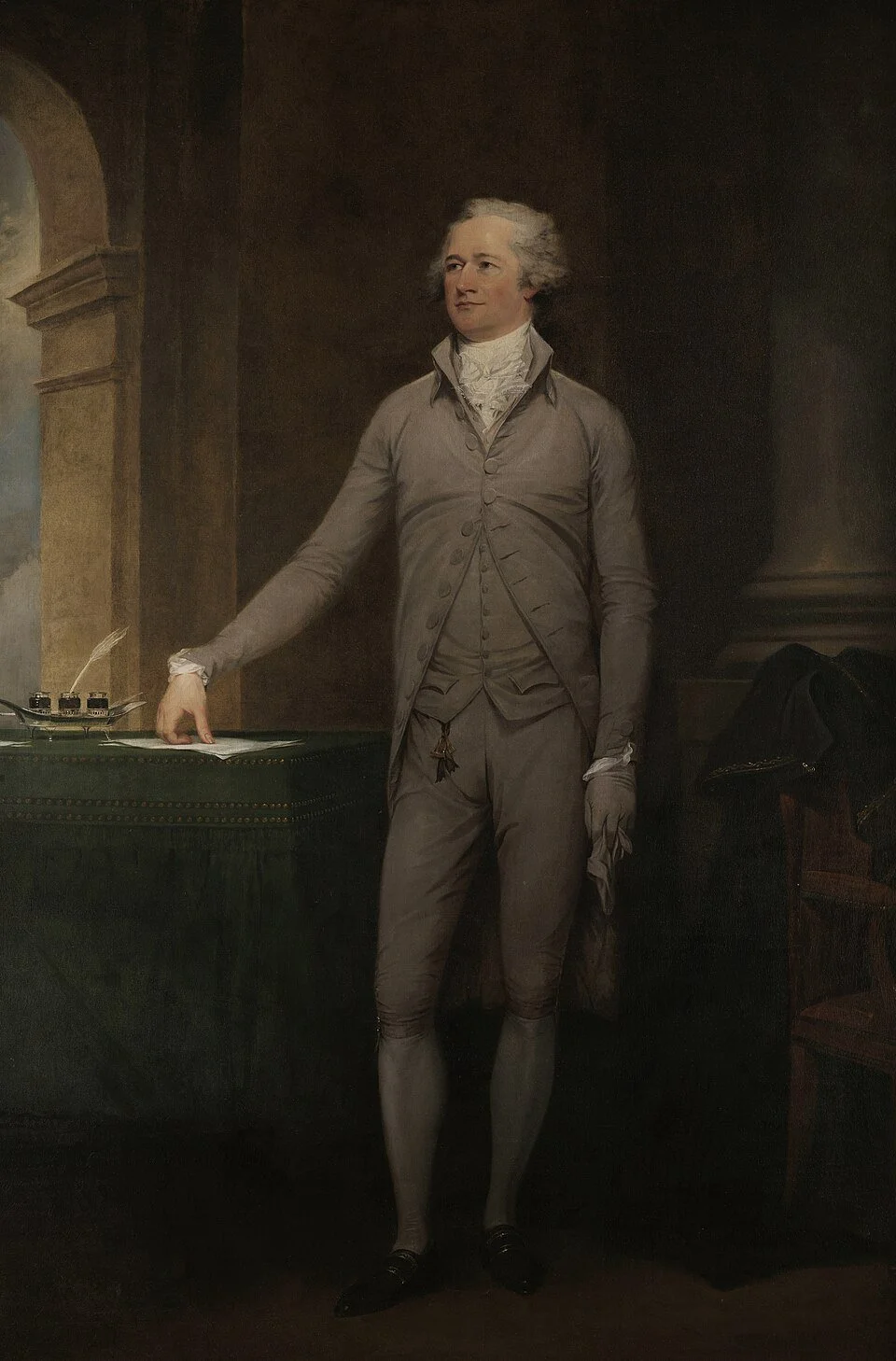
Alexander Hamilton. Painting by John Trumbull.
The Federalists viewed the Articles of Confederation as weak, and through these weaknesses, they recognized the necessity of a strong federal government. Hamilton, Madison, and Jay would pen the Federalist Papers. The Federalist Papers would articulate to the public the dangers of disunity and the need for a government that was capable of regulating commerce, maintaining defense, and ensuring public stability.[1] In Federalist No. 23, Hamilton emphasized that the nation's survival depended on a government with sufficient powers and the ability to respond to crises as they arose. In Federalist No. 10, Madison argued that a republic could better control factions than smaller state governments could.[2] The Federalists backed the claims by pointing to the Articles of Confederation's inability to raise revenue or to enforce treaties.
The Anti-Federalists, on the other hand, warned that the Constitution’s broad grants of power would take away liberties and empower rulers. In a speech at the Virginia Convention in 1788, Patrick Henry declared that the proposed government was “consolidated and not federal.” Henry saw that this posed a danger to state sovereignty and the rights of individual citizens.[3] Another Anti-Federalist, George Mason, refused to sign the Constitution because it lacked rights that protected specific freedoms, such as trial by jury and freedom of the press.[4] The Anti-Federalists feared that the executive branch would become too powerful, much like the monarch of England; the judiciary would be unaccountable, and Congress would overstep its authority.
Institutional questions
The debates between the Federalists and the Anti-Federalists primarily centered on institutional questions. Anti-Federalists worried that a president would essentially become too much like a king. The Federalists countered this argument in Federalist No. 69 by stating that the presidency had far too many restraints to become like a monarch.[5]The debate over congressional authority would spark a serious discussion. Federalists defended the “necessary and proper” clause as essential, while the Anti-Federalists condemned it as a blank check for what would become overreach. Lacking protections for individual liberties would be the Anti-Federalists’ most significant argument. Hamilton sought to alleviate concerns by demonstrating that a president could face impeachment and be removed from office, unlike a monarch, thereby establishing a system of checks and balances. A president could also face punishment for violating the law, which was quite different from that of a monarch. Anti-Federalists such as “Brutus” warned in 1787 that the “necessary and proper” clause would allow Congress to extend its authority into almost every aspect of government, reducing the states to “mere corporations”.[6] These different perspectives detail why the Bill of Rights became necessary.
It would be the Bill of Rights that would eventually lead to a final compromise between the Federalists and the Anti-Federalists. Several states, such as Massachusetts, Virginia, and New York, would not agree to ratify the new Constitution until the Federalists agreed to add amendments that would safeguard individual liberties.[7] After recognizing the necessity of the Bill of Rights, Madison drafted the amendments that Congress passed in 1789. In 1791, the Bill of Rights was adopted, and protections such as freedom of speech, religion, and the press were included in the Constitution.[8] Historian David Epstein noted that the Anti-Federalists, though defeated in ratification, “triumphed in securing the Constitution’s most popular feature.”[9] The insistence on protection against government abuse at the federal level ensured that liberty would remain a top priority in the United States. Scholars have highlighted the significance that this moment in history also played. Gordon Wood argues that the debates surrounding the Bill of Rights were not simply about certain liberties but about defining the meaning of American republicanism itself.[10] Wood saw the adoption of the first ten amendments as reflecting a more profound anxiety about concentrated power and demonstrated how the early republic sought to balance order with freedom.
Conclusion
In conclusion, the Federalists and the Anti-Federalists debates reveal the nature of our contested American founding and highlight the different ideological tensions that would shape the United States Constitution. Federalists such as Hamilton, Madison, and Jay argued in support of a strong federal government, believing it was necessary to maintain national unity, provide for defense, and foster economic stability. They believed that without authority, the union of the states risked deterioration. Anti-Federalists, such as Henry and Mason, thought that a strong federal government would threaten both liberties and state sovereignty. Fear of a strong national government becoming tyrannical, the Anti-Federalists insisted that the rights of the people be protected. The debate between the two factions would directly influence the structure of the new Constitution and ultimately lead to the adoption of the Bill of Rights. Guaranteeing freedoms such as freedom of speech, religion, and assembly, as well as protections against specific government actions, the Bill of Rights led to a compromise between the Federalists' desire for a stronger federal government and the protections the Anti-Federalists sought.[11] Scholars have noted that this compromise details how the American constitutional system was born through negotiations and careful balancing of competing ideals.[12]
Furthermore, the inclusion of the Bill of Rights demonstrated that the American Constitution was designed to be adaptable and to utilize arguments to transform conflict into a lasting institutional principle. The legacy of the Federalists and Anti-Federalists continues to define the United States today. Our Constitution continues to endure.
Did you find that piece interesting? If so, join us for free by clicking here.
Bibliography
Brutus. “Essay I,” October 18, 1787. In “The Anti-Federalist Papers and the Constitutional Convention Debates.” Edited by Ralph Ketcham. New York: Signet Classics, 2003.
Epstein, David F. “The Anti-Federalists and the Bill of Rights.” “Journal of American History 63, no. 2 (1976)”: 233–249.
Hamilton, Alexander. “Federalist No. 23.” In “The Federalist Papers”. Edited by Clinton Rossiter. New York: Penguin Books, 1961.
“Federalist No. 69.” In “The Federalist Papers.” Edited by Clinton Rossiter. New York: Penguin Books, 1961.
Hamilton, Alexander, James Madison, and John Jay. “The Federalist Papers.” Edited by Clinton Rossiter. New York: Penguin Books, 1961.
Henry, Patrick. “Speech Against the Constitution.” Virginia Ratifying Convention, June 5, 1788.
Levinson, Sanford. “Framing the Constitution: Federalists, Anti-Federalists, and the Bill of Rights.” New Haven: Yale University Press, 1987.
Madison, James. “Federalist No. 10.” In “The Federalist Papers.” Edited by Clinton Rossiter. New York: Penguin Books, 1961.
Mason, George. “Objections to the Constitution of Government of the United States of America.” 1787.
Rutland, Robert Allen. “The Birth of the Bill of Rights.” Chapel Hill: University of North Carolina Press, 1955.
United States Congress. “The Constitution of the United States”: A Transcription. National Archives. Last modified November 4, 2015. https://www.archives.gov/founding-docs/bill-of-rights.
Wood, Gordon S. Empire of Liberty: “A History of the Early Republic,” 1789–1815. Oxford: Oxford University Press, 2009.
[1] Alexander Hamilton, James Madison, and John Jay, The Federalist Papers, ed. Clinton Rossiter (New York: Penguin Books, 1961).
[2] Alexander Hamilton, “Federalist No. 23,” in The Federalist Papers, ed. Clinton Rossiter (New York: Penguin Books, 1961); James Madison, “Federalist No. 10,” in The Federalist Papers, ed. Clinton Rossiter (New York: Penguin Books, 1961).
[3] Patrick Henry, “Speech Against the Constitution,” Virginia Ratifying Convention, June 5, 1788.
[4] George Mason, “Objections to the Constitution of Government of the United States of America,” 1787.
[5] Alexander Hamilton, “Federalist No. 69,” in The Federalist Papers, ed. Clinton Rossiter (New York: Penguin Books, 1961)
[6] Brutus. “Essay I,” October 18, 1787. In The Anti-Federalist Papers and the Constitutional Convention Debates. Edited by Ralph Ketcham. New York: Signet Classics, 2003.
[7] Proceedings of the Massachusetts Ratifying Convention (1788); Proceedings of the Virginia Ratifying Convention (1788).
[8] United States Congress, The Constitution of the United States: A Transcription, National Archives, last modified November 4, 2015, https://www.archives.gov/founding-docs/bill-of-rights
[9] David F. Epstein, “The Anti-Federalists and the Bill of Rights,” Journal of American History 63, no. 2 (1976): 233–249
[10] Gordon S. Wood, Empire of Liberty: A History of the Early Republic, 1789–1815 (Oxford: Oxford University Press, 2009), 59.
[11] Robert Allen Rutland, The Birth of the Bill of Rights (Chapel Hill: University of North Carolina Press, 1955), 12–25.
[12] Sanford Levinson, Framing the Constitution: Federalists, Anti-Federalists, and the Bill of Rights (New Haven: Yale University Press, 1987), 45–60.