Texan independence was. Significant issue in the 19th century. Here, Fredrick Wolf looks at how it was  impacted by sovereignty and slavery. He also considers the role of the Alamo.
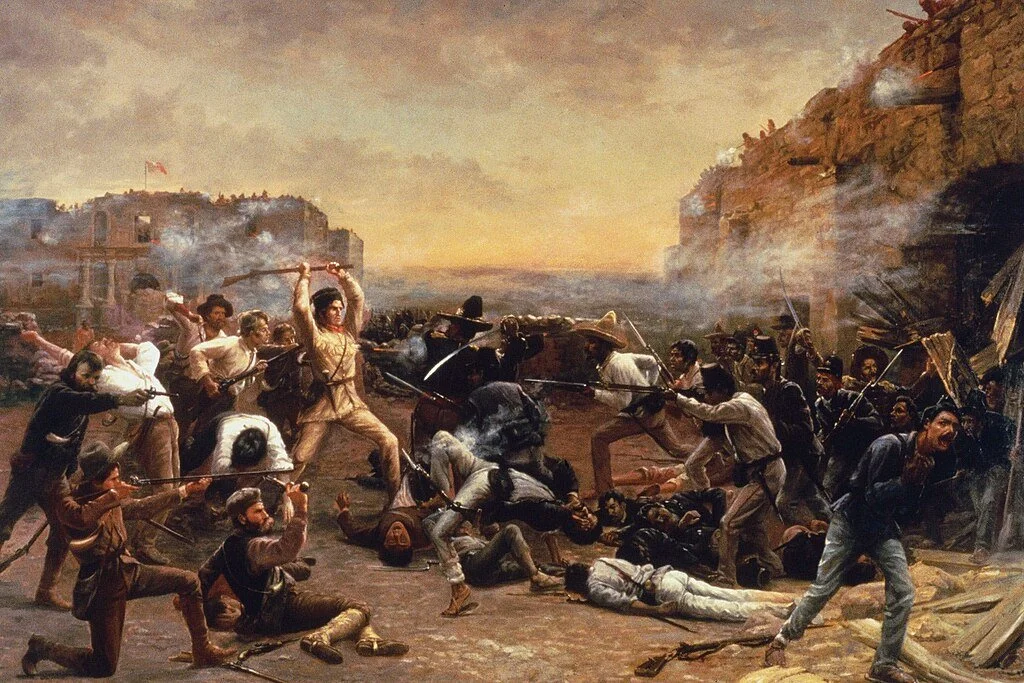
The Fall of the Alamo (1903) by Robert Jenkins Onderdonk.

“…the institution of slavery is neither an interest to be defended nor an outrage to be denounced, but merely a bygone state of things, through which – as through many another unfortunate conditions of society – the evolution of the human race has carried it; and we can therefore devote ourselves to the investigation of the subject with no prejudice except in favor of historic truth.”

–      Professor Justin H. Smith, The Annexation of Texas


The poster for the movie, The Alamo (1960), celebrates its history with the line, "The Mission That Became a Fortress…The Fortress That Became A Shrine….” The latter is a concise and accurate summary of the story of the structure, but not necessarily the events involved in what has famously become known as -- the Alamo – in downtown San Antonio, Texas.

Some historians believe slavery was the driving issue in the battle at the Alamo, arguing that Mexico’s attempts to end slavery contrasted with the hopes of many white settlers in Texas at the time who moved to the region to farm cotton. Renovations to the Alamo, itself, have recently been stalled due to political issues and discussions over the site’s legacy including the role of slavery in the Texas revolution.”

The rebellion in the northern states of Mexico, historically, has been attributed to a response to President Antonio López de Santa Anna repealing Mexico’s Constitution of 1824, abolishing the state governments and issuing autocratic decrees including the suspension of individual property rights.

This work takes the position of the aforementioned Professor Smith: It argues neither for nor against the institution of slavery being the premise behind the battle of the Alamo. It merely develops a reasoned structure of the era detailing the events, circumstances and status of slavery in Mexico from the first Texas colonization contracts to the Texas Revolution. The reader may then draw his or her own conclusion regarding slavery being a motivating cause behind the siege of the Alamo and the struggle for Texas’s Independence from Mexico.


Settlers in Tejas

When Moses Austin secured his first empresario contract to transport settlers to territory now known as Texas, the territory was the possession of Spain, and slavery was legal under Spanish law. The initial contract of 1821 made with the Spanish government made it clear that property rights of future colonists would be protected, including their right to hold slaves.

Agustín de Iturbide, a Mexican caudillo (military chieftain), became the leader of the conservative faction in the Mexican independence movement against Spain; as Agustín I, he briefly became the first emperor  of Mexico. The Iturbide government, of newly independent Mexico, reaffirmed in 1823 Moses Austin’s contract, with son, Stephen F. Austin as his lawful heir. This action secured the legal acquiescence of the Mexican national government to permit colonists and their slaves into the Mexican state of Coahuila y Tejas (Coahuila and Texas).


Issue of Slavery

The new Mexican Constitution of 1824 was vague on the issue of slavery, leaving the question to the individual states to determine how slavery would be dealt with. The law declared, generally, that Mexico would prohibit the importation of slaves, reflecting Mexico’s shift away from Spanish policies after gaining independence from Spain. But because the document left the issue of slavery to the states to decide, it was interpreted by Mexican legal authorities as only prohibiting the importation of slaves for resale. As a result, colonists in Texas, as well as native Mexican planters in southern Mexico, continued to import slaves for their own domestic use with the federal government making no effort to contravene such activity.


Coahuila y Tejas

The state of Coahuila y Tejas, officially the Estado Libre y Soberano de Coahuila y Tejas, was one of the constituent states of the newly established United Mexican States under its 1824 Constitution. The newly adopted state constitution of the state of Coahuila y Tejas allowed in 1827 for the importation of slaves from the U.S. for a period not to exceed six months after the document’s ratification. In September of that year, slaves could no longer be brought into Texas.

In May of 1828, the Congress of Coahuila y Tejas passed a law which made contracts of indentured servitude initiated in foreign countries valid within the state. This provided a means through which slaves could be brought into Texas by making them indentured servants for life. It should be noted that the distaste for slavery of many Mexican citizens and politicians was not necessarily due to a principled stand against the idea of slavery per se. It was, rather, the hereditary nature of slavery which was abhorrent to them. This law merely brought black servitude in Texas in line with the already existing form of servitude – the Mexican norm of debt peonage.


Slavery in Mexico

A legislative attempt to proscribe slavery within the country failed in the Mexican Congress in 1829. President Vicente Guerrero, second President of Mexico, and born of parents of African Mexican and Indian descent was granted sweeping powers to thwart Spain’s attempt to retake the country.

Jose Maria Tornel, the equivalent of the U.S. Speaker of the House of Representatives, influenced President Guerrero to use his newly granted emergency powers to abolish slavery in Mexico. But a little over two months later, the Governor of Coahuila y Tejas, Jose Maria Viesca, convinced the president to exempt Texas from the proscription. To be fair, it should be noted that even if the ban had taken effect in Texas, it would not have freed those already held under indentured servitude contracts.

Yet, at the time, events were changing rapidly in Mexico. In 1831, roughly eighteen months after Guerrero issued his decree banning slavery, it was annulled by the National Congress, along with most of the short-termed, late president’s emergency decrees. Slavery – involuntary servitude -- was once again the law of the land in all of Mexico. And it remained so until 1837, when the National Congress acted again, this time passing an emancipation bill – banning slavery -- nearly a year after Texas in 1836 had won its independence.


Debt Peonage

A few months after the National Congress had annulled Guerrero’s ban on slavery the state legislature of Coahuila y Tejas acted to limit indentured servitude contracts to ten years. But this did little to benefit those living under existing contracts; they still accumulated debt for food, clothing, housing, and medical care. The debt accrued such that it could never be satisfied and those under the contracts remained in debt to the holders of the contract – essentially -- in perpetuity.

This circumstance converted those under contract into debt peons at the end of their indenture terms. In other words, they were required to remain in service to the holders of the contract until those debts were paid, an eventuation nearly impossible. This was the system of servitude that was practiced throughout Mexico before and after Texas won its independence. It was not atypical for wealthy Mexican landowners to have thousands of debt peons in their service. And their treatment was much the same as slaves on American plantations. It should also be noted that the children of debt peons also accrued debts for their care while they were minors, making peonage functionally hereditary.

Such was the state of African bondage in Texas until independence was declared in 1836. The Texas Declaration of Independence, which lists all grievances set before the Mexican government, fails to mention slavery as a basis for redress.

Did Santa Anna march north to free the slaves, as one U.T. history professor has recently said? Or, was his intention to put down Federalist resistance in the northern Mexican states, of which Coahuila y Tejas was but one?

When Texas settlers rebelled in 1835, Santa Anna was quick to organize an expedition against them in defense of centralism. Texan colonists wanted to uphold federalism, a system that allowed for state sovereignty – freedom of choice. Santa Anna and several other Mexican politicians at the time advocated that a centralist government would better serve to unify their nation, after years of instability under federalism. A centralized authority, of course, could also sustain national privileges for the church and military, two special-interest groups that supported Santa Anna’s government.

As a parting remark, one point should be admitted into this commentary. The majority of Texas slaveholders were members of the Peace Party, an organization which lobbied against independence, at least until Mexican President Santa Anna made clear his intention to subdue them, by any means necessary, along with those of his perceived adversary -- the War Party.


The site has been offering a wide variety of high-quality, free history content since 2012. If you’d like to say ‘thank you’ and help us with site running costs, please consider donating here.


References

Costeloe, Michael. The Central Republic in Mexico, 1835-1846: Hombres de Bien in the Age of Santa Anna. Cambridge: Cambridge University Press, 1993.

Fowler, Will. “Santa Anna and His Legacy.” In Oxford Research Encyclopedia, Latin American History. New York, NY: Oxford University Press USA, 2015.

Fowler, Will. Santa Anna of Mexico. Lincoln: University of Nebraska Press, 2007.

Torget, Andrew J. Seeds of Empire: Cotton, Slavery, and the Transformation of the Texas Borderlands, 1800-1850. University of North Carolina Press, 2015.

Smith, Justin H. The Annexation of Texas. New York, NY: The Baker and Taylor Co., 1911.

Burrough, B. and Stanford, J. (2021, June 10). The Myth of Alamo Gets the History All Wrong. The Washington Post. The myth of Alamo gets the history all wrong - The Washington Post

Burrough, B. and Stanford, J. (2021, June 10). We’ve Been Telling the Alamo Story Wrong for Nearly 200 Years. Now It’s Time to Correct the Record. Time.com. It's Time to Correct the Myths About the Battle of Alamo | TIME

Hanna, J. (2025, October 24). The CEO of the Alamo's historic site has resigned after a top Texas Republican criticized her. Associated Press. https://www.yahoo.com/news/articles/ceo-alamos-historic-resigned-top-221630063.html

Webner, R. (2021, May 10). Alamo renovation gets stuck over arguments about slavery. The Texas Tribune. Alamo renovation gets stuck over arguments about slavery - The Texas Tribune

Moses Austin’s Spanish Empresario Contract. Texapedia.info. https://texapedia.info/1821-empresario-contract/

Barker, E. (2020, July 30). The History of Colonization in Texas: From Moses Austin to the National Colonization Law. Texas State Historical Association. Mexican Colonization Laws

McKay, S. (1994, December 1). The Constitution of 1824: Coahuila and Texas. Texas State Historical Association. Constitution of Coahuila and Texas

Coahuila y Tejas: The Mexican State Before Texas Independence. Texapedia.info. Coahuila y Tejas: The Mexican State Before Texas Independence

Joel. (2025, February 6). Rise of Debt Peonage in Mexico. Far Outliers. Rise of Debt Peonage in Mexico | Far Outliers

Anna, T. (Fall 2002). The Legacy of Vicente Guerrero, Mexico's First Black Indian President (review). Journal of Colonialism and Colonial History. Johns Hopkins University Press. Project MUSE - The Legacy of Vicente Guerrero, Mexico's First Black Indian President (review)

Blake, R. (2020, August 2). The Guerrero Decree: Abolishing Slavery in Mexico. Texas State Historical Association. Guerrero Decree

Mexico frees slaves. (2025, September 15). Texas State Historical Association. Texas History Lives Here | Texas State Historical Association

Indentured servitude. Wikipedia. https://en.wikipedia.org/wiki/Indentured_servitude

Barker, E. Pohl, J. (2025, May 21). The Texas Revolution: Key Events and Impact. Texas State Historical Association. Texas Revolution

Santa Anna and the Texas Revolution. Santa Anna's Role in the Texas Revolution

Dyreson, J. (1995, December 1). The Peace Party in Texas: A Historical Overview. Texas State Historical Association. https://www.tshaonline.org/handbook/entries/peace-party
Posted
AuthorGeorge Levrier-Jones

In Myths of the Civil War: The Fact, Fiction, and Science Behind the Civil War’s Most Told Stories, Professor Scott Hippensteel brings a unique perspective, applying science and skepticism to common claims about the rifled musket.

Here, Jeb Smith looks at the rifled musket.

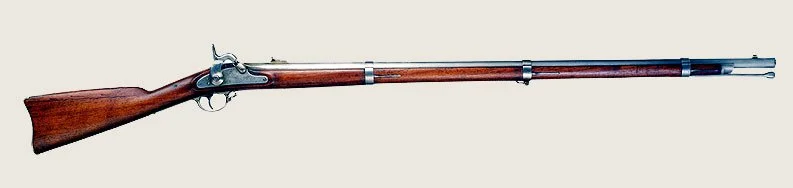
Springfield Model 1861 rifled musket.

Scott Hippensteel begins with “snipers,” pointing out that no such unit existed during the Civil War; the term and function came much later. Instead, those in the role were better described as sharpshooters and acted as skirmishers. He challenges the various claims of kills at 500 yards or greater, demonstrating some of the most famous supposed long-range killings to be inconceivable as actually happening, and suggesting they were in all likelihood from friendly fire, artillery shrapnel, or at best, from numerous skirmishers who would aim in a general direction and one happened to get lucky and strike an officer. He writes, “It was hopeless for a Civil War sharpshooter to aim at and attempt to kill a single specific officer at more than a few hundred yards; the exterior ballistics and accuracy of the available weapons made this task nearly impossible, regardless of the shooting talent of the soldier.”

Very few rifles were equipped with scopes, and fewer still were the trained individuals who could accurately hit a long-distance target even in training. Imperfections in powder, bullets, the rifle, the scope, and more made long-distance shots extraordinarily difficult. The weather, moisture in the air, wind (which can change the landing spot by a few feet even if VERY light), and other factors impacted long-range shots. Furthermore, the precision required to estimate the target’s distance and account for the bullet’s trajectory makes it unlikely that genuine long-distance kills occurred. Some sharpshooters needed to aim 14 feet above the target’s head and precisely measure the distance from hundreds of yards using old glass scopes that themselves impeded long-range shots. Hippensteel wrote, “Additionally, the front sight of these muzzleloaders was broader than any human-size target at five hundred yards. Between the required holdover and the width of the front sight, any view of the intended victim of the sharpshooter is completely obscured at this range.” To say it would be a shot in the dark is an understatement.


Conditions

Further, ideal conditions, perfect weather timing, etc., would not be the same as battle conditions with fog, smoke, and imperfect visibility. As a straight shot in the open was usually never beyond 125 yards, the eye could not accurately estimate a single target’s distance so as to calculate the trajectory for long-range shots. The enemy was rarely visible due to obscuring terrain, smoke and more at more than 100-150 yards.  Even under perfect conditions, with no human error, “perfectly aimed” shots still would often miss.

In addition, the number of steps that need to be done correctly to load the rifled musket, in the correct order, and the right way to fire a shot amid the noise, screams, adrenaline rush, shouting, smoke, confusion, fear, death and fatigue made getting off an accurate shot near-impossible and the performance in battle staggeringly poor. The best commanders could do with these citizen volunteers was often to maintain a steady fire aimed in the general direction of the opposing side, in order to cause enough damage to hold their position or push the others back over time, often due to the latter running out of ammo. After Gettysburg, 32-43% of the rifled muskets found were loaded with multiple bullets and discarded. Many soldiers whose gun malfunctioned picked up other random discarded ones, weapons they might never have fired before. Using ammo that was not meant for the new musket, that alone can cause mishaps.

Hippensteel conducted an in-depth analysis of weapons used in the U.S. military from 1770 to 2000, determining the “total firepower” and the overall killing ability, particularly in the range of up to 150 yards, the “killing zone” where the vast majority of kills occur. Evaluating bullet size, velocity, reload time, and other factors, he discovered that the lowest point occurred when the United States Army first adopted the rifled musket, and that the smoothbore actually puts out more firepower than the rifled musket. No wonder many commanders rejected the latter. Hippensteel wrote, “When the army adopted the rifled musket, the hitting power of the US infantrymen hit an all-time low. This seems strange for a weapon that was about to ‘revolutionize’ warfare…compared to its predecessor, the smoothbore musket, the rifled musket is 15-25 percent slower to load and has a muzzle velocity of only 950-1050 feet per second, compared with the 1,400-1,500 feet per second of the smoothbore.” Meaning that within the range of non-skirmishing Civil War combat, the smoothbore outperformed the rifled musket. Almost all fire occurred at under 200 yards, the enemy was often not visible beyond. And beyond 200 yards, special training was required to account for the low velocity of the weapon.


Differences

Noting the difference between what the rifled musket could do at distance in target practice vs in Civil War battles, he points out that because “Rifled muskets were much more precise …they could produce smaller groups (‘hits’ in target practice within a specific range or distance), because their rifling guided all the bullets to a more localized space downrange. However, this precision did not necessarily make the rifle more accurate in reality, the tight grouping might have been falling short (bullet has a high rate of drop) or long of the intended target because of the difficulty introduced by the parabolic flight path of the bullets.” He continues, “A precision weapon is only useful in combat if it is also accurate, and low muzzle velocity makes accuracy a challenge.” In other words, in actual combat, where you are not simply shooting at an unmoving target, your adjusted total accuracy equals out even if the rifle is more precise in practice. Unless you could allow for the difference, and the vast majority of soldiers could not, you lost the advantages.

In the end, smoothbore is similar overall to rifled for ranges of 75 yards and under, and is even preferred due to the lethality of buck and ball. At ranges of 250 yards or more, rifled is a waste of ammunition, so it is only between 75-250 yards where it has a hypothetical advantage for the typical soldier. But the smoke, terrain, and other effects of battle largely negated that, meaning that most commanders would not have their men fire until 100-150 yards, seeing shooting at longer distances as a waste of ammunition, or attempting to “shock” the enemy with a deadly volley from around 60 yards or under. So very little combat occurred at distances or under conditions to give the rifle musket an edge. Hippensteel summarizes “So the rifled musket had a limited advantage over the smoothbore on some battlegrounds, in some circumstances; it was, for example a better gun for skirmishers.”

Without machine guns or artillery, a company in Vietnam produced the same firepower as a Civil War corps. A brigade in WW1 did the same, also without artillery or machine guns. Further, modern weapons are smokeless and do not decrease visibility as black powder weapons did. The Civil War was not the first modern war. Hippensteel quotes Allen Guelzo: “Whatever the gains bestowed by the technology of the rifled musket…those improvements were only apparent under ideal conditions (which is to say, not in the middle of a firefight).” David Ward wrote, “The rifled musket did not revolutionize civil war operations because the weapon was not used at long range.” Further, diseases were the leading cause of death among Civil War soldiers, not what one considers “modern” weaponry.


Did you find that piece interesting? If so, join us for free by clicking here.

Peter the Great, one of the most notable Czars in Russian history and famous for opening Russia’s windows to the West, played a pivotal role in extending Russian borders further east into Siberia. Summoning a Danish Naval Officer in the service of Russia by the name of Vitus Bering, Czar Peter, in one of his final acts, ordered Bering to lead an expedition to the eastern extremity of the continent to the Kamchatka Peninsula in 1725. From there, Russia would move over to the American continent.

Brian Hughes explains.

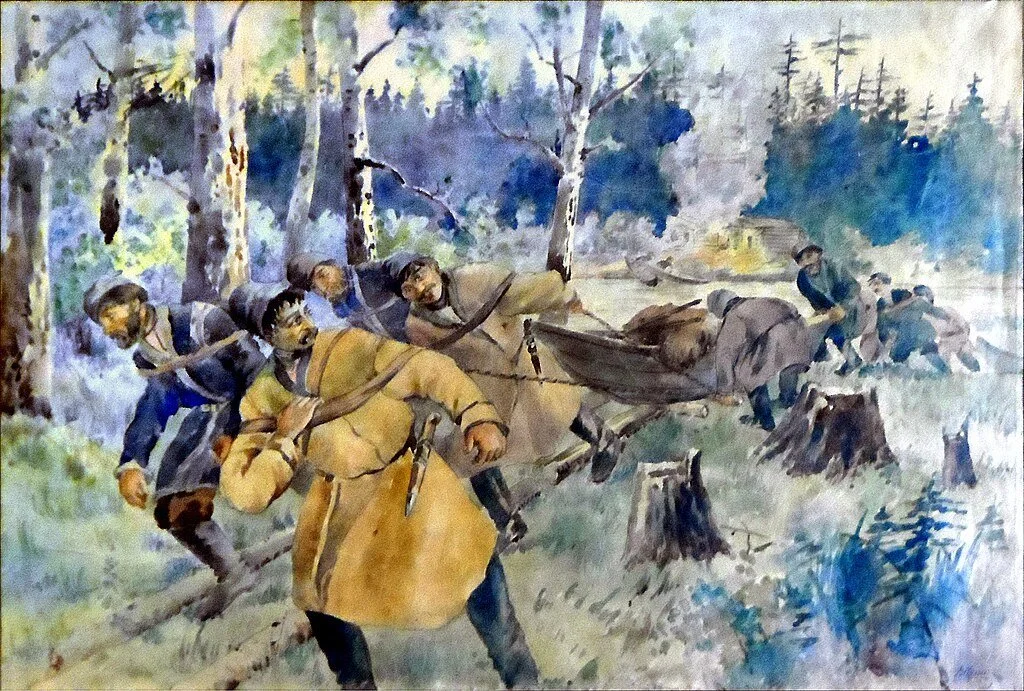
"Advancement of the Promyshlenniki to the East" by V.G. Vagner. Promyshlenniki translates approximately to hunter-trapper frontiersmen.

Back in 1725, it was unclear whether Czar Peter and Bering had prior knowledge that Asia and North America were not in fact connected, but the impetus for the exploration appears to have been a joint explorative/probing mission to determine how far west other European powers, especially Spain, had explored. After sailing into the sea which now bears his name, Bering initially failed to reach the North American mainland. It would be more than a decade before he embarked on a second expedition this time successfully reaching what is now Alaska in July 1741. Despite the impressive intrepidness and endurance made by the officers and men of the expedition the most immediate impact upon return to St. Petersburg was the procurement of rich furs, mainly sea otters. This later launched a gradual wave of highly enterprising traders, entrepreneurs and adventurers backed mostly by private or individual fortunes to tap into the fur rush, much like what the French and British had already been doing on the opposite side of the American continent.

Russian fur traders known as Promyshlenniki began to island hop eastward via Siberia and into the Alaskan mainland and broader Pacific Northwest. A relentless campaign ensued to harvest the highly sought after furs of sea otters, foxes, and various northern seals. Once one island/area was rapaciously depleted of furs the hunters and trappers merely moved on to the next and continued to exploit and slaughter. This had a horrific impact on the local native populace as they watched in horror and confusion as their abundant food and survival sources were destroyed and threatened with extinction.


1780s

By the 1780s the chaotic free for all operations of independently operating Promyshlenniki steadily gave way as six competing companies arose much like the Hudson’s Bay Company in British North America. Under such companies which were typically named for their founder(s) such as the Sheilikhov-Golikov Company. Competition would increase but took on a more organized fashion as the first permanent Russian settlements soon began to emerge because of coordinated and sustained trapping operations.

Despite some coordination and cooperation with the native populace, mainly Aleuts and Tlingits, relationships began to falter despite the pleadings and alleged interest in Native wellbeing of the distant and all too preoccupied monarch Catherine the Great. The all-too-common clash of cultures kept increasing in intensity and atrocities with several military encounters ensuing. The Natives never could gain a decisive edge given their lack of gunpowder and firearms and became fewer in number.

In 1808 the Russians relocated their erstwhile capital of Russia America from Kodiak Island to Sitka. There they took advantage of secure and deep harbors as they expanded their shipbuilding operations utilizing the abundance of timber in the surrounding area. Consolidating their regional monopoly the Russians virtually controlled much of the Pacific fur trade from the Aleutians to Northern California, providing lucrative furs and pelts to the markets in Asia and North America, even trading consistently with the newly created United States. Russian ships likewise began to sail further south into the Pacific laying anchor at places such as Easter Island and the Hawaiian Archipelago, all at the behest of the Czar who was determined that Russia remain a major player on the global geopolitical stage.


Mid Century

Russia would hold onto its outposts in Alaska ever so tenuously well into the mid-19th century as it faced consistently mounting pressure from the British and American who similarly coveted Alaska and the Pacific Northwest’s strategic and economic potential. The Russian attention eastward would wane however with the emphasis on southern extension into the Caucasus’s and Central Asia would pit Russia and Great Britain against one another in both hot and cold conflicts such as the Crimean War and the so-called Great Game.

In the 1850s, overhunting and trapping coupled with the bevy of conflicts abroad led to the Russian Empire devoting fewer men, material and resources to its outposts in the Pacific Northwest. Cognizant of Russia’s vulnerability from other European powers and prioritization of other regions the Czar decided to entertain and eventually approve a sale of Alaska to the United States in 1867 for the price of seven million dollars, roughly two cents per acre. Thus, ending the near century and a half legacy of Russian activity in North America. To this day the Orthodox Church is still a prominent institution in the now State of Alaska. A vestige harkening back to an often-overlooked chapter in American and Russian history.


Did you find that piece interesting? If so, join us for free by clicking here.

It seems intuitive that if someone is firing bullets at you, you seek cover, and if no tree or rock or fence is available, to build something protective to hide behind.  Yet, the U.S. Civil War was the first armed conflict in which extensive trenches were created. At the beginning, soldiers lined up and fired at those in the opposing line at point-blank range. But the death toll was outrageous; by the end of the war, picks and shovels became as much a part of fighting as artillery and guns.

Lloyd W Klein MD explains.

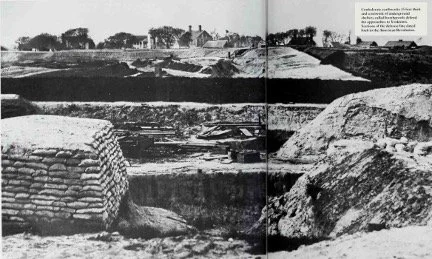
Entrenchments (also called field fortifications or earthworks) were widely used during the American Civil War,  becoming increasingly important as the war progressed.. Trench warfare was not as prevalent as in later conflicts. Except for sieges of fortified cities, combat in the past had been of short duration, major battles rarely lasting for more than a day. Early in the Civil War, we don’t see entrenchments at places like Manassas, Shiloh, or Antietam. While fighting behind stone walls and other make-shift barriers was resorted to at various locations, such as Gettysburg, the concept of “digging in” wasn’t prevalent until much later. Nevertheless, the development of trench warfare tactics in the Civil War foreshadowed their extensive use in future conflicts.

In discussing entrenchments, therefore, we are not talking about pre-existing stone walls (e.g., Marye’s Heights at Fredericksburg) or terrain features (e.g., the Sunken Road at Antietam or Little Round Top at Gettysburg). A "trench" is a deep, long ditch dug into the ground to provide shelter for soldiers from enemy fire, while a "breastwork" is a temporary fortification typically made of earth, built up to chest height, allowing soldiers to fire over it while remaining partially protected from enemy fire; essentially, a breastwork is a more shallow, elevated defensive structure compared to a trench which is a deeper, dug-out ditch. Trenches are significantly deeper than breastworks, often allowing soldiers to stand upright within them. Trenches are dug into the ground, while breastworks are often built up from loose earth or sandbags, sometimes on top of a shallow ditch. While both offer protection, trenches generally provide better cover against heavy artillery and gunfire due to their depth.


Trench Construction

The construction of trenches during the Civil War was a labor-intensive process that required organization, manpower, and tools. Commanders would first decide on the location and layout of the trench system. This planning involved selecting high ground when possible, avoiding natural obstacles, and creating a network that provided defensive depth and coverage. Engineer officers would generally plan and supervise.  Engineer regiments would assist, if available, but they were limited in number.  Most of the work was performed by detailed infantry, perhaps assisted by black labor, free or enslaved, depending on which side.

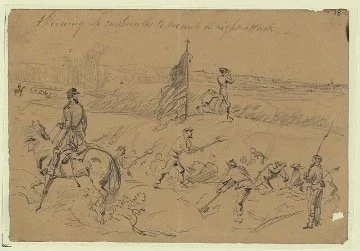
Soldiers would begin digging the main trench line, typically starting with a shallow trench and gradually deepening it. The soil removed was piled up to create a parapet (a protective wall) in front of the trench to provide additional cover and protection.

Proper drainage was essential to prevent water from accumulating in the trenches. Soldiers would dig drainage ditches and sometimes line the trench floor with wooden planks (duckboards) to keep it dry and prevent mud.

Trenches were often camouflaged to blend in with the surrounding terrain and reduce their visibility to the enemy. Soldiers would use natural vegetation, earth, and other materials to disguise their positions.

“Saps" would be dug forward from an existing trench line, and the new trench extended laterally from there. In addition to the main front-line trenches, support trenches were dug behind the front lines to serve as secondary defensive positions, supply routes, and communication lines. These trenches were connected by communication trenches, which allowed safe movement of troops and supplies between different parts of the trench system..


A typical rifle trench or field fortification included several features.

·       Parapet: The mound of earth in front, created from the soil dug from the trench. Protected soldiers from enemy fire.

·       Firing step (banquette): A raised step inside the trench allowing soldiers to stand and fire over the parapet.

·       Ditch: The trench itself, usually 4–6 feet deep and wide enough to allow movement.

·       Revetments: Logs, planks, gabions (cylindrical baskets filled with dirt), or sod used to reinforce trench walls.

·       Traverses: Earth barriers placed at intervals inside the trench to reduce the impact of enfilading fire.

Additional features of a sophisticated trench system might include:

·       Bombproofs: Underground shelters made with logs and dirt to protect from artillery.

·       Artillery platforms: Raised areas behind the main trench where cannons were mounted.

·       Communication trenches: Smaller connecting trenches used to move troops and supplies safely.

The construction process was continuous, with soldiers constantly improving and expanding their trench networks to adapt to the evolving battlefield conditions. The resulting trench systems could become extensive and complex, providing significant defensive advantages in the static, attritional warfare that characterized the later stages of the Civil War.

The area surrounding Corinth, Mississippi, was fortified heavily by the Union and Confederate forces who struggled to control the strategically important town. Today, those earthworks are some of the best-preserved in the country. Halleck conceived of Corinth as a quasi-siege, and the concept of building ever-closer lines was a siege stratagem.

Fortifications were made from mounded soil, baskets, timber, and even bales of cotton were very effective. Earth and sod were the primary materials, because they absorbed bullets and shell fragments better than wood or stone. Gabions (wicker baskets filled with earth) were used to reinforce the trenches. To prevent the trench walls from collapsing, soldiers reinforced them with logs, planks, or other materials. In some cases, trenches were lined with sandbags or gabions to stabilize the walls and absorb enemy fire. Trenches were often supplemented with additional fortifications such as earthworks, redoubts (enclosed defensive structures), and gun emplacements. Obstacles like abatis (felled trees with sharpened branches), wire entanglements, and chevaux-de-frise (spiked barriers) were placed in front of the trenches to hinder enemy assaults.

A  variety of tools were used to dig trenches, including shovels, picks, axes, spades, and occasionally makeshift tools. Soldiers themselves did the digging early on. Over time, both the Union and Confederate armies developed engineering units to supervise and speed up construction.


Increasing Utilization During the War

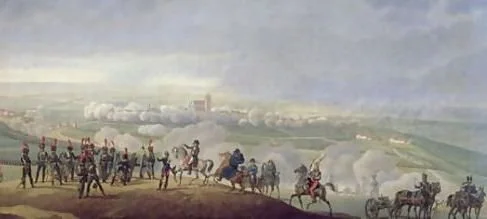
The underlying reasons for their increasing popularity as the war continued were improved technology, which had intensified firepower, and crippling deficiencies in communication, which technology had not yet solved. Field entrenchments were a response to progress in weapons technology. Rifle muskets, deadly accurate at several hundred yards, and close-order field artillery made previous battle tactics obsolete. The earthworks were designed to protect troops against this increased firepower. When McClellan advanced from Yorktown in the direction of Richmond, his progress was slowed by an outnumbered Confederate rearguard, which gave ground only grudgingly on a wide front. This was possible because no longer did men need to be packed into tight ranks in order to generate sufficient volume of fire to maintain their position against assault. Reciprocally, the thinning out of ranks made them less vulnerable to incoming fire. Such gams were ameliorated further when men took to lying down to shoot or, better still, made a point of firing from trenches or behind cover instead of standing up in the open, as in Napoleonic Wars or other European conflicts. As had been shown in the Crimea and at Solferino, head-on assaults against a well-emplaced enemy were no longer profitable operations of war. Even less viable was cavalry against modern artillery and rifle fire. Although neither army was yet able to apply the full devastating potential of modern weapons, and many old, muzzle-loading rifles were still in service, the Sharps and Spencer rifles were coming into use.


Early War Use (1861–1862)

At the beginning of the war, both Union and Confederate commanders favored offensive tactics and quick, decisive battles. There was a general belief that the war would be short, and both sides sought to achieve swift victories through aggressive maneuvers and direct engagements.

Many of the early commanders and soldiers lacked experience in modern warfare and did not initially appreciate the defensive advantages that entrenchments could provide. They were more accustomed to traditional Napoleonic tactics, which emphasized open-field battles and charges. Early in the war, entrenchments were used sparingly, mainly around forts, strategic river crossings, or defensive cities. The full impact of rifled muskets and artillery was not yet fully understood. As the war progressed, the increased range and accuracy of these weapons made entrenched positions more valuable for defense. Initially, commanders did not see the necessity for extensive fortifications.

At first, the strategic use of trenches was more limited and often makeshift. Trenches were used mainly for protection rather than extended combat. Building extensive entrenchments required significant time, labor, and resources. Early in the war, armies were more mobile and focused on quick movements and engagements rather than static defenses. There was also a psychological aspect to avoiding entrenchments. Many soldiers and commanders viewed digging in as a sign of weakness or lack of courage. They believed that bold offensive actions were more honorable and likely to bring victory.

However, battlefields like Yorktown (Peninsula Campaign, 1862) saw early use of extensive trenches by both Confederate and Union forces. When McClellan advanced from Yorktown in the direction of Richmond, his progress was slowed by an outnumbered Confederate rearguard, which gave ground only grudgingly on a wide front. This was possible because no longer did men need to be packed into tight ranks in order to generate sufficient volume of fire to maintain their position against assault. Reciprocally, the thinning out of ranks made them less vulnerable to incoming fire. Such gams were ameliorated further when men took to lying down to shoot or, better still, made a point of firing from trenches or behind cover instead of standing up in the open.

Battles like Antietam and Shiloh showed that lining up and firing wasn’t a winning tactic. As the war progressed and the brutal realities of modern warfare became apparent, the use of entrenchments increased significantly. The high casualties from direct assaults and the effectiveness of defensive positions in battles like Fredericksburg and Gettysburg led to a greater emphasis on fortifications. By the later stages of the war, trench warfare had become a common feature, culminating in the protracted sieges of Petersburg and other battles. By the end of the war, trench warfare had become the dominant mode of combat. The Union had some success with a new alignment of attacking forces at Spotsylvania Courthouse but in general, it became about how to deal with an entrenched enemy.


Shift to Entrenched Warfare (1863–1864)

Entrenchments became far more common as the war continued. Experience on many battlefields taught generals and soldiers that rifled muskets and artillery made frontal assaults deadly. The increased firepower and longer campaigns took their toll;  armies began digging in to protect themselves during sieges or static operations. Increasingly, it was the best defensive strategy, especially for Rebel armies. Confederates, often outnumbered, used trenches to hold ground more effectively.


Key Examples of Entrenchments

Battle of Vicksburg (May-July 1863): The Siege of Vicksburg involved extensive entrenchments by both Union and Confederate forces. The Union Army, under General Ulysses S. Grant, besieged the city, and Confederate defenders used fortifications to hold off the attackers for over 40 days before surrendering. The fall of Vicksburg was a turning point in the war, giving the Union control of the Mississippi River.


Chattanooga (1863) – Confederates entrenched on Lookout Mountain and Missionary Ridge.

Overland Campaign (1864) –

The Battle of Spotsylvania Court House (May 8-21, 1864) is another significant example where entrenchments played a crucial role. During this battle, which was part of the Overland Campaign, both Union and Confederate forces used extensive entrenchments. The most famous segment of the battle occurred at the "Bloody Angle," a section of the Confederate defensive works. At Spotsylvania, the unique earthworks straddled a ravine located on a hillside that ascends 12 feet over 30 yards. The defense was composed of three sets of trenches. The main line of trenches was composed of 11 steps with a traverse trench running along the side. The traverse trench connected all of the steps leading to the top of the hill. The other sets of trenches, just to the west of the main line, are constructed in the same fashion, but were significantly smaller than those along the mainline. Needless to say, this design was unlike any other fortifications in the Civil War.

Battle of Cold Harbor (May-June 1864): Confederate forces under General Lee were heavily entrenched, and Union forces led by General Grant suffered severe casualties in frontal assaults. The entrenched positions contributed to one of the war's most lopsided battles in terms of casualties. Union troops faced massive casualties assaulting well-dug Confederate lines.

Battle of Petersburg (June 1864-April 1865 – Perhaps the most significant use of trench warfare in the war. A 9-month siege with 30+ miles of trenches anticipated WWI-style warfare. Both sides built elaborate networks of trenches and fortifications. The Union forces, led by General Grant, eventually broke through the Confederate lines, leading to the fall of Richmond and the end of the war. Grant kept trying to swing around Lee's right and left flanks during the siege of Richmond and Petersburg. This eventually forced Lee to abandon his lines because he could not sufficiently man the ever-expanding defensive line that Grant imposed on him. Once dislodged, Grant turned Sheridan loose to cut off Lee's move west while the bulk of his army pushed in on Lee.


Petersburg

The most advanced form of trench warfare was observed in the Petersburg campaign in 1864. The defense of Petersburg by General Pierre Gustave Toutant Beauregard is often regarded as both bold and brilliant. He counterattacked Grant’s forward forces periodically to delude the Union army into believing his thinly spread force was much stronger. Meanwhile, he had his engineers building trenches, so that after 3 days, he was able to fall back into a defendable position. One quick determined rush by a Corps on 15th June 1864 might well have broken through. I can never understand why a man of Beauregard’s genius could not find a more central role in the Confederate army.

By June 18th, the trenches were so sophisticated that an army of 65,000 was insufficient to overcome the 40,000 men Lee had rushed to the spot by rail. Faced at first by an improvised line, the initial Federal assault failed from lack of co-ordination. Detachments advanced independently, inadequately supported by artillery, and were pinned to the ground by fire of only moderate intensity. By the time a set-piece attack could be launched on the 18th, the volume of defensive fire was annihilating, compelling Grant to call a halt and commence probing the city’s southern flank with a view to isolating it.

Keeping pace with each Federal sidestep to their left, the Confederates extended their entrenchment to their right, always in time to meet each assault while fiercely contesting Grant’s further attempts to cut the railroad line to Richmond or the one running westward from Petersburg. Assault was usually of the battering-ram sort – a blasting of the selected point of attack by artillery and mortars (the latter, with their plunging fire, being particularly suitable for striking at the deeper enemy emplacements) followed by a massed infantry charge.

Petersburg is the first instance of the use by the Union Army of the rapid-fire gun, the important precursor to modern-day machine guns. Twelve of the guns were purchased personally by Union commanders. The Gatling gun was a rapid-firing multiple-barrel firearm invented in 1861 by Richard Jordan Gatling. The Gatling gun's operation centered on a cyclic multi-barrel design which featured multiple rotating barrels powered by a hand crank, capable of firing several hundred rounds per minute. This design facilitated cooling and synchronized the firing-reloading sequence. As the hand wheel was cranked, the barrels rotated, and each barrel sequentially loaded a single cartridge from a top mounted magazine, firing the shot when it reached a set position (usually at 4 o'clock), then ejects the spent casing out of the left side at the bottom, after which the barrel is empty and allowed to cool until rotated back to the top position and gravity-fed another new round. This configuration eliminated the need for a single reciprocating bolt design and allowed higher rates of fire to be achieved without the barrels overheating quickly.


The Dimmock Line

The Dimmock Line was a series of Confederate defensive earthworks constructed to protect Petersburg. It was named after Captain Charles H. Dimmock, a Confederate engineer who designed it in 1862. Its length was 10 miles, forming a semicircle around the eastern and southern approaches to Petersburg, and incorporated 55 numbered artillery redans (small forts) connected by infantry trenches with both flanks anchored on the Appomattox River. It was built by enslaved laborers and Confederate soldiers. The Dimmock Line was initially effective in delaying Union forces during the early days of the siege, but Grant’s forces eventually extended around the line. Union troops finally attacked Petersburg directly, and elements of the Dimmock Line fell in mid-June 1864, which began the Petersburg Campaign. The Dimmock Line is historically significant as one of the earliest large-scale uses of entrenched field defenses in modern warfare, showing the transition from open battle to static, fortified lines.


Battle of the Crater

Digging a tunnel under the trenches and blowing it up seems like the most obvious and simple thing in the world. One of the most notable examples is the Battle of the Crater during the Siege of Petersburg (July 30, 1864). The mine built under the Confederate Lines at the Battle of the Crater was anything but simple. Although Grant and Meade were aware of its construction, neither expected any tactical benefit and seemed to have lost interest in it.

The Attack at the Redoubt at Petersburg on July 30th is the “correct” name of what is known as the Battle of the Crater. A mine containing four tons of black powder was detonated beneath the redoubt and its defenders. Placed in a cross shaft at the end of a 511-foot tunnel that a regiment of coal miners secretly dug, it was blown at dawn without warning to the enemy. General Ambrose Burnside, whose four divisions of infantry were to exploit the explosion, seems to have relied too much upon the shock effect of the mine; beyond doubt, the measures he took to ensure that the troops not only occupied the crater but pressed on rapidly beyond were ambiguous and unambitious. As for the troops, so staggered were they by the enormity of the explosion, the air pressure of its blast and the scene of carnage which met their eyes when they poured into the crater, that they lost all sense of purpose and stayed there all morning, poking about among the grisly ruins of dismembered men and equipment.

Lt. Col. Henry Pleasants originated the concept, commanding the 48th Pennsylvania Infantry of Major General Ambrose E. Burnside's IX Corps, Pleasants, a mining engineer from Pennsylvania in civilian life, proposed digging a long mine shaft under the Confederate Army lines and planting explosive charges directly underneath a fort (Elliott's Salient) in the middle of the Confederate First Corps line. If successful, not only would all the defenders in the area be killed, but also a hole in the Confederate defenses would be opened. If enough Union troops filled the breach quickly enough and drove into the Confederate rear area, the Confederates would not be able to muster enough force to drive them out, and Petersburg might fall.

Union forces, under the command of General Ambrose Burnside, devised a plan to break the Confederate lines at Petersburg by digging a mine underneath the Confederate fortifications. A regiment of Pennsylvania coal miners was tasked with digging the tunnel, which extended over 500 feet to a point beneath the Confederate defenses. Burnside, whose reputation had suffered from his 1862 defeat at the Battle of Fredericksburg and his poor performance earlier that year at the Battle of Spotsylvania Court House, was looking for a way to improve his military reputation.

The tunnel ran 510.8 feet. The shaft was dug with an upward incline to ensure water drainage. One-third of the way, the miners struck a vein of unworkable stone, so they further increased the slope to avoid it. Fresh air was drawn in by an ingenious air-exchange mechanism near the entrance. A canvas partition isolated the miners' air supply from outside air and allowed miners to enter and exit the work area easily. The miners had constructed a vertical exhaust shaft located well behind Union lines. At the vertical shaft's base, a fire was kept continuously burning. A wooden duct ran the entire length of the tunnel and protruded into the outside air. The fire heated stale air inside of the tunnel, drawing it up the exhaust shaft and out of the mine by the chimney effect. The resulting vacuum then sucked fresh air in from the mine entrance via the wooden duct, which carried it down the length of the tunnel to the place in which the miners were working. That avoided the need for additional ventilation shafts, which could have been observed by the enemy, and it also easily disguised the diggers' progress.

Lee had intelligence of my construction but made no reaction for 2 weeks. Finally, he initiated some minimal attempts to identify its location, but never did. Shafts were sunk but never found.


The mine was “T” shaped. Its entrance was narrow and 50 feet below the Confederate line. At the end was a 75-foot perpendicular shaft into which the explosives were placed.

Union soldiers filled the mine with 320 kegs of black (gun) powder, totaling 8,000 pounds. The explosives were approximately 20 feet under the Confederate works, and the T-gap was packed shut with 11 feet of earth in the side galleries. A further 32 feet of packed earth was placed in the main gallery to prevent the explosion from blasting out the mouth of the mine.

The mine was detonated on the morning of July 30, 1864. The explosion created a massive crater, killing or wounding hundreds of Confederate soldiers and creating a breach in their lines. Despite the initial success of the explosion, the follow-up assault by Union troops was poorly executed. Confusion, miscommunication, and ineffective leadership led to a chaotic and ultimately failed attack. Confederate forces regrouped and launched counterattacks, inflicting heavy casualties on the Union troops who had entered the crater. The Union assault ended in disaster, and the Confederate lines held.


The reasons for the limited Use of mines included:

·       Technical Challenges: Digging mines required specialized skills and knowledge, which were not always available in sufficient quantities. The process was labor-intensive and time-consuming, making it difficult to employ on a large scale.

·       Strategic Focus: Early in the war, both sides focused on traditional offensive and defensive tactics rather than siege warfare. As the war progressed and trench warfare became more common, the use of mining techniques increased, but it never reached the scale seen in World War I.

·       Resource Constraints: Mining operations required significant resources, including labor, explosives, and time. Both Union and Confederate forces often faced logistical challenges that limited their ability to conduct large-scale mining operations.

·       Effectiveness: While mines could create breaches in enemy lines, the effectiveness of such tactics depended on the ability to exploit the breach quickly and effectively. As seen in the Battle of the Crater, poor execution of follow-up attacks could negate the initial success of the mine explosion.


Overall, while mines were used during the Civil War, their employment was limited by technical, logistical, and strategic factors. The Battle of the Crater stands out as a significant example of mining in the Civil War, highlighting both the potential and the challenges of this tactic.


Impact and Legacy

Entrenchments slowed campaigns, turning mobile warfare into grinding, attritional battles.

They foreshadowed trench warfare in World War I, especially the siege at Petersburg.

They reflected how military technology had advanced faster than tactics, forcing adaptation.


The site has been offering a wide variety of high-quality, free history content since 2012. If you’d like to say ‘thank you’ and help us with site running costs, please consider donating here.


Further Reading

·       https://gettysburgcompiler.org/2020/12/09/unsolved-mystery-of-the-galleries-sixth-corps-trenches-at-spotsylvania-court-house/

·       https://www.thecanadianencyclopedia.ca/en/article/trench-warfare

·       http://www.petersburgproject.org/trench-warfare-in-civil-war-history.html

·       https://www.battlefields.org/learn/articles/something-new-art-war-civil-war-earthworks-and-trenches

·       https://weaponsandwarfare.com/2019/01/08/trench-warfare-in-the-american-civil-war/

One of the most vital statistics to discover regarding contributions to the U.S. Civil War effort by states is the total number of troops each state provided. From that, Jeb Smith looks at the importance of Virginia to the Civil War.

General William Tecumseh Sherman.

Finding statistics for each Confederate state regarding troop numbers is an uncertain and inconclusive process, with wildly varying estimates encountered; a situation not helped by Confederate forces’ destruction of records prior to the fall of Richmond. However, according to historian James M. McPherson in his book For Cause and Comrades, the following statistics represent the percentage contribution of each state[1] to the total forces of the Confederacy:

N. Carolina 15%

S. Carolina 6%

Virginia 14%

Texas 6%

Tennessee 12%

Kentucky 5%

Georgia 11%

Arkansas 3%

Alabama 9%

Missouri 3%

Mississippi 7%

Florida 2%

Louisiana 6%

Maryland 2%


However, according to Randolph H. McKim in his book The Numerical Strength of the Confederate Army, contemporary figures (of which he is highly skeptical, considering them wildly inflated) placed Virginia as the leader providing 175,000 troops, followed by North Carolina with 129,000, Tennessee at 115,000, Georgia 120,000, Alabama 90,000, South Carolina 75,000, Mississippi 70,000, and Florida 15,000. And according to the website Civil War Talk, the following is the number of troops supplied to the Confederacy by each state, with Virginia leading the way:

Virginia 160,875

S. Carolina 76,783

Tennessee 141,728

Louisiana 69,840

Georgia 135,774

Arkansas 58,000

Alabama 106,803

Missouri 39,750

N. Carolina 103,145

Kentucky 28,038

Mississippi 95,301

Florida 17,535

Texas 86,702    

Maryland 3,324


And the National Park Service’s (inflated but never corrected) numbers put Virginia as the leader at 282,432, followed by Tennessee at 277,183, Georgia at 244,142, and North Carolina at 202,009.

If any state were to challenge Virginia in total troop contribution to the Confederate armies, it appears that state is North Carolina. Clearly, no agreement is in place, as one has North Carolina slightly above Virginia while the other three show Virginia in the lead, and one puts North Carolina as low as fifth on the Confederate list of troops. And it does appear that Virginia contributed the most troops to the defense of the South. Not surprisingly, as according to the 1860 census, it had the South’s largest population, with 1,596,318 total, and a free population of 1,105,453. Tennessee (split loyalty) followed with a total population of 1,109,801, and Georgia with 1,057,286, including a significant slave percentage in each case. Then comes North Carolina, with a total population of 992,622, of which only 661,563 were free, as it had a higher percentage of slaves compared to Old Virginia (though lower than in Georgia).

This indicates that Virginia had a significantly larger population than North Carolina and a slightly higher percentage of free whites able to contribute in more ways than the typical slave. So we would expect, especially with war at the door, that Virginia, proud in its heritage and prestige, would muster the most men of all the Southern states. Further, North Carolina was strongly pro-Union before Lincoln's call for volunteers, more so than Virginia, and thus the loyalty to the South would likely not be as fervent. During General Sherman's famous (and infamous) March to the Sea, which involved burning and looting South Carolina and Georgia, his men's passage into North Carolina prompted a reminder by their commander of the state's loyalty to the Union, leading to a significant decrease in pillaging and overall bad behavior.

It is well known that Virginia led the seceding states in industrial production. With factories like the Richmond Armory and the renowned Tredegar Iron Works, which alone produced half the artillery pieces for the Confederacy (along with substantial navy ironclad material), Richmond was the center of industrial production in the Confederacy. Iron, coal, salt, and various agricultural materials were found within the state. A large amount of rail was laid in Virginia, utilized during the war not just to ship supplies but men to battle in and out of the state. And, of course, Virginia housed the Confederate government. North Carolina though was never considered among the most productive Southern states, with Georgia, Alabama, and Tennessee also mentioned behind Virginia.

However, the most compelling argument for Virginia’s status as the most influential state in the Confederacy is the exceptional Confederate generals it produced. A Google search of “top ten” Civil War generals will reveal that Virginia supplied many of the best commanders. It can at least be argued that they provided the top three generals of the war in Lee, Jackson, and George Thomas, who I believe to be the Union’s best commander, and all three regularly make the top five on historians’ lists. Others that often or occasionally make the top ten who hailed from Virginia are Jeb Stuart, Jubal Early, John Mosby, A.P. Hill, Joseph E. Johnston, and Richard Ewell. Added to that was the large population, trained militia, various military schools, and industrial production that Virginia contributed to the war. It makes me think Virginia had the most to contribute to the war of any of the states in the Confederacy, and perhaps the Union. In contrast, North Carolina was remarkably underproductive in its gifted generals.


Greatest in the Confederacy, or Union?

I believe few would disagree with my assessment that Virginia made more contributions to the Confederate war effort than any other Southern state. However, many might contest the claim that Virginia's contributions surpassed those of any Northern state.

In 1860, four states had larger populations than Virginia, with New York being the largest. New York not only contributed by far the most soldiers to the Union but was also an industrial powerhouse, and thus the leading contender from the North (Pennsylvania and Ohio might object).

A 24/7 Wall Street article, which used most likely inflated numbers (for all of the states – the National Park Service had even greater numbers for New York) claimed New York produced the most men of any state, with 448,850 soldiers, followed by Pennsylvania and Ohio, respectively providing 337,936 and 313,180. At the same time, Virginia was fourth (first among the Confederates) with 282,432. Obviously, the South mobilized a greater percentage of the population than the North, as seen in the comparison between Virginia's and New York's total output. Even so, New York has a significant advantage in manpower, 448,000 to 282,000. So how could I argue that Virginia was the leading state?

First, we must look at the statistics another way. According to the American Battlefield Trust, 31,000 Virginians were casualties in battle, and only 39,000 New Yorkers. The same numbers can be found in other locations. But why such a vast discrepancy in the percentage of casualties? And what does it tell us?

A substantial portion of troops from New York were recent immigrants, many of them essentially mercenaries who lacked the commitment to the cause of the native-born Americans. They thus were less willing to make the greatest sacrifice. Many were drafted, yet they opposed the war. New York City Mayor Fernando Wood advocated secession after Lincoln's election due to tariffs.  The city had large-scale riots opposing the draft and Lincoln in 1863, which then morphed into some of the worst race riots in American history. Lincoln won the 1864 election in the state by a small margin of 6,749, which included known intimidation and voter fraud in NYC aimed at swaying and intimidating Peace Democrats. In other words, the typical New Yorker lacked the dedication and commitment that the typical Virginian had. Thus, the two are not equal and cannot be judged by numbers alone.

Further, slaves in the South helped maximize the white population’s contribution. They worked the fields, fed the armies, built fortifications, repaired bridges, constructed railroads, and performed labor work, enabling a larger percentage of whites to participate in combat. General Beauregard noted that the slaves' construction of defensive works provided the soldiers with rest and time to train more effectively. And to a much greater extent than the South the North would lose production when men went to war, leaving farms and jobs vacant across the various states. There were also thousands of slaves and free blacks who would fight for the South or would be medics, cooks, musicians, etc, in the Confederate army.

But more than this, Southerners were, generally, better soldiers. State militias had a greater impact in the South, as did pre-war training, and the vast majority of military colleges (outside of West Point, where many attendees were Southerners) were located in the South. The South had quality generalship from the bottom up, and more talent to spread around. And the size of the Union Army depleted the quality of the commanders they did have. The South also produced many great generals with no military training, such as Nathan Bedford Forrest, Wade Hampton III and others.


Industry

Many historians, instead of only decrying the lack of industry in the South, will tell of the benefits of agrarian life regarding the military, especially the familiarity with weapons among the rural Southern population, where gun ownership was nearly universal. They had fewer police and thus often relied on armed citizens. A priority for them was dueling. They were more commonly hunters and farmers, needing to provide food and protect livestock, as well as engage in target practice or serve in a local militia. Even today, if you take 100 citizens in a rural area and put them with 100 urban, you can guess where the money would go if you bet who was more familiar with guns and could shoot better.

Another massive advantage that historians regularly admit is the Southern advantage of cavalry. The Southern agrarian lifestyle and lack of rail, urban life, and mass transit meant Southerners relied on horses for travel and were more accustomed to equestrianism than the Northern soldier. Southerner David Hundley wrote before the war that Southerners, if not racing horses, were hunting, shooting, fishing or swimming. He stated, “Whether for fox hunting like the old English or horse racing, horses were the beloved animal of the South.” Northerner Joseph Ingraham visited the South and wrote, “At the North, few ride except in gigs. But here all are horsemen; horsemen, and it is unusual to see a gentleman in a gig or carriage…cavalier bearing is thereby imperceptibly acquired, more congenial with the wild, free spirit of the Middle Ages than the refinement of modern times.” James Everitt, a plantation owner in North Carolina, said of the Southern gentleman, “From his very cradledom, he was made familiar with his horse.” So the typical Southern soldier was a far more experienced rider and also brought his horse with him, and thus could literally jump right into the war, while Northern cavalry had the horses provided for them by the army and needed to train.

Both North and South viewed Southern cavalry as far superior. Union General William Tecumseh Sherman described the Confederate cavalry in 1863 as “splendid riders, shots, and utterly reckless... the best Cavalry in the world.”. General Sherman noted how General Forrest’s cavalry could “Travel one hundred miles in less time than it takes our troops to travel ten.” A Union officer said of the cavalry in Virginia led by Ashby, “I can’t catch them, sir; they leap fences and walls like deer, neither our men nor horses are so trained.” Southern generals, especially early in the war, consistently demonstrated their superior riding skills and horsemanship by riding around entire Union armies, and in the case of J.O. Shelby, entire states, thereby boosting Southern morale. A song was written early in the war because of the dominance of the Southern cavalry under General Stuart in Virginia, who ran around the entire Union army on multiple occasions. Some of the lyrics go like this:

“If you want to have a good time, jine [Join] the cavalry!

Join the cavalry! Jine the cavalry!

If you want to catch the Devil, if you want to have fun,

If you want to smell Hell, jine the cavalry!”


Cavalry

Such was the dominance of the Virginia cavalry that warfare became a game, a confident, fun, certainty of victory.

The South effectively utilized cavalry from the onset to its full potential, and had many more trained cavalry officers. They had great cavalry commanders like Nathan Bedford Forrest, J.O. Shelby, Joseph Wheeler, John Mosby, Jeb Stuart, John Wharton, Wade Hampton III, Fitzhugh Lee, William Quantrill, the Native American leader Stand Watie, William Anderson, Turner Ashby, and more. The North lacked great cavalry generals, with Phil Sheridan being the only notable exception.

Now, there is no question that New York was an industrial giant, outperforming Virginia; however, when we look at Virginia, it could arm its soldiers with rifles and, as stated, produced half the Confederacy's artillery pieces from one factory alone. The North’s industrial output was only marginally over three times that of the South, and if Virginia produced at least half of the entire South’s manufactures, New York likely did not far outpace Virginia. Also, the majority of Confederate artillery was captured! They didn't have to produce as much due to on-field acquisition. Both sides really produced all they needed or could use. Due to a lack of proper lines of fire or suitable terrain and time to maneuver into position, neither army deployed all its artillery. Many battles were fought in the woods of Virginia to negate the advantage of manpower and artillery. Further, the use of artillery was not as vital as commonly believed; it only contributed to 5% of casualties during the war. And it was the South that first massed artillery. It was not until Gettysburg that the North began to do so.

Virginia provided its people with great defensive terrain, including many mountains, hills, rivers, and dense woods, to combat Northern advantages. The comparisons of Virginia generals and those from New York reveal an irreconcilable difference between the two. Virginia, ‘Our great Virginia’ as the state song says, was the most potent state during the war.


Jeb Smith is an author and speaker whose books include Defending Dixie's Land: What Every American Should Know About The South And The Civil War written under the pen name Isaac C. Bishop,  Missing Monarchy: Correcting Misconceptions About The Middle Ages, Medieval Kingship, Democracy, And Liberty and he also authored Defending the Middle Ages: Little Known Truths About the Crusades, Inquisitions, Medieval Women, and More. Smith has written over 120 articles found in several publications.

Links:

Defending Dixie's Land — Shotwell Publishing

Missing Monarchy: Correcting Misconceptions About The Middle Ages, Medieval Kingship, Democracy, And Liberty: Smith, Jeb J, Hedberg Jr., Lloyd R.: 9798327712362: Amazon.com: Books


[1] None of Kentucky, Maryland and Missouri were members of the Confederacy. They nevertheless appear in the statistics, since large numbers of citizens of each of these states served in the Southern forces. Note also that due to rounding the table does not add up to exactly 100%.

Was the politics of compromise a politics of appeasement?

More than 150 years after the Civil War ended, Americans continue to debate the circumstances that led to the bloodiest conflict on US soil and whether that struggle could have been avoided. The controversy typically centers around the issue of whether sufficient effort was made to arrive at a compromise, thereby precluding the deaths of over 600,000 Americans at the hands of other Americans.

But the real question should be:

Was there too much compromise?

The conflict was, indeed, not based on any failure to compromise; rather, if there was failure, it was in not dealing early on with the contrasting socioeconomics of the northern and southern states. But, of course, at the time there was a perceived need to, at almost any cost, bind the fledgling nation together in the face of great disparity between two economic systems. And this felt need was driven by a fear of losing what the founders had just sacrificed so much to achieve and institute – an independent republic with a democratic form of governance.

F. Andrew Wolf explains.

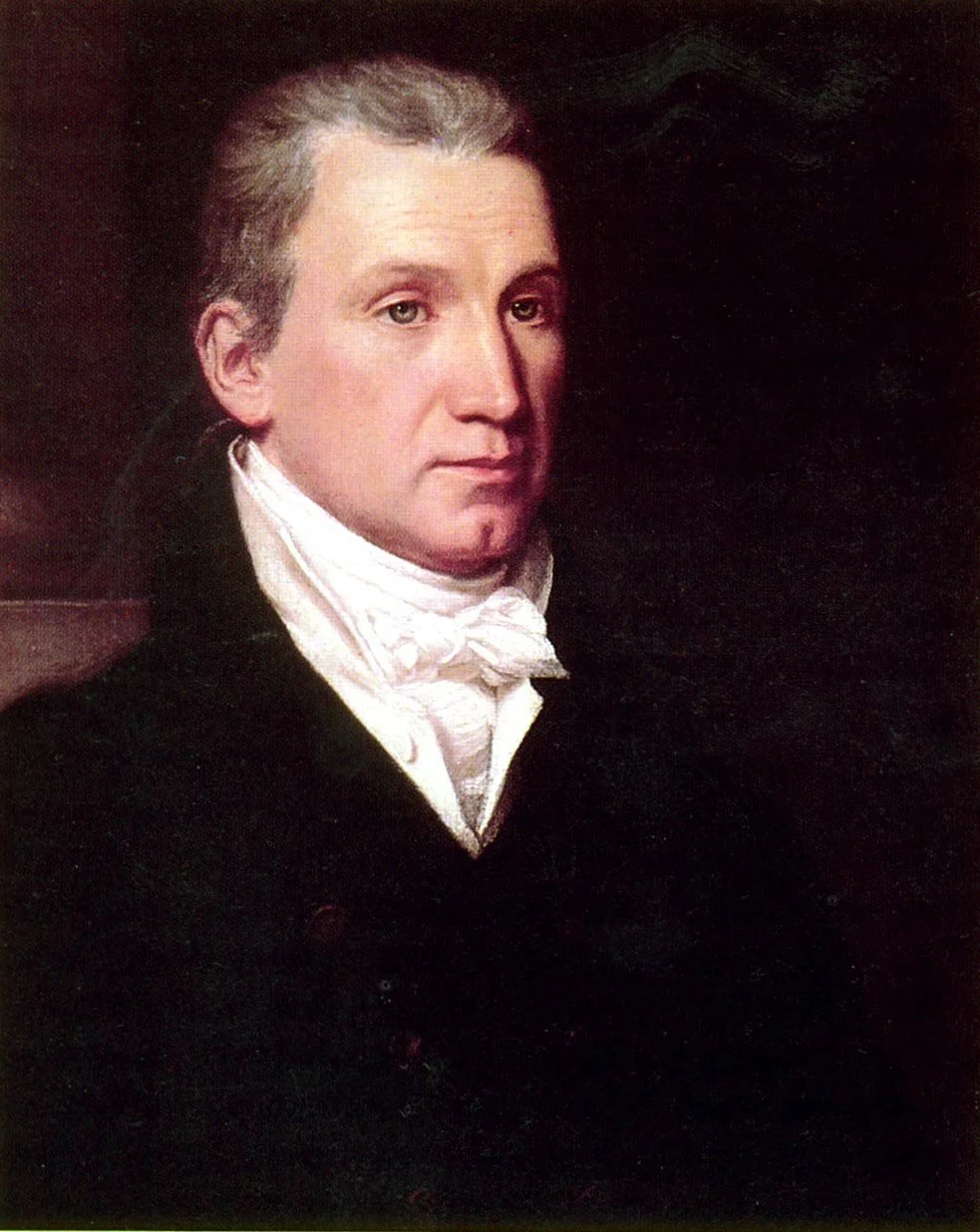
President James Monroe, the president who signed the Missouri Compromise.

US Constitution - the “three-fifths” compromise

The compromises regarding the two vastly different forms of socioeconomics began with the inception of the United States, itself. America’s Constitution famously declared that the institution of slavery would enjoy the status of official recognition in order to secure agreement with the southern states for a binding document.

The socioeconomics between the North and South (land, capital, population, industry, agrarian vs urban interests, types of labor force) were so vastly different that neither was willing to trust the other without a well-delineated form of equitable representation in the Constitution. This was to ensure that the voice of each was fairly heard in the law-making body that dealt with taxation and the subsequent disposition of that revenue. The result was the “Three-Fifths Compromise” for apportionment of representatives regarding the bonded servants in the South. It was agreed that each bondsman (slave) would count as three-fifths of a person for purposes of representation and taxation. Moreover, in rather euphemistic language, Congress was authorized to ban the international slave trade -- but not for another 20 years.

The immediate effect of this “formula” was to inflate the power of the Southern states in the House of Representatives and the Electoral College. These were the states in which the vast majority of enslaved persons lived.

The first Census, taken in 1790 after the Constitution’s ratification, is illustrative. 25.5% of North Carolina’s population was enslaved, as were 35.4% of Georgia’s, 39.1% of Virginia’s, and 43% of South Carolina’s. To offer context to the situation, the 1800 Census showed Pennsylvania's free population was 10% larger than Virginia’s but received 20% fewer electoral votes, because Virginia’s population was augmented by the Three-Fifths Compromise. 

In fact, counting enslaved persons under the compromise added an additional 13 members from “slave states” to the House and eighteen additional electors to the “College.” Is it a coincidence that for 32 of the first 36 years after the Constitution’s ratification, a white slaveholder from Virginia held the presidency?  

The situation was further compounded by the fact that the framers of America’s founding document failed to mention the issue of slavery as an institution even once. David Waldstreicher, professor emeritus in history at the City University of New York and author of Slavery’s Constitution, holds that this failure created ambiguity about the framers’ intentions as well as the constitutionality of both proslavery and antislavery legislation which was to follow.

It can be argued that the Civil War had its genesis in the incipient stages of the founding of America by the early compromises made in the Constitution over the issue of agrarian economics driven by the institution of slavery in the southern states.

This acquiescence to the perceived needs of the South -- to keep the nation bound together -- informed not only the evolution of slavery in America but gave rise to much of the dysfunction in national politics and issues of inequality, still with us today. It makes little sense to talk of a failure to compromise, except insofar as every war or political conflict is a failure to achieve agreement. The original compromises enshrined in 1787 would ultimately touch everything in America from that point on.


Nineteenth century compromises

Through the early to mid-nineteenth century, several agreements between the North and South were hammered out.

The Missouri Compromise of 1820 permitted Missouri to join the Union as a slave state in exchange for Maine entering as a free state. There was the Compromise of 1850 which allowed California’s admission as a free state but also enacted the Fugitive Slave Act, allowing for the kidnapping and re-enslavement of people in free states who had escaped slavery. And the Kansas-Nebraska Act of 1854 allowed western territories to decide for themselves if slavery was to be permitted.

The “Tariff of Abominations,” enacted in 1828 by representatives of the northern states, was a protective tariff aimed at supporting northern manufacturers by taxing imported goods, which worked against and angered southern states. This led to the Nullification Crisis, where South Carolina attempted, unsuccessfully arguing states’ rights, to nullify the tariff, further escalating tensions between the two regions.


Lincoln - the great compromiser

As slavery spread, so did the zeal of the antislavery cause. Abolitionists at the time were often depicted from various sources as suspicious, even dangerous fanatics. But in truth the antislavery movement comprised numerous efforts to compromise when it came to liberating those from the forced labor of involuntary servitude. One idea was that of colonization, which advocated resettling former slaves to South America or Africa (e.g., Liberia), derived from the jaundiced belief that they could never coexist with whites?

One of those advocates of colonization was Abraham Lincoln, offering support for the idea as late as 1862, as Daniel Biddle & Murray Dubin attest in a 2013 article in The Pennsylvania Magazine of History and Biography.

Even as a presidential candidate in the run-up to his election in 1860, Lincoln and his Republican Party colleagues were amenable to any number of compromises to keep the slaveholding South in the Union. One such proposal was the never-ratified Corwin amendment to the Constitution -- permitting the institution of slavery to continue (without federal interference) where it already existed -- but prohibit its establishment in new territories.

Yet, it was the slaveholding states of the South that refused to compromise on this offer, notes Manisha Sinha, historian at the University of Connecticut and author of The Slave’s Cause: A History of Abolition.

There was really only one aspect of the slavery issue where Lincoln could likely have circumvented the war between the states. “Lincoln could have avoided the Civil War if he had agreed to compromise on the non-extension of slavery, but that was one thing Lincoln refused to compromise on…” Sinha asserts.

“When it comes to the Civil War,” she added, “we still can’t seem to understand that the politics of compromise was a politics of appeasement that at many times sacrificed black freedom and rights.”


A culture war

At the center of the disagreement between northern and southern states was also the issue of “class differences” among white-male property owners.

A culture war was brewing between North and South. The North viewed their neighbors as somewhat backwards with little education, little in the way of industry and an aging infrastructure. The South felt denigrated and besieged economically.

Both regions had different visions of what constituted a moral society; yet, both were denominated by Christians who believed in democracy, capitalism and shared a history dating from America’s inception. Where they parted ways was on economics – and that meant slavery.

President Lincoln's election of 1860 was the final blow to the South. Most of his support came from north of the Mason-Dixon line, which put in jeopardy the South's clout in the Union. Southern states viewed the situation as an existential threat to their socioeconomic lifestyle and reacted to preserve it. 

This marked, for years to come, the beginning of the South’s decline in political power in Washington – a poignant footnote to the compromises embedded in the Constitution of the United States some 74 years earlier – ostensibly to keep the South in and the Union intact. But it would take a war between the states and the assassination of a president to finally achieve those ends.


Did you find that piece interesting? If so, join us for free by clicking here.


References 

Nittle, N. (2020, October 30). The History of the Three-Fifths Compromise. ThoughtCo. https://www.thoughtco.com/three-fifths-compromise-4588466

National Park Service. The Constitutional Convention: A Day-by-Day Account for August 16 to 31, 1787. Independence National Historical Park. https://www.nps.gov/articles/000/constitutionalconvention-august25.htm

Census.gov. Return of the Whole Number of Persons within the Several Districts of the United States. https://www2.census.gov/library/publications/decennial/1790/number-of-persons.pdf

Amar, A. The Troubling Reason the Electoral College Exists. Time.com. https://time.com/4558510/electoral-college-history-slavery/

Monroe, Dan. The Missouri Compromise. Bill of Rights Institute.  https://billofrightsinstitute.org/essays/the-missouri-compromise

Mark, H. (2025, June 9). Compromise of 1850. World History Encyclopedia. https://www.worldhistory.org/Compromise_of_1850/

Garrison, Z. Kansas-Nebraska Act. Civil War on the Western Border. https://civilwaronthewesternborder.org/encyclopedia/kansas-nebraska-act

McNamara, R. (2019, July 19). The Tariff of Abominations of 1828. ThoughtCo. https://www.thoughtco.com/tariff-of-abominations-1773349

Longley, R. (2021, October 6). The Corwin Amendment, Enslavement, and Abraham Lincoln. ThoughtCo. https://www.thoughtco.com/corwin-amendment-slavery-and-lincoln-4160928

Posted
AuthorGeorge Levrier-Jones

Napoleon Bonaparte’s name continues to evoke debate more than two centuries after his ascension to power. Some regard him as a genius, while others perceive him as a tyrant; however, few contest his profound impact. Napoleon not only achieved military victories but also transformed the conduct of warfare and the governance of nations. His success was attributable not merely to luck but to decisive decision-making, relentless ambition, and an exceptional comprehension of leadership for armies and populations.

Caleb M. Brown explains.

The Battle of Austerlitz, 2nd December 1805. By Joseph-François Schwebach.

David Bell observes that it was Napoleon’s combination of military audacity and political acumen that enabled Napoleon to rise rapidly and maintain prolonged dominance.[1]  Simultaneously, Napoleon’s ambition risked overshadowing prudence. His decline was influenced not solely by formidable adversaries and unfavorable timing but also by errors he committed. Jeremy Popkin emphasizes that the revolutionary upheaval that facilitated Napoleon's ascent also revealed the vulnerabilities within the empire he established.[2] Napoleon engaged in risk-taking, and occasionally, he encountered failure as a result.  Nevertheless, even after his demise, the institutions he founded and the legacy of his military campaigns continued to influence European political and military strategies. Whether revered or criticized, Napoleon remains among the most extensively studied figures in history. While luck may have played a part in his rise, it was his vision, expertise, and determination that positioned him among the greatest commanders in history.

Earlier in Napoleon's career, his brilliance was recognized, and luck played a much smaller role in his strategic understanding. The Italian campaign (1796-1797) demonstrated how Napoleon turned the demoralized and poorly supplied army of Italy into a powerful force. Napoleon’s capability for quick movement and his bold offensive tactics allowed for the outflanking and isolation of the Austrian troops. The victories at Lodi, Arcole, and Rivoli demonstrated Napoleon’s ability to use quickness and surprise to take the initiative against overwhelming enemy forces. [3] Moral and propaganda were another of Napoleon’s strong suits, presenting himself as a savior of the republic in the soldiers’ public reports.

In 1798, the Egyptian Campaign was a strategic failure that resulted in the destruction of the French fleet at the Battle of the Nile, but it was also a triumph of image-making for Napoleon.[4] Napoleon intended for the expedition to Egypt to be one of enlightenment, linking his military ambitions to the ideals of enlightenment of the time. Napoleon preserved his image in France despite the setbacks he faced while in Egypt, and upon returning to France, he seized the opportunity of political instability and became the leading figure of the Coup of 18 Brumaire (1799), establishing himself as the First Consul of France. Historian David A. Bell noted that Napoleon understood how to convert military victories into political authority and cultural myth, forging a new model of leadership.[5] Michael Broers adds that Napoleon’s rise was not simply the result of a power vacuum, but rather his uncanny ability to harness revolutionary energies while projecting order and decisiveness.[6] These years would lead to the foundation for Napoleon’s dominance.  


Victory

These victories helped pave the way for the apex of Napoleon’s strategic genius, which was soon seen. By 1805 and 1807, Napoleon reached the peak of his military strategic brilliance. The battles of Ulm and Austerlitz were two prime examples of how well Napoleon outthought and maneuvered his enemies. During the Battle of Ulm, Napoleon encircled the Austrian army and efficiently trapped them through a coordinated assault, rather than hastily engaging in a substantial confrontation. The capitulation of over 25,000 Austrian soldiers was not merely a victory; it exemplified Napoleon’s expertise in troop maneuvering, deception, and psychological warfare.[7] Austerlitz was probably the greatest battle of Napoleon’s career. Napoleon had faked a weakening of his flank, baiting the enemy into a daring offensive move. Michael Broers notes that when the enemy took the bait, he struck the center, splitting the line and turning a feint into a rout.[8]

Ulm and Austerlitz displayed to the world that Napoleon was a master at strategic manipulation; his 1806 campaign against Prussia also demonstrated his military genius. The employment of speed, innovation, and psychological warfare demonstrated his capacity to incapacitate the adversary. Napoleon’s triumphs at Jena and Auerstadt solidified his role in transforming the nature of warfare. According to Liaropoulos, Napoleon’s organizational revolution was political as much as military: he combined universal conscription with a modular command architecture—the corps system —to create armies capable of rapid maneuver and sustained operations across broad theaters.[9] What was astonishing about this was how the infantry, cavalry, and artillery operated together as a mini-army through communication and central command.

Despite the genius of Napoleon, he recognized that luck or fortune played a role in warfare as well. Napoleon wrote, “Luck favors the prepared mind.”[10] He recognized the importance of luck to the one who was prepared. Napoleon’s writings detailed his philosophy: success depended not on blind fortune, but on one's ability to anticipate and seize opportunities. Napoleon highlighted the dysfunction of the enemy as an opportunity for exploitation. Napoleon saw the role of luck as a resource and turned it into a weapon.


Limits

Yet while Napoleon’s earlier campaigns showed his gifted abilities to turn advantage into achievement, the following years revealed the limits to his vision. From 1808 to 1812, the Peninsular War and the Russian Campaign marked a shift in Napoleon’s dominance. In his correspondence, Napoleon acknowledged his underestimation of the extent of local resistance in Spain and the underestimated influence of the British forces under Wellington. This oversight led to two years of guerrilla warfare, which significantly depleted French resources across the peninsula.[11] In 1812, the Officiels de la Grande Armée articulated how logistical failures, attrition, and environmental hardships further overwhelmed the campaign.[12]  These deficiencies transcended operational shortcomings and denoted a misjudgment at the strategic level. This signifies the disintegration of Napoleon’s empire.

Following setbacks in Spain and Russia, Napoleon’s adversaries became increasingly confident and cohesive. The Battle of Leipzig in 1813 marked a pivotal turning point, whereby Napoleon was ultimately overwhelmed by the coalition opposing him. Morale had deteriorated among Napoleon’s troops, and his generals had begun to be reluctant to follow him into further wars. It was not solely a single error on the part of Napoleon, but rather an accumulation of strategic miscalculations, isolation in the world, and depleted resources, which ultimately led to the downfall of Napoleon’s reign.

Napoleon’s brilliance on the battlefield and his keen understanding of the political climate in France at the time were more than mere luck.  It was his vision, adaptability, and command authority that prevailed. Bell and Broers both spoke of Napoleon’s ability to transform battlefield victories into legitimacy and myth. Napoleon’s audacity, ambition, and faith in risk would also lead to his demise. As Popkin observed, the same revolutionary energies that propelled him to power also exposed the vulnerabilities of the empire. The miscalculations in Spain and Russia revealed limitations when confronting persistent adversaries, especially in challenging terrains and with fragile supply lines. The unified coalition opposing Napoleon proved to be overwhelming at the Battle of Waterloo. Napoleon was unable to overcome the opposition.


Legacy

Nevertheless, his legacy endures. Napoleon’s reforms, military modernization, and strategic ideas continue to influence contemporary thought, and we have studied these topics across various fields of learning. Viewing him as a genius, a gambler, or a tyrant, Napoleon Bonaparte remains an enduring figure today. He was widely recognized as a pioneering architect of modern warfare, whose innovative strategies and groundbreaking developments significantly shaped contemporary military tactics and technologies. His ambition knew no bounds, often transcending traditional human limits in pursuit of his revolutionary ideals. While remarkable successes marked his endeavors, they were also characterized by notable failures, each of which offers valuable lessons. These setbacks serve as crucial warnings and learning opportunities for future leaders and military commanders, emphasizing the importance of resilience, adaptability, and ethical considerations in the complex landscape of modern warfare.


Did you find that piece interesting? If so, join us for free by clicking here.


Bibliography

Bell, David. Napoleon. A Concise Biography. Corby: Oxford University Press, 2016.

Broers, Michael. Napoleon. Faber & Faber, 2014.

Chandler, David. The Campaigns of Napoleon. London: Weidenfeld & Nicolson, 1995.

Liaropoulos, Andrew N. “Revolutions in Warfare: Theoretical Paradigms and Historical Evidence--the Napoleonic and First World War Revolutions in Military Affairs.” The Journal of Military History 70, no. 2 (2006): 363–84. https://doi.org/10.1353/jmh.2006.0106.

Napoleon Bonaparte, Maxims of War, in Napoleon on War, ed. Bruno Colson (Westport, CT: Praeger, 2003), 45.

Napoleonica archives: The General Correspondence of Napoleon Bonaparte, Napoleon’s letters online

Napoleon I, Bulletins officiels de la Grande-Armée (1806), digitized PDF collection, Library of Congress

Popkin, Jeremy D. A Short History of the French Revolution. New York, NY: Routledge, 2020.

Rothenberg, Gunther E. The Art of Warfare in the Age of Napoleon. Chalford: Spellmount, 2007.


1.          David A. Bell, Napoleon: A Concise Biography (Oxford University Press, 2015), 72.

2.          Jeremy D. Popkin, A Short History of the French Revolution, 7th ed. (Routledge, 2020), 94.

3.          Gunther E. Rothenberg, The Art of Warfare in the Age of Napoleon (Bloomington: Indiana University Press, 1980), 103-105

4.          Gunther, 119-121

5.          Bell, 43-47

6.          Michael Broers, Napoleon: Soldier of Destiny (New York: Pegasus Books, 2016), 92-97

7.          David G. Chandler, The Campaigns of Napoleon (New York: Scribner, 1966), 438-447.

8.          Broers, 172-181

9.          Andrew N. Liaropoulo, “The Napoleonic Revolution in Military Affairs,” Journal of Military History, in Revolutions in Warfare: Theoretical Paradigms and Historical Evidence.

10.    Napoleon Bonaparte, Maxims of War, in Napoleon on War, ed. Bruno Colson (Westport, CT: Praeger, 2003), 45.

11.    Napoleonica archives: The General Correspondence of Napoleon Bonaparte, Napoleon’s letters online

12.    Napoleon I, Bulletins officiels de la Grande-Armée (1806), digitized PDF collection, Library of Congress

Napoleon Bonaparte lost the Battle of Waterloo in 1815, which ultimately led to his departure from France. There was much speculation about where he would end up after leaving France – including the possibility of Napoleon going to America.

Michael Thomas Leibrandt explains.

Napoléon in Sainte-Hélène by František Xaver Sandmann.

I’ve always loved that iconic painting by Jacques-Louis David of Emperor Napoleon on his horse crossing the Alps. It’s not just the beautiful grandeur of his military attire on parade — on his way to a victory at the Battle of Marengo — and ascension from First Consul of France to become Emperor. It’s the boldness of command that he showed as his French Army surprised the Austrian forces under Michael von Melas. This summer season marks 210 years since Napoleon’s final defeat at the Battle of Waterloo.

After crossing the river at Charleroi— Napoleon came between the British and Prussian forces — engaging and defeating Marshal Blucher at Ligny. But when Napoleon was lured into Battle around the village of Waterloo — Lord Wellington’s forces were able to hold out just long enough for the Prussians to arrive. At the end of the Battle — for one of the only times in history — Napoleon’s Old Guard was defeated in combat.

But immediately after vacating the battlefield at Waterloo — Napoleon wanted to continue the war after recently escaping his first exile on the island of Elba and landing once again on French soil. But to the surprise of some — Napoleon didn’t seize power with the shattered remnants of the French Army. Instead — he would abdicate the thrown for the second time on June 22nd after returning to Paris on June 21st.

On June 25th — Napoleon departed the French capital for the last time ever. He would see his mother for the last time in Malmaison — and most ironically would arrive on July 3rd in Rochefort with visions of boarding a ship to America — just hours before the celebration of American Independence from Britain. Napoleon’s plan would be to land somewherebetween Maryland and Virginia. But the French Provisional Government never provided the correct documents and passports.

For the man who had conquered most of Europe at his height of power — America offered the Emperor a new beginning. England had been at war with the United States just three years earlier — which meant that requesting that the American government extradite Napoleon Bonaparte at the Seventh Coalition’s request could be unlikely.

In the end — Napoleon would board a ship. It just wasn’t one bound for America. Instead — Napoleon Bonaparte landed on the island of Aix. He then surrendered to the British Army — and was exiled once again to the island of St. Helena — nearly one thousand miles off the coast of Africa despite his request to retire to the countryside of England. He would arrive on St. Helena in October of 1815 courtesy of the British ship (Northumberland.) He would perish on the island six years later.

With his death — so too faded the attempt of Napoleon to get to American shores. It’s interesting to speculate what it would have meant for Napoleon — Emperor of the French and nearly unbeatable on land — could have given military guidance to the United States Army. Before surrendering to the British — he would proclaim, “I put myself under the protection of their laws; which I claim from your Royal Highness, as the most powerful, the most constant, and the most generous of my enemies.”

Michael Thomas Leibrandt lives and works in Abington Township, PA.

Posted
AuthorGeorge Levrier-Jones

Lew Wallace was the youngest Major General in the Union Army at the time of his appointment early in the Civil War, which is especially interesting since he never went to West Point. His father was a lawyer and served as Governor of Indiana, while his grandfather was a Circuit Court judge and congressman. Born in Indiana in 1827, Wallace possessed natural talents in writing and drawing. Although he studied law and briefly served as a second lieutenant during the Mexican War, he did not see any action. Subsequently, he ventured into various pursuits such as publishing a newspaper, practicing law, organizing a Zouave unit militia, and being elected as a state attorney. However, his book did not achieve success.

Lew Wallace wrote Ben Hur, the best-selling American novel of the 19th century, and its success made him a wealthy and internationally famous man. Years earlier, he had been an acclaimed war hero and the youngest major general in the Union Army, before losing his command when blamed for the near disaster at the Battle of Shiloh. Wallace would devote much of his life to trying to clear his name of that charge.

Lloyd W Klein explains.

Lewis Wallace.

Civil War

The outbreak of the Civil War brought about significant changes in Wallace's life. As a staunch supporter of the Union, he switched his party allegiance and demonstrated exceptional skills in recruitment. Lew Wallace commanded the Indiana Zouaves, 11th Indiana Regiment Infantry. The 11th Indiana Infantry Regiment was organized at Indianapolis on April 25, 1861, for a three-month term of service, then reorganized and mustered in for the three-year service on August 31, 1861, with Col. Lewis Wallace as its commander. He served as Indiana's adjutant general and eventually assumed command of a regiment, despite lacking formal military education. In June 1861, he led a successful skirmish, resulting in his promotion to brigadier general and the command of a brigade.

Although he did not participate in the battle, he was entrusted with the command of Fort Henry by General Henry Halleck as the Union advanced towards Fort Donelson. Despite Grant's orders to remain on defense, Wallace took the initiative to launch a counterattack, preventing the enemy from escaping and reclaiming lost ground. His actions during the Battle of Fort Donelson earned him a promotion to major general at the age of 34.

Wallace commanded a brigade of volunteers at the Battle of Fort Donelson in Tennessee in February 1862. After his initiative and boldness had help secured the Federal victory and the capture of the entire Confederate army there, he was promoted to major general, making him the youngest major general in the Federal army.


Shiloh

Shiloh (April 6–7, 1862) was the place where Grant and Sherman came into their own, but it was almost the end of their careers. PGT Beauregard planned a surprise advance and attack at Pittsburg Landing, on the west bank of the Tennessee River. Exactly how involved Albert Sidney Johnston's role in the planning of the battle has been a subject of controversy. Larry J Daniel argues that Johnston was ill-equipped for the task and lacked the necessary skills.  The northern newspapers exaggerated the nature of the surprise at the time. Although there was no entrenchment, Sherman had received prior warning and some elements of the army quickly discovered the southern lines. Despite facing early setbacks, Sherman displayed remarkable tenacity and skill, proving to himself and others that he possessed the emotional and cognitive abilities required to lead an army.

At the time of the battle, Brigadier General Lew Wallace commanded a division under Major General Grant. On April 6, 1862, Confederate forces under Albert Sidney Johnston launched a surprise attack against Grant’s army near Pittsburg Landing, Tennessee. Wallace’s division was stationed several miles away at Crump’s Landing, north of the battlefield. When the Confederate attack began, Wallace received orders to move his division to support the Union line.

Grant claimed he ordered Wallace to take a specific route that would bring him directly into the Union right flank. Wallace, however, had already set off on a different route—one that made more sense based on the situation earlier that morning and where Union forces had been positioned. Wallace’s division was at Crump's Landing, five miles north of the Union line at the start of the battle. When the battle opened, Grant took his steamboat, Tigress, south to Crump's Landing, where he ordered Wallace to prepare his division to move, but did not specify the route to be taken.

Wallace did not initiate the movement of his division until noon. He then marched his forces towards Sherman's location, utilizing a road near the river. At 2:00 pm, a messenger informed Wallace that he had taken the wrong road. Wallace believed that he was supposed to reinforce Sherman and McClernand at their original camps, unaware that these divisions had been pushed back towards Pittsburg Landing. Consequently, Wallace found himself behind enemy lines and had to retrace his steps. As a result, he did not arrive on the first day of the battle.

He was eventually ordered to turn back and take another route, which cost several hours. His division did not arrive in time to participate in the fighting on the first day of the battle.

Much of the responsibility for the near disaster at Shiloh was pinned on Wallace. As the battle unfolded, commanding general U.S. Grant ordered Wallace to bring his men to the front. Unaware that the Federals had been driven back from their original position, Wallace took the road leading to where they had been before the battle began. Once he learned that the road he was on was taking him away from the army he was supposed to reinforce, rather than toward it, he countermarched his command and took a different road. The delay prevented Wallace from reaching the battlefield until the first day’s fighting had ended. Grant was furious, insisting that his orders specifically directed Wallace to take the other road. Wallace denied the claim, saying the orders had given no directions as to which road to take, and that he had taken the one that he believed would bring him to the action quickest.

In the confusion of the battle the written order was lost, so that what it actually said will never be known. But the blame nonetheless fell on Wallace and he was relieved of command. After the battle, Grant was unsure why Lew Wallace’s division did not arrive when and where he expected it.


Wallace’s men finally arrived late in the day and participated in the Union counterattack on April 7, helping turn the tide in the North’s favor. However, the damage to Wallace’s reputation had been done. Had he arrived earlier, his command of 5000 men might have assisted at the Hornet’s Nest, perhaps saving some of those from surrendering.

On the second day of the battle, the Army of the Ohio, led by Don Carlos Buell, arrived, along with Lew Wallace's division. The Union forces launched a successful counterattack, taking advantage of the Confederate lines, which had become disorganized and outnumbered. The fortunes of the battle shifted in favor of the Union, as Beauregard's men became entangled and exhausted. The Union forces pushed the Confederate lines back entirely, securing a significant victory.


The Controversy

Wallace, deeply wounded by the long-standing criticism, defended himself publicly and privately for decades. He claimed that Grant’s original orders were vague and that he acted in good faith. Wallace wrote letters, articles, and memoirs attempting to clear his name. In one pointed comment, he said: “I have been held responsible for a disaster I did not cause, and prevented from earning honors I might otherwise have won.” He also believed that politics and Grant’s rising prominence after the war made it unlikely that Grant would ever admit error or to clear him.

Grant in Battles and Leaders (1885) was sharp and critical of Wallace. He portrayed Wallace as having misinterpreted orders and delayed his movement to the battlefield, suggesting that Wallace’s failure to arrive on April 6 was a significant lapse that could have cost the Union the battle. This account echoed the prevailing narrative at the time—that Wallace was slow, took the wrong road, and failed to support his commander in a crisis.

In his Personal Memoirs (1885–1886) written while dying of cancer and racing against time, Grant’s tone softened. He still repeated the version of events that Wallace took the “wrong road” and had to be redirected, but he avoided assigning overt blame. He did not accuse Wallace of incompetence, nor did he suggest malice or dereliction of duty. Grant showed greater understanding of the confusion and fog of war. He acknowledged that Wallace believed he was following the correct route based on earlier assumptions about Union positions. Though Grant didn’t retract his earlier criticism, he presented the episode in a more even-handed, factual way, without the sting of his previous judgment. In a footnote, Grant acknowledged learning from Ann Wallace, the wife of General William H.L. Wallace (not related to Lew, who had been killed at Shiloh), that Lew Wallace’s division had taken a different route—presumably the one that made sense earlier in the day when Union lines were thought to be farther forward. This new information shaped Grant’s perception of the event, and he included it in his memoirs. Grant's memoirs, specifically on page 286, contain his admission that Lew Wallace's actions were understandable.

Modern historians tend to side more with Wallace, attributing the delay to ambiguous orders, a rapidly changing battlefield, and the primitive state of Civil War communications and maps In hindsight, both men were partly right: Wallace did what he thought was correct based on initial orders, and Grant had reason to be frustrated when desperately needing reinforcements. But Grant never formally or publicly admitted Wallace had done nothing wrong, and Wallace never felt vindicated in his lifetime.


After Shiloh

Following the battle, Halleck relieved Wallace of his command, although it is usually suggested that this was done at the behest of Grant, although there is no documentary evidence of that. Wallace then took charge of organizing the defenses of Cincinnati and northern Kentucky. However, in March 1864, he returned to command as the leader of the VIII Corps, with headquarters in Baltimore.

In July 1864, a small force under his command was able to sufficiently delay Confederate General Jubal Early at the Battle of Monocacy in Maryland that he may have saved Washington D.C. from capture. Nevertheless, the cloud of the Shiloh controversy still hung over him and would for the rest of his life.


Battle of Monocacy

Early's advance into the Shenandoah Valley and subsequent movement into Western Maryland in 1864 encountered a significant obstacle in the form of Lew Wallace's defense at Monocacy, just outside Frederick, Maryland. At this time, General Robert E. Lee had established his forces in entrenched positions at Petersburg and Richmond, while a Confederate army contingent approached Washington DC. However, the only opposition in their path was a smaller force of inexperienced Union infantry, led by the disgraced General Wallace. This outfit had no battle experience, and all of the resources were going to Grant.  His 2300 men were mostly 100-day men: a true backwater command.

Recognizing the urgency of the situation, General Ulysses S. Grant dispatched 3,500 men under General Ricketts to support Wallace. Nevertheless, there were virtually no other Union army units positioned between Frederick and Washington DC. Wallace understood the need to delay Early's advance until a more substantial defense could be organized.

Without receiving any specific orders from his superiors, Wallace made the strategic decision to position his forces along the Monocacy River, a few miles south of Frederick. This defensive stance aimed to protect the routes to both Baltimore and Washington DC. Following several skirmishes, a full-scale battle took place on July 9. Despite being heavily outnumbered, with Early's forces totaling 16,000 compared to Wallace's 4,500, the Union army held its ground. Even a cavalry attack failed to dislodge them, despite the Confederates attempting to outflank the Union forces. Eventually, the Confederate infantry executed a double envelopment maneuver, forcing the Union army to retreat across a stone bridge. Remarkably, the Union army survived five attacks from one of the most skilled division commanders in the Confederate army at that time. After 24 hours of intense fighting, the Union forces were compelled to fall back. Early's losses amounted to approximately 800 men out of the 14,000 engaged, while Wallace's forces suffered 1,300 casualties out of their 5,800. Wallace subsequently retreated to Baltimore. However, Early's delay in breaching this defensive line provided crucial time for the fortification of Fort Stevens. In his memoirs, Early himself acknowledged the critical impact that the Battle of Monocacy had on his ability to launch an attack on Washington DC.

The disgraced general, despite his valiant stand, initially faced blame from General Grant for yet another error. Consequently, following the Union's defeat, he experienced a brief demotion. Grant promptly relieved Wallace of his command, appointing Edward Ord as the new commander of the troops. However, once Federal officials recognized Wallace's accomplishments, he was reinstated to his position. Grant, in his memoirs, generously acknowledges Wallace's contribution. It was only later realized that, despite facing overwhelming odds, Wallace had bought crucial time that ultimately saved Washington DC. Although the battle at Monocacy was relatively small, its impact was significant. The engagement effectively halted General Early, providing Washington with a day's worth of time to secure reinforcements. This delay cost Early the initiative, from which he could never fully recover. The subsequent battle near Washington DC at Fort Fisher proved unsuccessful. Sheridan pursued Early back into the Shenandoah Valley and defeated him in multiple battles, most notably at Cedar Creek. Furthermore, the preservation of Washington influenced the course of the War and played a role in Lincoln's re-election. Wallace's actions at Monocacy should have been sufficient for Grant to recognize and revive his career.

Instead, Grant entrusted Wallace with non-command responsibilities. He sent Wallace to Texas in 1865 to negotiate a surrender with Kirby Smith. Wallace also served on the Lincoln Conspiracy Commission and headed the Wirz Commission. Later, he assumed the role of governor of the New Mexico territory, served as a minister to the Ottoman Empire, and, of course, became an esteemed author of a significant piece of American literature.


Post Bellum Activities

After the war, Wallace briefly accepted an appointment as general in the Mexican army before returning home to Indiana to resume his law practice and politics. He was defeated in two runs for Congress, but his loyal service to the Republican party (and to candidate James Garfield) earned him an appointment as Territorial Governor of New Mexico. Afterwards, he was appointed U.S. Minister to the Ottoman Empire (succeeding his former Confederate adversary James Longstreet).


Governor Of New Mexico Territory

Billy the Kid, also known as Henry McCarty, adopted the alias William H Bonney, which was not his true name. Despite his young age of 21, he had already taken the lives of 21 men before his own demise. Although his connection to Lew Wallace and the Civil War was not direct, it provides an intriguing insight into the historical context of that era.

At the tender age of 15, McCarty found himself orphaned. His first brush with the law occurred at 16 when he was arrested for stealing food in 1875. Merely ten days later, he committed another offense by robbing a Chinese laundry. Although he was apprehended, he managed to escape shortly after. Fleeing from the New Mexico Territory to the neighboring Arizona Territory, McCarty effectively transformed himself into an outlaw and a federal fugitive. It was during this time, in 1877, that he began using the name "William H. Bonney".

Following an altercation in August 1877, Bonney took the life of a blacksmith, making him a wanted man in Arizona. He subsequently returned to New Mexico and joined a group of cattle rustlers. Bonney gained notoriety in the region when he became a member of the Regulators and participated in the Lincoln County War of 1878. Alongside two other Regulators, he was later accused of killing three individuals, including Lincoln County Sheriff William J. Brady and one of his deputies.

Bonney's notoriety reached new heights in December 1880 when his crimes were reported by the Las Vegas Gazette and The Sun in New York City. Sheriff Pat Garrett successfully apprehended Bonney later that month. In April 1881, Bonney stood trial and was convicted for the murder of Brady. He was sentenced to be hanged in May of the same year. However, on April 28, Bonney managed to escape from jail, killing two sheriff's deputies in the process. He remained on the run for over two months before Garrett eventually caught up with him. On July 14, 1881, at the age of 21, Bonney was shot and killed by Garrett in Fort Sumner. It is worth noting that rumors circulated suggesting that Garrett did not actually kill Bonney, but rather orchestrated his escape.

Lew Wallace around 1903.

Billy the Kid

Wallace's arrival in Santa Fe on September 29, 1878, marked the beginning of his tenure as governor of the New Mexico Territory. This period was characterized by rampant lawlessness and political corruption, posing significant challenges for Wallace. One of his primary objectives was to address the Lincoln County War, a violent and contentious conflict among the county's residents. Additionally, Wallace sought to put an end to the series of Apache raids on territorial settlers.

In his efforts to restore order in Lincoln County, Wallace took decisive action on March 1, 1879. Recognizing that previous attempts had failed, he issued orders for the arrest of those responsible for the local killings. Notably, one of the outlaws apprehended was Billy the Kid. while governor of New Mexico, Wallace issued the “Wanted Dead or Alive” order for Billy the Kid. Subsequently, on March 17, 1879, Wallace held a clandestine meeting with Bonney, who had witnessed the murder of a prominent Lincoln County lawyer named Huston Chapman. Wallace's objective was to secure Bonney's testimony in the trial of Chapman's accused murderers. However, Bonney had his own demands, seeking protection from his enemies and amnesty for his past crimes. During their meeting, an agreement was reached, with Bonney becoming an informant in exchange for a full pardon. To ensure Bonney's safety, Wallace orchestrated a "fake" arrest and confined him in a local jail on March 20. As agreed, Bonney testified in court on April 14, providing crucial information against those involved in Chapman's murder. However, the local district attorney reneged on the agreement, refusing to release the outlaw. Faced with this betrayal, Bonney managed to escape and resumed his violent activities. In response, Garrett, a friend of Wallace, offered a $500 reward for Bonney's capture. This turn of events raises questions about whether Wallace genuinely intended to grant Bonney the promised pardon or if it was merely a ploy to gain his cooperation.  The controversy remains whether or not he offered the bargain cited above. 


Ben Hur

Just before leaving for Constantinople, Wallace published a novel he had written during his tenure in New Mexico. That book, Ben Hur, would become the best-selling American novel of the 19th century.

Wallace's literary career was born out of his boredom with studying law, as he openly admitted. Among his various works, his most renowned novel is the historical tale titled "Ben-Hur: A Tale of the Christ" (1880). This book achieved remarkable success, becoming the best-selling American novel of the 19th century and maintaining that distinction until Margaret Mitchell's "Gone With the Wind" surpassed it. Interestingly, Wallace completed this masterpiece while serving as the territorial governor of New Mexico in Santa Fe. "Ben-Hur" narrates the gripping story of Judah Ben-Hur, a Jewish nobleman who endures false accusations and subsequent enslavement by the Romans after being wrongly convicted of attempting to assassinate the Roman governor of Judaea. The novel not only explores themes of revenge and redemption but also intertwines the hero's journey with that of Jesus Christ.

Wallace had dedicated a significant portion of his life attempting to make amends for his perceived mistake at Shiloh, a theme that he also incorporated into his novel "Ben-Hur.". The novel drew heavily on Wallace’s life experience and the Shiloh controversy, particularly the sting of misunderstanding, unjust blame, and the long quest for redemption, which deeply influenced the emotional and moral fabric of the novel. The themes of Injustice and vindication, and the journey toward forgiveness, are the underpinnings of the novel. Wallace felt he had been wronged at Shiloh, unfairly blamed for failing to support Grant in time, and branded with a stain on his military career that haunted him for decades. The emotional core of Ben-Hur is the story of a man undone by injustice, who fights for redemption and meaning, and is a deeply personal reflection of Lew Wallace’s own life journey, including his painful legacy from Shiloh.

In Ben-Hur, the central character, Judah Ben-Hur, is a man falsely accused of attempted murder and condemned to slavery. Like Wallace, Ben-Hur spends much of his life struggling to restore his honor and find his place in a world that had cast him aside. Wallace was a deeply reflective man, especially later in life, and came to see personal injustice in a larger moral and even spiritual context. In Ben-Hur, Judah ultimately finds peace not through vengeance but through an encounter with Christ, which reshapes his understanding of justice, mercy, and purpose. This reflects Wallace’s philosophical reconciliation with the past—though he never fully forgave Grant, he found a higher peace through faith and writing. The famous chariot race, where Ben-Hur defeats his rival Messala (a stand-in for betrayal and empire), is often read as a metaphor for triumph over false judgment and humiliation. While not a literal retelling of Shiloh, it’s a narrative inversion: where Wallace had lost public esteem, Ben-Hur regains it, spectacularly and righteously.

Later in life, Wallace acknowledged that his religious searching and his internal struggles—including those tied to Shiloh—helped shape Ben-Hur. He once said: “The consciousness of having been wronged… became a sort of spur. It made me want to show that I was capable of something more.”

Ben Hur made Wallace a wealthy man, enabling him to spend the last years of his life pursuing his interests in writing, architecture, engineering, and in trying to clear his name from the Shiloh accusation. When the Spanish-American War broke out, Wallace, who was 71 years old, offered to raise a volunteer regiment. When the offer was declined, he attempted to enlist as a private. He died at his home in Crawfordsville, Indiana, in 1905, at age 77.


The site has been offering a wide variety of high-quality, free history content since 2012. If you’d like to say ‘thank you’ and help us with site running costs, please consider donating here.

The War of 1812 was raging when the capital was stormed.  The invaders made short work of the overmatched defenders and rampaged through the city, setting fire to the legislative buildings and executive mansion.  Withdrawing, they left behind smoldering ruins and a foe with a keen desire for retribution.  That  retribution would occur sixteen months later, when the British ravaged Washington D.C. in retaliation for the pillaging of the Canadian capital of York by U.S. forces on April 28, 1813.

James F. Byrne Jr explains.

The arrival of the U.S. fleet prior to the capture of York. April 27, 1813.

In June of 1812, the nascent United States declared war on its former colonial master in response to British impressment of American seamen and other outrages to national honor.  Focusing on its ongoing existential struggle against Napoleon, Britain initially adopted a defensive strategy with its 5500 regular troops in Canada.  This strategy would prove to be more than a match for American offensive actions.

The Americans expected a quick and resounding victory,  but events would prove the preparedness of the American Army was not equal to these lofty expectations.  A campaign launched in 1812 resulted in the humiliating loss of Detroit and additional disasters along the Niagara River.  Viewing the results of the American operations, the London Times complacently reported “the war had lasted nearly four months yet … the record of the American achievements is a universal blank.”

To rectify this situation, Secretary of War Armstrong pushed for a concentrated attack along Lake Ontario against Kingston - the primary British naval base on the lake.  If Kingston fell, Upper Canada would eventually follow.  However, Armstrong’s plan was opposed by the senior Army commander along the Canadian border, General Henry Dearborn.  A Revolutionary War veteran, the now overage, and overcautious Dearborn erroneously believed that Kingston was strongly defended and convinced Armstrong to forego striking that strategic objective in lieu of seizing a symbolic prize – York, the capital of Upper Canada.

Weakly garrisoned by 600 British regulars, militia and native warriors, York was under the command of Lieutenant Governor Roger Sheaffe.  The defenses of York consisted of a series of blockhouses and obsolete artillery.  Shaeffer scattered his regulars and native allies around the city and left the militia in the capital – more or less to their own devices.

On April 26, 1813, an American flotilla of 14 armed brigs carrying 1,700 regulars arrived off the coast of York.  The following morning  troops under the command of General Zebulon Pike stormed ashore west of the town against feeble opposition.  British reinforcements were miles away and unable to move  along the shore road which was pounded by naval gunfire.  Forced to detour into the woods, some reinforcements got lost, most got delayed, and none reached the bridgehead.  As the British floundered in the woods, Pike ordered an advance.  British attempts to rally were futile, as well coordinated American artillery and ship-based fires supported the advancing Infantry.  General Sheaffe ordered his regulars to abandon the city and retreat east along the shore.  He left the Canadian militia (in the words of one observer) “standing in the street like a parcel of sheep,” instructing them to negotiate their own surrender.


Battle over

The battle was over, but the victory not yet secured.  Over 300 tons of gunpowder stored in a stone warehouse exploded as the Americans approached the city.  Among the 37 casualties was General Pike, courageously if not wisely leading from the front.  The death of Pike led to a breakdown of discipline among the American troops.  Officers on the ground could not rein in their men, and Dearborn remained aboard ship, observing while the Canadian capital was destroyed.

The burning of York infuriated the British command.  The Commander in Chief instructed his subordinates to “assist in inflicting that measure of retaliation which shall deter the enemy from a repetition of similar outraged.”  In August of 1814, those instructions were faithfully conducted when British forces captured Washington D.C., torching most government buildings.  


Lessons Learned:

·       Joint operations are a combat multiplier.  The well-coordinated naval support at York hamstrung British mobility.

·       Force management is necessary for victory.  Sheaffe ignored over half his potential combat power (the militia) and suffered accordingly.

·       A blind army is a defeated army.  Sheaffe did not recon alternate routes to possible landing sites and was unable to reinforce his defense at the point of the American attack.

·       Have a succession plan.  Pike carefully orchestrated the American landing and assault – but discipline died with him.

·       Operations should support strategic objectives; the successful attack at York had little positive impact on the war.


Did you find that piece interesting? If so, join us for free by clicking here.

Posted
AuthorGeorge Levrier-Jones