Ever since watching the movie The Last Samurai starring Tom Cruise and Ken Watanabe, Jeb Smith has admired and been fascinated by feudal Japan and the samurai. The movie, based on various historical figures and events from 19th-century Japan, portrays the contrast between traditionalism and modernity.

Here Jeb looks at the samurai in the context of the book The Life and Battles of Saigo Takamori by Mark Ravina.

Posthumous portrait of Saigō Takamori by Tokonami Masayoshi. `Source: Public domain, Collection of Kagoshima City Museum of Art, available here.

The samurai contrast between traditionalism and modernity shows, on one hand, how you had the traditional warrior samurai, living agrarian, rural, lifestyles centered on close-knit, decentralized and self-governing, deeply religious farming communities. They were content to live as their ancestors had, guarding, protecting, and living out their traditions, and were resistant to money, progress, political power, and innovation. Instead, honor, faith, family, and freedom were what mattered most. On the other hand, you had certain Japanese who were influenced by Western capitalism and colonization. They sought to modernize Japan, leaving behind its traditions for the benefits of money and political power. We observe politicians and bureaucrats influencing the Japanese Emperor to adopt modernity and centralized power, and create a singular nation out of the various distinct regions that existed under feudal Japan. This involved engaging in trade agreements with the West and pursuing technological advancements, all aimed at generating wealth and gaining power and leading to centralized rule, a modern military and economy, and European lifestyles, including Western dress. The contrast is clearly seen in how they waged war, the traditional Samurai side using bows and swords, and modern imperial forces cannons and rifles.

In the movie, the character Lord Moritsugu Katsumoto is based on the life of Saigo Takamori, who led the “Satsuma Rebellion” against the modernizing Japanese government in 1877 in an attempt to defend traditional Japanese samurai values.


From Movie to Book – Saigo’s Heritage and Tradition

In his acclaimed work, The Last Samurai: The Life and Battles of Saigo Takamori, Mark Ravina, a scholar of Japanese history, provides an in-depth examination of Saigo’s life.

He was huge compared to most of his peers, nearly six feet tall with a muscular build. He was described as intimidating with a deadly stare, yet also sensitive, showing emotion and crying in public at plays. He was brave, willing, even desiring to die for a cause, yet gentle, soft, and sought peace. To the samurai, bravery was connected to morality. Courage means believing in something outside of oneself, such as conviction, principle, loyalty, and good character, which can be trusted. Selfish individuals who prioritize their own interests over others’ lives cannot be trusted.

Saigo possessed natural qualities that men admired, as they respected his dedication, loyalty, honor, and the way he handled adversity. He also treated others with respect and honor. He taught his students that we have to stop fearing death, which is inevitable, to truly “live in harmony with heaven.” He was very “black and white” principled and focused on the few things he thought were important.

Born in 1827, Saigo grew up poor in the Satsuma region, known for its agricultural, rural, and remote lifestyle, in the far southwest corner of Kyushu, the southernmost of the four main islands of Japan. Largely isolated, its people spoke a regional dialect incomprehensible to other sections of Japan. Saigo and the residents of the region were considered “backward,” old-fashioned, and traditional.

In Satsuma, the local samurai were descendants of various regional samurai rulers dating back centuries. Centuries before, the samurai were somewhat feudal vassals of the Shogun, who parceled out the lands and territories to the samurai to rule as military rulers who in turn passed them on to their descendants. As in feudal Europe, they essentially became local lords or monarchs and ruled their domains as autonomous areas. In the 1850s, “Japan” was not yet a centralized nation, but a variety of local realms with no professional army. Japan, as a singular nation, existed only in thought, not in practice: however, fealty (at least symbolically) was given to the capital.

Traditional loyalty dates back to medieval Japan, where vassals were remarkably loyal to their personal Lord, even sometimes committing suicide if their Lord passed, rather than serve another. Saigo was loyal to, and believed in, a divine order rather than individuals, even his Lord, whom he fiercely loved and served in every way he could. However, divine law was higher than man’s, and all, whether peasant, vassal or lord, shogun or emperor, were to be loyal above all to the gods, and to the high law from heaven that governed all people; in the Western context, “natural law.” Further, Ravina wrote, “Saigo’s opposition to a central bureaucracy was rooted in a Confucian understanding of power: governments should rule, he thought, through broad precepts and moral examples rather than extensive regulation.” He believed the cultivation of people who are moral, “loyalty, filial piety, humanity, and love,” would not need governmental laws and dictates; the focus should be on moral people rather than top-down coercion.

The local samurai were generally considered equal, with a few powerful overlords of large tracts of land, and the capital did not receive blind obedience, as we are accustomed to in our centralized democratic governments today. Instead, they maintained fealty out of choice, provided that the Shogun or central power was honest.

Multiple rural aristocratic castles dotted the landscape. One castle for each region was the general though not invariable rule. While the samurai ruled from the castles and centers of towns, most villagers outside the samurai’s control lived as autonomous peasants in small local villages. Traditional Japanese society, in which Saigo grew up, was an extremely hierarchical society where you could kill a lower-class individual who insulted you; in fact, you were required to do so by law. Samurai made a distinction between killing for honor and murder, the latter being outlawed and degrading.

Saigo hailed from a clan of fierce warriors dating back to the 11th century, who demonstrated legendary military prowess, especially during the 11th to 13th centuries, once helping fight off Mongol invasions, for which his ancestors won renown.  Regarding his more immediate lineage, Ravina wrote, “His father, Kichibei, was formally a full samurai (shi or jokashi), and the family should, in theory, have lived off of his stipend. But in practice the Saigo family lived more like goshi: self-sufficient rural warriors.”[1]

Learning the way of the sword was not the only thing samurai held as valuable. Honor, courage, honesty, and the avoidance of foul language were priorities instilled among the aristocratic samurai class. A focus on the past, on ancestors and tradition was central to the samurai culture and worldview. Saigo’s traditionalism was, of course, heavily influenced by his aristocratic samurai education, which shunned Western ideas, technological advancements, and modernism as a whole, condemning “novelties” and focusing on ancient texts. While many would later use gunpowder, initially the samurai despised muskets as dishonorable killing weapons, plus now even peasants could kill samurai who had trained their whole life by the way of the sword. Firearms degraded warfare and opened it to the lower classes. Saigo was raised as an aristocratic gentleman. He was well versed in philosophy, especially the ancient Chinese philosophers, and held a great interest in Japanese history.

Saigo upheld the traditional view of the Emperor who, in his mind, represented Japanese history, people, and traditional culture. The emperor was not a monarch but more like a medieval feudal king; his power was in religious symbolism, and he was to “reign rather than rule.” The samurai, the warrior class, were to be the true rulers at the local levels as feudal lords, not the Emperor, nor the Shogun, the supreme (in theory though not always practice) military ruler who also was involved in politics from the capital. Saigo argued it was unnatural to have multiple leaders, both a Shogun and an Emperor, preferring to downgrade the Shogun to a simple local Samurai lord. According to Saigo and others like him, the dynasty of emperors had existed since the dawn of time. The current Emperor, a lineal descendant of the Sun Goddess Amaterasu, holds divine authority over all, including his servants the samurai and the Shogun.

Saigo resisted outside Western influences because they exerted pressure on the Emperor, and came from mere men, who were not the true authority; thus, resisting them upheld the divine. He also sought to maintain the policy of isolationism, refusing foreign trade and contacts, to preserve Japan's religious purity, as Western powers sought to allow evangelists and missionaries into Japan. Whatever the potential financial blessings might be, the religious aspects were too vital to Saigo to sell out. This also played a role in why he did not fear the technologically advanced Western navies and armies; instead, he believed that tactics and morality would determine the outcome of a war, as he refused to trade with the West.

As a samurai, Saigo was non-materialistic, showing no interest in expensive clothing or new fashions. Ravina wrote,“Saigo’s preference for simple, traditional pleasures distinguished him from his colleagues in the Meiji government who used their new wealth and influence to entertain in Western style, hosting, for example, European-style costume balls. For Saigo, such lavish novelties were emblems of a revolution gone bad.” Thus, the main Western priority, and what drove the push for modernity, technological advancements, and centralized power —that is, money, trade and financial interests —was readily resisted by the aristocratic, non-materialistic, localized hierarchical moral and traditional samurai such as Saigo.

He was often disgusted with politics, seeking relief in rural farming, hunting, gardening, learning, fishing, and hiking, as politics made him “foul tempered.” But the tyranny of rulers and the suffering of the people along with the necessity of self-preservation drove him into politics just the same. He was a “tireless crusader against an oppressive government.” Also, his extreme loyalty to his lord kept him active in politics.

His first experience outside of his education quickly revealed to him the oppressive taxation of his region and its adverse effects on farmers and peasants. The taxes, he believed, kept the area poor and prevented development. Many left the area to avoid them, moving to other regions with less oppressive taxation policies. Similar to feudal Europe, the aristocratic and warrior classes were supported by peasants through taxation. However, the Satsuma region was samurai-heavy, lacking sufficient peasants as support. When living in hiding in the remote Amami Islands, he wrote, “It is painful to see the extent of tyranny here.” He felt for the islanders’ suffering under heavy local tax policies. Many inhabitants were enslaved on large sugar plantations in order to profit the local government, which instituted a monopoly on the product, even killing anyone who attempted to sell it unauthorized.


“Progress”

Western nations had long sought to influence Japanese politics and economics, and they pressured Japan to engage in trade and open itself up to modernity. Japan had a long history of isolation from these powers, partly to keep Christianityout and maintain its religious purity. However, a faction within Japan grew increasingly concerned about the technological advancements of Western nations. After the British defeated China in the First Opium War in the middle of the 19th century, they argued that Japan needed to modernize and advance its own capabilities to protect itself from foreign nations that might seek to dominate it (Saigo eventually, and reluctantly, in part in service of his lord, accepted this position and helped implement it.) However, it was the Americans that finally “opened up” Japan from its traditional isolationist stance. They did so through purposely intimidating them with their technologically elite navy. However, Saigo helped institute a modern centralized Japanese imperial government under the Emperor, seeing it as the lesser of two evils.

Perhaps due to his unawareness of what would occur in a centralized system that he had previously helped introduce, Saigo appears to have undergone a significant shift in his opinions about the imperial government after leaving the capital and returning to full-time country life, where he became happy, healthy, and a renowned local figure. At this time, he was described by an Austrian diplomat as “having the manners of a country gentleman.” National politics made him stressed, angry, and unhealthy; he found the minute details of administration and governance annoying and difficult to endure, periodically retreating to the woods to “forsake the world.” He endorsed and promoted self-sufficiency and, in support of the old feudal ways of Japan, Saigo warned of the:


“dangers of introducing market principles into landownership. In hard times, he observed, the poor would be forced to sell their lands to the rich, which would exacerbate their poverty… [he desired instead] to ensure that all farmers had adequate plots and then maintain the principle of common land. This was the only way to avoid the unseemly spectacle of people ‘fighting over land, blinded by the prospect of immediate gain’… [he was] unwilling to let commerce corrupt the Satsuma countryside, and… ready to subvert the will of the central government to protect the virtue of his domain.”


So, when the new centralized modern government instituted things like a nationwide property tax and invaded private property, he was outraged. Ravina wrote, “At the heart of the conflict were two different political agendas, the desire to build a powerful centralized state, and the desire to maintain Satsuma as a distinct polity.” The central power, as all do, quickly became intolerant of diversity and decentralization, snuffing out and eradicating its competitors. It began to enforce, through law, the removal of class distinctions, hierarchy, feudalism, and the power of local samurai, as well as any other form of social stratification. Over time, the central government abolished the local rulers, eradicated hereditary inheritance rights, replaced the daimyo and samurai domains, appointed politicians from the capital, and “implemented national standards in taxation, civil administration, law, and education.”

In opposition to the traditional feudal and regional samurai forces, the newly minted central Japanese government was constructing a modern national force, and utilizing national taxation, national conscription, and government power to foster and bring to bear the full might of industry, including railways, steamships, telegraphs, and, for the first time in Japanese history, land mines, rockets, and more. With big government and big money colluding with big business, comes big war.

Japan was modernizing, especially its military, which had become a national force rather than a regional feudal one. Now upheld by a national tax and conscription, and supplied and organized by modern communications, for the first time in history the common man replaced the aristocratic feudal samurai warrior. The samurai heritage and culture, along with their function and purpose, were being abolished and replaced, Mark Ravina wrote “The modern Japanese army had explicitly rejected feudal concerns and symbols. The new Japanese army was based on modern nationalism, not regional feudal lords. The 1872 edict that created the conscript army described the Samurai tradition as a terrible inequity. Conscription was described as a great egalitarian project... to ‘grant equal rights to all.’” The modern national movement was one towards equality, away from the hierarchy of the samurai.

When the new national Japanese forces forced a favorable economic treaty for themselves at the expense of Korea, through military force and threat, Saigo was outraged, saying that just war is based on “Heaven’s principles” and is fought only for a just cause, not for money. That this new national government would place money before honor was “beneath contempt”; money was nothing to fight a war over, even if it could be easily won. The New National Japan wished to create an Empire, but this particular samurai wanted nothing to do with it, viewing Western nations as less civilized because, even though technologically advanced, they colonized weaker nations for economic and political gain. “He thought war for economic advantage was reprehensible and barbaric.”

However, Saigo’s own region of Satsuma had been left largely unchanged, and local samurai still ruled in this remote, rural area untouched by Japan’s modernization. When the government cracked down on traditional resistance to national conformity, including outlawing swords, the samurai’s favored weapons, allowing only government officials to carry them, it was too much for the reactionary segments of Japan’s samurai culture; rebellions sprang up in various areas. It was attacking their identity, removing them as a people and bringing them all down to a common denominator, easily manipulated and controlled.

We observe a similar historical scenario around this time in America's lead-up to the Civil War, where the North pushes forward towards capitalism, centralized power, economic growth, and overall thrusting into modern society and ideas. At the same time, the South stood as defiantly as the samurai, set on maintaining traditions, local control, and close-knit religious communities. Famed Confederate General Robert E. Lee warned that if the Republicans' transformation of the decentralized Union into a singular centralized nation were to occur, “the consolidation of the states into one vast republic, sure to be aggressive abroad and despotic at home, will be the certain precursor of that ruin which has overwhelmed all those that have preceded it.” Proving the truth of this, the American capitalist, interventionist, militaristic, Republican-controlled “One nation” was not content with becoming authoritarian in the United States, or even wiping out the South. Instead, they then removed or exterminated the Native Americans in their quest for western expansion and then went abroad, for financial reasons and “democracy,” influencing countries as distant as Japan, desiring to recreate it in their own capitalist Western image.


Resisting Modernity – The Satsuma Rebellion

The Satsuma rebellion was the bloodiest combat Japan had seen in 300 years and was led by “The Last Samurai,” Saigo Takamori. It was a revolt against the modernizing and centralizing imperial government that had turned tyrannical and sought to eradicate samurai from Japan. During the rebellion (and after his death) Saigo became to the samurai, “an exemplar of traditional virtues and a symbol of opposition to the state.” Like the Confederacy during the American Civil War, they were fighting for the preservation of local decentralized control, tradition, and autonomous lords. The Tokio Times, in favor of a modernizing Japan, noted the similarities:

[T]he idea of national integrity has been stated and established. Widespread throughout the empire it is accepted and appreciated, as never before, that this is one country;—not a bundle of semi-sovereign and jealous powers, but a nation. In this respect the moral of the strife coincides strikingly with the lesson of the civil war in America. There, as here, one of the vital issues was the question of the relation of the state to the central authority, and the result in both cases has vindicated the claims of the latter to be the superior and final arbiter. That this, an “inevitable crisis,” here as in America, has been fairly met and satisfactorily adjusted is matter for congratulation.”[2]


The rebellions were “culturally and politically reactionary.” Some segments rejected any Western weapons, including guns, and used only the outlawed samurai swords in defiance. The rebels faced a much larger and better-equipped national force. They were outnumbered and outmatched, but bravely fought a war of resistance, eventually succumbing to an overwhelming force, mainly due to a lack of supplies. Yes, in some battles, even fighting with swords against muskets and cannons. While much of the force originally had muskets, they quickly ran out of ammunition, and as stated some rejected the use outright. But they were dedicated and willing to die to defend their heritage and lifestyles, Saigo saying, “We are determined to fight to our deaths, to fulfill our moral obligations to a noble cause.”


Death of the Last of the Samurai

Before their final battle, knowing it would be their last, the samurai sent those unwilling to die off to avoid such a fate, and then celebrated the night by reading poems about honor, courage, and death around a campfire. Takamori would die by seppuku, having a close friend cut off his head on the field of battle after a charge against a vastly superior force.

His death and that of his faithful followers meant the annihilation of feudal tradition in Japan and its form of government and society. It was claimed that “[T]he present victory is not simply a suppression of Saigo’s rebellion alone, but is a universal triumph over the old feudal idea of the supremacy of the shizoku everywhere.”

Saigo became the symbol of honor, old ways, samurai tradition, and resistance to modernity. Despite a formidable government propaganda campaign, he remained immensely popular, and was widely seen as the model samurai: loyal, courageous, fearless in the face of death, incorruptible, fair, and compassionate.

Despite the fact that the modern Japanese government was the cause of his rebellion and death, and despite their attempts to censor him and his legends, Saigo became the symbol of resisting the powerful and imperial government, a beloved “rebel.” His courage, honor, morality, and way of life made him a hero, even to his enemies, and a legendary and admired figure right up to the present day.


Now read about the person who opened the world of Japan to the West here.

Jeb Smith is an author, speaker, and historian who has written five books, published over 130 articles in several publications, and has been featured on various podcasts, television, and radio interviews. For speaking engagements, interviews, or questions, please get in touch with him at authorJebSmith.com.


[1] (Ravina 26)

[2] (Ravina 5). “Tokio” was the spelling used by the publication.

Posted
AuthorHistory Is Now Magazine

Gabriele Esposito’s book, Japanese Armies 1868-1877: The Boshin War and Satsuma Rebellion (Osprey Publishing 2020), is an excellent summary of two significant conflicts that forever transformed Japan. A short but informative read, it covers historical events adapted for the famous movie The Last Samurai, starring Tom Cruise and Ken Watanabe.

Jeb Smith explains.

Japanese troops at Yokohama, prior to fighting the Satsuma Rebellion in 1877.

For hundreds of years Japan had been ruled by a mere figurehead —an emperor with a religious function but little genuine authority—with all real power in the hands of the shogun, the hereditary military leader of Japanese society. The shogunate, as the central authority was known, implemented an extreme isolationist policy, keeping Japan religiously and culturally pure from Western barbarian influences.

Maintaining a decentralized feudal society, “Japan” as an institution could barely be said to exist. It was separated into 250 domains ruled almost autonomously by local lords as independent feudal states. Families of daimyo warlords parceled out lands to samurai warriors who could be called upon in times of war or for policing. Feudal Japan was a highly hierarchical society, with peasants as always at the bottom of the pile.

However, Japan was forced to open to Western nations in the 1850s due to American intimidation, bringing in new ideas and new goods. Disagreement and dissent arose within Japan over whether to modernize to protect itself and maintain its independence, or to isolate itself further. Beginning in 1860, isolationists began making moves within Japan to bring down the shogun and place the emperor in full authority. In 1863, the emperor called for the expulsion of all foreigners from Japan, and many Westerners were murdered. The shogunal forces received aid from the West, seeking to modernize their navy and army. Various feudal clans supported either the shogun or the emperor, leading to the Boshin War.

Jules Brunet (played by Tom Cruise in the movie as the American officer Nathan Algren), a western military advisor and trainer, was ordered to return to France but disobeyed, instead fighting with a small contingent for the shogunal forces even after their eventual defeat. The imperial forces led by Saigō Takamori (who later became famous for defending the samurai against the centralized, modernized Japanese government during the Satsuma Rebellion) were victorious, pushing their opponents into northern Japan. Now with modernized weapons, the shogunal forces continued the fight as it raged back and forth, but the feudal clans and Brunet were forced out of Japan’s main and largest island Honshu, fleeing to the northern tribal island of Hokkaido, where all those still loyal to the shogun gathered.

In 1868, Brunet helped form a new government and trained the army on Hokkaido. But the imperial forces' naval supremacy and technological advantages helped capture the island, and Japan became united under the emperor in 1869. Brunet escaped.

Japan became a centralized, unified country and opened to the west (initially, the emperor had been opposed to western intervention) and began dismantling the decentralized local lordships, as well as any remaining elements of hierarchy or inheritance. The military was modernized, and the samurai were left behind. Public education, national tax, industrialization and more transformed Japanese life, while outlawing the samurai weapon of swords.  Class distinction vanished, at least in theory, hierarchy replaced with equality.

Traditionalists were once more outraged, especially the Samurai clans, leading to the secession of the traditionalist Satsuma territory, led by "The Last Samurai," Saigō Takamori, and other dissident samurai. They openly rebelled in 1877. Samurai wore traditional outfits and armor, and used swords as a protest against their being illegal and outlawed. Most fought and died this way.

The imperial, modernized Japanese army greatly outnumbered the rebels and maintained significant technological advantages. Despite this, massive battles raged with heavy losses on both sides, before the samurai and their allies were forced to retreat and engage in guerrilla tactics while hunted down by imperial forces. Eventually, they lost all their gunpowder units and their numbers dwindled, yet they kept fighting for months on end. Then, the final 3,000 or so chose Mount Enodake as a last defensible position. Surrounded and vastly outnumbered, their defeat was inevitable; many committed seppuku (ritual honorable suicide) rather than surrender to their foes.

However, as he had done multiple times before, Saigō escaped, and with the last 500 samurai armed with swords and traditional weapons chose a literal last hill to die on; opposing him was an imperial army of 30,000.

Saigō was among the last 40 or so samurai in the battle who made a final headlong charge at the enemy, was wounded multiple times, and committed seppuku with the help of an aide. All of them died in battle, preferring death to dishonor.


Jeb Smith is an author and speaker whose books include Defending Dixie's Land: What Every American Should Know About The South And The Civil War written under the pen name Isaac C. Bishop,  Missing Monarchy: Correcting Misconceptions About The Middle Ages, Medieval Kingship, Democracy, And Liberty and he also authored Defending the Middle Ages: Little Known Truths About the Crusades, Inquisitions, Medieval Women, and More. Smith has written over 120 articles found in several publications.

Imperialism leads to war, bloodshed, and generations suffering from its consequences. It is rare to see imperialism yield positive outcomes. While imperialism was not that favorable in China, the cabinet of Emperor Meiji brought about drastic changes in Japan that laid the foundations of the advanced nation we know today. The advanced military technologies adopted by Japan were a significant factor in its victory in the First Sino-Japanese War. Was modernization the only smart step toward the building of a strong country? What did the Tongzhi Restoration lack in comparison to the Meiji Restoration? Disha Mule explains.

If you missed them, you can read Disha’s article on the First Sino-Japanese War here, and how the war may have led to the collapse of the Qing dynasty here, and Korea in the 19th century here.

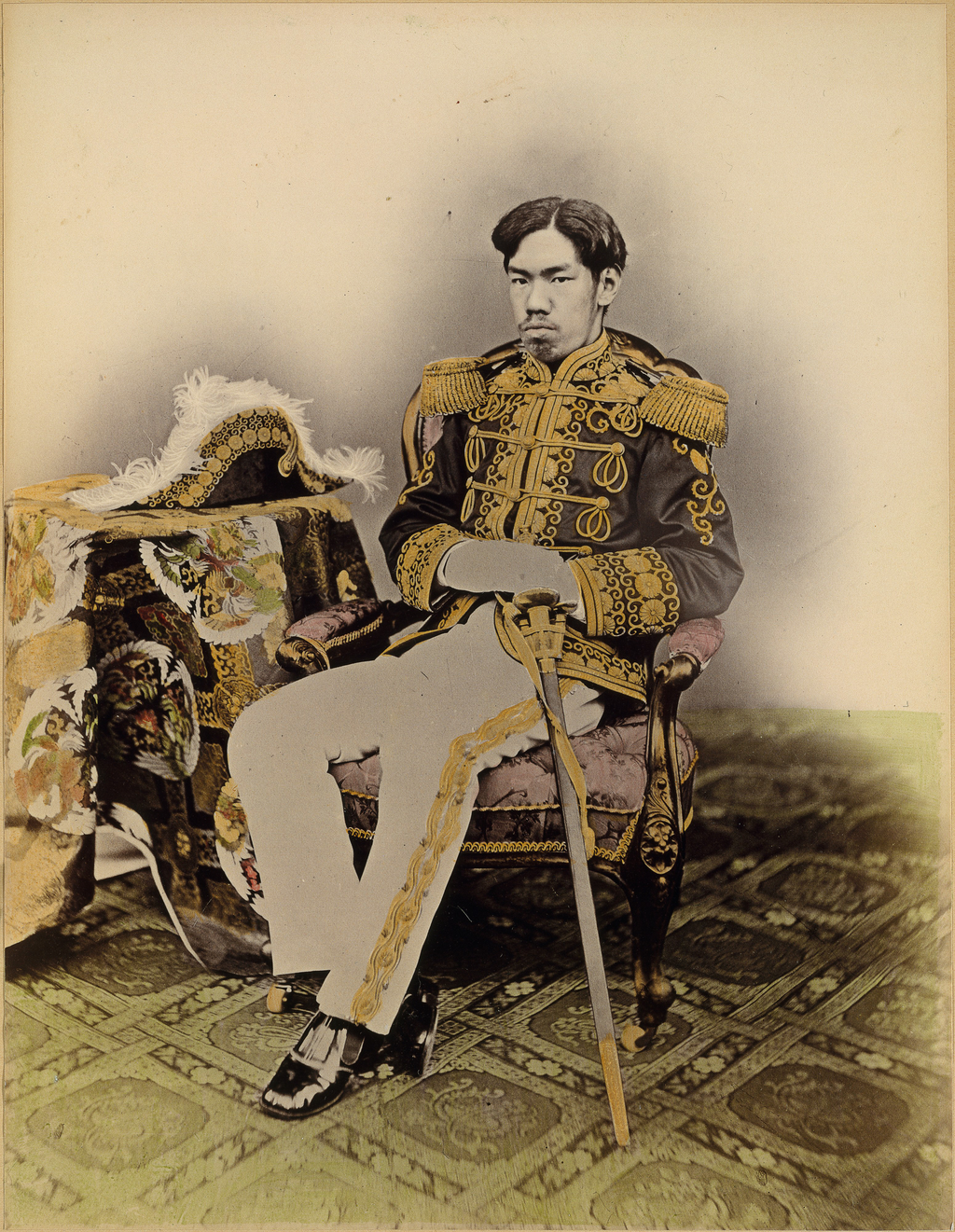
An. image of Emperor Meiji in 1873. Photograph by Uchida Kuichi.

The Tokugawa Shogunate

As far back as the twelfth century, Japan was ruled by shoguns or military generals. The emperor did not exercise much power. The shogun did not need the emperor’s permission to run the administration. The country was divided into numerous domains, each ruled by a daimyo. The stability of this system was disturbed during the fifteenth century when Japan found itself in a constant state of war, that continued for about a hundred years. It was in 1603, with the establishment of the Tokugawa shogunate, that the chaos ended. After its victory at Sekigahara, one of the major problems for the new shogunate was impressing its superiority upon the entire country.

The founder of the shogunate, Tokugawa Ieyasu, had a clever way of keeping the daimyos in check. This system was called sankin kotai. The daimyo had to be present in the shogun’s castle in Edo (now Tokyo) from time to time. In his absence, he had to leave his family there. The main purpose behind keeping these hostages was to ensure there was no possibility of any rebellion against the shogun. This system was made more strict during the time of the third shogun, Tokugawa Iemitsu(1).

However, the shogun’s rule was not entirely unquestioned. The daimyos at Choshu and Satsuma were among the strongest of his opponents. He ensured that these tozama (outsiders) daimyos remained far away from the capital of Edo(2).

And so, the Tokugawa rule continued for over two centuries. This period is also called the Edo period and saw many developments in the economic and educational fields.

The Western World Comes Knocking

As many European powers had started establishing colonies worldwide, the constant threat of invasion from the West loomed over kingdoms in Asia. It was inevitable that the kingdoms in the east, that had remained secluded for centuries, had to open up. The isolation policy of Japan (sakoku) prevented the entry of foreigners and prohibited Japanese people from leaving the country. The only Western country that had contact with Japan during this period of seclusion was Holland. This changed with the signing of the Treaty of Kanagawa.

Japan was coerced into signing the Treaty of Kanagawa when Commodore Matthew Perry of the US Navy brought his fleets to Japanese shores. China’s defeat in the First Opium War was an important turning point in Japan’s perception of the West. The Japanese were convinced that the ‘barbarians’ would stop at nothing until they had everything going their way(3). The unequal treaties were calculated plans made by the Western powers to exploit the resources of the other country involved. The Treaty of Nanjing opened up five Chinese ports; the Treaty of Kanagawa was meant to serve a similar purpose. By agreeing to the treaty, the Japanese cleverly appeased the Westerners and at the same time, got a chance to explore Western advancements.

Unlike the Chinese, the Japanese were already educated about the happenings around the world(4). The Dutch traded with Japan through the port of Nagasaki. They were demanded to submit reports to the shogun, detailing everything that they learned about the world from the ships arriving at Nagasaki(5). The Tokugawa regime had also set up a similar outpost at Pusan, in order to maintain diplomatic relations with Korea(6).

It is also noteworthy that during the 1860s, the Qing dynasty in China was trying to bring back its popularity through the Tongzhi Restoration. The chief driving force behind the movement was the emperor’s mother, Empress Dowager Cixi. But it was not an easy task.

China was home to a diverse population. It consisted of the Hans, the Mongols, the Manchus, etc. These communities often had many clashes, making governing them difficult. The improper execution of Confucianism was labeled as the root cause of all the difficulties of the state(7).

The Self-Strengthening Movement in China helped in uplifting the situation to some extent. In 1868, the Burlingame Mission was sent to countries like the US, Britain, France, etc. In the same year, China and the US signed the Burlingame-Seward Treaty which reduced the hostility between the states and made traveling less complicated. Despite its intentions of reforming China, the Burlingame Mission could not make much of an impact due to the reluctance of certain pro-Confucian officials(8).

On the contrary, Japan was a more homogenous society. The sense of solidarity was strong amongst the Japanese youth who spoke the same language and belonged to the same culture. This unity proved to be advantageous for the shogunate as these scholars would later become the leaders of their domains and help in smooth administration(9). Japan had also started sending missions to other countries, even before the famous Iwakura Mission during the Meiji period. Traveling became much easier for Japanese citizens, thanks to the Tariff Convention of 1866 which removed the ban on overseas travel(10). A Chinese writer called Wei Yuan had written a book containing details about Western countries. Ironically, it was more popular among the Japanese than the Chinese(11).

Emperor Meiji

The Choshu and Satsuma domains were not particularly on friendly terms, but they shared a strong dislike for the shogunate. The age-old saying ‘The enemy of an enemy is a friend’ seems apt to describe the formation of the Satcho alliance in 1866.

The shogunate went to war with Choshu in 1866, where it had to accept defeat. The next months were marked with numerous rebellions - as many as 106 peasant protests(12). The daimyo at Tosa, another anti-Tokugawa domain, proposed to make the administration bicameral. The shogun seemed to come to terms with the idea, provided the Tokugawas would be the rightful owners of their land(13). However, the Choshu and Satsuma domains were not pleased with the fact that the shogun’s family would still, within the new system, manage to hold a considerable amount of power with the lands they possessed. They marched to Kyoto and convinced the crown prince Mutsuhito, who had just ascended the throne, to take the power in his hands. This was the start of a massive civil war between the armies of the Tokugawa shogunate and the imperial loyalists, otherwise known as the Boshin War.

The last shogun, Tokugawa Yoshinobu, resigned on November 9, 1867. This formally marked the end of the shogunate. The power was handed over to the emperor. Mutsuhito was now known as Emperor Meiji.

In 1868, in the coronation ceremony of the new emperor, it was proclaimed that decisions would be taken after consulting the public and ‘knowledge would be sought from all around the world’(14). Many Western military traditions like firing a twenty-one-gun salute soon became an eminent part of Japanese military traditions. The emperor himself wore Western clothing but did not entirely give up his Japanese roots(15). It was the Emperor's cabinet that was responsible for the rapid changes in the society (the emperor was just a boy of 15 when he was crowned). But the emperor was sincerely curious about the developments in the nation. He valued education - both traditional and Western(16). He also encouraged the production of Japanese goods. Sakuma Shozan’s ideology of blending Eastern ethics with Western science is said to have influenced Meiji greatly(17). While major changes kept happening, a mission was sent abroad in 1871 to learn about the West with a closer lens. The Iwakura Mission was a milestone in the process of establishing a distinct identity of the imperial state and nullifying the effects of the unequal treaties.

It is quite interesting that both China and Japan faced similar kinds of crises. Japan systematically tackled them by making the necessary changes that the circumstances called for. The rise of imperialism in Japan overlapped with the decline of the Qing dynasty in China. The Qings, undoubtedly, made a blunder by ignoring the telltale signs of their incompetence, resulting in a rather humiliating defeat in the war with Japan in 1894.

What do you think of the Meiji Restoration? Let us know below.

Now read Disha’s article on the Hitler Youth here.

Bibliography

Gordon, Andrew. A Modern History of Japan: From Tokugawa Times to the Present. Oxford University Press, 2003.

Jansen, Marius B. The Making of Modern Japan. Cambridge, MA: The Belknap Press of Harvard University Press, 2000.

Keene, Donald. Emperor of Japan: Meiji and his World, 1852-1912. Columbia University Press, 2002.

Vogel, Ezra F. China and Japan: Facing History. Cambridge, MA: The Belknap Press of Harvard University Press, 2019.

Wilson, Noell H. “Western Whalers in 1860s’ Hakodate: How the Nantucket of the North Pacific Connected Restoration Era Japan to Global Flows.” Chapter. In The Meiji Restoration: Japan as a Global Nation, edited by Robert Hellyer and Harald Fuess, 40–61. Cambridge: Cambridge University Press, 2020.

References

1 Marius B. Jansen, The Making of Modern Japan, ‘The Tokugawa State’, 56-57.

2 Ezra F. Vogel, China and Japan: Facing History, ‘Trade without Transformative Learning, 838–1862’, 52.

3 Andrew Gordon, A Modern History of Japan: From Tokugawa Times to the Present, ‘The Overthrow of the Tokugawa’, 48-49.

4 Vogel, China and Japan, ‘Responding to Western Challenges and Reopening Relations, 1839–1882’, 67-68.

5 Ibid.

6 Gordon, A Modern History of Japan, ‘The Tokugawa Polity’, 18.

7 Vogel, China and Japan, ‘Responding to Western Challenges and Reopening Relations, 1839-1882’, 69.

8 Ibid, 71.

9 Ibid, 66.

10 Noell H. Wilson, The Meiji Restoration: Japan as a Global Nation, ‘Western Whalers in 1860s’ Hakodate: How the Nantucket of the North Pacific Connected Restoration Era Japan to Global Flows.” 48-49.

11 Vogel, China and Japan, ‘Responding to Western Challenges and Reopening Relations, 1839–1882’, 67-68.

12 Gordon, A Modern History of Japan, ‘The Overthrow of the Tokugawa’, 57-58.

13 Ibid.

14 Vogel, China and Japan: Facing History, ‘Responding to Western Challenges and Reopening Relations, 1839–1882’, 73.

15 Keene, Emperor of Japan, 'Chapter 23', 214-215.

16 Ibid.

17 Ibid, ‘Chapter 21’, 193.

As Japan conquered more territory from the 1930s, and as World War Two grew in scale following the attack on Pearl Harbor in 1941, propaganda efforts across Japanese-controlled East Asian territories became more important. Here, Maddison Nichol follows up on his article on Nazi World War Two propaganda (here), and explains the importance of race and anti-Western ideology in the promotion of Japan’s East Asian Co-Prosperity Sphere.

A Japanese 1930s propaganda poster promoting co-operatuion between Japan and - Japanese-controlled - Manchuria and China.

A Japanese 1930s propaganda poster promoting co-operatuion between Japan and - Japanese-controlled - Manchuria and China.

In 1941, the Japanese Empire attacked Pearl Harbor in a surprise air raid. The intention was to sink much of the American Pacific Fleet which was a threat to growing Japanese imperial ambitions in East Asia. Many people forget that Japan had been at war with China since 1937, and by 1941 Japanese society was used to military propaganda blasts about the lofty East Asian Co-Prosperity Sphere and other grandiose ideas intended to mask the ugly nature of imperialism. But how did the Japanese Empire justify their aggression and conquests to their own people and those living in the conquered regions? By utilizing racially charged propaganda, picked up from the Germans under Hitler, and vilifying the Western imperial powers through past acts of aggression and gunboat diplomacy, the Japanese intended to create a semblance of authority and affection among their own people and the conquered inhabitants of Asia.


Race

WW2 was a war that revolved around the idea of race. At the apex of the Nazi racial hierarchy were the Aryans, those with blonde hair and blue eyes and the purest of all races. Aryans were the ‘super race’ in this ideology, and the presence of a ‘super race’ means there must be a ‘sub race’. Essentially, the idea goes that everyone who wasn’t Aryan, or in our case here, Japanese, was a ‘sub race’ and inferior to the ‘super race’. The Japanese were even referred to as ‘yellow Aryans’ by their Axis allies.[1]

How did the Japanese utilize their idea of racial superiority? Domestically, like in Nazi Germany, the Japanese proclaimed that they were racially superior to Koreans, Chinese, and other Asian peoples. The Japanese watched Hitler disrupt the status quo of Europe through racially charged propaganda in just shy of a decade, so the Japanese figured they could do the same thing in Asia under their own banner.[2] There was one issue with this new racial model developed by the Japanese. The Nazis had a scapegoat, such as those of Jewish and Slavic descent. The Japanese didn’t. Luckily, like any imagined order, they could just make one up like the Nazis did. Instead of Jews and Slavs, the Japanese chose Britons and Americans, the premier imperial powers in Asia.[3]

There was a long, and confusing, rationale about racial superiority in the Second World War, but the simple version is that the Germans thought they were the superior race destined to rule the world, and so did the Japanese. All this background aside, let’s get into the propaganda itself.

The term “New World Order” is not unfamiliar among savants and scholars of the Second World War. The Nazis used it constantly, and yet not many know that the Japanese intended to create their own New Order in Asia. This was called the East Asia Co-Prosperity Sphere. The central tenant for the Co-Prosperity Sphere was that Asia should belong to Asians and not be subject to the British and American imperial ambitions.[4] Naturally, the Japanese Empire should control all of Asia instead of the Europeans. Throw off the yoke of Western imperialism for… well, another version of Western imperialism.

The real reason for the war in Asia was imperial ambitions. Japan needed coal, iron, and other resources that they just didn’t have in the Home Islands that other nearby areas had, such as Korea and Indonesia. However, masking these goals through race allowed the Japanese to persuade their own people that they intended to liberate Asia from the West. They tried to inform the conquered people that they meant no harm, but were there to free them from the Western powers.[5] A Japanese propaganda corps sent to the Philippines was told to deliver messages about why the Japanese were compelled to go to war. Leaflets describing why the Japanese had gone to war against the USA were given out to Filipinos during the invasion of the Philippines by special propaganda corps.[6] The goal was to try and convince the Filipinos that Japan was an ally, not an enemy. Asia must be liberated from the Europeans and Americans so that peace can reign in Asia. Japanese propagandists cited race issues in the United States as justification for a war of Asian liberation and handed it out to both Japanese people domestically and those of conquered areas to justify their imperial ambitions through the lens of racial struggle.[7] This idea of race goes well with the next big aspect of Japanese wartime propaganda, past deeds of atrocity committed by the Western powers.


Reminders of Western Atrocities

In 1839, Great Britain attacked Qing China for restricting the trade of Opium into China. Opium was a major export for the British and the Chinese market for the drug was lucrative and funded many well off British merchants back in Britain. The Opium Wars went from 1839-1842, and 1856-1860 and brought down the long-established era of Chinese dominance in East Asia. It also worried other parts of Asia, such as Japan, by showing the other Asian countries that Europe would always get what it wanted and was willing to fight against anyone who opposed them.

This war, while over a century old by the time Japan bombed Pearl Harbor, was made into a wartime film by the Japanese to enable everyone to recall the atrocities of the British in the name of wealth. The film was “intended to demonstrate the evils of the British Empire and by extension, the need for someone to step in to halt European aggression, The Opium War also implicitly states the case for Japan as China’s saviour.”[8] By making the Japanese and the Chinese remember the British atrocities against the Chinese, it would hopefully rally the Japanese to support the war while also promoting Japan as the savior of China. By portraying the British in such a negative light, Japanese propagandists hoped the Chinese would support the Japanese effort in creating the Co-Prosperity Sphere and finally bring peace to a racially pure Asia free from Western imperialism.

We don’t know how well the film was received in China and other occupied territories, but on the home front it was a big hit.[9] Much like the Germans, film was intended to reach a broader audience and get people to grasp the key points of the ideological propaganda. But film was not the only way to get people to recall atrocities. In The Philippines, Japanese propaganda corps tried to get Filipinos to remember American atrocities against them, such as how the Filipino soldiers of the USAFFE were being used as shields for the Americans, or how the soldiers were discriminated against by the Americans.[10] They also reminded the Filipinos of how 297 of 300 Filipino laborers were murdered by American soldiers after the completion of the Fort.[11] By trying to appeal to the Filipinos through invoking recollections of American atrocities, the Japanese intended to create a truce between the two Asian peoples by declaring how Japan was their savior from Western atrocities.

We know in hindsight that the Japanese committed atrocities of their own in China, The Philippines, and other areas of occupied Asia. But this was their propaganda strategy to garner support domestically and in the occupied territories for the Japanese war effort. By utilizing the all-too-common race idea into propaganda and causing Asians to remember Western imperial violence, the Japanese tried to create their New World Order in Asia with their superior race leading the rest. Europe and America would be removed, and peace would return to Asia at last. There are many other facets to Japanese wartime propaganda, such as bushido and kokutai, but in broad strokes race and past atrocities were the central ideas to the creation of the Co-Prosperity Sphere. Japan’s “super race” would lead the rest of Asia into an era of peace and harmony free from the corruption of the West. Anyone who actually believed them would soon be taught that liberation was just another name for imperialism.


What do you think of Japanese World War Two propaganda? Let us know below.


[1] Saul K. Padover, “Japanese Race Propaganda”, in The Public Opinion Quarterly 7, No. 2 (Summer, 1943), 192.

[2] Ibid, 193.

[3] Ibid, 194.

[4] Ibid, 196.

[5] A. J. Grajdanzev, “Japan’s Co-Prosperity Sphere”, Pacific Affairs 16, No. 3 (September 1943), 311.

[6] Motoe Terami-Wada, “The Japanese Propaganda Corps in the Philippines”, in Philippine Studies 38, No. 3 (Third Quarter 1990), 285.

[7] “Japanese Race Propaganda”, 197-198.

[8] David Desser, “From the Opium War to the Pacific War: Japanese Propaganda Films of World War II”, in Film History 7, No. 1, Asian Cinema (Spring, 1995), 44.

[9] Ibid, 44.

[10] “The Japanese Propaganda Corps in the Philippines”, 292.

[11] Ibid, 294.

Sources

1: Saul K. Padover, “Japanese Race Propaganda”, in The Public Opinion Quarterly 7, No. 2 (Summer, 1943), 192.

2: Ibid, 193.

3: Ibid, 194.

4: Ibid, 196.

5: A. J. Grajdanzev, “Japan’s Co-Prosperity Sphere”, Pacific Affairs 16, No. 3 (September 1943), 311.

6: Motoe Terami-Wada, “The Japanese Propaganda Corps in the Philippines”, in Philippine Studies 38, No. 3 (Third Quarter 1990), 285.

7: Saul K. Padover, “Japanese Race Propaganda”, in The Public Opinion Quarterly 7, No. 2 (Summer, 1943), 197-198.

8: David Desser, “From the Opium War to the Pacific War: Japanese Propaganda Films of World War II”, in Film History 7, No. 1, Asian Cinema (Spring, 1995), 44.

9: Ibid, 44.

10: Motoe Terami-Wada, “The Japanese Propaganda Corps in the Philippines”, in Philippine Studies 38, No. 3 (Third Quarter 1990), 292.

11: Ibid, 294.

The word ‘Ninja’ has interesting connotations in most Western countries; however, Ninjas have a long and fascinating history as secret agents or mercenaries in Japan. Here, Captain Max Virtus (aka Adrian Burrows) returns to the site and, in a light-hearted way, tells us what you don’t know about Ninjas…

PS – Max has just released a new book, Escapades in Bizarrchaeology (Amazon US | Amazon UK).

Ogata Shuma (later Jiraiya) raising his sword to kill a python attacking a large toad, Jiraiya is portrayed as being a ninja. From mid-19th century Japan.

Ogata Shuma (later Jiraiya) raising his sword to kill a python attacking a large toad, Jiraiya is portrayed as being a ninja. From mid-19th century Japan.

Everyone loves a Ninja! I know that I, Captain Max Virtus, and the rest of planet Earth certainly do. But what do we really know about those Shinobi?

Not a lot. And what we do know is usually wrong. And what we don't know is mostly right.

The problem is that information is scarce due to Ninjas being so mysterious and secretive. Which was the whole point - after all they were the feudal Japanese equivalent of a Secret Agent. Each Shinobi was trained in espionage, sabotage, infiltration and assassination (although not necessarily in that order). Ninjas saw most activity during the Sengoku (or Warring States) period of Japan in the 15th century, which is when local lords vied for power and land, but had pretty much ceased to exist by the 17th century when Japan was unified. They were at the height of their powers for approximately 200 years, a drop in the historical ocean, yet we still fondly remember them today.

Now thanks to my warehouse of Bizarrchaeology, I have learnt a great deal about the ways of the Ninja. Sure, they more than likely spent a lot of time doing the things you would expect a ninja to do; setting explosives, tree climbing, making poisons, throwing shuriken and eating pizza in their sewer layer. But what are some things that you don't know about Ninjas? Glad I asked myself that question!


Ninjas love Cricket(s)

As I discovered when trying to sneak up on an owl whilst covered in bells (don't ask, I've set myself some fairly strange and highly unnecessary challenges during my time as a Captain of Bizarrchaeology) even the stealthiest of Ninja's footsteps can be heard. The best way to avoid this? Simple, bring a box of crickets with you wherever you go. Those chirp chirping chappies are heard throughout Japan, so a roaming Samurai won't be alerted by hearing their familiar stridulation (that’s a fancy word for chirp but seeing as I had already used the word chirp in the previous sentence, I thought I had better use a different word. I wouldn't want to type chirp again now would I?). A skilful Ninja can release the crickets from their containment into the wild and then continue with their sneaking, safe in the knowledge that they will not be heard.

Normal
0


false
false
false

EN-GB
JA
X-NONE


 <w:LatentStyles DefLockedState="false" DefUnhideWhenUsed="true"
DefSemiHidden="true" DefQFormat="false" DefPriority="99"
LatentStyleCount="276">
<…

A (possibly) Stridulating Cricket. Is it just me or would giant Crickets be freakin' terrifying? Let's all just take 12 minutes and 32 seconds out of our day and think about that. Available: here.

Ninjas had fake feet

It makes sense, after all, the last thing you want that roaming Samurai to notice is a trail of footprints belonging to a highly skilled and deadly ninja. So instead Ninja footwear would have 'ashiaro' (fake footprints) affixed upon them, making it appear that the feet belonged to an elderly woman or a young child rather than a trained Ninja carrying a deadly Kunai (which was actually a simple gardening tool, it's going to look much less suspicious if a Ninja is caught carrying some hedge clippers rather than a skull split-tingly sharp Katana and a yumi long bow). In actual fact, Ninjas rarely used the weapons that you'd expect them to.


Real Ninjas don't wear Black

Yes, I know, I was shocked and saddened by this discovery too. When I think of a Ninja I like to imagine a man of shadow, clad in the distinctive Shinobi Shizoku, dressed from head to toe in an awesome looking black onesie of death (or a giant mutant turtle, either or). But that is exactly the point - the last thing a secretive Ninja would want is to LOOK like a secretive Ninja. Instead a Ninja should look like everyone else.

What would a Ninja have most likely worn? I’m glad you asked. A loose fitting Gappa travel cape that conceals light armour worn in layers beneath it (loose parts of the clothing would be tied with rope to prevent the total embarrassment of tripping out of a tree and ending up incapacitated in front of a startled would be victim). It's still worth wearing dark colours though, the last thing you would want is a red blood stain on your chest for everyone to see.

So there you have it, several things that you probably didn't know about Ninjas. Whilst reading this escapade you have also discovered how you can be a Ninja. Because the best way to be a real Ninja is to be absolutely nothing like a real Ninja. After all that is exactly what a real Ninja would do.


We do hope you enjoyed the article! You can read another of Max’s articles on the three most bizarre tanks ever here. You can also read Max’s new book Escapades in Bizarrchaeology: The Journals of Captain Max Virtus - available in both print and electronically.


Blurb on Escapades in Bizarrchaeology

The History Book For People Who Don't Like History - Yet!

Captain Max Virtus has spent his life Excavating the Extraordinary and Unearthing the Unusual. Gathering the history of the Bizarre to exhibit in his Warehouse of Bizarrchaeology.

Now you have the opportunity to take a guided tour of his life's work, in this, his personal journal.

Discover why bats were used as bombs, how an emu can defeat a tank, the reason why guns were installed in cemeteries ... and how you can get shot with an arrow ... and survive.

All this ... and then things get really weird!

Take History To The Max.

Book available here: Amazon US | Amazon UK

Posted
AuthorHistory Is Now Magazine
CategoriesBlog Post