In the summer of 1642, England stood upon the edge of an abyss. Years of political confrontation, religious disputes, and constitutional arguments had brought the kingdom to a moment of unprecedented crisis. What had begun as a struggle over taxation, royal authority, and the limits of government was rapidly becoming something far more dangerous. The language of petitions and parliamentary debate was giving way to the language of muskets, cavalry charges, and battlefield commands.
Terry Bailey explains.
You can read part 1 on the background to the war here.
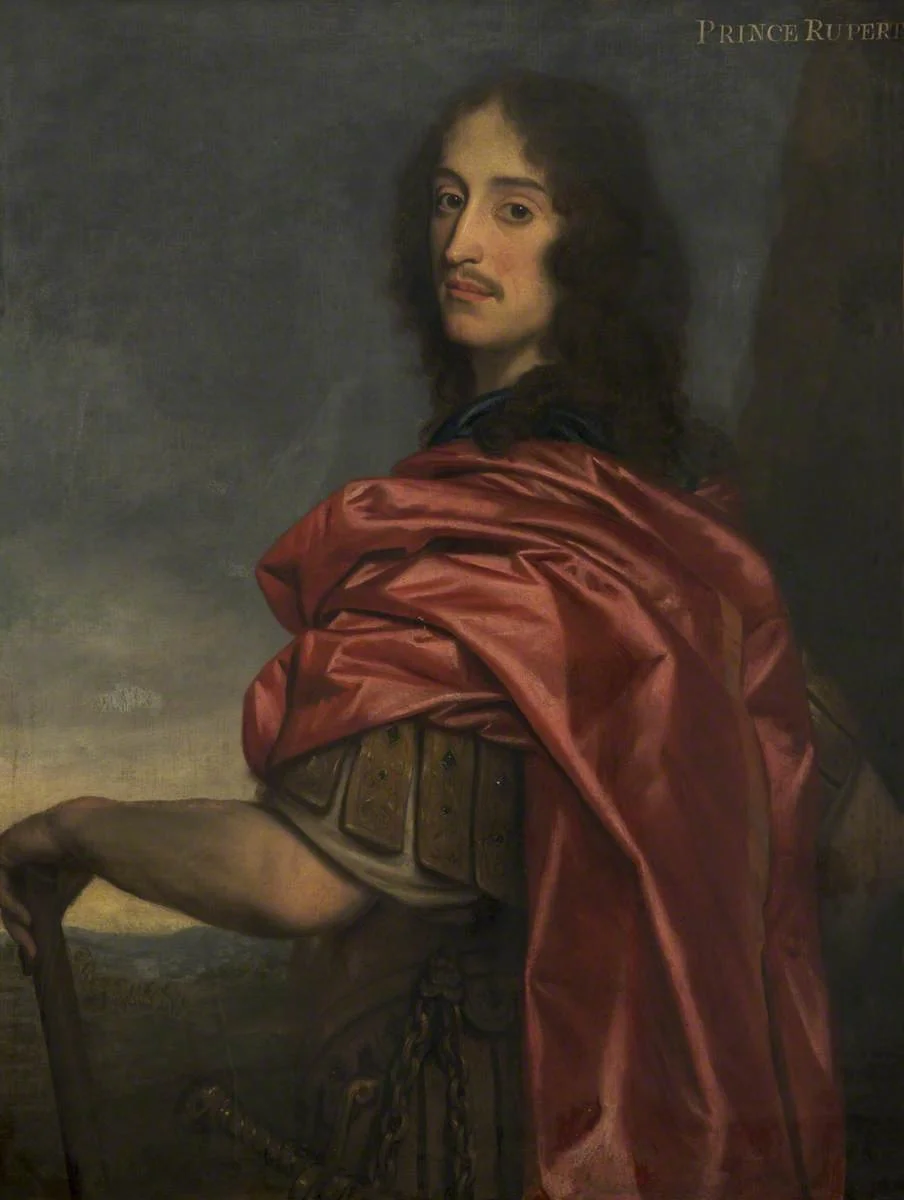
Portrait of a Nobleman (said to be Prince Rupert) by the Circle of Gerard van Honthorst. Source: Public domain, Bolton Museum, available here.
For generations, Englishmen had believed that their political system rested upon a delicate balance between Crown, Parliament, and the ancient laws of the realm. Few imagined that this system could collapse entirely. Yet by the time King Charles I raised his standard at Nottingham in August 1642, compromise appeared impossible. The nation fractured into rival camps, communities divided against themselves, and neighbors prepared to fight neighbors in a conflict that would ultimately reshape the political future of Britain.
The English Civil War was far more than a military contest. It was a struggle over fundamental questions of authority and legitimacy. Could a king rule by divine right regardless of parliamentary opposition? Could Parliament lawfully resist its sovereign? What role should religion play in government? These questions would not only determine the outcome of the war but would also influence the development of constitutional government for centuries to come.
The division of England into Royalist and Parliamentarian camps did not occur overnight. Throughout the 1630s and early 1640s, political loyalties remained fluid and uncertain. Many who later became committed Royalists had initially criticized Charles I's policies, while numerous future Parliamentarians still considered themselves loyal subjects of the king.
Most English people did not desire revolution. They wanted stability, prosperity, and peace. Yet events increasingly forced them to choose sides. The attempted arrest of the Five Members in January 1642 convinced many that Charles could no longer be trusted. At the same time, Parliament's growing control of government alarmed those who feared that traditional authority was being undermined. The resulting divisions cut across every level of society. Noble families split over questions of loyalty. Merchants found themselves supporting opposing causes. Clergymen preached conflicting visions of England's future. Even within individual households, husbands and wives, fathers and sons, could disagree about where their allegiance lay.
The labels that emerged reflected these divisions. Supporters of the king became known as Royalists, often referred to by their opponents as Cavaliers. The term originally implied a swaggering, aristocratic horseman and was intended as an insult, although many Royalists eventually embraced it. Parliament's supporters became known as Roundheads, a reference to the shorter hairstyles favored by many Puritans and London citizens. These labels, however, often concealed a far more complex reality. Allegiance was shaped by local circumstances, personal loyalties, religious beliefs, economic interests, and family traditions. The Civil War was not a simple contest between rich and poor, north and south, or aristocrats and commoners. It was a deeply complicated conflict that divided every layer of English society.
One of the most remarkable aspects of the crisis was the growing importance of public opinion. Previous political disputes had largely been confined to the royal court and Parliament. By the 1640s, however, political arguments were being conducted before an increasingly engaged national audience. The spread of printing played a crucial role in this transformation. Pamphlets poured from printing presses in unprecedented numbers. Political speeches were reproduced and distributed. Sermons were printed and circulated across the country. Newspapers and newsletters reported developments with growing frequency. For perhaps the first time in English history, competing political movements attempted to mobilize popular support on a national scale.
Royalist writers portrayed Charles I as the lawful sovereign whose authority had been granted by God. They argued that resistance to the king threatened the very foundations of social order. If subjects could rebel against their monarch, what would prevent the collapse of all authority?
Parliamentarian propagandists presented a very different picture. They depicted Charles as a ruler who had repeatedly violated English law and attempted to govern without regard for Parliament or the rights of his subjects. According to this view, resistance was not rebellion but a defense of England's ancient constitution.
Both sides claimed to be defending liberty.
Both sides claimed to be protecting religion.
Both sides claimed to be preserving England.
The result was one of the earliest large-scale propaganda wars in European history.
Religion lay at the heart of many political disagreements. To modern observers, it can be difficult to appreciate the intensity of religious feeling in seventeenth-century England. Questions of doctrine and worship were not regarded as private matters. They were believed to have direct consequences for the fate of the nation and the salvation of souls. Many Protestants viewed Charles's religious policies with profound suspicion. Under the influence of Archbishop William Laud, the Church of England had adopted practices that appeared, to critics, dangerously close to Roman Catholicism. Greater emphasis was placed upon ceremony, church decoration, and episcopal authority. To Puritans, these developments represented a betrayal of the Reformation.
The king's marriage to the Catholic princess Henrietta Maria only intensified these fears. Rumors circulated constantly about Catholic influence at court. Every political dispute became entangled with concerns about religion. Parliament successfully presented itself as the defender of Protestant England. This message resonated strongly among many communities, particularly in London and the southeast. For countless Parliamentarian supporters, the war became a struggle not merely for political rights but for the future of the Protestant faith itself.
Royalists, however, viewed these fears as exaggerated and often deliberately manipulated. They argued that Parliament's religious radicals threatened the established Church and the stability of the kingdom. Thus, religious concerns pushed both sides further apart, making compromise increasingly difficult.
Economic interests also shaped the emerging conflict. England in the seventeenth century was undergoing significant social and economic change. Trade was expanding, towns were growing, and commercial wealth was becoming increasingly important. Many of the kingdom's largest trading centers tended to support Parliament. London, by far the wealthiest city in England, became the financial heart of the Parliamentarian cause. The capital's merchants possessed enormous resources, and Parliament's control of London gave it access to vital loans, supplies, and manpower.
By contrast, many rural regions displayed stronger support for the Crown. The traditional social order remained influential in much of the countryside, where local gentry often exercised considerable authority and where loyalty to the monarchy retained deep roots. Yet even these regional patterns had numerous exceptions. Wealthy merchants could be found among the king's supporters, while many country gentlemen sided with Parliament. Economic considerations interacted with religious beliefs and local politics to produce a complex patchwork of allegiances. England was not divided by a single fault line. It fractured along many.
The symbolic beginning of the Civil War occurred on the 22nd of August 1642 when Charles I raised the royal standard at Nottingham Castle. The ceremony was intended to signal that the king was formally calling his loyal subjects to arms. It was a declaration that political dispute had become military conflict. The choice of Nottingham reflected strategic considerations. Located near the center of England, the town offered access to important routes and communications. Yet the ceremony itself revealed the difficulties facing the Royalist cause.
A violent storm struck shortly after the standard was raised. Strong winds reportedly tore the banner down. Many observers interpreted the incident as a divine warning regarding the king's cause. Whether viewed as a bad omen or merely an unfortunate accident, the event quickly became part of the war's mythology. More importantly, the response was initially disappointing. Fewer supporters arrived than Charles had hoped. The king possessed prestige and legitimacy, but converting loyalty into effective military power proved more difficult than expected. The Civil War had begun, but neither side yet understood how long or destructive it would become.
Unlike many continental states, England possessed no large standing army. Both sides therefore faced the immense challenge of developing military forces almost from scratch. Recruitment relied heavily upon local militias and the influence of powerful individuals. Noblemen and wealthy landowners raised regiments among their tenants and dependents. Towns organized companies of volunteers. Existing militia units were absorbed into larger military formations. The resulting armies reflected the social diversity of the kingdom.
Royalist forces generally attracted greater support from sections of the aristocracy, traditional landowners, and regions where loyalty to the monarchy remained strongest. Parliament drew heavily from London's population, commercial communities, Puritan congregations, and areas concerned about royal authority. Neither army was initially well-trained. Weapons varied widely in quality. Uniforms were inconsistent or absent. Supply systems were primitive. Officers often possessed little military experience. Many soldiers entered the war with romantic notions of honor and glory. They quickly discovered a harsher reality of exhaustion, hunger, disease, and fear.
The greatest challenge was maintaining discipline. Commanders had to transform enthusiastic volunteers into effective fighting forces capable of operating under battlefield conditions. This process would take years and would become one of the defining military stories of the war.
Among the most colorful figures of the conflict was Prince Rupert of the Rhine. Nephew to Charles I and grandson of King James I, Rupert brought valuable continental military experience to the Royalist cause. Tall, energetic, and fearless, he rapidly acquired a reputation for personal courage. His leadership of Royalist cavalry became legendary. Rupert favored aggressive attacks designed to shatter enemy formations through speed and shock. His cavalry often achieved spectacular successes. At the same time, critics argued that his impetuous nature sometimes prevented him from exploiting victories effectively.
Parliamentarian propaganda portrayed him as a ruthless foreign adventurer. Wild rumors circulated that he possessed supernatural powers and even travelled with a magical dog capable of deflecting bullets. Such stories reflected both fear and fascination. Rupert became one of the war's most recognizable figures and a symbol of the Royalist cause.
If Rupert represented military energy, John Pym represented political determination. For years, Pym had stood at the forefront of parliamentary opposition to Charles I. Through speeches, alliances, and organizational skill, he helped transform scattered grievances into a coordinated political movement. Pym understood that wars were won not only on battlefields but through administration, finance, and public support. Parliament's ability to raise money, organize resources, and maintain political cohesion owed much to his efforts. Though he never commanded troops in battle, his influence on the war's outcome would prove immense. Many historians regard him as one of the principal architects of Parliament's eventual success.
Another important figure was Thomas Fairfax. The son of a distinguished Yorkshire family, Fairfax combined personal courage with genuine military talent. During the opening campaigns, he demonstrated a capacity for disciplined leadership that would later distinguish him from many contemporaries. Unlike commanders whose authority depended largely upon social rank, Fairfax showed a willingness to learn from experience and adapt to changing circumstances. These qualities would become increasingly important as the war evolved from a conflict of enthusiastic amateurs into a struggle requiring a professional military organization. The future belonged not merely to bravery but to efficiency, discipline, and innovation.
The first major battle of the war took place at Edgehill on the 23rd of October 1642. Thousands of men assembled in the Warwickshire countryside, many experiencing combat for the first time. The atmosphere combined excitement, fear, and uncertainty. Few participants knew what to expect. Prince Rupert's cavalry launched a powerful assault against Parliament's horsemen, driving them from the field. Yet in pursuing the fleeing enemy, many Royalist riders became separated from the main battle.
Meanwhile, the infantry struggle at the center developed into a brutal contest of musket fire and pike combat. Units advanced and retreated amid confusion, smoke, and mounting casualties. As darkness approached, neither side had achieved a decisive advantage. The battle ended inconclusively.
Yet Edgehill carried enormous significance. It demonstrated that neither side could easily defeat the other. Expectations of a short war evaporated. The conflict would demand far greater sacrifices than anyone had imagined.
For ordinary civilians, the outbreak of war brought profound disruption. Armies required food, horses, carts, accommodation, and money. Communities were expected to support whichever force happened to occupy their area. Refusal could lead to punishment. Trade routes became dangerous. Markets were disrupted. Agricultural production suffered. Taxes increased as both sides sought resources for the war effort. Families often experienced the conflict in deeply personal ways. Relatives fought on opposing sides. Long-standing friendships collapsed under political pressure. Parish churches became centers of dispute as religious divisions intensified.
The psychological impact was equally severe. Rumors spread constantly. Reports of battles and atrocities circulated through towns and villages. Uncertainty became a permanent feature of daily life. For many civilians, the Civil War was not an abstract political struggle but a harsh reality that entered their homes, threatened their livelihoods, and shattered familiar certainties.
By the close of 1642, England had crossed a threshold from which there could be no easy return. The constitutional crisis that had begun with arguments over taxation and royal authority had evolved into a national civil war. The raising of the royal standard, the formation of rival armies, and the bloody confrontation at Edgehill confirmed that political compromise had given way to armed struggle.
Yet beneath the military conflict lay deeper issues that would shape the future of the English-speaking world. Questions concerning divine monarchy, parliamentary sovereignty, religious authority, and political legitimacy were now being tested in the harshest possible arena. The outcome would determine not only who governed England but also how government itself would be understood.
The kingdom had fractured into competing visions of authority and liberty. What followed would become one of the most consequential struggles in British history, a conflict that would ultimately challenge the ancient assumptions of monarchy, give birth to new political ideas, and set England upon the long and uncertain road toward constitutional government.
In conclusion, the outbreak of the English Civil War in 1642 marked the moment when political disagreement ceased to be a matter of speeches, petitions, and parliamentary maneuverings, and instead became a contest decided by the sword. The raising of the royal standard at Nottingham, the hurried development of rival armies, and the inconclusive yet bloody encounter at Edgehill all demonstrated that England's constitutional crisis had passed the point of peaceful resolution. Neither Charles I nor Parliament had anticipated the scale or duration of the struggle they had unleashed. What many believed would be a short campaign to compel negotiation instead became a prolonged conflict that would consume the kingdom for nearly a decade.
Yet the significance of these opening months extends far beyond the military events themselves. The divisions that emerged in 1642 revealed a nation wrestling with questions that had no simple answers. Was a monarch's authority truly absolute if it threatened the liberties of his subjects? Could Parliament lawfully resist the Crown without descending into rebellion? Could religious unity be maintained in a kingdom increasingly divided by competing interpretations of Protestantism? These constitutional, political, and religious dilemmas transformed the Civil War into far more than a dynastic dispute. It became a profound debate about the very nature of government, sovereignty, and the relationship between rulers and the ruled.
The conflict also demonstrated that wars are fought not only on battlefields but within the hearts and minds of ordinary people. Propaganda became a powerful political weapon, shaping public opinion through pamphlets, sermons, rumors, and newspapers. Economic interests, local loyalties, and religious convictions proved just as influential as military victories in determining where communities placed their allegiance. Families were divided, friendships dissolved, and entire regions found themselves drawn into opposing camps. England was no longer a united kingdom governed by differing opinions; it had become a nation physically, politically, and emotionally fractured.
The early campaigns likewise exposed the strengths and weaknesses of both sides. The Royalists possessed experienced commanders such as Prince Rupert and enjoyed considerable support among the traditional landed elite, yet they struggled to translate loyalty into sustained military success. Parliament, under the political guidance of men such as John Pym and with rising officers including Thomas Fairfax, increasingly recognized that victory would require efficient administration, disciplined armies, reliable finance, and effective organization as much as courage in battle. The war was already beginning to reward professionalism over privilege, and this evolution would have profound consequences for the future conduct of warfare in Britain.
Perhaps most importantly, the events of 1642 shattered centuries-old assumptions about English government. The medieval ideal that the Crown and Parliament formed complementary parts of a single constitutional order had broken down entirely. Divine right monarchy had collided with an increasingly confident Parliament that believed it possessed both legal authority and moral responsibility to restrain the king. Once these competing claims were defended by armed force rather than constitutional compromise, the kingdom entered uncharted political territory from which there could be no easy return.
As the war continued into 1643 and beyond, neither side would achieve the swift victory it had expected. Instead, the conflict would become larger, more organized, and increasingly ideological. New alliances would be forged, military reforms would revolutionize England's armies, and political ambitions would grow ever more radical. What had begun as an attempt to settle a constitutional dispute would ultimately lead to the trial and execution of a king, the temporary abolition of the monarchy, and the introduction of an English republic—developments almost unimaginable when the royal standard first fluttered above Nottingham Castle.
The opening phase of the English Civil War therefore stands as one of the great turning points in British history. It was the moment when centuries of inherited political tradition gave way to revolutionary change. The questions first asked in the summer of 1642—about authority, liberty, representation, religion, and the limits of executive power—have never entirely disappeared. They continue to resonate through modern constitutional democracies, reminding us that the struggle between power and accountability, between order and liberty, is not confined to the seventeenth century but remains one of the defining themes of political history.
The next stage of the conflict would prove even more transformative. As both sides adapted to the realities of prolonged warfare, the struggle would evolve from a contest between king and Parliament into a revolution that challenged every established institution of English society. The battles that followed would decide not only the fate of Charles I, but also the future direction of the English state itself.
Now read about Terry’s series on King Kenry VIII and his wives here.