The story of the English Civil War is often told as a struggle between a tyrannical king and a liberty-loving Parliament. Yet such a simple interpretation obscures the complex reality of the man whose decisions helped plunge England into one of the most traumatic periods in its history. Charles I was neither a monster nor a fool. He was a deeply religious, conscientious, and principled ruler who sincerely believed that he was defending the rightful order of society. His tragedy was that the world around him was changing far more rapidly than he understood, and his refusal to compromise transformed political disagreements into a national crisis.
Terry Bailey explains.
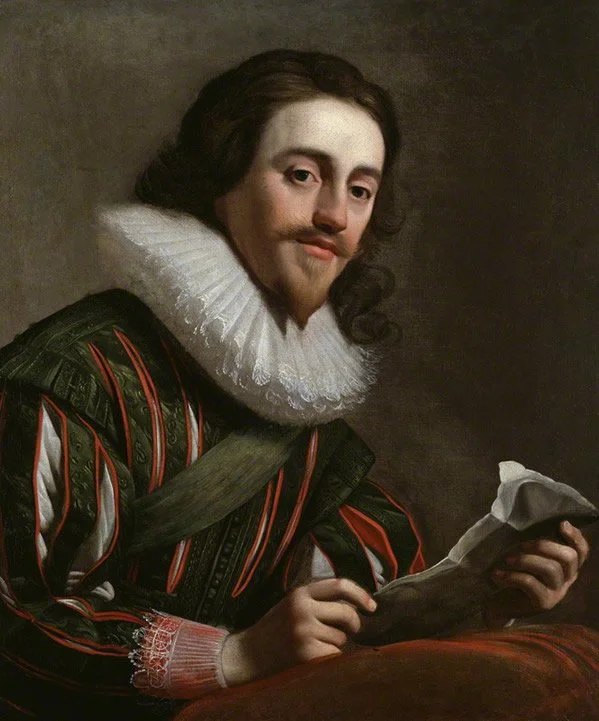
Portrait of Charles I Stuart (1600-1649), king of England. By Gerard van Honthorst. Source: Public domain, available here.
When civil war finally erupted in 1642, England had experienced decades of religious upheaval and constitutional uncertainty. The Reformation had shattered old assumptions about authority. New religious movements challenged traditional structures of power. Parliament had become increasingly confident in asserting its role within government. Against this backdrop stood a king whose understanding of monarchy belonged to an older age. Charles believed that kings ruled by divine appointment and that obedience to the Crown was part of God's design for society. Increasingly, many of his subjects disagreed.
Charles Stuart was born on the 19th of November, 1600 at Dunfermline Palace in Scotland. As the second son of King James VI of Scotland and Anne of Denmark, he was never expected to inherit the throne. The young prince's early years were marked by frailty and uncertainty. He suffered from physical ailments that delayed his development and left him struggling to match the expectations placed upon royal children. Unlike his elder brother Henry Frederick, who appeared destined for greatness and enjoyed widespread popularity, Charles was shy, reserved, and introspective.
The death of Henry Frederick in 1612 dramatically altered Charles's future. Suddenly the reluctant younger son became heir to three kingdoms. The experience had a profound effect upon his personality. Throughout his life he remained cautious, private, and intensely self-controlled. Those who knew him often commented on his dignity and seriousness, qualities that could inspire respect but also produce distance between the king and his subjects. He possessed courage and conviction, yet lacked the flexibility and political instinct that often prove essential to successful leadership.
When Charles inherited the throne in 1625, he also inherited the political philosophy of his father, James VI and I. James had been one of the most articulate defenders of royal authority in Europe. He believed firmly in the Divine Right of Kings, the doctrine that monarchs derived their authority directly from God rather than from the consent of their subjects. According to this thought process, kings were accountable primarily to God and not to representative institutions such as Parliament.
James, however, had combined these beliefs with considerable political skill. Although he frequently quarreled with Parliament, he generally understood when compromise was necessary. Charles inherited the principles but not the pragmatism. To him, monarchy was not simply a political institution; it was a sacred office established by divine will. Challenges to royal authority therefore appeared not merely as constitutional disputes but as threats to the God-given order of society itself.
The king's marriage further complicated his position. Shortly after ascending the throne, Charles married Henrietta Maria of France, a Catholic princess and sister of the French king Louis XIII. In an England still haunted by memories of religious conflict, the marriage immediately generated suspicion. Protestant fears of Catholic influence remained strong, and many English subjects viewed the new queen with deep unease.
Henrietta Maria's open practice of Catholicism fueled rumors that the royal court was becoming a center of Catholic influence. While many of these fears were exaggerated, perceptions often proved more important than reality. Throughout Charles's reign, critics repeatedly pointed to the queen's religion as evidence that England's Protestant identity was under threat. The marriage therefore became a symbol of wider anxieties about the king's religious policies and political intentions.
Relations between Charles and Parliament deteriorated almost from the beginning of his reign. England became involved in a series of unsuccessful military ventures against Spain and France that required substantial financial resources. Traditionally, monarchs relied upon Parliament to grant taxes needed for such campaigns. Parliament, however, increasingly expected concessions and reforms in return for financial support.
Charles regarded these demands as unacceptable intrusions upon royal authority. Parliament, meanwhile, believed it was defending the ancient rights and liberties of English subjects. What began as disputes over taxation soon evolved into a broader constitutional struggle over the nature of government itself.
The conflict reached a significant turning point in 1628 with the presentation of the Petition of Right. This remarkable document sought to reaffirm long-established legal principles by declaring that the Crown could not impose taxes without parliamentary consent, imprison subjects without due process, or use martial law arbitrarily. Parliament regarded the Petition as a necessary safeguard against royal overreach.
Charles reluctantly accepted the measure, but his acceptance concealed fundamental disagreements. Parliament believed the Petition represented a binding constitutional settlement. Charles viewed it as a temporary political necessity. Neither side fully appreciated how incompatible their interpretations had become. The seeds of future conflict had already been planted.
In 1629 the king took a dramatic and unprecedented step. Frustrated by continual disputes, he dissolved Parliament and embarked upon a period of government without parliamentary involvement. This era, later known by critics as the Personal Rule, would last for eleven years.
The Personal Rule remains one of the most controversial periods of Charles's reign. His opponents later condemned it as an era of arbitrary government and unconstitutional behavior. Yet the reality was more complicated. England remained largely peaceful during much of the 1630s. Commerce expanded, administration functioned effectively, and many people experienced stability and prosperity. To supporters of the Crown, the absence of parliamentary conflict appeared beneficial.
Nevertheless, significant tensions simmered beneath the surface. Charles sought alternative sources of revenue that avoided dependence upon Parliament. The most controversial of these was Ship Money. Traditionally imposed on coastal communities during times of emergency, the tax was extended across the kingdom and levied during peacetime. Although courts initially upheld its legality, many subjects regarded the measure as evidence that the king intended to govern indefinitely without parliamentary consent.
At the same time, Charles became increasingly associated with religious reforms championed by William Laud, Archbishop of Canterbury. Laud believed that the Church of England should emphasize ceremony, beauty, and order in worship. Churches were renovated, altars were repositioned, and greater attention was paid to liturgical practices.
To Charles and Laud, these reforms restored dignity and reverence to religious life. To many Protestants, especially Puritans, they appeared dangerously close to Roman Catholicism. Religious disagreements quickly acquired political significance. If the king could impose controversial religious changes without consultation, many feared that no effective limits existed upon his authority.
Religion in seventeenth-century England was never merely a matter of personal belief. It shaped political loyalties, social identities, and concepts of national purpose. Consequently, opposition to Laud's reforms became intertwined with broader concerns about royal power. What Charles regarded as the promotion of unity increasingly appeared to his critics as evidence of authoritarian ambition.
The crisis finally erupted in Scotland. In 1637 Charles attempted to introduce a new prayer book into the Scottish Church. The reaction was immediate and explosive. Many Scots viewed the measure as an attack upon their Presbyterian traditions and religious independence. Riots broke out, resistance spread rapidly, and opposition soon became organized through the National Covenant.
The resulting Bishops' Wars exposed the weaknesses of Charles's position. Suppressing the Scottish rebellion required military resources that he simply could not afford. After more than a decade of ruling without Parliament, the king found himself forced to summon one.
The Parliament that assembled in April 1640 became known as the Short Parliament because it lasted only a few weeks. Rather than immediately granting funds, members focused upon grievances concerning royal policies. Frustrated by their resistance, Charles dissolved the assembly. The decision proved disastrous. Military setbacks continued, financial pressures mounted, and by November he had no choice but to summon another Parliament.
This new assembly became known as the Long Parliament, and it would fundamentally alter the balance of power within England. Members moved aggressively against the king's closest advisers. William Laud was imprisoned. Thomas Wentworth, Earl of Strafford and one of Charles's most capable supporters, was executed. New legislation sought to ensure that future monarchs could not rule without Parliament for extended periods.
The atmosphere of distrust deepened throughout 1641. News of rebellion in Ireland generated widespread fear and uncertainty. Both king and Parliament believed military action was necessary, but neither trusted the other with control of armed forces. Questions that had once seemed abstract constitutional issues now carried immediate practical consequences.
The breaking point came in January 1642. Charles entered the House of Commons with armed guards and attempted to arrest five leading parliamentary members on charges of treason. The men had already escaped, and the king's action shocked contemporaries across the political spectrum. For many English subjects, the attempted arrest confirmed their fears that Charles was prepared to use force against Parliament itself.
The incident destroyed what little trust remained between king and Parliament. Reconciliation became increasingly unlikely. Both sides began gathering supporters, stockpiling weapons, and preparing for the possibility of war. Political disagreements that might once have been settled through negotiation now seemed irreconcilable.
By the summer of 1642 England had become a nation divided. Families, communities, and counties found themselves drawn into opposing camps. Royalists believed they were defending lawful monarchy and the divinely ordained structure of society. Parliamentarians insisted they were protecting England's liberties and constitutional traditions. Both sides claimed legitimacy. Both believed God favored their cause.
When Charles raised his royal standard at Nottingham in August 1642, the English Civil War officially began. Yet the conflict was about far more than the fate of one king. It represented a profound struggle over the nature of political authority, the relationship between religion and government, and the source of legitimate power within the state.
Charles I remains one of history's most tragic rulers because his greatest virtues became the source of his downfall. His integrity, faith, and determination commanded admiration, but his inability to compromise prevented him from adapting to changing circumstances. He saw himself as a guardian of sacred principles, while his opponents increasingly viewed him as a threat to English liberty. Between these competing visions lay a gulf that neither side could bridge.
The crisis of Charles's reign would unleash forces that transformed England forever. Questions about sovereignty, representation, religious authority, and the limits of government would dominate the decades that followed. The struggle between king and Parliament would evolve into a revolution, an experiment in republican government, and ultimately the emergence of a constitutional monarchy. In many respects, the modern political world began with the failure of Charles I to understand that power in England was no longer what it had once been.
The tragic conclusion of Charles I lies not in simple villainy or incompetence, but in the collision between a deeply held belief system and a society undergoing profound transformation. He was a king shaped by the assumptions of an earlier age, convinced that monarchy was a sacred institution ordained by God and that preserving royal authority was synonymous with preserving order itself. In many respects, Charles never believed he was acting against the interests of his kingdoms. Rather, he saw himself as defending them against forces that threatened to unravel the natural and divine structure of government. Yet it was precisely this certainty that rendered compromise impossible.
Throughout his reign, every major dispute, whether over taxation, religion, military authority, or constitutional principle was intensified by a fundamental disagreement about where sovereignty ultimately resided. Charles viewed concessions as dangerous precedents that weakened the Crown's God-given authority. Parliament increasingly viewed resistance as necessary to protect the ancient rights and liberties of English subjects. Neither side initially sought revolution, yet both became trapped within a cycle of mistrust from which there seemed no escape. What began as political disagreement gradually evolved into an ideological struggle that challenged the very foundations of the English state.
Religion further deepened these divisions. In seventeenth-century England, faith and politics could not be separated. Charles's support for Archbishop Laud's reforms, his marriage to a Catholic queen, and his attempts to impose religious uniformity across his kingdoms convinced many Protestants that both their faith and freedoms were under threat. At the same time, Charles regarded religious conformity as essential to national unity and social stability. The result was a conflict in which both sides believed they were defending sacred principles, making reconciliation increasingly difficult and ensuring that political disputes acquired a moral and spiritual intensity.
The breakdown of trust between Crown and Parliament was perhaps the most decisive factor of all. By the time Charles entered the House of Commons to arrest the Five Members in January 1642, the constitutional relationship upon which English government depended had effectively collapsed. The king no longer trusted Parliament to govern responsibly; Parliament no longer trusted the king to rule lawfully. Once that trust disappeared, political institutions could no longer contain the tensions that had accumulated over decades. The resort to arms became not inevitable, but increasingly probable.
The outbreak of civil war in 1642 marked far more than a struggle between rival political factions. It represented a revolutionary moment in English history. For the first time, fundamental questions about authority, legitimacy, representation, and the nature of government would be contested not only in Parliament and royal councils, but on battlefields across the kingdom. The conflict would challenge long-established assumptions about monarchy, inspire unprecedented political debate, and ultimately lead to the trial and execution of a reigning king, an event that shocked Europe and altered the course of history.
Yet Charles's legacy extends far beyond his own lifetime. The constitutional issues raised during his reign did not disappear with his death. Instead, they continued to shape the political evolution of Britain for generations. The struggle between royal prerogative and parliamentary authority would eventually produce a constitutional settlement in which monarchs ruled with Parliament rather than above it. Ideas concerning representative government, the rule of law, and limitations upon executive power would emerge strengthened from the turmoil. In this sense, the crisis of Charles's reign became a crucial stage in the development of the modern state.
As England moved towards civil war, few contemporaries realized that they stood at the threshold of a political transformation that would reverberate far beyond their own century. The conflict that Charles helped unleash would reshape government, redefine sovereignty, and influence constitutional thought throughout the English-speaking world. His story is therefore not merely the story of a king who lost his throne. It is the story of an age in transition, when medieval concepts of divine monarchy collided with emerging ideas of parliamentary government and popular political participation.
The raising of the royal standard at Nottingham in August 1642 marked the end of one chapter in English history and the beginning of another. Ahead lay years of bitter warfare, political experimentation, religious upheaval, and revolutionary change. The questions that Charles I could not answer peacefully would now be decided by armies in the field, and the consequences would transform England forever.
Now read part 2 about the path from protest to civil war here.