Interest in historical hoaxes involving credible public figures has remained consistent among readers of popular history, particularly cases documented across a long enough timeline to trace both the deception and its eventual unravelling. The Cottingley Fairies photographs represent one of the most thoroughly documented such cases, spanning from their creation in 1917 to a confession that did not arrive until 1983, a full 66 years later. What makes the case remarkable is not simply that two young girls fabricated a set of photographs, but that those photographs went on to convince one of the most publicly rational men in England: Sir Arthur Conan Doyle, the creator of Sherlock Holmes, a character whose entire literary identity rests on the rigorous, skeptical application of observed evidence.
Sami Hashem explains.
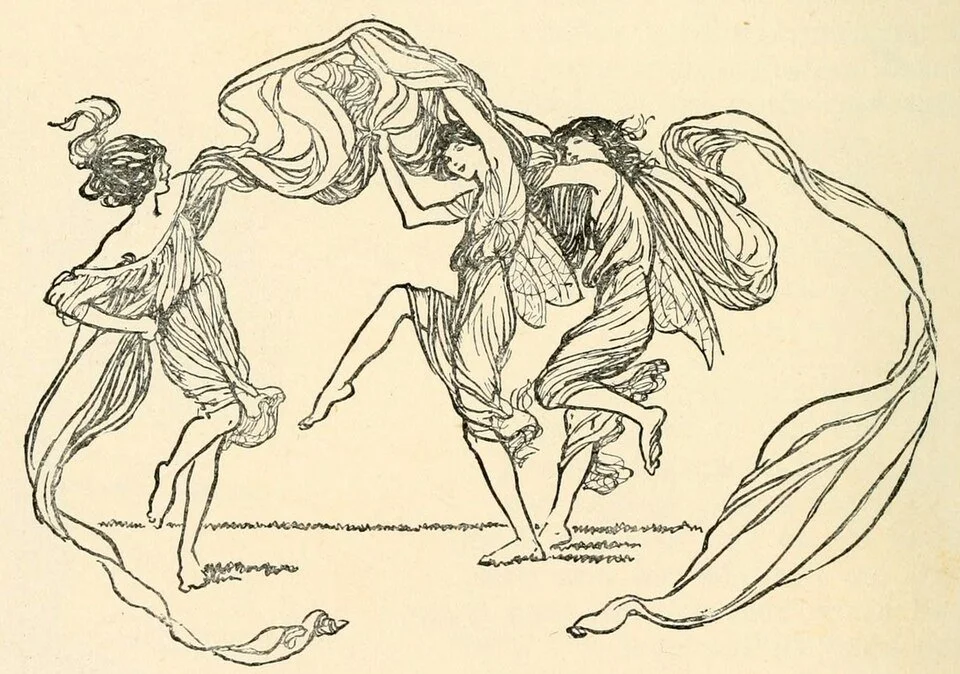
Illustration of dancing fairies, 1914, taken from the poem “A Spell for a Fairy,” by Alfred Noyes, in Princess Mary’s Gift Book", London, 1914. Source: Public Domain, Claude A. Shepperson, available here.
Yorkshire, Summer 1917
The story begins in the small village of Cottingley, near Bradford, in West Yorkshire, England. Elsie Wright, then 16 years old, lived with her family beside a stream known locally as Cottingley Beck. Her younger cousin, Frances Griffiths, 9 years old, had recently moved to the area with her mother, and the two girls quickly became close, spending long afternoons playing together by the water.
According to the account both girls gave decades later, Frances began coming home from these outings with wet shoes and stockings, a detail that drew repeated scolding from her mother. Pressed to explain why she kept getting soaked at the same spot day after day, Frances offered a simple, almost throwaway explanation: she had been visiting fairies who lived by the stream. It was, by all later accounts, meant as a way to avoid further trouble rather than the opening move in what would become one of the twentieth century's most famous hoaxes.
Elsie, protective of her younger cousin and perhaps annoyed at not being believed herself, decided to back up the story with physical evidence. She borrowed her father Arthur Wright's camera, a Midg quarter-plate camera that was, notably, the only camera the family owned. Working from illustrations she had seen in a popular children's book of the era, Princess Mary's Gift Book, Elsie traced a set of fairy figures onto stiff paper, cut them out carefully, and colored them in. To make the cutouts stand upright for the photograph, she and Frances propped them up using ordinary hatpins pushed into the ground and surrounding vegetation.
The resulting photograph showed Frances sitting behind a small waterfall, apparently watching four fairies dance in front of her. A second image, taken shortly afterward, showed Elsie herself sitting beside what appeared to be a gnome. Both photographs were developed by Arthur Wright in his home darkroom. According to later family accounts, Arthur was skeptical from the start and reportedly searched the girls' bedroom for scraps of paper or other evidence of trickery, without success, since the cutouts had already been disposed of.
Three Quiet Years (1917–1920)
For roughly three years, the photographs existed only as a minor curiosity within the Wright and Griffiths families. They were shown to relatives and a handful of acquaintances, generating mild interest and occasional skepticism, but nothing approaching public attention. Elsie's mother, Polly Wright, held a personal interest in Theosophy, a spiritual movement popular in Britain at the time that emphasized the possible existence of unseen worlds and beings, including nature spirits. This interest would prove to be the thread that eventually pulled the photographs out of the family's private life and into the national spotlight.
In 1919, Polly Wright brought the photographs to a meeting of the Theosophical Society in Bradford, where they were shown as an illustration during a lecture on fairy life. From there, copies began to circulate more widely within Theosophist circles, eventually reaching Edward L. Gardner, a prominent member of the society who took a particular interest in psychic phenomena and the possibility of scientifically verifiable evidence for the existence of nature spirits.
Enter Arthur Conan Doyle (1920)
Gardner, recognizing the potential significance of the photographs, brought them to the attention of Sir Arthur Conan Doyle in 1920. Doyle was, by this point in his life, deeply and publicly committed to spiritualism, a movement holding that the spirits of the dead could communicate with the living. This commitment had deepened substantially following a string of devastating personal losses during the First World War: Doyle's son Kingsley, his brother Innes, and two brothers-in-law had all died during the war or shortly afterwards, some in combat and others from war-related illness, alongside two nephews. For a man who had built his fame on the fictional Sherlock Holmes's cold, deductive rationalism, Doyle's private grief had pushed him toward an urgent, sincere search for proof of a world beyond death and ordinary perception.
Doyle had, in fact, already been commissioned to write an article on fairy life for the Christmas edition of The Strand Magazine, the same publication that had originally serialized many of his Sherlock Holmes stories, before he had even seen the Cottingley photographs. When Gardner showed him the images, Doyle recognized an opportunity to support the article with what appeared to be genuine photographic evidence.
Seeking to establish credibility before publication, Doyle arranged for the photographic plates to be examined by experts at Kodak. The company's assessment was carefully, deliberately neutral: Kodak's technicians stated that they could find no obvious evidence of the photographs being fake, while also explicitly declining to certify them as genuine evidence of supernatural beings, noting that a sufficiently skilled photographer could likely have staged similar images through conventional means. Doyle, primed by his own convictions and eager for validation, treated the absence of a definitive fraud finding as something close to confirmation.
Doyle published his article, "Fairies Photographed: An Epoch-Making Event Described by A. Conan Doyle," in the December 1920 Christmas issue of The Strand Magazine, presenting the Cottingley photographs as genuine evidence of fairy life. The article caused an immediate sensation, drawing both public fascination and significant ridicule from segments of the press and scientific community who viewed the endorsement as an embarrassing lapse from a man otherwise associated with rigorous logical thinking.
At Gardner's urging, Elsie and Frances had in fact produced three additional photographs during the summer of 1920 bringing the total number of images in the series to five. These later photographs showed increasingly elaborate fairy scenes, including one depicting a fairy offering a flower to Elsie.
Early Skepticism Takes Hold (1921–1922)
Public skepticism toward the photographs began building almost immediately after their initial publication, and it did not take long for a damaging piece of evidence to surface. In December 1921, the candle manufacturing firm Price and Sons publicly pointed out a striking resemblance between the photographed fairies and illustrations the company itself had used in advertising material for its night-lights, imagery that closely matched the style and posture of the figures traced from Princess Mary's Gift Book.
This revelation should, by any reasonable standard, have ended the controversy. It did not. Doyle, in subsequent writings and public statements addressing the criticism, acknowledged the theoretical possibility that the images could be staged cutouts, but consistently argued that the girls involved were too young, too unsophisticated, and too lacking in artistic training to have produced such convincing fabrications on their own. He maintained this position for the remainder of his life.
Doyle died in 1930, having never publicly abandoned his belief in the Cottingley Fairies' authenticity.
A Debate That Refused to Die (1930s–1970s)
Following Doyle's death, public interest in the Cottingley Fairies did not fade as quickly as might be expected for what was, by most informed accounts, an increasingly obvious hoax. The photographs continued to be referenced periodically in discussions of psychic phenomena and spiritualism throughout the following decades, and Elsie and Frances themselves, now adult women living quiet private lives, largely declined to comment publicly on the matter, neither confirming nor denying the growing suspicion surrounding their childhood photographs.
The advent of television-era investigative journalism in the 1960s and 1970s brought renewed scrutiny to the case. Documentary producers and journalists periodically approached the two women, by then elderly, seeking clarification, and were generally met with evasive or noncommittal responses. The persistence of this ambiguity, decades after the photographs' original publication and years after Doyle's death, meant that the Cottingley Fairies remained an unresolved public question well into the later twentieth century, a remarkable duration for what was fundamentally a homemade prank involving cardboard and hatpins.
The Investigation That Finally Closed the Case (Early 1980s)
A definitive resolution finally arrived through the work of Geoffrey Crawley, the editor of the British Journal of Photography, who conducted a detailed technical investigation into the photographs in the early 1980s. Crawley's analysis examined the images with a level of photographic and technical expertise that had not been systematically applied to the case before, and his conclusions were unambiguous: the photographs were staged, using paper cutouts supported by hatpins, vindicating the doubts that the Price and Sons comparison had first raised six decades earlier.
Faced with Crawley's findings, Elsie Wright finally broke her silence. In 1983, she wrote a full confession acknowledging that the photographs had been faked using cardboard cutouts. In a subsequent 1985 interview, she offered a remarkably candid and sympathetic explanation for why she and Frances had allowed the deception to continue for so long, stating simply: "Two village kids and a brilliant man like Conan Doyle — well, we could only keep quiet." The comment captured something poignant about the situation: two young girls, having stumbled into an elaborate prank that spiraled far beyond their control once endorsed by a national celebrity, found themselves trapped by the sheer social weight of correcting a man as prominent and as publicly invested as Doyle had become.
The One Detail That Was Never Fully Resolved
In perhaps the strangest coda to the entire affair, Frances Griffiths did not fully align with her cousin's confession. While she confirmed that the first four photographs in the series had indeed been staged using the cardboard cutouts, she maintained, consistently and until her own death, that the fifth and final photograph in the series was genuine, depicting real fairies rather than a fabricated scene. Neither Frances nor anyone else ever offered a fully satisfying explanation for this partial recantation, and it remains one of the case's unresolved footnotes, a small, strange holdout of conviction inside an otherwise fully confessed hoax.
Why the Story Still Resonates
The Cottingley Fairies endure in popular memory not simply as a curious historical prank, but as an instructive case study in how thoroughly personal grief and preexisting belief can override even a formidable, publicly celebrated intellect. Doyle's spiritualism was not a passing fancy; it was a direct, deeply felt response to catastrophic personal loss during a war that had devastated an entire generation of British families. His eagerness to accept the Cottingley photographs reflects less a failure of intelligence than a demonstration of how urgently people in mourning can want to believe in evidence of something beyond ordinary, observable reality, and how a carefully hedged corporate statement from Kodak, neither confirming nor denying authenticity, proved more persuasive to him than the far more obvious explanation eventually confirmed six decades later by two aging women and a photography expert with better equipment than anyone had thought to use in 1920.
Did you enjoy the piece? Join us on X here to receive regular updates: @HistoryIsNowMag
Sources
Wikipedia, "Cottingley Fairies," accessed 2026.
University of Leeds, "The Cottingley fairies: A study in deception," Medium, 2021.
Museum Crush, "Arthur Conan Doyle and the Cottingley Fairies," 2020.
Historic UK, "The Cottingley Fairies," 2023.
The Arthur Conan Doyle Encyclopedia, "The Coming of the Fairies."