Early in the U.S. Civil War a prison exchange system was developed by agreement between the two sides. It called for equal exchanges of all soldiers captured based on rank. Once exchanged, these soldiers could return to their units. The balance remaining after equal exchanges were to be paroled, and not to take up arms again until they were formally exchanged.
Lloyd W Klein explains.
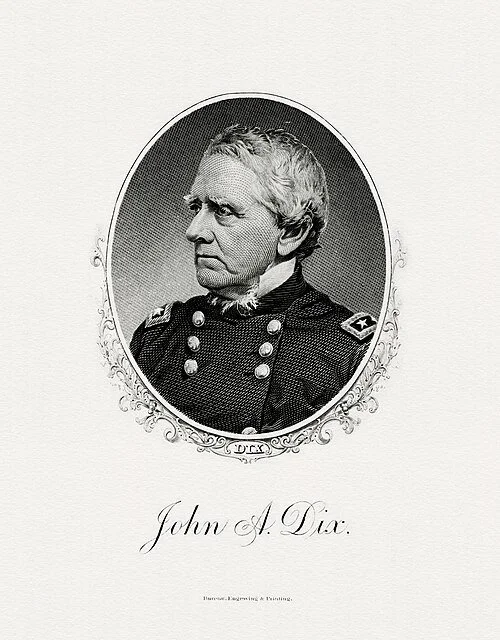
John A. Dix.
The Dix-Hill Cartel
On July 22, 1862, Union Maj Gen John A Dix and Confederate Major General Daniel Harvey Hill concluded an agreement for the general exchange of prisoners between the Union and Confederate armies. A scale of equivalents was developed wherein an officer might be exchanged for a certain number of enlisted men, or might entail a parole in which no military capacity was allowed until officially exchanged. Officers were exchanged for more soldiers than others. The operation of the system was:
Soldiers of equivalent ranks would be exchanged on a one to one value,
Corporals and sergeants were worth two privates,
Lieutenants were worth four privates,
A captain was worth six privates,
A major was worth eight privates,
A lieutenant colonel was worth 10 privates,
A colonel was worth 15 privates,
A brigadier general was worth 20 privates,
A major general was worth 40 privates, and
A commanding general was worth 60 privates.
The Exchange System worked well in 1862 but there were irregularities on both sides, in which paroled men nevertheless rejoined their units. Edwin Stanton wanted to suspend the exchanges because he felt that southern soldiers weren’t following the rules of the parole. Secretary Stanton saw a potential for Union soldiers to abuse the parole system. The Confederates had begun paroling a number of Western prisoners unilaterally, including some two thousand taken at the April 1862 battle of Shiloh. The violations continued with the parolees from Vicksburg and Port Hudson.
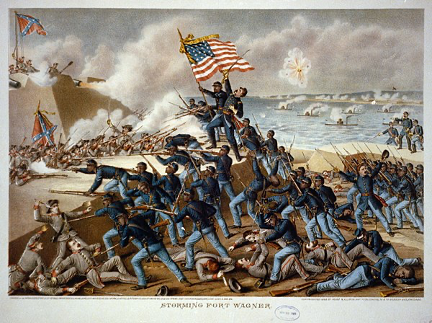
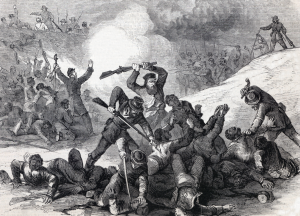
Storming Fort Wagner.
Cessation of the Cartel and Its Implications
In September of 1862, President Lincoln called for the enlistment of black soldiers into the Union Armies as part of the preliminary draft of the Emancipation Proclamation. In December 1862, President Davis responded by issuing a proclamation that neither captured black soldiers nor their white officers would be subject to exchange. That the black soldiers were fugitive slaves and subject to capital punishment.
In January 1863 the Emancipation Proclamation became official and the United States began the active recruitment of black soldiers. Jefferson Davis was incensed by this, and threatened severe actions.
President Davis made an official proclamation that black POWs were fugitive slaves. In May 1863, the Confederate Congress passed a joint resolution that formalized Davis' proclamation that black soldiers taken prisoner would not be exchanged: “That all commissioned officers in the command of said Benjamin F. Butler be declared not entitled to be considered as soldiers engaged in honorable warfare but as robbers and criminals deserving death, and that they and each of them be whenever captured reserved for execution.” Find the proclamation here: http://www.freedmen.umd.edu/pow.htm
The Lieber Code
Lincoln’s response was to assure that The Lieber Code, General Order 100, issued in April 1863, responded to this crisis. The Lieber Code was not written as a direct reaction to the collapse of the Dix–Hill Cartel or Jefferson Davis’s refusal to recognize Black Union soldiers as lawful combatants. But the final form, timing, and political purpose of the code were very heavily shaped by those crises. In effect, the breakdown of prisoner exchange and Confederate policy toward Black soldiers turned the Lieber Code from a general effort to codify the laws of war into a strategic and moral response to the Confederacy’s stance.
Work on the code had begun in 1862, well before the collapse of the prisoner-exchange system.
Henry Halleck had long wanted an American codification of the laws of war. Francis Lieber had been thinking about such a code for years, drawing on European theory. The War Department’s Law of War Committee met in late 1862—months before Davis’s December 1862 proclamation threatening to treat captured Black Union soldiers as slaves and their white officers as criminals.
This was in essence the first major revision of the 1806 Articles of War.
While not the original motivation, the timing and urgency of the Lieber Code reflect the breakdown of the Dix–Hill Cartel (mid–late 1862) and Davis’s policy. The Union needed a principled basis to suspend the Cartel One of its articles stipulated that the United States government expected all prisoners to be treated equally, regardless of color. By late 1862 it was clear that the Confederacy would not exchange or treat Black Union soldiers as POWs. The cartel was therefore unworkable. The Lincoln administration needed a legal and moral justification for halting exchanges without appearing to commit retaliation for its own sake.
The Lieber Code provided it—explicitly authorizing retaliation when the enemy violates the laws of war; the equal treatment of all lawful combatants regardless of race; the duty of the U.S. government to protect all its soldiers. This was crucial. It offered a codified, internationally resonant legal framework for the Union’s stance. The full document can be found here: https://avalon.law.yale.edu/19th_century/lieber.asp#sec3
Most of its ideas were incorporated into the Hague Convention of 1907, and remain among the fundamental rules of war to this day as an antecedent of the Geneva Conventions.
Franz Lieber was a German-American legal scholar. He had fought with the Prussian Army and been wounded at Waterloo. He later moved and taught for 20 years in South Carolina, where he was repulsed by slavery. In 1861 he became professor of law at Columbia University in NYC. Two of his sons fought for the Union, a third fought for the Confederacy and was killed in action. Halleck, a lawyer with an interest in International Law, consulted Lieber regarding ethical dilemmas early on and invited him, along with Stanton, to undertake this project.
The Lieber Code expressly forbade giving "no quarter" to the enemy (i.e. killing prisoners of war), except in such cases when the survival of the unit that held these prisoners was threatened. It forbade the use of poisons, stating that use of such puts any force who uses them entirely outside the pale of the civilized nations and peoples; it forbade the use of torture to extract confessions or information; it described the rights and duties of prisoners of war and of capturing forces. Most of its ideas were incorporated into the Hague Convention of 1907, and are the fundamental rules of war to this day.
The Lieber Code is formulated as a series of x articles, really just statements of principle. Section III is compised of articles 48 – 80 covers the principles involving prisoners of war. The Code Directly Addresses the Black Soldiers Question. All soldiers fighting under a recognized government are lawful combatants (Arts. 57–60). No distinction may be made on “color, descent, or condition” once they are uniformed combatants. Retaliation is justified if the enemy mistreats prisoners on racial grounds (Arts. 27–29). These provisions were absolutely a response to Davis’s proclamation of December 23, 1862 (declaring Black Union soldiers slaves “invading the South”), and the Confederate Congress’s subsequent approval of that policy. Lieber himself acknowledged this. His correspondence with Halleck in early 1863 shows that the issue of Black POW protection was explicitly in mind as the code was being finalized.
What the Lieber Code Said About POWs
Key Principles:
Humane Treatment
Article 56: Prisoners of war are “public enemies” and not criminals. They are to be treated with humanity.
Article 75: Prisoners must not be “subjected to any revenge or other ill treatment.”
No Torture or Cruelty
Article 16: “Military necessity does not admit of cruelty…nor of torture to extort confessions.”
No Retaliation Against POWs
Article 59: Reprisals must not include harming POWs unless it is a direct retaliation for mistreatment of one’s own POWs—and even then, only under strict necessity.
Rights and Respect
Officers were to be treated in accordance with their rank.
Prisoners were protected from violence, pillage, or abuse.
Labor
Prisoners could be made to work (Article 76), but only within humane bounds and consistent with their rank.
The Lieber Code expressly forbade giving "no quarter" to the enemy (i.e. killing prisoners of war), except in such cases when the survival of the unit that held these prisoners was threatened. Article 60 provides: “It is against the usage of modern war to resolve, in hatred and revenge, to give no quarter. No body of troops has the right to declare that it will not give, and therefore will not expect, quarter; but a commander is permitted to direct his troops to give no quarter, in great straits, when his own salvation makes it impossible to cumber himself with prisoners.
It forbade the use of poisons (Article 70), stating that use of such puts any force who uses them entirely outside the pale of the civilized nations and peoples; it forbade the use of torture to extract confessions or information; it described the rights and duties of prisoners of war and of capturing forces.
Article 58 directly addresses the use of Black soldiers: “The law of nations knows of no distinction of color, and if an enemy of the United States should enslave and sell any captured persons of their army, it would be a case for the severest retaliation, if not redressed upon complaint. The United States cannot retaliate by enslavement; therefore death must be the retaliation for this crime against the law of nations.”
Application to the Prisoner Exchanges
Originally Edwin Stanton wanted to suspend the exchanges because he felt that Southern soldiers weren’t following the rules of the parole. Secretary Stanton saw a potential for Union soldiers to abuse the parole system. The Confederates had begun paroling a number of Western prisoners unilaterally, including some two thousand taken at the April 1862 battle of Shiloh. The violations continued with the parolees from Vicksburg and Port Hudson. It was Lincoln, the astute politician, who realized it would be unpopular to suspend exchanges for that reason, but if applied to the USCT it would be better accepted. The Code was therefore also a strategic countermove. The Union needed a public, intellectually credible, “laws of war” document to show why exchanges were suspended, why retaliation policies were lawful, why Black soldiers had to be protected, and why the Confederacy was violating international norms. The Lieber Code gave the Lincoln administration a fully articulated legal and moral position—something European observers were watching closely.
The Lieber Code was issued unilaterally by the United States, and no other nation was bound by its formalities at the time. However, when the Confederates breached its principles, the US government needed to respond.
At Fort Wagner, several black prisoners from the 54th Massachusetts were not exchanged with the rest of the white soldiers who participated in the assault on Fort Wagner in July 1863. This is the infamous attack where Colonel Robert Gould Shaw was killed leading his men in a charge. When a Union officer asked the Confederates at Battery Wagner for the return of Shaw's body, he was informed by the Confederate commander, Brigadier General Johnson Hagood, "We buried him with his _____."
On July 30, 1863, President Abraham Lincoln issued General Order 252, which effectively suspended the Dix-Hill Cartel until the Confederate forces agreed to treat black prisoners the same as white prisoners. Large scale prisoner exchanges ceased by August 1863, resulting in a dramatic increase in the prison populations on both sides. Neither side was prepared for this sudden responsibility. The inhumane consequences on both sides are well known.
Large scale prisoner exchanges ceased by August 1863, resulting in a dramatic increase in the prison populations on both sides. Neither side was prepared for this sudden responsibility. The inhumane consequences on both sides are well known.
Other Alleged Examples
The fact is that it was official CSA policy to kill all black POWs. Secretary of War James Seddon responded to PGT Beauregard’s request for the official policy as to how to handle his black POWs. Confederate Secretary of War James A. Seddon, in a November 30, 1862, letter to General P. G. T. Beauregard, outlined a policy of executing captured black soldiers as criminals guilty of breaking slave insurrection laws. You can find this brief letter here: http://historymaking.org/textbook/items/show/97
Fort Pillow occurred on April 12, 1864. The Congressional Investigation into the battle concluded that the massacre was consistent with official CSA policy. The next month, the Confederacy in May 1864 passed a law stating that black U.S. soldiers captured while fighting against the Confederacy would be turned over to the state, where the captured would be tried, according to state laws.
The exchange system had collapsed in late 1863 because of the failure of Confederate prisoners (and their government) to observe paroles, most notably those issued to the surrendered garrison of Vicksburg. When Union soldiers captured some of those unexchanged soldiers at Chattanooga, Stanton decided that something had to be done. Making matters worse, the Confederacy refused to exchange black Union soldiers. Stories that Confederate soldiers murdered black captives carried more impact after Nathan Bedford Forrest's men stormed Fort Pillow on April 12, 1864, and killed black soldiers who were attempting to surrender.
Actual Treatment of POWs
The Union treatment of Confederate POWs generally aligned with the Lieber Code, especially early in the war. Large prison camps like Camp Douglas (IL) and Point Lookout (MD) had harsh conditions—exposure, poor sanitation, and disease. Sherman reportedly used POWs to clear land mines outside of Savannah. That wasn’t expressly against the Lieber Code, but it would be forbidden today. As the war progressed and prisoner exchanges collapsed (due in part to Confederate refusal to exchange Black Union soldiers equally), conditions worsened, with overcrowding and high death rates.
The Confederate treatment of Union POWs was notably worse, especially at Andersonville (Camp Sumter) in Georgia. It was an outdoor prison built for 10,000; held over 30,000 at peak.
It had minimal shelter, contaminated water, inadequate food. Nearly 13,000 of 45,000 prisoners died—a mortality rate of ~29%. Commandant Henry Wirz was tried and executed after the war for war crimes—one of the few such examples.
Did Grant End the Exchanges?
It is often erroneously claimed that General Grant ordered the suspension of Dix-Hill he was not the Commander in Chief at this time, and had nothing to do with it. https://www.nps.gov/ande/learn/historyculture/grant-and-the-prisoner-exchange.htm?fbclid=IwAR0Re2-Imgr8m_qqAYEGK4iAeKRlEA3mafVQpHiqZHtkyRG_ELag97xEE1s&mibextid=kdkkhi
It is taught in most history books that the exchange system ended during the Overland Campaign. This quote is usually presented as proof that General Grant ended the system:
"It is hard on our men held in Southern prisons not to exchange them, but it is humanity to those left in the ranks to fight our battles. Every man we hold, when released on parole or otherwise, becomes an active soldier against us at once either directly or indirectly. If we commence a system of exchange which liberates all prisoners taken, we will have to fight on until the whole South is exterminated. If we hold those caught they amount to no more than dead men. At this particular time to release all rebel prisoners North would insure Sherman's defeat and would compromise our safety here." – General Ulysses S. Grant, August 18, 1864.
The myth is that Grant eschewed the exchanges to prevent the Southern armies to regain its captured men, thus favoring the Union side. Supposedly he did it because of the callous arithmetic of the war – calculating that by stopping exchanges the Union armies could simply outlast the Confederates. In fact, President Abraham Lincoln suspended the Dix-Hill Cartel in retaliation for the Confederacy's refusal to exchange black soldiers captured in the summer of 1863.
During the Summer of 1864 Grant pointed out that the refusal to exchange prisoners, however harsh it might seem, drained the Confederacy of much needed manpower; exchanged Confederates would return to the ranks to kill more Yankees, complicating calculations based on the supposed humanity of exchanges. As you can see, Grant wrote this almost 1 year after the exchanges had stopped. It is fascinating that this is the quote that appears on the Wirz monument, trying to shift blame for Andersonville onto Grant.
In the late summer of 1864, a year after the Dix-Hill Cartel was suspended, Confederate officials approached Union General Benjamin Butler about resuming the cartel and exchanges, including black prisoners. Butler, the Union Commissioner of Exchange, contacted Grant for guidance on the issue. Grant responded on August 18, 1864 with this statement. In their conversation, Grant informed Butler that he approved an equal exchange of soldier for soldier, but did not approve a full resumption of the Dix-Hill Cartel. His issue was with the cartel's stipulation that the balance after equal exchanges was to be paroled and sent home to await formal exchange. By August 1864, Confederate prisoners far outnumbered Union prisoners, so a resumption of the cartel would release thousands more Confederates. Grant also felt that once released, Confederate prisoners would likely violate their paroles and rejoin their units. Many of the Union prisoners, on the other hand, had already fulfilled their enlistments and would likely go home.
An agreement for resuming prisoner exchanges would not be reached until the winter of 1864-1865. Had Confederate authorities agreed to exchange black soldiers, however, the exchanges would have been resumed; and in January 1865 Confederate authorities agreed it was best to exchange "all" prisoners, regardless of color. The reality is that Grant did approve a prisoner for prisoner exchange that did in fact occur.
The Purpose of Rules of War
Creating rules or laws to govern war, an inherently unethical human behavior, is one of history’s most painful and persistent tensions. The desire for moral restraint versus the brutal realities of war must be balanced; and clearly, winning the war is the foremost goal. Are the “rules” or “laws” of war phony? No, they’re not phony—but they are imperfect and often inconsistently applied.
The laws of war, such as those codified in the Lieber Code (1863), the Hague Conventions (1899, 1907), and the Geneva Conventions (especially after WWII), are real legal instruments. They’re backed by treaties, military doctrine, and in some cases, courts (like the International Criminal Court).
These laws serve several purposes. They limit unnecessary suffering, especially of civilians and prisoners. They maintain some moral legitimacy—for both domestic and international audiences. The rules prevent escalation into unbounded barbarism (e.g., genocide, torture as routine policy). And, they set standards for holding individuals accountable (think of the Nuremberg Trials or modern war crimes prosecutions).
But while they also protect the combatant, a major purpose is to the military and political leaders who order destruction and death. By following an international code of rules, war trials and criminal prosecution have a built in defense.
In conclusion, The Lieber Code was not conceived as a response to the collapse of the Dix–Hill Cartel or to Davis’s policy on Black soldiers, but those events decisively shaped its final content, its timing of issuance, and its strategic purpose. It not only gave an ethical response to the problem, but a politically savvy public stance.
The site has been offering a wide variety of high-quality, free history content since 2012. If you’d like to say ‘thank you’ and help us with site running costs, please consider donating here.