William Speakman stands as one of the most striking examples of individual courage in the Korean War, a conflict often overshadowed by the Second World War and the later trauma of Vietnam, yet one that produced acts of gallantry no less extraordinary. His Victoria Cross was earned during the bitter fighting of the Second Battle of Maryang-san in November 1951, when United Nations forces were locked in a relentless struggle against repeated and determined assaults by Chinese troops. Speakman's actions—charging forward under heavy fire with his pockets stuffed full of grenades—were not only physically daring but psychologically decisive, galvanizing exhausted comrades at a moment when pressure, cold, and fear threatened to overwhelm them.
Terry Bailey explains.
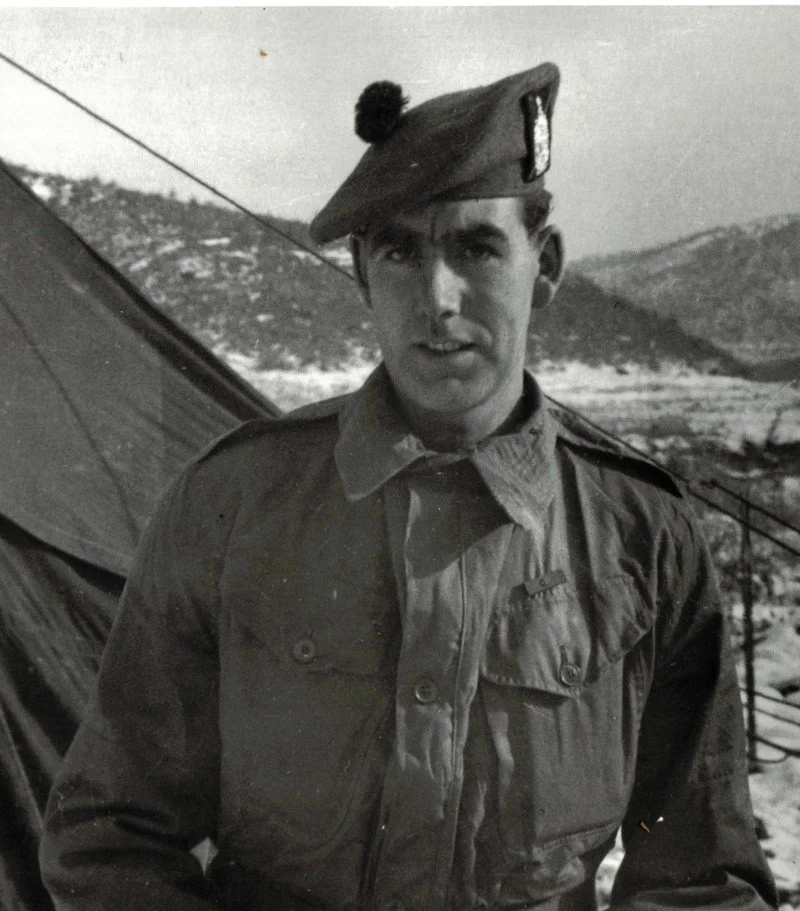
William Speakman-Pitt, Victoria Cross.
Born in 1927 in Altrincham, Cheshire, William Speakman grew up in a Britain shaped by economic hardship and looming global instability. His early life was unremarkable in the way that many working-class childhoods of the interwar years were, marked by austerity, discipline, and the formative experience of the Second World War on the home front. Air raids, rationing, and the omnipresence of uniformed men left a deep impression on an entire generation, instilling both resilience and a familiarity with sacrifice. Nothing in Speakman's youth suggested that he would one day perform an act of heroism that would be recognized at the highest level, yet his background fostered the quiet toughness and sense of duty that later defined his conduct.
In the post-war years, as Britain struggled to redefine itself amid imperial decline and economic strain, military service remained a steady path for many young men. Speakman enlisted in the army and joined the King's Own Scottish Borderers, a regiment with a long and distinguished history. For Speakman, as for countless others, the army offered structure, camaraderie, and purpose. By the time he was deployed to the Far East, he was a private soldier rather than an officer or senior non-commissioned leader, a fact that would later make his actions all the more remarkable. His courage was not the product of rank or expectation, but of individual resolve under extreme circumstances.
The Korean War began in June 1950 when North Korean forces crossed the 38th parallel and launched a surprise invasion of South Korea. The rapid collapse of South Korean defenses prompted a United Nations response, spearheaded by the United States but supported by forces from across the Commonwealth and beyond. British troops, including the King's Own Scottish Borderers, soon found themselves fighting in a conflict that was as politically complex as it was militarily brutal. The initial phase of the war was highly mobile, with dramatic advances and retreats, but this fluidity changed dramatically following the intervention of Chinese "People's Volunteer Army" forces late in 1950.
The Chinese entry transformed the war. Mass infantry attacks, often conducted at night and supported by mortars and bugle calls, pushed UN forces back and shattered any illusion of a quick victory. By 1951 the conflict had settled into a grinding stalemate, with both sides contesting rugged hills and ridgelines across central Korea. These features, often barren, steep, and exposed, dominated the surrounding terrain and supply routes, making them tactically invaluable and fiercely contested. Battles were fought not for sweeping territorial gains, but for individual hills whose names were often little more than map references, yet whose possession could decide the fate of an entire sector.
The Second Battle of Maryang-san formed part of this wider struggle for dominance in the hills north of the Imjin River. Maryang-san was not a single peak but a complex of interconnected heights, heavily fortified by Chinese troops who had dug deep defensive positions into the rocky ground. The King's Own Scottish Borderers were tasked with holding these positions against determined counterattacks once they had been taken. The conditions were appalling: freezing temperatures sapped strength and concentration, while constant shelling and small-arms fire left little opportunity for rest. Sleep was scarce, nerves were frayed, and the line between endurance and collapse grew increasingly thin.
On the 4th of November 1951, Chinese forces launched a renewed assault against positions held by Speakman's platoon. Attacking in strength and using the cover of broken ground, they pressed forward with the clear intention of overwhelming the defenders. It was during this critical moment that William Speakman's extraordinary courage came to the fore. Recognizing that the attackers were closing in and that defensive fire alone might not be enough, Speakman volunteered to carry grenades forward to the most threatened areas. Stuffing his pockets with as many grenades as he could carry, he moved out into the open, fully exposed to enemy fire.
From forward positions, Speakman hurled grenade after grenade into the advancing Chinese troops, disrupting their formations and forcing them to take cover. Each throw required him to stand, aim, and expose himself anew to small-arms and mortar fire. The physical danger was immense, but so too was the psychological strain. Yet Speakman persisted, returning to resupply and then advancing again as the pressure mounted. His actions bought precious time for his platoon, blunting the momentum of the attack at a moment when it threatened to break through.
What truly set Speakman apart was not a single moment of reckless bravery, but his repeated willingness to do it again. When another Chinese attack developed from a different direction, he once more filled his pockets with grenades and advanced alone. Again he pelted the enemy at close range, his conspicuous courage visible to all around him. Inspired by his example, other soldiers followed him forward, strengthening the defense and restoring confidence along the line. In an environment where fear and exhaustion could so easily paralyze action, Speakman's initiative transformed the psychological balance of the fight.
The official citation for William Speakman's Victoria Cross captured both the physical and moral dimensions of his conduct. It highlighted not only his gallantry under fire, but also the inspirational effect his actions had on those around him. He had no obligation, by rank or formal responsibility, to expose himself in this way, yet he did so repeatedly and deliberately, fully aware of the danger. His behavior embodied the traditional ideals of the Victoria Cross: "most conspicuous bravery" and "self-sacrifice in the presence of the enemy." In the attritional warfare of Korea, where heroism often went unseen amid artillery barrages and night fighting, Speakman's actions stood out with rare clarity.
Following the war, William Speakman returned to civilian life and later adopted the surname Speakman-Pitt. Like many veterans of Korea, he carried his experiences quietly, rarely seeking public attention despite the prestige of his award. He remained closely associated with his regiment and was deeply respected within military and veterans' communities, attending commemorative events and maintaining strong bonds with former comrades. Those who knew him often remarked on his modesty and reluctance to dwell on his own heroism, a trait shared by many recipients of the Victoria Cross.
William Speakman died in 2018, closing a life that spanned post-war Britain and one of the Cold War's most intense and unforgiving conflicts. His Victoria Cross action at Maryang-san remains inseparable from the broader story of the Korean War—a war defined by harsh terrain, extreme weather, and ferocious close-quarter fighting. Yet within that wider struggle, his courage retains a distinct clarity. Armed with little more than grenades and determination, a private soldier repeatedly stepped forward when it mattered most, turning the tide of a desperate moment and inspiring others to do the same. His story endures not simply as a tale of bravery, but as a powerful reminder that leadership and resolve can emerge from any rank when circumstances demand it.
In the final reckoning, William Speakman's story illuminates both the character of the Korean War and the enduring nature of individual courage within it. His actions at Maryang-san were not isolated feats of daring divorced from their context, but a direct response to the brutal realities of hill fighting, exhaustion, and relentless enemy pressure. In a war often reduced to statistics, diplomatic stalemate, or vague Cold War abstraction, Speakman's conduct restores the human dimension: the moment when one soldier's resolve arrests collapse, steadies frightened men, and transforms desperation into resistance. His bravery demonstrates how, even in industrialized modern warfare, the outcome of a fight can hinge on personal initiative and moral courage.
Speakman's Victoria Cross also challenges narrow assumptions about leadership and heroism. He was neither an officer issuing orders nor a seasoned veteran shaped by years of combat command, but a private soldier who recognized what the situation demanded and acted without hesitation. His leadership was instinctive rather than institutional, emerging from character rather than rank. In this sense, his actions reflect the highest traditions of the British Army and the Commonwealth forces in Korea, where cohesion, mutual trust, and example often mattered more than formal authority. The inspirational effect of his conduct, men following him forward under fire, underscores how courage can be contagious when visibly demonstrated.
Beyond the battlefield, Speakman's quiet post-war life reinforces the distinction between heroism performed and heroism advertised. Like many veterans of Korea, he returned to a society that largely moved on, carrying memories of extreme violence and hardship without public recognition commensurate with their sacrifice. That Speakman bore his fame with humility only deepens the significance of his achievement, aligning personal modesty with extraordinary public honor. His life serves as a reminder that the Victoria Cross does not celebrate aggression or glory, but selflessness under the most severe conditions imaginable.
Ultimately, William Speakman's legacy endures as both a personal testament and a wider historical symbol. His courage at Maryang-san encapsulates the intensity of the Korean War and the often-overlooked sacrifices of those who fought it. More enduring still is the lesson embedded in his story: that in moments of crisis, when fear, fatigue, and uncertainty converge, the actions of a single individual can shape events far beyond their immediate reach. In remembering Speakman, we are reminded that heroism is not confined to grand strategy or famous names, but can arise, with devastating clarity, from the determination of one soldier who refuses to yield.
The site has been offering a wide variety of high-quality, free history content since 2012. If you’d like to say ‘thank you’ and help us with site running costs, please consider donating here.