Perhaps the most fascinating Civil War general to Jeb Smith is Nathan Bedford Forest. Many think he is not just the best cavalry general of the American Civil War but among the greatest to ever live. He acquired more confirmed kills in war than any America has ever achieved. No general as high a rank as Forrest killed as many men since the medieval period. He had 29 horses shot from under him and said, “I ended the war a horse up.” He was one of the most feared individuals of the war and was said to be a “Superhuman warrior.” One friend who knew him before the war said he looked unrecognizable in battle. His face and eyes would change.

A natural military genius, Forrest rose from the rank of private to lieutenant general. His willingness to mix personally in combat led to him receiving multiple wounds doctors feared would be fatal, all of which he survived. The famed Civil War author Shelby Foote opined that the Civil War produced two geniuses: Abraham Lincoln and Nathan Bedford Forrest.
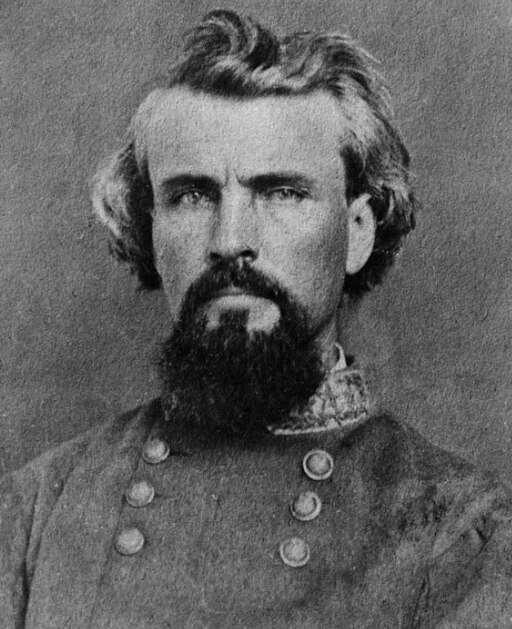
Nathan Bedford Forrest.

Pre-war

Born into poverty in Tennessee, Forrest received little formal education and no military training. By 1860, he owned two plantations, traded extensively in slaves, and was one of the wealthiest men in Memphis. He was tall, muscular, and powerful even for his size. An adamant believer in states’ rights and secession, the war was not the first violence he engaged in. Before it even began, he had killed several people.

In 1845, in Mississippi, his uncle was killed in a street fight; in retaliation, Forrest then killed two of his uncle’s murderers with a pistol and wounded two more with a knife someone in the crowd threw to him. There are unconfirmed reports that he killed others on two more occasions, including being severely wounded himself during one such engagement and recovering from what had seemed mortal wounds, as he would do more than once later in his career.


The Civil War

Forrest survived and was involved in some truly miraculous combat situations and multiple brushes with death, earning him an immense reputation as a warrior. When the war began, Forrest raised his own regiment, paid for their equipment, and advertised for recruits in Memphis, writing, “Come on, boys, if you want a heap of fun and to kill some Yankees.” Forrest had no trouble gaining men, as his reputation for toughness, aggression, and bravery had already spread widely. The general once told his men, “I have never, on the field of battle, sent you where I was unwilling to go myself.” And he quickly proved his fearlessness and tactical skill to them.

Early on in the war, Forrest led a cavalry charge against a Union line and single-handedly engaged multiple troops despite receiving wounds. A similar situation occurred later in the war when Forrest was mounted on his horse and attacked by four federals at once, receiving horrific wounds to his head and arm. He was able to retaliate and kill one of his ambushers, stating later, “No damn man kills me and lives.” Yet the situation became even worse for him as three more federals came shooting and stabbing at him. He was now surrounded, and on top of that, his horse was then shot [would eventually prove mortal], but riding on his injured horse, Forrest then jumped a wagon that was blocking his retreat. Thirty paces down the road, he was attacked by yet another federal with a saber. Forrest ended his attacker's life soon after.

In another instance, as the Confederates were chasing retraining federals, Forest found he outpaced his men and was surrounded by dozens of retreating federals; he was shot multiple times, and his horse was once more wounded mortally. But before his steed departed, and among a hail of bullets, he escaped, utilizing his revolver to cut a way clear.

In a dangerous and fortunate battle, where Forrest was riddled with 15 bullet holes in his uniform, and his horse fell dead after sustaining seven bullet wounds. Later that day, he had another horse die from under him. Soon after, he received what doctors initially believed to be yet another mortal wound during a confrontation with a subordinate. However, he would heal and return to command.

Forrest led by example. He would not order his men to do anything he would not do. He often would do a mission when no volunteers would offer. He himself would go on dangerous scouting missions and once crossed a frozen river when none of his men would. In Six Armies in Tennessee, historian Steven E. Woodworth wrote that Forest “would fight anyone, anytime.” Perhaps that was no truer than when Forrest and his command were surprised and surrounded by federal forces. The general commanded his men to “charge em both ways,” and his men did, and many escaped. Forrest also stated, “Never stand and take a charge… charge them too.”


Battle Results

A gifted military genius...he was the prophet of mobile warfare. His campaigns [allegedly] studied by German proponents of the blitzkrieg...His operations are more reminiscent of a 20th century panzer leader, such as Heinz Guderian or Erwin Rommel, than of any commander of his age.

-Barry C Jacobsen The ten Best Generals of the Civil war


Likie Jackson, Forrest always attempted to “Get their first with the most,” and his fast cavalry, adaptability, strategy, ambushing tactics, and fearless leadership led to some remarkable results, especially while raiding. He would conduct swift but decisive assaults on the enemy, often utilizing a cavalry charge. In The Civil War, Bruce Catton wrote,  “Forrest ... used his horsemen as a modern general would use motorized infantry. He liked horses because he liked fast movements.”

Forest sought to outflank his enemy and create chaos; he was vicious and efficient in attacking any weakness in his adversary’s defenses while also being unpredictable. Attacking the weak spot of the enemy mercilessly, Forest stated, “Get ’em skeered, and keep the skeer on ’em.” He would throw his entire force on the enemy, rarely keeping reserves. He led his men as a warrior of old; he did not hang back but showed courage, leading in charges. He was excited about warfare, observers saying he changed physical features and would “come alive.”

Forrest was one of the few Cavalry commanders who could consistently and successfully utilize the Cavalry charge in the Civil War. In part, because he kept somewhat of a bodyguard made up of about 100 of his best soldiers around him at all times, and would use this elite force to strike the enemy at the right place and time to turn the battle in his favor. Some of his remarkable lopsided battle results are as follows.

Due to the massive trouble Forrest was causing to Union supply lines, and his raiding ability and devastation he was causing on isolated units, General Sherman had had enough, and so decided to make no mistakes about it, to hunt Forest down with a vastly superior force, and take him out of the war. Sherman sent Samuel Sturgis, with a command of 3,300 cavalry and 5,000 infantry, along with 22 guns, to "bag" Forrest's command of 3,200 men. Instead, Forrest drove the Federals 58 miles, captured 19 of the guns, all the Federals' baggage and supplies, 200 wagons, 30 ambulances, 161 mules, 20 horses, took 2,000 prisoners, caused 300 killed, 400 wounded, and the destruction/disorganization of the more significant Union force. Confederate casualties were under 500.

One raid in Tennessee caused 3,500 federal casualties, eight artillery captured, 400 horses and mules, 100 wagons, 100 cattle, 3,000 arms stores, destroyed rail, six bridges, two locomotives, 50 freight cars, and captured/destroyed 50 blockhouses. During the raid, Forrest gained 1,000 men from recruitment and from men who had deserted Confederate general Joe Johnston army to join a commander who would fight, General Forrest. Forrest's losses were 300; he returned stronger than he left.

Of another raid, also in Tennessee, a federal newspaper wrote, “Forrest with less than 4,000 men has moved right through the 96th army corps, has passed within 9 miles of Memphis, carried off 100 wagons, 100 beef cattle 3,000 conscripts, innumerable stores, tore up railroad track, cut telephone wire, burned and sacked towns ran over picket lines. Again, with 1,800 in command, Forrest captured 150 federals, killed 25, wounded another 50, captured 200 horses, a few wagons, and 2 artillery, tore up the railroad, and captured rail cars. He rearmed his entire force with better-captured weapons than when they went into the raid. Forrest Lost 3 killed 5 wounded.

In one of his renowned assaults, with only 1,800 men, he captured 2,200 federals (not including killed and wounded), and he lost only 30 men, 150 wounded. In another battle, the Federal losses were 500 prisoners, 10 killed [ 230 soon after], 16 wagons, and three ambulances. Forrest lost only one killed and two wounded. Another time with just 300, Forrest led an attack on a depot. The results were 400 prisoners and the capture of 1,000 horses, 15 wagons, 600,000 rounds of ammo, 100,000 rations, clothes, etc., and $500,000 worth overall.

 In a month-long campaign that destroyed rail, 2,500 federals were killed or taken as prisoners, and once more, his command came back stronger and better equipped than he left. During the four minor skirmishes, he lost 200 men but killed 350, captured 2,000 prisoners, and captured artillery and wagon. Forrest had to release prisoners on many occasions as he had too many to control, often larger than his own force. Forrest once had prisoners help move artillery wagons through rough roads to be set free.

In a particularly daring attack, Forrest charged his command up a hill against a force twice his size, supported by artillery. Remarkably victorious, he took 75 prisoners, recaptured 60 Confederate prisoners, and captured the artillery. These events were just a few of the kinds of lopsided victories and successes Forest achieved.


Deception

Forrest excelled at scouting, ambushing, and deception. He kept the enemy uncertain of his movements and could cross bridges or “impassable” streams when he was “trapped.” He could also be creative; he once used captured Union infantry drums to make his Cavalry force appear more numerous, thereby preventing an attack by the Union. He once used some of the older men in his command to dress as civilians and give false information to the upcoming federals on the whereabouts of his men. Another time he had his men wear captured federal uniforms to gain information from them. Once, while trying to convince a Union commander to surrender, he made his force of 4,500 appear to be 10,000 to the Federal commander, convincing the general to surrender his command. He did things like have his artillery brought up over and over in circles to appear like he had more guns than he did whilst negotiating with his adversary.


Feared by Many

Follow Forrest to the death if it costs 10,000 lives and breaks the treasury. There will never be peace in Tennessee till Forrest is dead.

-William T Sherman


Few, perhaps none would hesitate to call Forrest the most feared individual soiler of the war, the last man you would not to fight to the death against on the field of battle, but also The Civil War Trust's article on Forest reads, "the most feared commander of the war... no Union commander was able to effectively come to grips with Forrest's cavalry during the war." In 10 Best Generals in American History, Barry C Jacobsen referred to him as "Perhaps the most feared general in American history."

Because of Forrest's fighting ability, fearlessness, aggressiveness, unpredictable and lightning-fast raids and assaults, and great success, he became widely seen as the most feared commander on either side of the war. In one instance, an enthusiastic and confident federal cavalry command was prepared to attack the much smaller Confederate cavalry command. Upon receiving notice that it was, in fact, under the direction of General Forrest, the Union officer called off the attack despite the significant manpower advantage.


Where Does Forrest Rank in Civil War Generals?

Having him [Forrest] in an army was something like operating in concert with a band of formidable but unpredictable barbarians allies...could be an excellent cavalryman for practicality any purpose if he could be convinced to pursue his commanders wishes.

-Steven E Woodworth Six Armies in Tennessee the Chickamauga and Chattanooga Campaigns University of Nebraska press


If you were to rank Civil War soldiers just as fighting men, I think Forest would come out on top; if you were to rank the best cavalry commander, he could well be your first choice. Perhaps even If you were to rank generals with a division or less, he might come out on top. However, he was not always reliable enough to work as part of a larger command and perhaps not as great as others with larger groups of men and thus his impact was not as outstanding as a Grant, Jackson, or Lee. So, where does he rank? That, of course, would depend on personal opinion. He is widely regarded as the best Cavalry commander of the war and is usually ranked around 5th overall commander. He excelled in a limited area, such as a division or less, or when allowed to conduct raids. At this, he had no peers. However, he did not have the impact of generals in the regular army on the major battlefields.

Forrest was hard to control and did his own thing. He once threatened to kill Braxton Bragg, the army commander, and so was shipped to Mississippi. This, in part, made it so Forrest could not do what many thought should have been done: work on Sherman's supply during his invasion of Atlanta and turn him back like he did Grant in his first attempt on Vicksburg. Forrest stated in 1864 “There is no doubt we could soon wipe old Sherman off the face of the earth, John, if they'd give me enough men and you enough guns.”

In the end, Forrest is for me tough to gauge. Compared to other great generals of the war. I think with a division to command he would have been as feared as Stonewall, perhaps even more so. But he was more a berserker type general, one you are glad he is on your side and can achieve remarkable outcomes if you let him loose on the enemy, but perhaps not as versatile as a Stonewall Jackson or Robert E. Lee. I think someone like Grant had a larger influence on an entire army than Forest could achieve.


Jeb Smith is an author and speaker whose books include Defending Dixie's Land: What Every American Should Know About The South And The Civil War written under the pen name Isaac C. Bishop,  Missing Monarchy: Correcting Misconceptions About The Middle Ages, Medieval Kingship, Democracy, And Liberty and he also authored Defending the Middle Ages: Little Known Truths About the Crusades, Inquisitions, Medieval Women, and More. Smith has written over 120 articles found in several publications.
Posted
AuthorGeorge Levrier-Jones

Texan independence was. Significant issue in the 19th century. Here, Fredrick Wolf looks at how it was  impacted by sovereignty and slavery. He also considers the role of the Alamo.

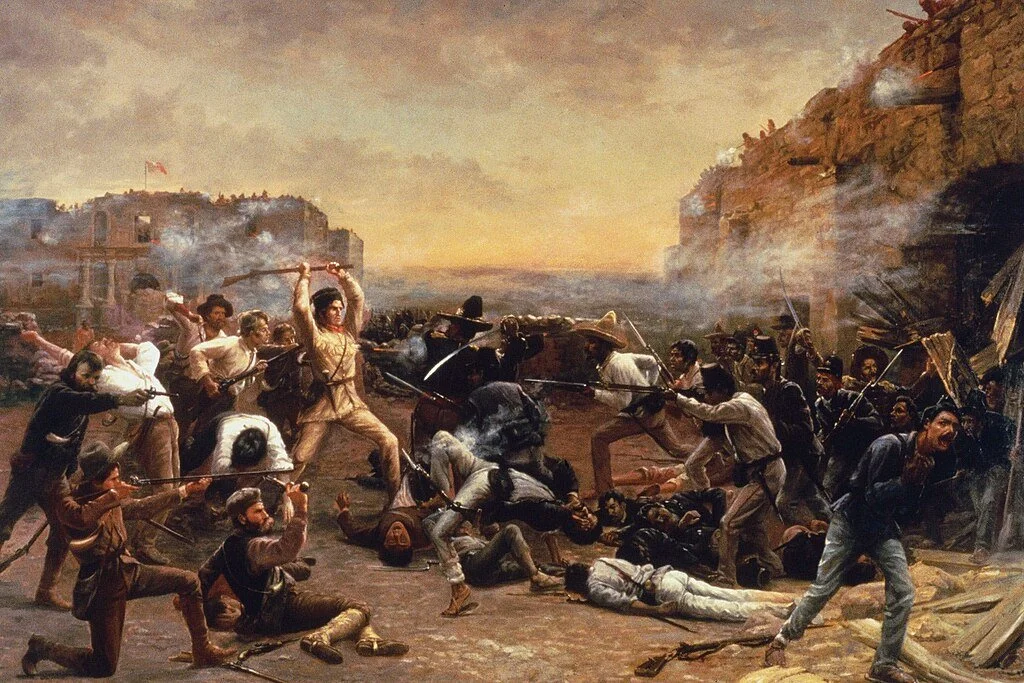
The Fall of the Alamo (1903) by Robert Jenkins Onderdonk.

“…the institution of slavery is neither an interest to be defended nor an outrage to be denounced, but merely a bygone state of things, through which – as through many another unfortunate conditions of society – the evolution of the human race has carried it; and we can therefore devote ourselves to the investigation of the subject with no prejudice except in favor of historic truth.”

–      Professor Justin H. Smith, The Annexation of Texas


The poster for the movie, The Alamo (1960), celebrates its history with the line, "The Mission That Became a Fortress…The Fortress That Became A Shrine….” The latter is a concise and accurate summary of the story of the structure, but not necessarily the events involved in what has famously become known as -- the Alamo – in downtown San Antonio, Texas.

Some historians believe slavery was the driving issue in the battle at the Alamo, arguing that Mexico’s attempts to end slavery contrasted with the hopes of many white settlers in Texas at the time who moved to the region to farm cotton. Renovations to the Alamo, itself, have recently been stalled due to political issues and discussions over the site’s legacy including the role of slavery in the Texas revolution.”

The rebellion in the northern states of Mexico, historically, has been attributed to a response to President Antonio López de Santa Anna repealing Mexico’s Constitution of 1824, abolishing the state governments and issuing autocratic decrees including the suspension of individual property rights.

This work takes the position of the aforementioned Professor Smith: It argues neither for nor against the institution of slavery being the premise behind the battle of the Alamo. It merely develops a reasoned structure of the era detailing the events, circumstances and status of slavery in Mexico from the first Texas colonization contracts to the Texas Revolution. The reader may then draw his or her own conclusion regarding slavery being a motivating cause behind the siege of the Alamo and the struggle for Texas’s Independence from Mexico.


Settlers in Tejas

When Moses Austin secured his first empresario contract to transport settlers to territory now known as Texas, the territory was the possession of Spain, and slavery was legal under Spanish law. The initial contract of 1821 made with the Spanish government made it clear that property rights of future colonists would be protected, including their right to hold slaves.

Agustín de Iturbide, a Mexican caudillo (military chieftain), became the leader of the conservative faction in the Mexican independence movement against Spain; as Agustín I, he briefly became the first emperor  of Mexico. The Iturbide government, of newly independent Mexico, reaffirmed in 1823 Moses Austin’s contract, with son, Stephen F. Austin as his lawful heir. This action secured the legal acquiescence of the Mexican national government to permit colonists and their slaves into the Mexican state of Coahuila y Tejas (Coahuila and Texas).


Issue of Slavery

The new Mexican Constitution of 1824 was vague on the issue of slavery, leaving the question to the individual states to determine how slavery would be dealt with. The law declared, generally, that Mexico would prohibit the importation of slaves, reflecting Mexico’s shift away from Spanish policies after gaining independence from Spain. But because the document left the issue of slavery to the states to decide, it was interpreted by Mexican legal authorities as only prohibiting the importation of slaves for resale. As a result, colonists in Texas, as well as native Mexican planters in southern Mexico, continued to import slaves for their own domestic use with the federal government making no effort to contravene such activity.


Coahuila y Tejas

The state of Coahuila y Tejas, officially the Estado Libre y Soberano de Coahuila y Tejas, was one of the constituent states of the newly established United Mexican States under its 1824 Constitution. The newly adopted state constitution of the state of Coahuila y Tejas allowed in 1827 for the importation of slaves from the U.S. for a period not to exceed six months after the document’s ratification. In September of that year, slaves could no longer be brought into Texas.

In May of 1828, the Congress of Coahuila y Tejas passed a law which made contracts of indentured servitude initiated in foreign countries valid within the state. This provided a means through which slaves could be brought into Texas by making them indentured servants for life. It should be noted that the distaste for slavery of many Mexican citizens and politicians was not necessarily due to a principled stand against the idea of slavery per se. It was, rather, the hereditary nature of slavery which was abhorrent to them. This law merely brought black servitude in Texas in line with the already existing form of servitude – the Mexican norm of debt peonage.


Slavery in Mexico

A legislative attempt to proscribe slavery within the country failed in the Mexican Congress in 1829. President Vicente Guerrero, second President of Mexico, and born of parents of African Mexican and Indian descent was granted sweeping powers to thwart Spain’s attempt to retake the country.

Jose Maria Tornel, the equivalent of the U.S. Speaker of the House of Representatives, influenced President Guerrero to use his newly granted emergency powers to abolish slavery in Mexico. But a little over two months later, the Governor of Coahuila y Tejas, Jose Maria Viesca, convinced the president to exempt Texas from the proscription. To be fair, it should be noted that even if the ban had taken effect in Texas, it would not have freed those already held under indentured servitude contracts.

Yet, at the time, events were changing rapidly in Mexico. In 1831, roughly eighteen months after Guerrero issued his decree banning slavery, it was annulled by the National Congress, along with most of the short-termed, late president’s emergency decrees. Slavery – involuntary servitude -- was once again the law of the land in all of Mexico. And it remained so until 1837, when the National Congress acted again, this time passing an emancipation bill – banning slavery -- nearly a year after Texas in 1836 had won its independence.


Debt Peonage

A few months after the National Congress had annulled Guerrero’s ban on slavery the state legislature of Coahuila y Tejas acted to limit indentured servitude contracts to ten years. But this did little to benefit those living under existing contracts; they still accumulated debt for food, clothing, housing, and medical care. The debt accrued such that it could never be satisfied and those under the contracts remained in debt to the holders of the contract – essentially -- in perpetuity.

This circumstance converted those under contract into debt peons at the end of their indenture terms. In other words, they were required to remain in service to the holders of the contract until those debts were paid, an eventuation nearly impossible. This was the system of servitude that was practiced throughout Mexico before and after Texas won its independence. It was not atypical for wealthy Mexican landowners to have thousands of debt peons in their service. And their treatment was much the same as slaves on American plantations. It should also be noted that the children of debt peons also accrued debts for their care while they were minors, making peonage functionally hereditary.

Such was the state of African bondage in Texas until independence was declared in 1836. The Texas Declaration of Independence, which lists all grievances set before the Mexican government, fails to mention slavery as a basis for redress.

Did Santa Anna march north to free the slaves, as one U.T. history professor has recently said? Or, was his intention to put down Federalist resistance in the northern Mexican states, of which Coahuila y Tejas was but one?

When Texas settlers rebelled in 1835, Santa Anna was quick to organize an expedition against them in defense of centralism. Texan colonists wanted to uphold federalism, a system that allowed for state sovereignty – freedom of choice. Santa Anna and several other Mexican politicians at the time advocated that a centralist government would better serve to unify their nation, after years of instability under federalism. A centralized authority, of course, could also sustain national privileges for the church and military, two special-interest groups that supported Santa Anna’s government.

As a parting remark, one point should be admitted into this commentary. The majority of Texas slaveholders were members of the Peace Party, an organization which lobbied against independence, at least until Mexican President Santa Anna made clear his intention to subdue them, by any means necessary, along with those of his perceived adversary -- the War Party.


The site has been offering a wide variety of high-quality, free history content since 2012. If you’d like to say ‘thank you’ and help us with site running costs, please consider donating here.


References

Costeloe, Michael. The Central Republic in Mexico, 1835-1846: Hombres de Bien in the Age of Santa Anna. Cambridge: Cambridge University Press, 1993.

Fowler, Will. “Santa Anna and His Legacy.” In Oxford Research Encyclopedia, Latin American History. New York, NY: Oxford University Press USA, 2015.

Fowler, Will. Santa Anna of Mexico. Lincoln: University of Nebraska Press, 2007.

Torget, Andrew J. Seeds of Empire: Cotton, Slavery, and the Transformation of the Texas Borderlands, 1800-1850. University of North Carolina Press, 2015.

Smith, Justin H. The Annexation of Texas. New York, NY: The Baker and Taylor Co., 1911.

Burrough, B. and Stanford, J. (2021, June 10). The Myth of Alamo Gets the History All Wrong. The Washington Post. The myth of Alamo gets the history all wrong - The Washington Post

Burrough, B. and Stanford, J. (2021, June 10). We’ve Been Telling the Alamo Story Wrong for Nearly 200 Years. Now It’s Time to Correct the Record. Time.com. It's Time to Correct the Myths About the Battle of Alamo | TIME

Hanna, J. (2025, October 24). The CEO of the Alamo's historic site has resigned after a top Texas Republican criticized her. Associated Press. https://www.yahoo.com/news/articles/ceo-alamos-historic-resigned-top-221630063.html

Webner, R. (2021, May 10). Alamo renovation gets stuck over arguments about slavery. The Texas Tribune. Alamo renovation gets stuck over arguments about slavery - The Texas Tribune

Moses Austin’s Spanish Empresario Contract. Texapedia.info. https://texapedia.info/1821-empresario-contract/

Barker, E. (2020, July 30). The History of Colonization in Texas: From Moses Austin to the National Colonization Law. Texas State Historical Association. Mexican Colonization Laws

McKay, S. (1994, December 1). The Constitution of 1824: Coahuila and Texas. Texas State Historical Association. Constitution of Coahuila and Texas

Coahuila y Tejas: The Mexican State Before Texas Independence. Texapedia.info. Coahuila y Tejas: The Mexican State Before Texas Independence

Joel. (2025, February 6). Rise of Debt Peonage in Mexico. Far Outliers. Rise of Debt Peonage in Mexico | Far Outliers

Anna, T. (Fall 2002). The Legacy of Vicente Guerrero, Mexico's First Black Indian President (review). Journal of Colonialism and Colonial History. Johns Hopkins University Press. Project MUSE - The Legacy of Vicente Guerrero, Mexico's First Black Indian President (review)

Blake, R. (2020, August 2). The Guerrero Decree: Abolishing Slavery in Mexico. Texas State Historical Association. Guerrero Decree

Mexico frees slaves. (2025, September 15). Texas State Historical Association. Texas History Lives Here | Texas State Historical Association

Indentured servitude. Wikipedia. https://en.wikipedia.org/wiki/Indentured_servitude

Barker, E. Pohl, J. (2025, May 21). The Texas Revolution: Key Events and Impact. Texas State Historical Association. Texas Revolution

Santa Anna and the Texas Revolution. Santa Anna's Role in the Texas Revolution

Dyreson, J. (1995, December 1). The Peace Party in Texas: A Historical Overview. Texas State Historical Association. https://www.tshaonline.org/handbook/entries/peace-party

Posted
AuthorGeorge Levrier-Jones

When Roman sailors and merchants in the first centuries of the Common Era looked southward from the mouth of the Red Sea, the island they called Taprobane, now almost universally identified with Sri Lanka, appeared in their geographies as a rich and mysterious partner in an expanding Indian Ocean trade network. Classical geographers and travel writers treated Taprobane both as a place of fabulous commodities and as a real staple of long-distance exchange: it appears in the Periplus of the Erythraean Sea, in Pliny the Elder's Natural History, and on Ptolemy's maps, and these accounts, read together with archaeological finds around Sri Lanka's ancient ports, make a persuasive case that Greco-Roman traders reached the island's shores, if sometimes indirectly, from the mid-first century CE onward.

Terry Bailey explains.

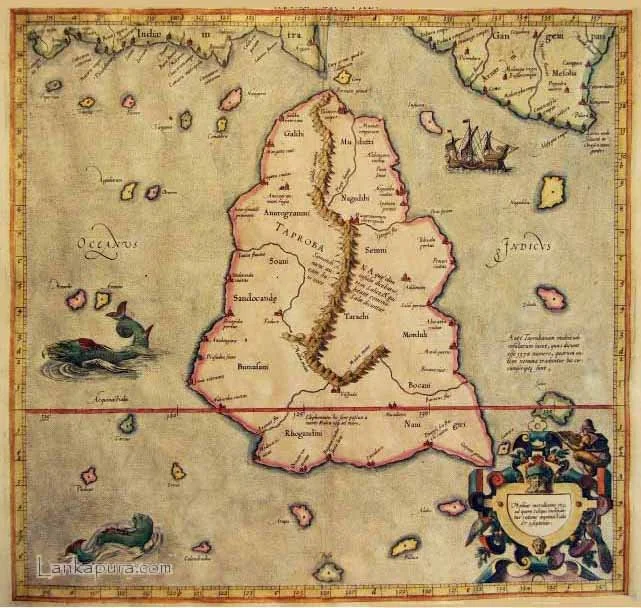
A map of Taprobane from Ptolemy's Geography.

The short but vivid Periplus of the Erythraean Sea, a Greek seaman's handbook usually dated to the mid-first century CE, is the most direct contemporary Roman-period testimony to long-distance navigation in the Indian Ocean. Its anonymous author describes routes, seasons and goods, and although Taprobane receives briefer treatment than the western Indian ports, the Periplus places the island within the author's pragmatic commercial map: it is a known source of gems, ivory and other sought-after products and a waypoint for ships that ranged along the eastern Indian seaboard and beyond. The Periplus also reflects the adoption of the monsoon crossing, knowledge of seasonal wind patterns credited to figures such as Hippalus, which made regular oceanic linkages between the Red Sea and South Asia feasible and economically attractive for Roman subjects based in Egypt.

Pliny the Elder and Ptolemy amplify the picture of Taprobane as an object of classical curiosity and commerce. Pliny compiled earlier reports and travelers’ tales into his encyclopedic Natural History and explicitly names Taprobane among the distant islands whose products reached Mediterranean markets; Ptolemy's Geographia, meanwhile, institutionalized Taprobane on maps, even if the island's scale and position were distorted in late antique cartography. These literary testimonies outline what the Roman-world readers believed they were buying from the Indian Ocean: not only luxury items such as pearls, gems, spices and exotic woods, but also useful commodities—elephants for war and ivory for luxury works—that made a voyage to Taprobane, or through agents who dealt with it, commercially worthwhile.

Textual notice must be matched to material traces, and here archaeology supplies concrete, if sometimes contested, evidence. Excavations and survey work at Sri Lanka's ancient trading sites—most notably Mantai (the harbor complex at Mannar), Godavaya and certain finds around the southern ports and the Ruhuna region—have produced imported ceramics, Indo-Roman wares, and metal finds datable to the first few centuries CE. These finds indicate that goods and perhaps persons moved between the island and the wider Indian Ocean economy at the time classical authors wrote. Archaeologists have recovered Roman or Roman-style amphora sherds and Mediterranean imports mixed with local and South Indian ceramics in contexts that often line up with the mid-first through third centuries CE, supporting the textual evidence that Taprobane was part of long-distance trade networks rather than an isolated curiosity.

Numismatics has contributed one of the most headline-grabbing types of evidence: Roman and Indo-Roman coins found on the island and in neighboring Indian ports. Scholars have catalogued a variety of coins—official Roman denominations, later Byzantine and Sasanian pieces, and locally struck imitations, that turn up in hoards and stray finds across Sri Lanka's archaeological record. The presence of Roman gold, silver and bronze specimens, and of imitations that adapt Roman portraiture and types, demonstrates multiple channels of contact: direct importation, trade mediated by South Indian merchants, and the island's participation in a wider monetary ecology that incorporated foreign coinage as bullion or prestige money. At the same time, numismatists caution that coin deposits are slippery evidence for regular commercial routes, coins travel, are hoarded, reused and sometimes arrive centuries after they were minted, so they illuminate connectivity without always proving direct, continuous Roman state involvement.

Material culture beyond coins, such as fragments of Mediterranean amphorae, glassware and certain classically styled objects helps round out the picture. Amphora sherds linked by form and fabric to Mediterranean production argue that Mediterranean foodstuffs (wine, preserved fish or oil) or at least their containers were carried into the Indian Ocean system. Yet many of the "Roman" finds in South Asia were funneled through intermediary entrepôts on the Malabar coast and the Arabian littoral; the principal agents of exchange in this era were often Indian, Arabian and later Southeast Asian merchants who operated the coastal networks and transshipped cargoes to and from Sri Lankan anchors. Consequently, although Roman subjects and merchants surely appear among the actors of this commerce, especially in Egyptian port cities like Berenice and Myos Hormos—the day-to-day movement of goods to Taprobane seems to have been largely run by regional middlemen who connected Mediterranean markets to South Asian and island producers.

Certain Sri Lankan exports made the island especially prized by Mediterranean consumers. Classical authors and later commentators repeatedly emphasize cinnamon (whose precise identification in ancient texts is debated), pearls from the island's offshore banks, high-quality gemstones and ivory. Archaeology confirms the island's role in pearl fishing and its access to precious stones and fine timber, while epigraphic and local traditions record long-standing maritime commerce. The intersection of demand in the Roman world for luxury consumables and Sri Lanka's capacity to supply them produced the economic logic for sustained contact, sometimes direct, sometimes indirect—across the Indian Ocean.

Historians still debate the scale and intimacy of Roman contact with Taprobane. Older popular narratives sometimes implied a flood of Roman merchants and colonial outposts, but modern scholarship tends toward a more nuanced reconstruction: the Roman world was linked into the Indian Ocean by regular traffic and predictable monsoon crossings, yet most trade remained mercantile rather than imperial in character. Exchanges involved ships and traders from many polities, and Roman interest in the island was commercial and mediated through established regional networks. Recent syntheses emphasize networks rather than empires and stress local agency: Sri Lankan rulers and coastal cities actively engaged with incoming traders, negotiated the terms of exchange, and integrated foreign goods into local economies and status displays.

To read the Roman footprint on Sri Lanka is therefore to read an intricate palimpsest: classical texts furnish names, commodities and routes; coins and imported pottery confirm episodes of contact; port archaeology (Mantai, Godavaya and elsewhere) gives archaeological contexts; and numismatic and ceramic studies provide the cautionary notes that turn sensational finds into careful historical argument. Together they show a world in which a Mediterranean empire's appetites met an Indian Ocean island's riches through the wind and skill of monsoon sailors, the networks of Indian and Arabian middlemen, and the receptive markets of the classical Mediterranean. The story of Roman contact with Taprobane is thus not simply one of exotic discovery but of interlocking economic systems whose consequences can still be traced across texts, maps and the soil of Sri Lanka's ancient harbors.

If modern readers take away anything from these fragments of evidence, it should be the image of an ancient globality: long before industrial shipping lanes and steam power, mariners harnessed seasonal winds and a shared appetite for luxury to connect Rome and Taprobane. The contacts were episodic and mediated, yet real—and archaeology keeps revealing fresh details that transform classical blurbs into a living maritime history of exchange, negotiation and cultural contact centered on an island the ancients called Taprobane.

Therefore in conclusion, the story of Roman contact with Taprobane, (modern Sri Lanka), reveals a world far more interconnected than traditional histories of empire and conquest often suggest. It illustrates how commerce, curiosity, and the mastery of the monsoon winds drew distant civilizations into dialogue across thousands of nautical miles. Taprobane stood at the crossroads of the Indian Ocean trade, a hub where the ambitions of Mediterranean merchants, the enterprise of South Asian and Arabian intermediaries, and the wealth of the island's own natural resources converged. Rather than a tale of colonization or conquest, it is one of exchange and adaptation, in which goods, ideas, and cultural influences circulated through the flexible networks of ancient trade.

From the Roman amphora fragments unearthed at Mantai to the gold coins buried in Sri Lankan soil, every discovery underscores that global trade, even in antiquity, was a shared venture driven by mutual interest and the steady rhythm of the monsoon. Taprobane's presence in classical geography, literature, and cartography speaks not only to Roman fascination with distant lands but also to the island's active participation in shaping the maritime world of its time. In the final measure, the legacy of these contacts lies in their reminder that globalization is not a modern invention, it is a continuous human story that began when early sailors learned to follow the winds from the Red Sea to the shining shores of Taprobane.


The site has been offering a wide variety of high-quality, free history content since 2012. If you’d like to say ‘thank you’ and help us with site running costs, please consider donating here.


Notes:

Hippalus

Hippalus was a Greek navigator and mariner traditionally credited with one of the most important breakthroughs in ancient navigation, the discovery of the direct sea route across the Indian Ocean from the Red Sea to the west coast of India, aided by the predictable seasonal winds known today as the monsoon. His exploits, usually dated to the 1st century BCE, revolutionized maritime trade between the Greco-Roman world and India by allowing sailors to venture directly across the open ocean rather than hugging the dangerous and time-consuming coastlines of Arabia and Persia. Although few details of his life are known, Hippalus's name became synonymous with this vital navigational discovery, with both the southwest monsoon wind and the route itself often referred to in ancient texts as the Hippalus or Hippalus wind.

Before Hippalus's innovation, Greek and Roman merchants relied largely on intermediary traders and coastal navigation routes that followed the Arabian Peninsula, using small vessels ill-suited for deep-sea travel. By observing the regular reversal of the monsoon winds, blowing from the southwest in summer and the northeast in winter, Hippalus realized that a direct crossing from the Red Sea to the Malabar Coast of India was possible. This not only shortened the voyage but also dramatically increased the volume and efficiency of trade. His discovery effectively opened the Indian Ocean to Greco-Roman seafarers and established a reliable maritime corridor that endured for centuries, connecting ports such as Berenice and Myos Hormos in Egypt to Muziris and Barygaza in India.

The Periplus of the Erythraean Sea, a 1st-century CE Greek navigational text, preserves some of the earliest references to Hippalus's route. Although historians debate whether Hippalus himself made the voyage or merely identified the wind pattern, his legacy was profound. Roman merchants soon began to dominate the Indian Ocean trade, importing spices, silks, gemstones, and ivory in exchange for gold and silver. The new route not only enriched the Roman economy but also deepened cultural exchanges between the Mediterranean world and South Asia, influencing art, religion, and material culture on both sides. Thus, even though the man Hippalus remains elusive, his name endures as a symbol of early scientific observation and the spirit of exploration that bridged civilizations across the seas.

In Myths of the Civil War: The Fact, Fiction, and Science Behind the Civil War’s Most Told Stories, Professor Scott Hippensteel brings a unique perspective, applying science and skepticism to common claims about the rifled musket.

Here, Jeb Smith looks at the rifled musket.

Springfield Model 1861 rifled musket.

Scott Hippensteel begins with “snipers,” pointing out that no such unit existed during the Civil War; the term and function came much later. Instead, those in the role were better described as sharpshooters and acted as skirmishers. He challenges the various claims of kills at 500 yards or greater, demonstrating some of the most famous supposed long-range killings to be inconceivable as actually happening, and suggesting they were in all likelihood from friendly fire, artillery shrapnel, or at best, from numerous skirmishers who would aim in a general direction and one happened to get lucky and strike an officer. He writes, “It was hopeless for a Civil War sharpshooter to aim at and attempt to kill a single specific officer at more than a few hundred yards; the exterior ballistics and accuracy of the available weapons made this task nearly impossible, regardless of the shooting talent of the soldier.”

Very few rifles were equipped with scopes, and fewer still were the trained individuals who could accurately hit a long-distance target even in training. Imperfections in powder, bullets, the rifle, the scope, and more made long-distance shots extraordinarily difficult. The weather, moisture in the air, wind (which can change the landing spot by a few feet even if VERY light), and other factors impacted long-range shots. Furthermore, the precision required to estimate the target’s distance and account for the bullet’s trajectory makes it unlikely that genuine long-distance kills occurred. Some sharpshooters needed to aim 14 feet above the target’s head and precisely measure the distance from hundreds of yards using old glass scopes that themselves impeded long-range shots. Hippensteel wrote, “Additionally, the front sight of these muzzleloaders was broader than any human-size target at five hundred yards. Between the required holdover and the width of the front sight, any view of the intended victim of the sharpshooter is completely obscured at this range.” To say it would be a shot in the dark is an understatement.


Conditions

Further, ideal conditions, perfect weather timing, etc., would not be the same as battle conditions with fog, smoke, and imperfect visibility. As a straight shot in the open was usually never beyond 125 yards, the eye could not accurately estimate a single target’s distance so as to calculate the trajectory for long-range shots. The enemy was rarely visible due to obscuring terrain, smoke and more at more than 100-150 yards.  Even under perfect conditions, with no human error, “perfectly aimed” shots still would often miss.

In addition, the number of steps that need to be done correctly to load the rifled musket, in the correct order, and the right way to fire a shot amid the noise, screams, adrenaline rush, shouting, smoke, confusion, fear, death and fatigue made getting off an accurate shot near-impossible and the performance in battle staggeringly poor. The best commanders could do with these citizen volunteers was often to maintain a steady fire aimed in the general direction of the opposing side, in order to cause enough damage to hold their position or push the others back over time, often due to the latter running out of ammo. After Gettysburg, 32-43% of the rifled muskets found were loaded with multiple bullets and discarded. Many soldiers whose gun malfunctioned picked up other random discarded ones, weapons they might never have fired before. Using ammo that was not meant for the new musket, that alone can cause mishaps.

Hippensteel conducted an in-depth analysis of weapons used in the U.S. military from 1770 to 2000, determining the “total firepower” and the overall killing ability, particularly in the range of up to 150 yards, the “killing zone” where the vast majority of kills occur. Evaluating bullet size, velocity, reload time, and other factors, he discovered that the lowest point occurred when the United States Army first adopted the rifled musket, and that the smoothbore actually puts out more firepower than the rifled musket. No wonder many commanders rejected the latter. Hippensteel wrote, “When the army adopted the rifled musket, the hitting power of the US infantrymen hit an all-time low. This seems strange for a weapon that was about to ‘revolutionize’ warfare…compared to its predecessor, the smoothbore musket, the rifled musket is 15-25 percent slower to load and has a muzzle velocity of only 950-1050 feet per second, compared with the 1,400-1,500 feet per second of the smoothbore.” Meaning that within the range of non-skirmishing Civil War combat, the smoothbore outperformed the rifled musket. Almost all fire occurred at under 200 yards, the enemy was often not visible beyond. And beyond 200 yards, special training was required to account for the low velocity of the weapon.


Differences

Noting the difference between what the rifled musket could do at distance in target practice vs in Civil War battles, he points out that because “Rifled muskets were much more precise …they could produce smaller groups (‘hits’ in target practice within a specific range or distance), because their rifling guided all the bullets to a more localized space downrange. However, this precision did not necessarily make the rifle more accurate in reality, the tight grouping might have been falling short (bullet has a high rate of drop) or long of the intended target because of the difficulty introduced by the parabolic flight path of the bullets.” He continues, “A precision weapon is only useful in combat if it is also accurate, and low muzzle velocity makes accuracy a challenge.” In other words, in actual combat, where you are not simply shooting at an unmoving target, your adjusted total accuracy equals out even if the rifle is more precise in practice. Unless you could allow for the difference, and the vast majority of soldiers could not, you lost the advantages.

In the end, smoothbore is similar overall to rifled for ranges of 75 yards and under, and is even preferred due to the lethality of buck and ball. At ranges of 250 yards or more, rifled is a waste of ammunition, so it is only between 75-250 yards where it has a hypothetical advantage for the typical soldier. But the smoke, terrain, and other effects of battle largely negated that, meaning that most commanders would not have their men fire until 100-150 yards, seeing shooting at longer distances as a waste of ammunition, or attempting to “shock” the enemy with a deadly volley from around 60 yards or under. So very little combat occurred at distances or under conditions to give the rifle musket an edge. Hippensteel summarizes “So the rifled musket had a limited advantage over the smoothbore on some battlegrounds, in some circumstances; it was, for example a better gun for skirmishers.”

Without machine guns or artillery, a company in Vietnam produced the same firepower as a Civil War corps. A brigade in WW1 did the same, also without artillery or machine guns. Further, modern weapons are smokeless and do not decrease visibility as black powder weapons did. The Civil War was not the first modern war. Hippensteel quotes Allen Guelzo: “Whatever the gains bestowed by the technology of the rifled musket…those improvements were only apparent under ideal conditions (which is to say, not in the middle of a firefight).” David Ward wrote, “The rifled musket did not revolutionize civil war operations because the weapon was not used at long range.” Further, diseases were the leading cause of death among Civil War soldiers, not what one considers “modern” weaponry.


Did you find that piece interesting? If so, join us for free by clicking here.

In the 400-plus years since William Shakespeare’s death, multiple poets, playwrights and other creatives have indicated they are inspired by him.

Those who use common terms such as skim milk, hot-blooded and night owl, whether or not they have written a play or poem, have been influenced by Shakespeare.

But who inspired Shakespeare? Janel Miller takes a brief look at some of the individuals who inspired the man often regarded as one of the greatest in his craft.

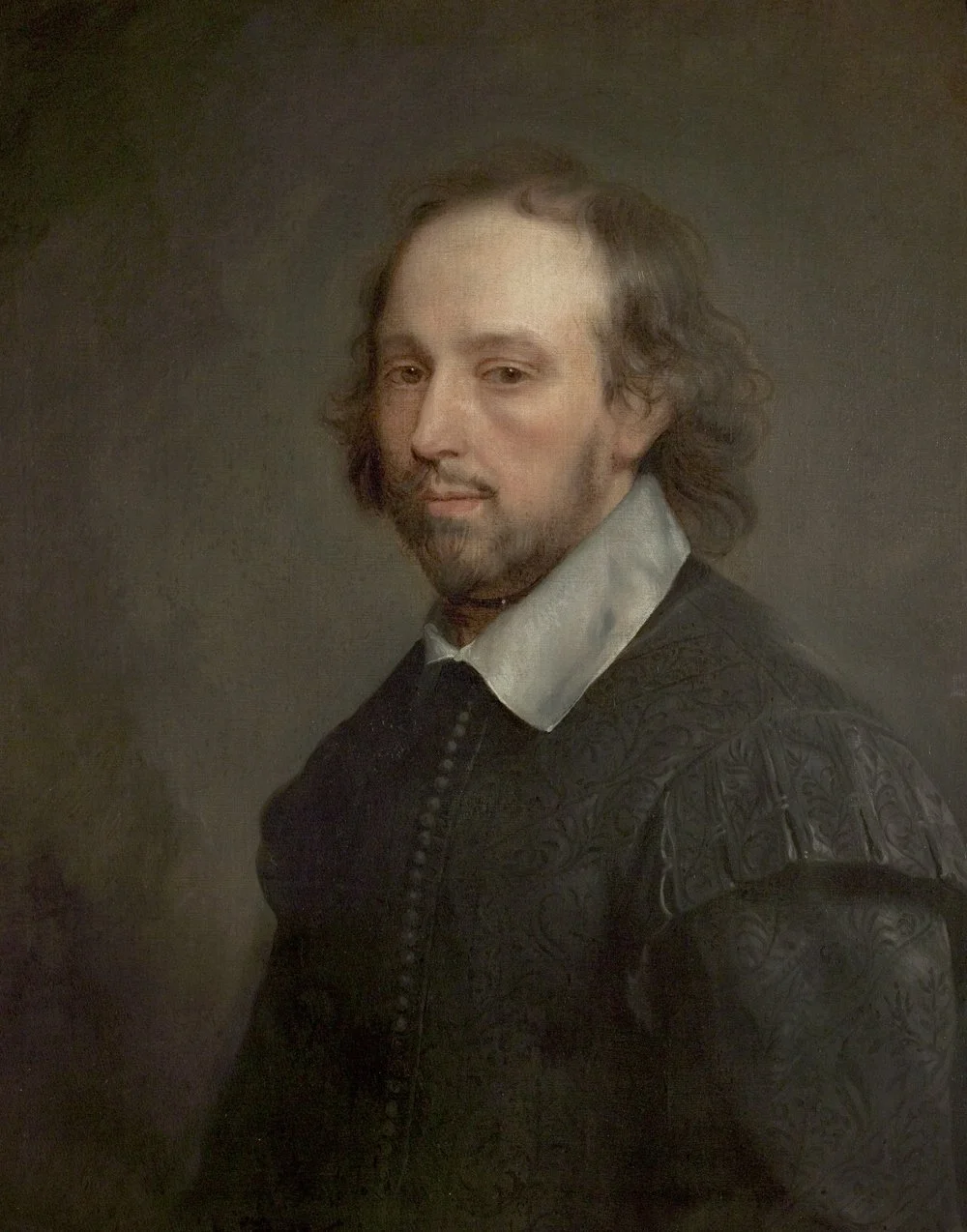
The Soest Portrait of Shakespeare, circa 1667. By Gerard Soest.

Typically, the curriculum of Elizabethan English schools like the one Shakespeare attended included courses in Latin, Greek, the art of rhetoric and play production. This is likely how Shakespeare was introduced to the Roman poet Ovid, who lived and died around the start of the Common Era.

Some of Ovid’s influence can be seen in his telling of the secret love of Pyramus and Thisbe that culminates in both committing suicide in his “Metamorphoses,” which was released in 8 A.D. Centuries later, a play within Shakespeare’s “A Midsummer Night’s Dream” retells the story of Ovid’s ill-fated lovers.

In addition, Shakespeare’s  “Venus and Adonis,” which tells the story of the goddess of love’s pursuit of a male hunter, is also said to draw some of its themes from identically named characters in “Metamorphoses.”

Shakespeare was also likely influenced by “The Chronicles of England, Scotland, and Ireland,” Raphael Holinshed’s 1577 work on the history of those countries.

In Shakespeare’s “Richard III,” illustrations of Holinshed’s inspiration include some of the details surrounding Henry's wounds, the command to transport a corpse to Whitefriars and a bleak prediction regarding Rougemont.

Still another Shakespeare influence was likely Edward Hall’s 1548 work titled “The Union of the Two Noble and Illustre Families.”

Cases of this point can be seen in Shakespeare’s “Henry IV,” where a few features of the Holland plot, the situation surrounding Talbot and Chastillon’s demises and the battle at Wakefield. Other Shakespeare works featuring Henry IV, Henry V and Henry VI also use details from Hall’s work.

Comparisons can also be drawn between “Richard II” and Hall’s work, such as “when Hereford broke his mind to Norfolk, more for dolour and lamentaction” and Worchester’s reminder of the pledge Henry made at Doncaster.


In Context

The phrase “Imitation is the sincerest form of flattery” may come to mind as this essay is read (it certainly was as it was written). Shakespeare is by no means the only creative inspired by other creatives.

Examples of this can be found in various modern-day versions of Sir Arthur Conan Doyle’s 19th-century creation named Sherlock Holmes – one of the most depicted characters of all time.

For example, one of the characteristics of Mark Gatiss and Stephen Moffatt’s take on the detective in the television series “Sherlock” had the title character set in the present day and trying to quit smoking cigarettes instead of pipe tobacco.

In addition, Rob Doherty, when creating the television show “Elementary,” also chose to set the show in the present day and make Holmes’ sidekick Dr. Watson a woman, instead of a man.

While imitation from those regarded as the best may be acceptable, it can be beneficial to add personal touches.  


Did you find that piece interesting? If so, join us for free by clicking here.


References

Britanica.com Editors. Britanica.com. “William Shakespeare.” William Shakespeare | Plays, Poems, Biography, Quotes, & Facts | Britannica. Accessed October 26, 2025.

Shakespeare-online.com Editors. Shakespeare-online.com. “Shakespeare's Influence on Other Writers.” https://www.shakespeare-online.com/biography/shakespearewriter.html.  Accessed October 26, 2025.

Klein, C. History.com. https://www.history.com/articles/10-ways-shakespeare-changed-the-way-you-talk. “10 Ways Shakespeare Changed the Way You Talk.” Accessed October 26, 2025.

Brittanica.com Editors. Brittanica.com. “William Shakespeare.” William Shakespeare | Plays, Poems, Biography, Quotes, & Facts | Britannica. Accessed October 26, 2025.

Shakespeare.org Editors. Shakespeare.org. https://www.shakespeare.org.uk/explore-shakespeare/podcasts/lets-talk-shakespeare/was-shakespeare-educated/. “Was Shakespeare Educated?” Accessed October 26, 2025.

Brittanica.com Editors. Brittanica.com. https://www.britannica.com/biography/Ovid-Roman-poet. “Ovid, Roman Poet.” Accessed October 26, 2025.

Walsh, P.  “Ovid and His Influence.” University Review, Vol. 2, No. 6, Pages 26-37. https://www.jstor.org/stable/45241810. Accessed October 26, 2025.

Penn State Centre Stage Editors. Psu.edu. https://sites.psu.edu/amidsummernightsdream/pyramus-and-thisbe/. “A Midsummer Night’s Dream.” Accessed November 2, 2025.

Walsh, P.  “Ovid and His Influence.” University Review, Vol. 2, No. 6, Pages 26-37. https://www.jstor.org/stable/45241810. Accessed October 26, 2025.

Mowat, B. and Werstine, P. Folger.edu. https://www.folger.edu/explore/shakespeares-works/venus-and-adonis/about-shakespeares-venus-and-adonis/. “About Shakespeare's Venus and Adonis.” Accessed November 2, 2025.

Begg, E. “Shakespeare’s Debt to Hall and Holinshed in Richard III.” Studies in Philology. Vol. 32, No. 2, Pages 189-196. https://www.jstor.org/stable/4172274. Accessed October 26, 2025.

Brittanica Editors. Brittanica.com. “Raphael Holingshed.” https://www.britannica.com/biography/Raphael-Holinshed. Accessed November 1, 2025.

Begg, E. “Shakespeare’s Debt to Hall and Holinshed in Richard III.”” Studies in Philology. Vol. 32, No. 2, Pages 189-196. https://www.jstor.org/stable/4172274. Accessed November 1, 2025.

Royal Collection Trust Editors. Royal Collection Trust. “Edward Hall (1497-1547).”  https://www.rct.uk/collection/1027621/the-union-of-the-two-noble-and-illustrate-famelies-of-lancastre-and-york-beeyng. Accessed November 1, 2025.

Zeeveld, W. G. “The Influence of Hall on Shakespeare's English Historical Plays.” ELH. Vol. 3, No. 4, Pages 317-353. https://www.jstor.org/stable/2871549. Accessed November 1, 2025.

Guinness World Record News. Guinesswordrecords.com. https://www.guinnessworldrecords.com/news/2012/5/sherlock-holmes-awarded-title-for-most-portrayed-literary-human-character-in-film-tv-41743. “Sherlock Holmes Awarded Title for Most Portrayed Literary Human Character in Film & TV.” Accessed November 1, 2025.

BBC One Editors. BBC.co.uk.  https://www.bbc.co.uk/programmes/articles/3FvspTyB0YHhtN7MRns2Fm/about-sherlock. “About Sherlock.” Accessed October 26, 2025.

Peterson of Dublin Editors. https://www.peterson.ie/pipes/sherlock-holmes/. Pipes. Accessed November 1, 2025.

Sherlock Forum Editors. Sherlock Forum.com. https://www.sherlockforum.com/forum/topic/1146-sherlock-smoking/. “Sherlock Smoking.” Accessed October 26, 2025.

NPR Editors. NPR.org. “https://www.npr.org/2012/09/27/161859930/sherlocks-dr-watson-as-a-woman-is-elementary. “A Woman as Sherlock’s Dr. Watson is Elementary.” Accessed October 26. 2025.

Mayer Amschel Rothschild, the founder of the Rothschild banking dynasty famously said “Give me control of a nation’s money and I care not who makes its laws”, suggesting that whoever controls the economy of a country has more power than the lawmakers. The Swadeshi Movement, while fundamentally political, was India’s realization of this truth and understanding the importance of economic control. Over the years, many historians and scholars have given their definition of the term “Swadeshi”, all revolving around self-sufficiency and local self-reliance.

Shelton Rozario explains.

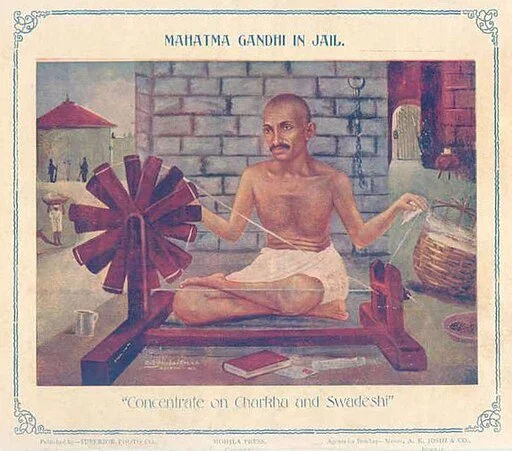
"Concentrate on Charkha and Swadeshi," a poster in the Swadeshi Movement. It shows Mahatma Gandhi using a Charkha.

According to Gandhi, the term Swadeshi is “that spirit within us which restricts us to the use and service of our immediate surroundings to the exclusion of the more remote.” He promoted the importance of indigenous skills, using them to live a simple and dignified life. For Sri Aurobindo, “It is an intellectual change, it is a spiritual change, it is a political change…Swadeshi is that which belongs to our own country. When applied to industry and commerce it means  the preference for our own articles produced by Indian labour and the exclusion of articles produced by the labour of foreign people.” Lisa N. Trivedi opines that the “social collective of Bharat (the dominant indigenous term for India) was the template on which popular swadeshi repertoires were forged.”

The Swadeshi Movement went beyond mere boycott and eventually became a way of living. This idea has been stressed upon in Gandhian philosophy and also in influential works like that of Rabindranath Tagore’s 1904 essay ‘Swadeshi Samaj’. It emerged as a mass political movement from 1905 onwards and developed into a crucial instrument for economic policy making post 1947, after Indian independence. This movement is about the making of a local economy and revival of the industries that were disbanded by the British. Despite harsh measures such as arrests and lathi charges to suppress it, the movement had already succeeded in forging a sense of national identity among Indians.


Drain of Wealth and Early Swadeshi Awakening

The economic awakening in colonial India occurred after the ‘Drain of Wealth’ debate put forward by Dadabhai Naoroji. In his work ‘Poverty and Un-British Rule in India’ originally published in 1901, he spoke about how Britain was practically bleeding India’s revenue. Dr. Dhananjaya in her study of this writes how “The Indian government was also forced to impose significant home charges as reparations on the people of England due to the political, administrative, and commercial ties between the two countries. The Home Charge covered annuities for irrigation and railroad projects, interest on public loans obtained from England, and payments to British workers in India in the form of salaries and pensions.”

Naoroji and the Indian National Congress had put forward their demands for industrial development, reduced taxes and promotion of Indian industries which were never given any importance. Between 1883 and 1892, Naoroji said that the total drain amounted to Rs. 24 crores which substantially increased to 51.5 crores by 1905. D.E. Wacha, the President of the Indian National Congress in 1901 also suggested that the drain was about thirty to forty crores. The figure varies as per the calculations of historians but drain of wealth from India was undeniably a major issue. In 1891, the Swadeshi agenda was adopted by the Indian National Congress. This became a national cause after the British Government amended the 1894 cotton duties in 1896 to benefit the textile manufacturers in Manchester by imposing a uniform 3.5% duty on manufactured Indian cloth.

Nitin Pai while tracing the early economic developments during the Swadeshi Movement highlights how “swadeshi…already became a social proxy against what many saw as political “mendicancy”. Bal Gangadhar Tilak in 1896 organized boycotts and publicly burned foreign cloth in Bombay. Mahadev Govind Ranade's work through the Industrial Conference of Western India aimed to promote industrial development in Bombay in the late 1880s. This phase marked the establishment of early Swadeshi stores, indigenous banks and the rise of an entrepreneurial Indian class. Nitin Pai sheds light on the global movements during this emergent political phase such as the abolition of slavery in America, the American Civil War, Industrial Revolution, all culminating in changing the “pattern of the deployment of Indian capital.”


Swadeshi and Local Enterprises in Full Swing

When Lord Curzon partitioned Bengal on October 16, 1905, his reasons revolved around Bengal being too large of a province. However, the main reason as supported by many historians was to curb Bengali nationalism, using the old tactic of “divide and rule” from the British playbook. In a 1903 memo, Curzon wrote: Bengal united is a power; Bengal divided will pull in different ways. East Bengal and Assam with approximately 31 million people became one unit while Bihar, Orissa and West Bengal formed the others. Little did Curzon expect that this move would act like a catalyst for the already brewing Swadeshi Movement.

Hundreds and thousands of people gathered on August 7, 1905 at Calcutta’ Town Hall chaired by moderate leader Surendranath Banerjee. Following this, students opted out of government schools, local banks and mills sprouted to promote the local economy. Some of the most prominent Swadeshi enterprises from Bengal include Acharya P.C. Ray's Bengal Chemicals, Bange Lakshmi Cotton Mills, Calcutta Potteries and the Swadeshi Steam Navigation Company (1906) by V.O. Chidambaram Pillai. In her article ‘Boycott of Lancashire Cloth: The real economic battle’, Diksha Tyagi observes how Import of foreign cloth declined by 1.5 crore rupees in 1907…Bombay’s textile mills, benefiting from increased demand for indigenous cloth, earned profits of over 2.7 crore rupees…” She further says that even Brahmins boycotted foreign goods and refused to perform pujas with those items.

When Gandhi arrived in 1915, he gave the movement a broader meaning by incorporating social, religious and cultural aspects. He promoted the khadi (cloth woven on handloom from fibers like cotton, silk, wool, etc.) as an alternative to the mill cloth and began spinning it in his Sabarmati Ashram. After World War I and brutal effects of the Great Depression in America, the British economy was slowly but surely crumbling. Khadi became a symbol of economic sufficiency and by 1925, the All India Spinners’ Association (AISA) was set up. They offered employment to women too who now became active economic contributors.


From Khadi to National Consciousness

Another major blow to the British economy was the Dandi March of 1930, a part of the larger Civil Disobedience Movement. Following the principles of satyagraha (truth) and ahimsa (non-violence), this was a salt march against a series of British laws that prohibited Indians from locally producing or selling salt. The Swadeshi movement post 1930s went beyond producing cloth and aimed at creating a decentralized economy. This was the opposite of what the British believed in : a centralized model of production. Nitin Pai writes “As India headed towards independence, swadeshi began to move from being an instrument of protest to a principle of economic policy of the new republic.”

The majority of the population of India during the 1940s had still not adapted to an urban lifestyle. In this sense, Gandhi’s vision of a self-sufficient village economy represents a microcosm of India itself. Trisha Rani Deka opines that Gandhi’s “entire effort of swadeshi was revolving around the village economy…village self-sufficiency, village self-government, cultivation of village and cottage industries were the main agenda in his concept of swadeshi.” Thus, this led to the revival of indigenous products, particularly handlooms and cottage industries. Gandhi himself said that his model was : “Not mass production, but production by the masses.” This community spirit further cultivated a collective identity and national consciousness which was rooted in atmashakti or self-reliance.

Interestingly for Gandhi, the total boycott of foreign goods or western items was never on the table. He would be willing to “buy surgical instruments from England, pins and pencils from Austria and watches from Switzerland” but “will not buy an inch of the finest cotton fabric from England or Japan or any other part of the world because it has injured and increasingly injures the millions of the inhabitants of India.”(Young India, 12-3-1925, p. 88). He was against mass industrialization as it would force villagers to leave their homes and craft, reducing them to factory workers. Even though the post 1947 models reflect a Nehruvian planning and state led heavy industrialization, Gandhi's Gram Swaraj ideals are reflected in the rural schemes and support for village industries.


Conclusion

India under a colony of the British was not only treated as a market and source of raw materials. For centuries under the rule of the British Raj, the Indian subcontinent was only a dumping ground for foreign grounds whose artisanal industries were dismantled. The Swadeshi Movement changed that and emerged as the first great reversal. What once was a dependent and culturally dependent colony saw an awakening and revival of its own local enterprises. As described by Gandhi : When every individual is an integral part of the community…when the economy is local… when homemade handicrafts are given preference, it is the real swadeshi.”

From the early efforts of the Indian National Congress to the growth of local enterprises and the entrepreneurial spirit, Swadeshi became a way of living. The pharmaceutical industries, banks, national schools and handloom industries laid the foundation of some big names that exist to this day. In many ways Swadeshi was India’s first “Atmanirbhar Bharat” that boosted the local economy via a model that revived its economy and embraced ethical consumption.


Over the past two years, Shelton has worked with various organizations as a content writer and contributes as a fact-checker for DigitEYE India, an IFCN signatory. He is passionate about history, politics and culture.


References

●      Joseph, S. K. (n.d.). Understanding Gandhi’s vision of Swadeshi. Retrieved on October 19, 2025 fromhttps://www.mkgandhi.org/articles/understanding-gandhis-vision-of-swadeshi.php

●      Aurobindo, Sri. “Swadeshi and Boycott.” Bande Mataram, 1907. Web. https://sri-aurobindo.co.in/workings/sa/37_06_07/0306_e.htm.

●      Trivedi, L. N. (2003). Visually Mapping the “Nation”: Swadeshi Politics in Nationalist India, 1920-1930. The Journal of Asian Studies, 62(1), 11–41. https://doi.org/10.2307/3096134

●      Dhananjaya. (2021). The Drain Theory of Wealth and Dadabhai Naoroji: An Overview. International Journal of Novel Research and Development, 6(7). https://www.ijnrd.org/papers/IJNRD2107007.pdf

●      Pai, N. (2021, July 2). A Brief Economic History of Swadeshi. Indian Public Policy Review, 2(4). https://doi.org/10.55763/ippr.2021.02.04.002

●      Tyagi, D. (2025, August 8). Boycott of Lancashire Cloth: The real economic battle. Organiser.https://www.organiser.org/2025/08/08/306782/bharat/boycott-of-lancashire-cloth-the-real-economic-battle/

●      Deka, T. R. (2020). Gandhi’s vision of Swadeshi and its relevance. International Journal of Management (IJM), 11(10), 2587-2593.https://iaeme.com/MasterAdmin/Journal_uploads/IJM/VOLUME_11_ISSUE_10/IJM_11_10_260.pdf

Posted
AuthorGeorge Levrier-Jones
Categories20th century

Zheng He, one of the most remarkable figures in maritime history, was a Chinese admiral, explorer, and diplomat whose seven great voyages in the early 15th century projected the power and prestige of Ming Dynasty China across the Indian Ocean. Born around 1371 in the Yunnan province during the waning years of the Mongol-led Yuan Dynasty, Zheng He was originally named Ma He. He was of Hui Muslim descent, and his family's faith would remain an important part of his identity throughout his life. His early years were marked by turmoil; during the Ming conquest of Yunnan in 1381, Ma He was captured by Ming forces as a boy and was castrated, entering service in the household of Prince Zhu Di, the future Yongle Emperor. His intelligence, resourcefulness, and loyalty soon brought him to prominence within the prince's inner circle. When Zhu Di ascended to the throne in 1402, he recognized Ma He's talents and conferred upon him the name Zheng He, granting him command of an ambitious enterprise that would redefine the scale of maritime exploration.

Terry Bailey explains.

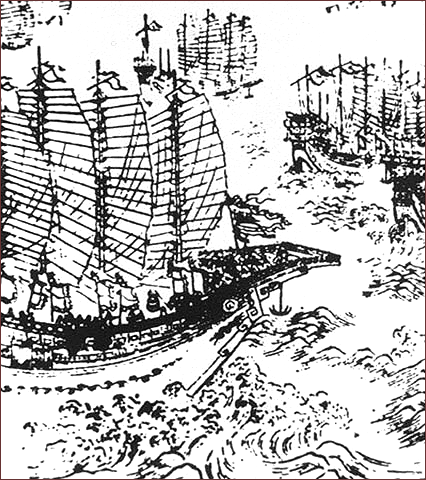
A Chinese woodblock print showing Zheng He's ships.

Between 1405 and 1433, Zheng He led seven massive naval expeditions that reached an extent unparalleled in the pre-modern world. Sailing from the great port of Nanjing and later from Liujiagang and Changle, Zheng He commanded fleets that dwarfed those of contemporary Europe, some comprising over 300 ships and tens of thousands of men. His flagship, often called the "Treasure Ship" (宝船, Baochuan), was said to have been up to 120 meters long, a floating palace of diplomacy and commerce. The first voyages took him to Southeast Asia, visiting ports in modern-day Vietnam, Thailand, Java, and Sumatra before crossing the Indian Ocean to reach Calicut on the Malabar Coast of India.

Later expeditions extended China's reach to Ceylon (Sri Lanka), Hormuz in the Persian Gulf, and the Swahili Coast of East Africa, including Mogadishu and Malindi. These voyages were not primarily for conquest, but rather for diplomacy and trade; Zheng He carried lavish gifts from the emperor, secured tributary relations, and brought back exotic goods such as spices, ivory, precious stones, and even a giraffe, an animal that so fascinated the Ming court that it was described as a qilin, a mythical creature symbolizing virtue and harmony.

The achievements of Zheng He's voyages were multifaceted. They demonstrated Chinese mastery of shipbuilding, navigation, and logistics on a scale never before attempted. The fleets were equipped with advanced magnetic compasses, watertight bulkhead compartments, and sophisticated star maps. Zheng He's role as both an admiral and a diplomat made him an embodiment of Ming China's outward-looking confidence during the Yongle Emperor's reign. He established diplomatic relations with over thirty foreign states and secured China's influence in vital maritime trade routes linking East Asia, South Asia, Arabia, and Africa. His voyages also promoted cultural and religious exchanges; as a Muslim, Zheng He visited mosques and supported communities of fellow believers abroad, leaving inscriptions that reveal his piety and his sense of mission as a servant of the emperor.

Zheng He's later life reflected both the triumph and decline of his era. After his final voyage, which took place around 1431–1433, the political mood in China shifted sharply inward. The enormous cost of the expeditions, combined with renewed threats from nomadic powers on China's northern frontier, led subsequent emperors and court officials to end support for maritime exploration. Zheng He likely died on the return voyage from the seventh expedition, possibly in Calicut or at sea, though some sources claim he returned to China before his death and was buried in Nanjing. His tomb, located on the southern slope of Niushou Mountain near Nanjing, remains a place of cultural significance, though it contains only his clothes and a symbolic cenotaph rather than his actual remains.

The primary sources documenting Zheng He's voyages provide invaluable insight into this extraordinary chapter of history. The most famous of these is the Ming Shi ("History of the Ming"), which records his achievements in official court annals. More detailed accounts come from contemporaries such as Ma Huan, a Muslim interpreter who accompanied Zheng He on several voyages and wrote the Yingyai Shenglan ("Overall Survey of the Ocean's Shores"), describing the peoples, customs, and landscapes encountered along the route. Another chronicler, Fei Xin, composed the Xingcha Shenglan ("Description of the Starry Raft"), while Gong Zhen, another member of the fleet, wrote the Xiyang Fanguo Zhi ("Records of Foreign Countries in the Western Ocean"). These works, written in refined classical Chinese, combine geography, ethnography, and travel narrative, providing an invaluable window into both the material and human dimensions of Zheng He's journeys.

Archaeological evidence has also corroborated elements of Zheng He's story. Excavations at the Longjiang shipyard in Nanjing have revealed slipways and timbers large enough to support the construction of the enormous treasure ships described in the chronicles. Chinese porcelain shards and Ming coins found as far afield as Kenya, Sri Lanka, and the Persian Gulf further attest to the reach of Zheng He's maritime enterprise. In 2010, the discovery of an ancient Chinese anchor off the coast of Malindi fueled debate over the physical traces left by his expeditions in East Africa.

Additionally, stone inscriptions attributed to Zheng He, such as the 1407 Liujiagang stele and the 1431 Changle stele, survive as direct statements of purpose and faith, invoking both the Buddha and Allah in a syncretic reflection of Zheng He's worldview and the inclusiveness of the Ming maritime project.

Zheng He's legacy has endured long after his voyages faded into obscurity. For centuries, China turned inward, its maritime ambitions curtailed by isolationist policies, and the memory of Zheng He was reduced to legend. Yet in modern times, he has been rediscovered as a symbol of peaceful exploration and cross-cultural exchange. His journeys demonstrated that centuries before the European Age of Discovery, China had already mastered the oceans and built a network of contacts that stretched from the South China Sea to the coast of Africa. In Zheng He's wake, the world glimpsed the potential of global navigation, not for conquest, but for curiosity, diplomacy, and mutual enrichment. His life remains a record of the heights that human ambition and organization can reach when guided by vision and confidence in the vastness of the world beyond the horizon.

Zheng He's life and legacy stand as a profound symbol of the power of exploration guided not by conquest, but by curiosity, diplomacy, and a vision of cultural exchange. His seven voyages across the Indian Ocean were not merely feats of navigation or imperial display, they were acts of global connection at a time when much of the world remained isolated within its own horizons. Through his command of the immense treasure fleets, Zheng He demonstrated the technological and organizational prowess of Ming China, showcasing a civilization at its zenith of maritime innovation. Yet beyond the grandeur of his ships and the exotic cargoes they carried lay a deeper achievement: the forging of peaceful relations between vastly different peoples, faiths, and nations across Asia and Africa.

In Zheng He, the threads of history, religion, and empire were uniquely intertwined. As a Hui Muslim serving a Confucian court, he embodied the diversity and tolerance that characterized the Ming Dynasty's outward-facing moment. His voyages not only expanded China's influence but also reflected a worldview in which harmony among nations and respect for difference were integral to the pursuit of greatness. This spirit is echoed in the inscriptions he left behind, invoking both Buddha and Allah, a rare and moving testament to his belief in the universality of human faith and purpose.

The decline of China's maritime enterprise following Zheng He's death marked a turning point in world history. While Europe embarked upon its own age of exploration, the Ming Empire turned inward, allowing the memory of Zheng He's accomplishments to fade into the background of myth. Yet history has revived his story as one of vision and possibility. In the modern era, Zheng He has come to symbolize not imperial ambition, but the idea of global engagement built upon respect, cooperation, and mutual understanding. His voyages are a reminder that exploration can serve as a bridge between cultures rather than a means of domination.

Ultimately, Zheng He's legacy endures not only in the chronicles of his journeys or the relics uncovered along his routes, but in the enduring idea that humanity's greatest discoveries lie in its capacity to reach outward and connect. His fleets may have long vanished beneath the waves of time, but the wake of his voyages still ripples through history, inspiring generations to look beyond the edge of the known world with the same sense of wonder and courage that guided the great admiral of the Ming seas.


The site has been offering a wide variety of high-quality, free history content since 2012. If you’d like to say ‘thank you’ and help us with site running costs, please consider donating here.

Posted
AuthorGeorge Levrier-Jones
CategoriesBlog Post

This the story of William Hitler, the nephew of Adolf Hitler. William enlisted and served in the U.S. Navy in 1944 after personally imploring the President, Roosevelt to admit him into the Allied armed forces. After some understandable hesitation, the U.S. authorities relented, and William proceeded to join the fight against the Axis regime in the Pacific. This is his story.

Steve Prout explains.

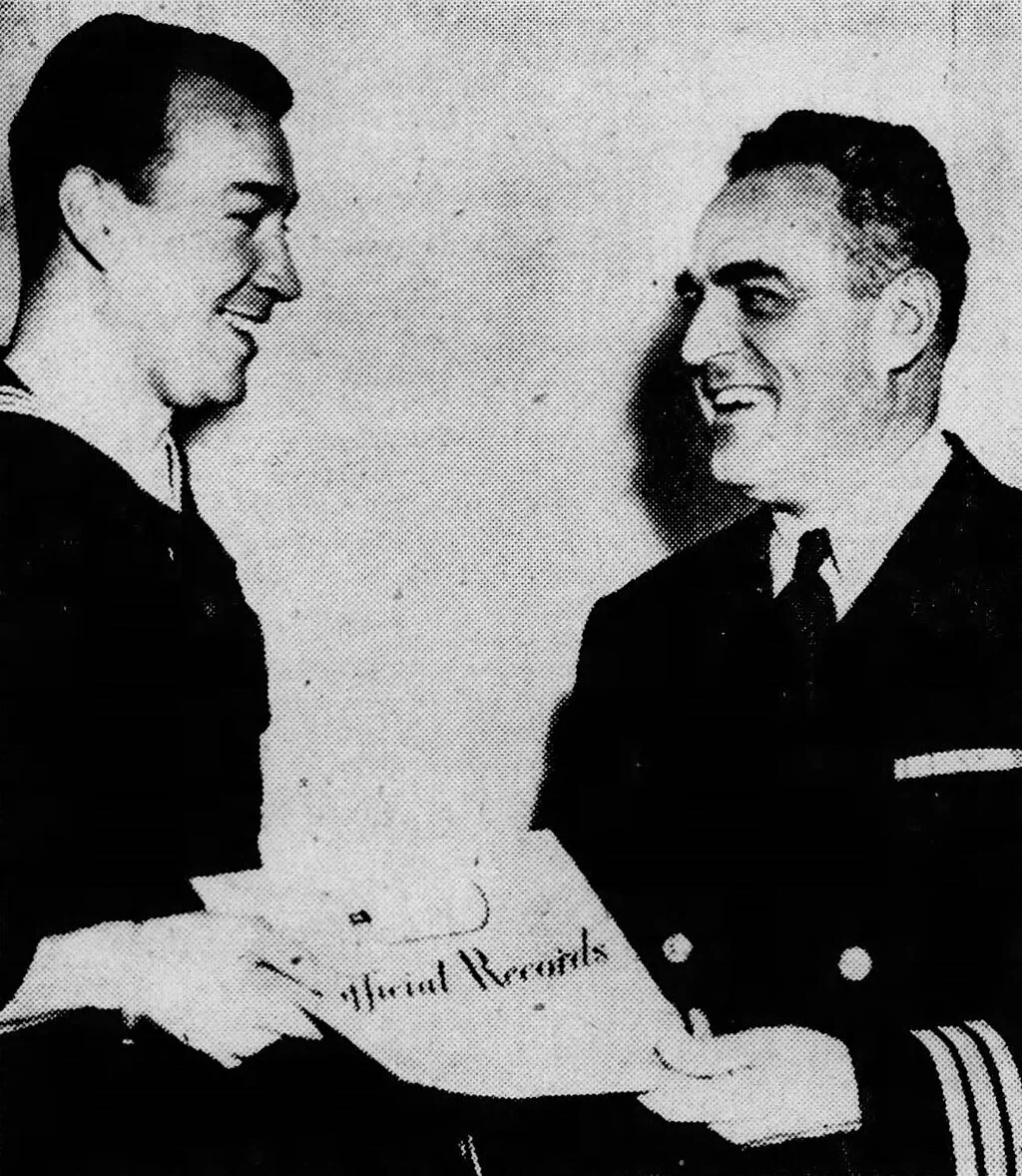
William Hitler receiving his honorable discharge from Navy Commander Louis A. Fey.

The early life of William Hitler

William was born in March 1911 in Liverpool, England to Alois Hitler and Bridget Dowling. Alois, William’s father was the half-brother of Adolf Hitler, therefore making Adolf William’s half uncle. William’s parents met in 1909 in Dublin when Alois was working as a waiter. Alois met Bridget Dowling there and they quickly eloped to London in 1910 and married. It was not an auspicious start to married life because Alois was accused of “kidnapping” Bridget by her father. The reality was that Alois did not obtain the customary yet old-fashioned blessing for the marriage from Bridget’s father. Eventually Bridget’s family become resigned to the fact that the marriage was now a fait accompli. The couple then moved and settled in Toxteth, Liverpool where William was born a year later.

The marriage did not last, and Alois returned to Germany in 1914 where he entered a bigamous marriage with Hedwig Mickley. They would both produce a son whom them named Heinz. Unlike William, Heinz became an ardent Nazi, who later perished in Soviet captivity in 1942. Alois became a restaurant owner which continued to run throughout the war’s duration. His wife, Bridget, was left to raise William alone in England now with the aid of her Irish family. Meanwhile, in Germany Adolf Hitler was about to make the family name a terrible part of history.

At the age of eighteen, while his half-uncle Adolf was making his presence known in German politics, William took on a more sober profession and trained to be an accountant in Highgate, London with Benham and Sons. When his connection to Adolf Hitler was discovered, his position was allegedly terminated, and many subsequent opportunities became closed to him.


Visting Germany and meeting Adolf Hitler

In 1929, after turning eighteen, William visited in Germany at the request of his estranged father. While in Germany he met his uncle Adolf Hitler for the first time, who was beginning to make an impact on German political life. After a brief stay William returned England. The first meeting with his uncle did not go well. Shortly after his return to England William was ordered to return to Berlin by Adolf, who subsequently admonished his nephew for his public revelations about him. William had on his return authored several articles that were published which irked the Nazi leader and he forced William to withdraw them. The incident appeared to have blown over, or it was more likely that Adolf Hitler’s wider ambitions in German politics consumed his full attention. William would try unsuccessfully to make a life in England and Adolf would seize control of Germany. It would be another four years before William would visit again and that also  did not go well for William.

In 1933 William returned to Germany, this time on the advice of his mother with the plan to use Adolf Hitler’s influence to improve William’s career opportunities. Britain at the time was still recovering from the Great Depression and had little to offer William. To make matters worse, being related to the Hitler family was very limiting for William; however, Germany’s economy was showing signs of prosperity and being related to Adolf Hitler carried some currency for William.

The plan seemed to work at first. Adolf’s influence first found William work in the Reich Credit Bank. This did not seem to favor William who then took on the role as a car salesperson in the Opel Car Factory. William did not last in any of  these jobs and his constant demands for alternative ones exasperated his uncle. He would soon label William, My loathsome nephew” and stated, “I didn’t become Chancellor for the benefit of my family…No one is going to climb on my back.” In 1939, after refusing to give up his British citizenship and fearing being trapped in In Germany while it was in a war, he fled back to England and then onto the USA. William had spent six years in Germany.

Willam also had little good to say about his uncle and of his time in Germany. On a tour of the USA in 1939 he officially announced that he “had no time for Hitler” and he (Adolf) was “of no benefit to the human race”.

He was projecting as an avid anti-Nazi doing “the right thing” but let us for a moment analyze that stance. Was the extent of his antipathy toward his uncle or the regime. Also was it more owing to failure to prosper in Germany than a dislike of Nazism?

William spent six years in Germany, and this was long enough to not fail to see the loathsome direction the Nazi Party and his uncle were taking the country and its people. However, we do not know how well acquainted he was with Adolf Hitler and how often he met his uncle. It is worth considering that in 1939 the true face and brutality of Nazism and Hitler were now becoming clearer to the world . Public events such as Kristallnacht, the antisemitism in the streets, the growing totalitarianism, the secret police, the rallies, and the growing militarism did not seem to deter William who still persisted in trying to carve out a career when all this was going on. He still could have easily slipped back to England. We will never know, and this is doing him a disservice.


William, the USA, and the war

After William left Germany, he visited the United States with his mother and began an anti-Nazi themed lecture tour that focused on his time with Adolf Hitler. This was encouraged by publisher William Randolph Hearst who, like William, saw this as very lucrative. William immediately went on a nationwide lecture tour of the USA. It was simply titled “My Uncle Adolf.”  The content was of course focused on his experiences with Hitler and the Nazis to the various audiences. This would be the only theatre where William would challenge his uncle’s regime. His combat experience would be confined to the Pacific theatre.

When World War II broke out William was still in the United States, but he still tried to join the British forces. For obvious reasons he was rejected and for a short while he sat as a bystander as the German army subjugated Europe. When the U.S. later entered the war William send a letter dated March 3, 1942, to President Roosevelt appealing for him to be allowed to join the U.S. forces and stating why he felt he was not allowed to serve in the British forces. The letter read:

“I am the nephew and only descendant of the ill-famed Chancellor and Leader of Germany who today so despotically seeks to enslave the free and Christian peoples of the globe. Under your masterful leadership men of all creeds and nationalities are waging desperate war to determine, in the last analysis, whether they shall finally serve and live an ethical society under God or become enslaved by a devilish and pagan regime.”


It continues:

"All my relatives and friends soon will be marching for freedom and decency under the Stars and Stripes … I am respectfully submitting this petition to you to enquire as to whether I may be allowed to join them in their struggle against tyranny and oppression. As a fugitive from the Gestapo, I warned France through the press that Hitler would invade her that year. The people of England I warned by the same means that the so-called ‘solution’ of Munich was a myth that would bring terrible consequences….The British are an insular people and while they are kind and courteous, it is my impression, rightly or wrongly, that they could not in the long term feel overly cordial or sympathetic towards an individual bearing the name I do.”


His application was passed to the FBI who eventually seemed satisfied with his background and his intentions. William was drafted into the US Navy in March 1944. He served as a pharmacist’s mate (aka hospitals corpsman), earning himself the purple heart medal after receiving a shrapnel wound to the heart. He remained in service until 1947. Whether his uncle knew about his enlistment or not we cannot be certain. It is more likely Adolf Hitler showed no interest in his nephew’s affairs after washing his hands of him before the war. Also, Adolf Hitler’s mental state deteriorated as the tide of the war was turning against Germany, therefore his “loathsome nephew”  would have been of little interest to him amid his more pressing concerns.


Post War Life

After the war, William changed his name to William Stuart-Houston and became an entrepreneur. He married Phyllis Jean Jaques in 1947 shortly after leaving the navy. Unlike his father before him he remained married and stayed with Phyliss until his death in 1987. It was a marriage that was certainly more successful than that of his parents. They had four sons born between 1949 and 1965, Alexander, Louis, Howard, and Brian (the latter being the youngest). None of William’s children sired any offspring. His wife, Phyllis, died in 2004.

It is of little surprise that William would spend his life in relative obscurity after the war. The true nature of his uncle’s legacy and the full extent of the Nazi atrocities were a permanent stain to his name. William had an extraordinary life, with winning the Purple Heart, being personally attended to by Roosevelt, vehemently opposing Adolf Hitler, and going on to run a successful business in America.

Although William served as a medic in the US Navy and not in actual physical combat, the challenges he faced were just as formidable. He had the reputation of his family name to overcome and as the horrors of the Nazi brutality were revealed post war, that challenge certainly would not have been made any easier. Despite his limited combat experience his actual contribution to the Allied cause was greater than he could have imagined. His public opposition to his uncle and his voluntary service spoke volumes as invaluable propaganda for the Allies.


The site has been offering a wide variety of high-quality, free history content since 2012. If you’d like to say ‘thank you’ and help us with site running costs, please consider donating here.

The Siege of Ninety Six was a siege in South Carolina in the American Revolutionary War from May to June 1781. The Patriot Nathanael Greene led a force of 1,000 in a siege against Loyalists in Ninety Six. The siege took place around Star Fort. Abrielle M. Lamb explains.

Nathaniel Greene. By John Trumbull, 1792.

Patriots and Loyalists

During the American Revolution, there were two major groups that emerged in the colonies concerning war efforts and conflicting sentiments towards England. Many are familiar with the patriots, the revolutionists who dumped tea in the harbor and challenged the authority of the King. However, there were a number of individuals and communities in the colonies who did not align with the patriot movement or desire independence from the crown; these groups were known as loyalists. Loyalists supported the English Monarchy in retaining power over the colonies and a continuation of their reign in America. In the struggle between patriots and loyalists there was a significant landmark that is less discussed compared to larger memorials or battle sites but, nonetheless, should be remembered. A major loyalist community during the American Revolutionary Era was Ninety Six in South Carolina. There had been a considerable amount of tension in this area before and during the Revolution between patriots and loyalists; however, it was the loyalists who had control of this area. Star Fort shielded the settlement of Ninety Six, according to The American Battlefield Trust, “Ninety Six was protected by the formidable Star Fort and the smaller Stockade Fort. Its garrison was made up almost entirely of loyalist colonists.”[1]


Star Fort

The Star Fort would prove to be a truly significant location during the American Revolution, specifically during the siege of Ninety Six in the latter half of the war. Star Fort was designed, as its name suggests, in the shape of a star which differed from the common square fort layout at that time. The fort was set into the ground, making the walls thick mounds of earth. The construction of the fort lasted from December of 1780 to early 1781. The star shaped design was not a common or largely desirable layout as capacity for soldiers was greatly reduced, and the design was more difficult to construct than the average square forts. However, loyalist engineer, Lt. Henry Haldane was convinced that the unique shape with its eight points would be more beneficial in the long run. The benefit that Haldane saw in the design was that the points of the star made it possible for musket and cannon fire to cover all sides and shoot in every direction from the fort's walls.[2] Though it was constructed using an uncommon design, it proved a strong front for the British Army and loyalist forces.


Nathanael Greene and His Siege

The patriot revolutionist, Nathanael Greene, launched a famous attack known as the Siege of Ninety Six which took place from May 22 – June 18, 1781. On June 18, Greene issued an attack on the fort, while at the same time, British troops were traveling from Charleston to Ninety Six to support and defend their forts. It was with some hesitation that Greene gave the order, but he did order the attack on Star Fort. The battle lasted for just under an hour in which time Greene’s men valiantly attempted to take the fort from the loyalists but were inevitably forced to retreat. The incoming British troops from Charleston arrived two days after Greene’s army withdrew from the area. The loyalists had indeed held their ground but after the siege British officers concluded that their position was too vulnerable and abandoned their post.[3] There are several reasons that the Star Fort was significant during the American Revolution, two of the main points of its importance rests in Greene’s attack and Britian's inevitable abandonment of the fort. Greene’s attack on the fort was important because although Greene had to retreat while the loyalists held their position at Ninety Six, he had launched a daring attack. Greene’s continued fighting and strategy in North and South Carolina during the war greatly contributed to American independence.[4] The impact that Green’s siege had on the British was significant. When they abandoned the fort, they destroyed what was left after the siege and burned the buildings that remained. The war continued and there were other battles fought in the southern colonies but the British departure from the fort effectively brought an end to the British occupation at Ninety Six.[5] Though Greene did not take Star Fort during his siege, he showed his strength and the courage of his men; and although the British Army held Star Fort, they were ultimately forced to abandon their position.


The Star Fort Today

Today, visitors can walk out to the Star Fort and battlefield which has undergone very little reconstruction since its original construction. The National Park Service comments, “The siege trenches are partially reconstructed, but the Star Fort is original. The Star Fort was an earthen fort. As you see it today is how it looked in 1781... The walls are a little weatherworn in places, but are original.”[6] There are many benefits to visiting physical locations for research and learning. Visiting Star Fort would be helpful for anyone studying the American Revolution to be able to gain a better understanding of how the fighting took place and to see the impressive star shaped fort that had such a large impact on the southern battles, fighting, and strategy during the war for independence.


Did you find that piece interesting? If so, join us for free by clicking here.


Bibliography

“Ninety Six.” American Battlefield Trust. Last modified October 5, 2022. https://www.battlefields.org/learn/articles/ninety-six.

“The Star Fort.” National Parks Service. U.S. Department of the Interior. Last modified August 30, 2024. https://www.nps.gov/nisi/learn/historyculture/the-star-fort.htm.

Cann, Marvin L. “War in the Backcounty: The Siege of Ninety Six, May 22-June 19, 1781.” The South Carolina Historical Magazine 71, no. 1 (January 1971): 1–14.

Fore, Samuel K, and Walter B Edgar. “NINETY SIX, BATTLES OF (1775, 1781).” Essay. In 101 People & Places That Shaped the American Revolution in South Carolina, 103–105. Columbia, SC: University of South Carolina Press, 2021.

“Star Fort Image - Online Tour Stop 11.” National Parks Service. U.S. Department of the Interior, n.d. Accessed October 20, 2025. https://www.nps.gov/nisi/learn/photosmultimedia/online-tour-stop-11.htm.


[1] “Ninety Six.” American Battlefield Trust. Last modified October 5, 2022.

[2] “The Star Fort.” National Parks Service. U.S. Department of the Interior. Last modified August 30, 2024.

[3] Samuel K. Fore and Walter B Edgar. “NINETY SIX, BATTLES OF (1775, 1781).” Essay. In 101 People & Places That Shaped the American Revolution in South Carolina, 103–105. Columbia, SC: University of South Carolina Press, 2021.

[4] “Ninety Six.” American Battlefield Trust. Last modified October 5, 2022.

[5] Samuel K. Fore and Walter B Edgar. “NINETY SIX, BATTLES OF (1775, 1781).” Essay. In 101 People & Places That Shaped the American Revolution in South Carolina, 103–105. Columbia, SC: University of South Carolina Press, 2021.

 [6] “The Star Fort.” National Parks Service. U.S. Department of the Interior. Last modified August 30, 2024.

Posted
AuthorGeorge Levrier-Jones
CategoriesBlog Post

Ethics are moral principles that govern a person’s behavior in a society. In very simple terms, they constitute the rights and wrongs that guide people’s conduct. The Indian ethics are generally connected to the principle of anekantavada or many-sidedness, emphasizing that there is “no absolute truth” and no neatly defined binaries of right and wrong. They are based on factors such as the person practicing them, the situation, and the time at which they are practised. Indian ethics focus on accepting and encouraging diverse thoughts and beliefs, hence propagating “unity in diversity” and “diversity in unity.”

Apeksha Srivastava explains.

A manuscript from the Mewar Rāmāyaṇa. This shows Rāma slaying Rāvaṇa.

It is surely extremely strange that whenever, either in Greek, or in Chinese, or in Persian, or in Arab writings, we meet with any attempts at describing the distinguishing features in the national character of the Indians, regard for truth and justice should always be mentioned first.” — F. Max Müller, Sanskritist and philologist (1882)


The Rig Veda and Upanishads

Composed between 1500–1000 BCE, the Rig Veda mentions the concept of Ritam (cosmic order) through which the physical and the social worlds are sustained. Ritam can be understood as the sense of righteousness. It later developed into the concept of Satyam (truth), with strong ethical implications. Dharma, the building block of Indian ethics, has been translated from the Rig Veda to refer to words such as justice, duty, righteousness, and order, among others. It is important to note that dharma is a multifaceted concept and does not denote a single idea or meaning.

Composed between 800 and 500 BCE, the Upanishads reveal further developments in Indian ethical thought. For example, Aham Brahma asmi (1.4.10; Brihadaranyaka Upanishad) translates to “I am Brahman (the Absolute)” and can be understood as: A person is a part of God (and not separate from this universal consciousness). It is essential to grow cognizant of this identity. Further, the Upanishads highlight that every person has a distinct nature (svabhava), function, truth, and path (svadharma), echoing the concept of anekantavada. The Puranas also propagate notions like all creation is interconnected and that one can be happy when all are happy.


Beyond Binaries

The Ramayana and Mahabharata stories underline the idea that ethics are complex. Several dilemmas shape the events of these epics and put forth the question: How to decide what is dharma in different situations? The central message of the Bhagavad Gita, part of the Mahabharata, is Nishkama Karma, meaning desireless action. It propagates the concept that people should work without any expectation of results. What matters ultimately is the inner growth of the individual, which can be achieved when one’s actions align with one’s dharma. Nishkama Karma forms the basis of Karma Yoga, a spiritual practice of selfless action that can lead a person to liberation (moksha). Lord Krishna emphasized that dharmacannot be practiced in passivity; several situations arise when a person needs to take a particular side in life. Some examples showcasing the sophisticated nature of dharma include the following:

Dronacharya: In the Mahabharata, Drona was a master of advanced military arts, including divine weapons. The Pandavas decided to use Drona’s only weakness, his son Ashwatthama, to save many lives in the war. The Pandava Bhima killed an elephant named Ashwatthama and spread the news of his death. Drona asked the Pandava Yudhishthira (known for always speaking the truth), who clearly said that Ashwatthama was killed. It is said that Krishna suppressed the word ‘elephant’ by blowing the conch. The news of the death of his son eventually led to the slaying of Drona. This story emphasizes that if an untruth saves lives, then perhaps ethics is not about always telling the truth.

Vibhishana and Kumbhakarana: Ravana’s brothers Vibhishana and Kumbhakarana in the Ramayana skillfully demonstrated that there is no single path to dharma and no single way of solving an ethical dilemma. Kumbhakarna adhered to the dharma of loyalty to his kin. At the same time, Vibhishana chose to follow the dharma of saving the people from the evil of his brother Ravana by opposing his kin and supporting Rama.


Buddhism’s Eightfold Path

Buddhism originated in the Indian subcontinent and mentions a noble eightfold path encompassing the ‘right’ vision, intention/aspiration, speech, action, livelihood, effort, mindfulness, and concentration. Once Buddha preached, “... whenever someone abuses us, we can either choose to accept or decline that anger. Our response will decide who owns and keeps the bad and negative feelings.” This story beautifully encourages the practice of the right speech, action, and mindfulness. Buddhism also talks about having compassion for others. Aligning with this idea, Buddhist economics studies the production, distribution, and consumption of goods/services by changing the focus from self-interest to no-self (generosity), with ‘right’ livelihood and sustainability. While traditional economics emphasizes maximizing profits, Buddhist economics aims to minimize suffering (losses) for all.


Morals in Jainism

Jainism also originated in the Indian subcontinent and mentions the Triratna (three jewels) as the ‘right’ faith, knowledge, and walk. Ahimsa (non-violence), Satya (truth), asteya (non-stealing), brahmacharya (chastity), and aparigraha (Non-possession) are its five ethical codes. Detachment (non-attachment or non-possession) is one of its main morals. It can serve as the means to attain the realization of one’s self. Jainism’s concept of violence, acceptable only when absolutely necessary for self-defense, appears to echo with Lord Krishna’s advice from the Mahabharata that dharma cannot be practiced in passivity (at least, in certain situations according to Jainism).


The Timeless Classic

Composed around the 5th century CE by Thiruvallur and consisting of 1,330 short couplets, the Kural is a classic Tamil language text. It is considered a great work on morality, known for its secular nature. Some examples from this work include (a) In prosperity, bend low [be humble], (and) in adversity, stand straight [be strong], and (b) Always aim high—failure then is as good as success. This text provides worldly wisdom and guidance to make ethical decisions.

Some Case Studies on Different Aspects of Dharma

Din-i-Ilahi: The Divine Faith was propounded by the Mughal emperor Akbar (1582), who wanted to unite his people so that all of humankind could worship God according to their faith. Its writer, Abu’l-Fazl, expressed, “every sect can assert its doctrine without apprehension, and everyone can worship God after his own fashion.” Discriminations among the different religions of the realm were prohibited. Here, religious harmony emerges as a critical component of dharma.

The Story of Panna Dhai: I remember a story my mother told me during childhood. It is the tale of Panna Dhai, a 16th-century maid to Rani Karnavati, who helped her in political matters and the upbringing of the prince, Udai Singh II, along with her own son, Chandan. During the attack on Chittor, Panna sent Udai out to a river while putting her son in Udai’s place on the bed. When Bhanvir, the enemy, came and asked for Udai, Panna pointed at the bed occupied by her son and watched as Banvir murdered him. An epitome of courage and sacrifice, Panna adhered to the dharma of loyalty to her kingdom, where she lived. Saving the prince was more important to her than her child. This incident reflects anekantavada (“no absolute truth”) and dharma that depends on the person, situation, and time of practice. Panna chose her duty as a nursemaid over being a mother. Had she not done so, India might not have known the ancient hero Maharana Pratap, who was later born as the eldest son of Udai Singh II.

The Bishnoi Sacrifice: In the year 1730 at Khejadli (Rajasthan), 363 Bishnoi women, children, and men, led by Amrita Devi, sacrificed their lives to protect Khejadli trees while chanting their Guru’s teaching: “If a tree is saved even at the cost of one’s head, it is worth it.” It led the Maharaja of Jodhpur to prohibit tree cutting and animal hunting in all Bishnoi villages, attaching a sense of sacredness to these forms of nature. Such traditions from India are based on the dharmaof non-hurting and simple living.

Beyond One’s Life: Bal Gangadhar Tilak (1856–1920) was a mathematics teacher, social reformer, and freedom fighter. He encouraged people to fight for India’s freedom so future generations could enjoy the fruit. It can be equated with thedharma of having no relaxation (in one’s efforts) so that one does not incur the curse of one’s children and descendants.

Guest is God: Indians have believed since ancient times in the spiritual tradition of guests being considered divine. Adhering to this principle as their dharma, many Taj Hotel employees died saving the lives of the hotel guests during the 26/11 Mumbai terrorist attacks. Although many knew all the back exits that could have safely led them out of the hotel, they stayed back to save the guests selflessly.

In conclusion, India’s ethics system is based on diverse philosophies, religious teachings, and cultural traditions spanning thousands of years. It is important to note that the information provided in this article is not exhaustive in nature. The complexity associated with ethics reflects India’s pluralistic society, offering insights into living a meaningful life. Understanding the anekantavada aspect of these ethics not only highlights India’s glorious past but also inspires discussions about morality in a rapidly changing world.


Apeksha Srivastava is pursuing her Ph.D. at the Indian Institute of Technology (IIT) Gandhinagar, Gujarat, India. She was a visiting researcher at the University of Colorado, Colorado Springs (USA) from April to July 2024.


References

  1. Danino, M. (2020). System of ethics in India: Lecture and discussions. Perspectives on Indian Civilization course at IIT Gandhinagar.

  2. Nadkarni, M.V. (2011). Ethics in Hinduism (Book – Ethics For Our Times: Essays in Gandhian Perspective). Oxford Scholarship Online.

  3. Ganguli, K.M. (1883–1896). The fifteenth day at Kurukshetra – The fall of the preceptor, Drona (Mahabharata). Retrieved from wisdomlib.org.

  4. Mahatthanadull, S. (2018). The noble eightfold path: The Buddhist middle way for mankind. International Buddhist Studies College, Mahachulalongkornrajavidyalaya University.

  5. BBC. (2009). The three jewels of Jainism. BBC Religions.

  6. Tiruvaḷḷuvar (around the 5th century CE). Tirukkural. Retrieved from wisdomlib.org.

  7. Rajasthan Heritage Protection & Promotion Authority. (n.d.). Panna Dhai panorama, Kameri, Rajsamand. Rajasthan Government.

  8. Spiegel, A. (2011, December 23). Heroes of Mumbai’s Taj Hotel: Why they risked their lives. NPR.

Posted
AuthorGeorge Levrier-Jones
CategoriesBlog Post