The Christian Kingdom of Makuria was in modern-day Egypt at the time of Arab Conquest of Egypt, under the Rashidun Caliphate. Here, Husain Roussel explains the 642 AD & 652 AD Wars between them, including the First and Second Battle of Dongola.
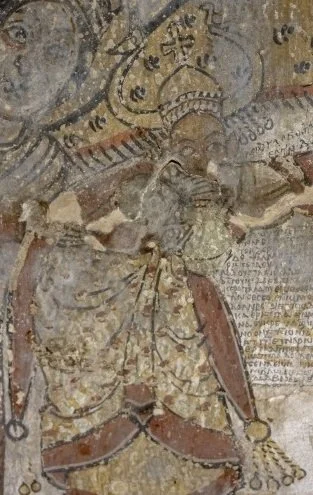
Image: A possible depiction of king David of Makuria. Source: Public domain, pcma.uw.edu.pl, available here.
Introduction
A new religion known as Islam was making a strong presence in the Middle East and the holy warriors of the Islamic faith were defeating the most powerful armies known to exist during the late antiquity into the early medieval period. The Islamic forces of the Prophet Muhammad and his successors were sending the armies of the Byzantine Empire and the Sasanian Empire of Persia on the run. The Islamic military machine’s conquests of the Arabian Peninsula, Persian controlled territories, and North African Byzantine Christian territories seemed to have no end in sight. Christian communities around the newly conquered realms of the caliphate now under Islamic jurisdiction while not under threat of persecution from the Islamic leadership would have to pay their due in taxes to avoid impressment for military service. This included swearing loyalty to the new overlords of the Islamic faith to maintain their way of life under occupation. In Egypt after the conquest and takeover by the Rashidun Caliphate from the Byzantine Empire (Eastern Roman Empire) between 639 and 642 AD several Christians decided to flee into Nubian controlled lands rather than submit loyalty or convert to Islam.
The Coptic Christians of Egypt who remained were allowed to practice their faith as long as they paid tribute and swore loyalty to the new rulers however the Nubian Christian Kingdoms seemed to offer the best chance of protection for those Coptic Christians fearing any suppression or persecution of their faith by the Islamic administration. A reconquest of Egypt by the Byzantine Empire was obviously in doubt however thanks to Byzantine missionaries Nubia already had a strong Orthodox Christian foundation for populations south of Egypt during the years of Byzantine control and later under Islamic control. The Rashidun Caliphate of Egypt now decided to lead holy jihad expeditions for Islamic dominance in Nubian lands. The embolden warriors of Islam believed their mission was to spread the new faith as far as possible with new lands to convert always welcomed on the list of potential conquests. They saw themselves as unstoppable and their army of God invincible. These holy jihads and skirmish raids in the Nubian controlled lands would be the setting for two conflicts in a battle of faiths between the Christian Nubian Kingdom of Makuria in Nubia (Sudan) and the Islamic Kingdom of the Rashidun Caliphate that now ruled in Egypt. The Kingdom of Makuria was determined to protect their Christian faith, Christian citizens, and independence from Islamic control at all costs. They would therefore become the iron wall that would resist the goals of the Rashidun Caliphate to spread Islam further into Nubian lands.
Background of the Kingdom of Makuria
The Kingdom of Makuria was one of the Sudanese Nubian kingdoms to emerge as successor states to The Kingdom of Kush after it had fallen to the Aksumites in 350 AD. The emerging Nubian groups formerly under control of the Kushite Kingdom and remnants of the Meroitic Kushite population began mixing with a host of Nubian settlers forming into three new Christian kingdoms called The Kingdom of Nobatia (400 AD - 7th Century AD), The Kingdom of Alodia (6th Century AD - 1500 AD), and the Kingdom of Makuria (5th Century - Late 15th Century) in addition to the Christian Kingdom of Aksum located in Ethiopia and Eritrea. Makuria emerged around 500 AD and became a Christian kingdom and ally to the Byzantine Empire sometime in the 6th century AD. The Kingdom of Makuria initially covered the Nile area from the 3rd Cataract and somewhere between the 5th and 6th Cataracts. During the peak of the kingdom’s Golden Age, they had managed to reach from the Aswan in southern Egypt down toward the present day capital city of Khartoum in central Sudan.
The capital of the kingdom of Makuria named Old Dongola was located on the east bank of the Nile River between the 3rd and 4th Cataracts in northern Sudan. Old Dongola (not to be confused with present New Dongola) consisted of several Nubian and Byzantine mixed architectural designed buildings including churches like the Church of the Granite Columns, several royal administrative buildings, and a heavily fortified citadel. The Makurians in addition to their native tongue of Nubian spoke the Greek and Coptic languages for ecclesiastical purposes and relied on Greek and Arabic for diplomatic relations. They had a powerful military, and like the Kingdom of Kush before them was known for their army of skilled and deadly accurate Nubian archers in battle. The 9th century Muslim Historian Al-Baladhuri mentions an account in which the Nubians were associated with the epithet "pupil smiters" because of their skill in striking the eyes of their opponents
Annexation by Makuria of The Nubian Christian Kingdom of Nobatia
From 618-629 AD the Sasanian Empire of Persia managed to occupy the Byzantine Prefecture (Province) of Egypt during their ongoing wars with the Byzantine Empire before Byzantine forces were able to retake it. This break with Byzantine Egyptian trade networks weakened the ongoing trade and economy of Makuria’s northern neighbor the Nubian Christian Kingdom of Nobatia located on the 1st Cataract extending down to the 3rd Cataract of the Nile River. The Kingdom of Makuria took the instability in Nobatia as an opportunity to annex the kingdom and thereby creating a unified Nubia to repel any potential invasion from outsiders in the future. This would later mean that the Rashidun Caliphate was now sharing a border with the Kingdom of Makuria putting a target on the backs of the Makurians and moving them closer to the top on the Rashidun Caliphate’s hit list of future invasions.
Once Makuria annexed The Kingdom of Nobatia they left the culture and traditions intact with some autonomy except for the administration of the territory. The King of Makuria decided to remove the royal family of Nobatia from power and installed his own viceroy called the Eparch of Nobatia (Domestikos of Pakhoras) in the capital of Nobatia called Faras (Pachoras). The Eparch of Nobatia would administer the territory from Faras on behalf of the King of Makuria and to be his eyes and ears in that region for threats or rebellions. The annexation expanded the reach and profits of the Makurian Kingdom as they began to obtain vast control of Nubian gold mines, several crucially important desert trade routes, and major oases that extended into the western and eastern deserts. Their expansions also included parts of the northern Kordofan area of Sudan rich in agricultural and pastoral resources.
Kingdom of Makuria’s Relationship with the Byzantine Empire
The Kingdom of Makuria shared a very mutual and friendly relationship early with the Byzantine Empire. The relationship began sometime around 530 AD when the Byzantine Emperor Justinian wanted to seek new allies against the expansionist policies of the Sasanian Empire of Persia. Emperor Justinian was of the Orthodox Chalcedonian faith while his wife the Empress Theodora was a champion of the Orthodox Miaphysite doctrine. They both sent missionaries into Nubia to convert the populations after 540 AD to counter any plans by the Persians for building a Nubian alliance. The Kingdom of Makuria embraced the Chalcedonian beliefs of Emperor Justinian while the Kingdom of Nobatia and Kingdom of Alodia aligned with the Miaphysite beliefs of the Empress Theodora due to their close ties with the Coptic Orthodox Church of Alexandria in Egypt.
The Makurians and Byzantines regularly exchanged diplomats and delegations. For example, Makuria sent a delegation in 573 AD to give diplomatic gifts in the form of ivory and exotic animals like giraffes to the Byzantine Emperor and Empress to strengthen cooperation and trade networks. The exchange of ideas, culture, military tactics, and languages was evident as seen in Byzantine Greek administrative titles used by the Kingdom of Makuria like Architriclinus (Master of Banquet), Eparchos (Governor / Prefect / Bishop), and Meizoteros (Chief Steward) for their own official royal court titles. Trade flourished between them as the Byzantines provided new knowledge and assisted with Nubian architectural designs for fortifications, Nubian textiles with unique Byzantine influenced clothing, and the spreading of the Orthodox Christian faith.
Background of the Rashidun Caliphate
The Rashidun Caliphate was the continuation of the mission to spread the Islamic faith after the death of their leader the Prophet Muhammad in 632 AD. The successors leading the Rashidun Caliphate were his closest companions and commanders who served him during his campaigns in the Arabian Peninsula to spread the new faith and defeat his pagan enemies. The four rulers of this first Islamic State to emerge after the death of the Islamic Prophet Muhammad were known as the Rightly Guided Caliphs named Abu Bakr, Umar, Uthman, and Ali. While they were either related by blood to the Prophet Muhammad or marriage within his family this was not a hereditary privilege and they were elected to their post by a council of peers. The Rashidun Caliphate expanded quickly after successfully taking over the Arabian Peninsula. Their vast empire between 632-661 AD controlled the Middle East, the Caucasus, and parts of North Africa, and to be even more precise their conquests included all of the Arabian Peninsula, the Levant, the Caucasus and Anatolia regions, Mesopotamia including former Sasanian Empire of Persia territories and the grain wealthy Byzantine Prefecture of Egypt.
Rashidun Caliphate in Egypt
Byzantine Egypt was a logical choice for invasion as a major breadbasket to provide the grain and wheat necessary to feed the caliphate’s massive army to fight more wars and a source of food in case of famine within the regions controlled by the caliphate. Egypt also provided a new source of income from the taxes paid by the newly acquired subjects to fund additional campaigns for extending the territory of the emerging Islamic State. The Byzantine naval yards in Egypt along with the location of Egypt provided the perfect staging area for launching more invasions throughout North Africa and Byzantine controlled areas in the Mediterranean Sea like Cyprus, Rhodes, Sicily, and Crete. The exhaustive wars fought between the Sasanian Empire of Persia and the Byzantine Empire over the years weakened both of these former superpowers while draining manpower and resources needed to defend Egypt. This proved to be a deciding factor in delivering a very easy conquest of the territory for the Rashidun Caliphate. Egypt was invaded during the reign of Caliph Umar and led by his General Amr ibn al-As in 639 AD. General Amr invaded the territory with 4,000 troops a decision he made on his own due to previously living in Egypt as a merchant and understanding the Byzantine military situation in the region.
General Amr both understood and calculated that the Byzantine forces left to maintain order in Egypt at the time were made up of local Coptic militias designed more as a border garrison police force than a formidable fighting force. He managed to defeat all of the local Byzantine counter offenses and negotiated treaties of surrender with the fortified cities he laid siege on. The Byzantine Empire did make a request to their Nubian allies the Kingdom of Makuria for assistance against the Rashidun Caliphate in defense of Egypt against the Muslims, however the Nubian forces were too far away and locked down in local conflicts to offer any kind of assistance. They were fighting a war with fierce nomadic tribal groups like the Blemmyes (Beja) who were once enemies of the Kingdom of Nobatia and now a problem inherited by Makuria. The Byzantine Empire eventually sent an invasion fleet of 300 ships under Byzantine Admiral Manuel to retake Alexandria and other territory in 645 AD by order of the Byzantine Emperor Constans II. The Byzantine success was however short-lived as the Muslim General Amr now serving under the reign of the Rashidun Caliph Uthman was dispatched with 15,000 men to repel and defeat the Byzantines in the region once and for all. This last Muslim victory formerly secured Egypt from further Byzantine invasions and outside Christian influence.
Rashidun Caliphate Invades Christian Nubia and the Kingdom of Makuria
The Kingdom of Makuria and the Rashidun Caliphate began exchanging small raids into each other’s territories which eventually grew troublesome for stability on the shared border. The Rashidun Caliphate wanted to secure the southern border of Egypt from further raids and realized there was also wealth and new trade routes to obtain in conquering the Nubians. The Rashidun Caliphate was already high on adrenaline and knew no defeats on any of the fronts they were fighting a war on. Driven by their faith in God, superiority in military might, and the teachings of Islam they probably did not expect much from what must have been seen as a backwater kingdom when they decided in Egypt to invade and march on the Kingdom of Makuria. Makuria was cut off from any support by the Byzantine Empire and the Rashidun Caliphate’s worse fear was a large unified Christian army created between the Makurians and the Christian Kingdom of Aksum in Ethiopia. They also did not know if the largest Nubian Kingdom south of Makuria the Nubian Christian Kingdom of Alodia who shared a peaceful relationship with Makuria would also be part of a potential unification. The Muslim General Amr ibn al-As now the acting Rashidun Governor of Egypt decided in 642 AD to send his nephew General Uqba ibn Nafi with an army and cavalry of about 20,000 men to crush the Nubians and annex the territory.
The monarch of Makuria at this time was King Qalidurut and had at his disposal according to modern accounts an army consisting of deadly archers numbering between 8,000 to 10,000 men to defend the Kingdom of Makuria from the Arab invasion. The Muslim army managed to reach Dongola the capital of the Kingdom of Makuria and laid siege to the town in what would be known as the First battle of Dongola. General Uqba ibn Nafi’s army left a path of destruction but could not break the Nubian will to fight and die for their king, land, and Christian God. The Makurian warriors chose to use a variety of military tactics versus face to face combat that was unfamiliar to the Muslim army. The Nubians fought ferociously to defend their capital using several forms of guerilla warfare while their archers inflicted heavy damages on the advancing Muslim lines. So precise were the Nubian archers that many warriors in the Muslim army returned home with one eye left for sight. The 9thCentury Muslim historian Al-Baladhuri states the Muslims found that the Nubians fought strongly and met them with showers of arrows. Many of the Muslims returned wounded, including with injuries to the eyes. The accounts of the time while uncertain show about 10,000 to 15,000 Muslim soldiers killed in the battle while the accounts for the Nubians show about 2,000 warriors dead. Regardless of the numbers the Muslim army unable to adapt to Nubian war tactics and secure a quick major victory decided to withdraw from the conflict. The orders for withdrawal came from the Caliph Uthman, and the Arab General disgusted with a rise in heavy losses gathered what remained of his expeditionary army and return empty handed back to Egypt without conquering the Nubian homeland.
Rashidun Caliphate’s Second Invasion to Destroy the Makurian Kingdom
The Kingdom of Makuria and the Rashidun Caliphate managed to work out some form of peace treaty around 645 AD. The peace treaty eventually came to an end under accusations that the Nubians had violated the treaty. The Rashidun Caliphate once again decided to invade the Kingdom of Makuria and face the fierce Nubian warriors of King Qalidurut in what would become known as the Second Battle of Dongola. The Arab army went in confident of victory because this time they had a siege weapon called a manjaniq (traction trebuchet) to breach the fortified walls of the capital city. The Rashidun Caliph Uthman ordered his governor in Egypt Abdallah ibn Sa'd to make the Nubians pay for breaking the peace treaty. The Egyptian Governor Abd Allah ibn Sa'd sent about 5,000 men including heavy mailed cavalry troops with the catapult for a siege of Dongola in 652 AD to begin the conquest of Nubia. They managed once again as in the first invasion to reach the capital Dongola and create mass destruction in the surrounding areas around the city. The Arabs assumed the heavy cavalry charges combined with the siege weapon firing relentlessly on the city would break the morale of the Nubian defenders. The catapult weapon was indeed destructive while destroying several buildings and the city cathedral however like in the first invasion the Arabs underestimated the skill of Nubian archers.
The Nubians had the high ground on the walls of a heavily fortified city and despite multiple firing from the catapult the reign of fire from their arrows was equally destructive and decimated the Arab heavy cavalry charges. According to the 10th century Shiite Historian Ahmad al-Kufi, “the Muslims had never [before] suffered a loss like the one they had in Nubia”. Governor Abdallah ibn Sa'd had inadvertently turned his heavy cavalry charges into lambs for the slaughter against the barrage of fire from Nubian arrows. The Makurian King Qalidurut remained defiant, refused to surrender, and rejected any unfavorable terms during the battle. King Qalidurut instead relied on his legendary archers to turn the tide and force a diplomatic stalemate. The Arab army was unable to breach the walls or obtain anything to force a surrender by The Kingdom of Makuria or the inhabitants. The battle did not give way to either side and continued to be a draw with losses by the Arab army especially the cavalry becoming extremely heavy. The two rivals made the decision to agree on a pact called the Baqt to end the conflict which provided equal terms for trade, peace, tribute, and mutual cooperation in the future. This allowed for the Kingdom of Makuria to remain a separate regional power in their own right preserving Christianity in Nubia for the next 600 years.
Conclusion
The Kingdom of Makuria having the ability to defend themselves valiantly against the Rashidun Caliphate when so many other kingdoms and empires had fallen so quickly is at best a true David and Goliath story with credit to their skilled archers of whom gained great respect from several medieval Muslim Historians. Makuria eventually switched from loyalty to the Byzantine Church due to diplomatic isolation to the Coptic Church in Egypt allowing for more unity with Egyptian Christians. The Baqt treaty signed in 652 AD created a mutual ceasefire for a stable frontier where Makuria would send 350-400 noncitizen slaves of working age to the Rashidun Caliphate and the Rashidun Caliphate would send barley, lentils, wine, textiles, grain, and specially bred horses to the Kingdom of Makuria. The Baqt pact more importantly required safe passage of Muslims and Christian Nubians within Egypt and Nubian lands.
Muslim historians of much later times would claim that King Qalidurut of Makuria fell to his knees begging for mercy and peace from the Arabs during the second invasion, and yet the Makurians under King Kyriakos were said to have led an invasion force of 100,000 men in 748 AD simply to save just one man. The man they saved was Pope Michael I the Patriarch of the Coptic Church in Alexandria from the Umayyad Caliphate governor of Egypt after imprisonment and extortion. The Makurian military began to siege the Egyptian capital of Fustat resulting in the Umayyads releasing the Patriarch to diminish hostilities. This is not the reasoning nor actions taken by a supposedly broken people on their hands and knees begging for mercy. The Baqt nonaggression pact would hold for the next 600 years allowing Christianity to flourish in Nubia until the collapse of Makuria that finally opened the gates for Arab and Islamic influence to get a foothold and spread across the Sudan Region.
Enjoyed the piece?
Join thousands of history readers getting occasional updates on new blog posts, books, and video releases — plus a free history book to get you started.
References
O'Kelly, M. (2026). The Makurian Invasion of 748 AD and the Forgotten Christian Kingdom That Defied Islam. Mark Kelly.
Oriental Publishing. (2024). The History and Rise of the Rashidun Caliphate. [E-book]
Faraji, S. (2012). The roots of Nubian Christianity uncovered: The triumph of the last pharaoh: Religious encounters in Late Antique Africa. Africa World Press.
Lobban, Richard (2003). Historical dictionary of ancient and medieval Nubia. Lanham: Rowman & Littlefield.
Spaulding, Jay (1995). "Medieval Christian Nubia and the Islamic World: A Reconsideration of the Baqt Treaty". The International Journal of African Historical Studies. 28 (3): 577–94.
Clark, Desmond J.; Roland Anthony Oliver; J. D. Fage; A. D. Roberts (1975). The Cambridge History of Africa Volume 2 c. 500 B.C. - A.D. 1050. Cambridge: Cambridge University Press.
Illustration 1: Mural from Faras showing a Nubian dignitary protected by Jesus Christ from the 12th century. (Public Domain Illustration).
Illustration 2: Painting from Faras, Nubia, depicting a female member of the royal Makurian family, perhaps a princess. She is protected by Virgin Mary and the Christ Child. Dated to the 12th century. Michalowski: "Faras. Die Kathedrale aus dem Wüstensand". pp. 167-168. (Public Domain Illustration)